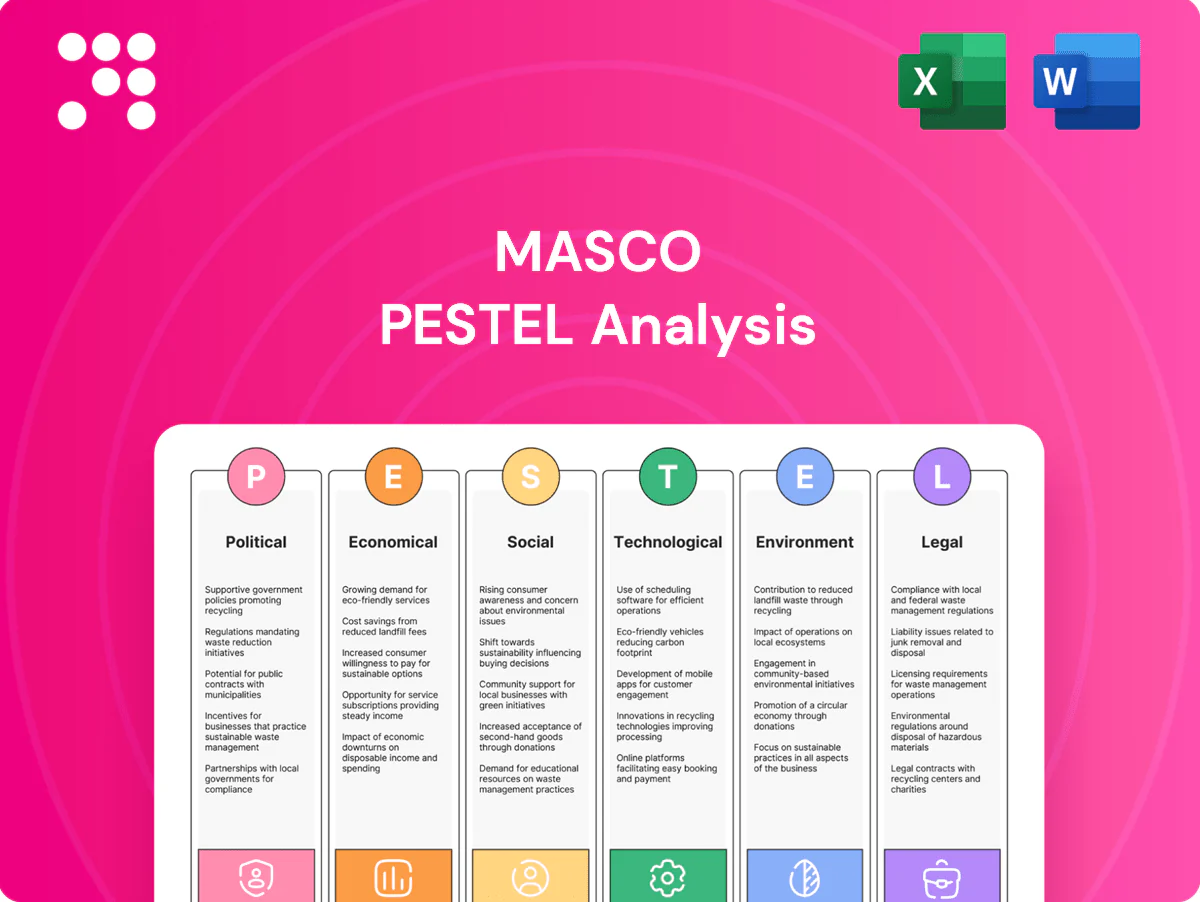
Masco PESTLE Analysis

Your Competitive Advantage Starts with This Report
Gain a competitive edge with our PESTLE analysis of Masco. Explore political, economic, social, technological, legal and environmental forces shaping its markets and margins. Purchase the full report for actionable insights, ready-to-use charts and strategic recommendations.
Political factors

Trade policy and tariffs on building products
Import duties on metals, resins, and finished fixtures — notably U.S. Section 232 tariffs of 25% on steel and 10% on aluminum — can raise Masco’s input costs and disrupt pricing. Ongoing U.S. 301 tariffs on Chinese goods, often up to 25%, and evolving EU measures force shifts in sourcing and margin profiles. Masco may rebalance suppliers or pass costs through to protect profitability, so monitoring tariff exclusions and bilateral deals is essential for agility.
Government housing and infrastructure stimulus
Public spending via the Bipartisan Infrastructure Law (about 1.2 trillion USD) and Inflation Reduction Act climate provisions (roughly 369 billion USD) boosts demand for repair/remodel and new construction, expanding markets for Masco products. Federal and state tax credits such as the 30% Residential Clean Energy Credit for qualifying equipment stimulate growth in energy- and water-saving fixtures. Regional policy timing creates uneven demand across states and metro areas. Masco can time product launches to coincide with funded programs to capture incremental spend.

Building codes and standards alignment
Local and national building codes—over 40 states reference ICC model codes—directly dictate product specifications for faucets, cabinets and architectural products, forcing manufacturers to design to code. Changes to water-use and safety standards, such as EPA WaterSense requiring roughly 20% water savings, shift product mix and certification needs. Proactive compliance improves chances to secure bids with large builders and contractors. Active industry advocacy helps shape practical, innovation-friendly code updates.

Political stability in key markets
Stable governance in North America and Europe supports predictable demand and supply operations for Masco, which reported about $7.5 billion in net sales in FY2024 and earns the majority of revenue from North America. Volatility, sanctions, or sudden policy swings can disrupt logistics, FX and customer confidence, raising working capital and lead-time risks. Diversifying facilities and channels and running scenario planning preserves continuity for Masco's core brands.
- Exposure: majority revenue from North America (~2024)
- Risk: sanctions/logistics → higher FX and lead-time volatility
- Mitigation: diversified facilities/channels
- Preparedness: scenario planning for critical brands
Procurement and public-sector contracting
Government procurement rules shape Masco’s access to institutional projects as US federal and state contracting exceed 500 billion dollars annually, making compliance a commercial gatekeeper.
Expanded Buy American/Buy America provisions from recent infrastructure laws push sourcing or assembly choices toward domestic suppliers and can raise input costs.
Transparency and anti-corruption compliance are mandatory; certified SKUs and product certifications unlock HUD, CDBG and other affordable-housing renovation contracts funded with billions in federal/state grants.
- procurement-size: over 500bn annual US contracting
- buy-local: Buy American/Buy America expansion
- compliance: mandatory transparency/anti-corruption
- opportunity: certified SKUs access HUD/CDBG programs
Tariffs hike costs; $7.5B U.S. sales concentrate political risk
Tariffs (Sec232, 301) and expanded Buy American raise input costs and force sourcing shifts; FY2024 net sales ~$7.5B concentrate political exposure in North America. Infrastructure (BIL ~$1.2T) and IRA (~$369B) lift remodeling and energy-efficient fixtures demand. Procurement rules (> $500B US contracting) and state code adoption (40+ states reference ICC) create compliance gatekeepers.
| Metric | Value |
|---|---|
| FY2024 net sales | $7.5B |
| BIL | $1.2T |
| IRA | $369B |
| US contracting | >$500B/yr |
What is included in the product
 Detailed Word Document
Explores how macro-environmental forces—Political, Economic, Social, Technological, Environmental, and Legal—specifically affect Masco, with data-backed trends and forward-looking insights to identify risks and opportunities for executives, consultants, and investors; delivered in clean, report-ready format for strategy, scenario planning, and funding discussions.

 Customizable Excel Spreadsheet
A concise, visually segmented Masco PESTLE summary that highlights regulatory, economic, and supply‑chain risks for quick reference in meetings; editable notes let teams localize insights and drop the summary directly into presentations for fast alignment.
Economic factors

Housing cycle and remodel spend sensitivity
Repair/remodel outlays and housing starts — roughly 1.3M annualized U.S. starts in 2024 — remain core demand drivers, with the U.S. home improvement market near $450B annually. Economic slowdowns and lower turnover reduce discretionary upgrades, while ~5% YoY home price gains in 2024 and aging housing stock boost replacement spend. Masco can shift marketing toward essential maintenance and value-led SKUs in downturns to sustain volumes.
Interest rates and mortgage affordability
Higher rates—with policy rates near 5.25% in 2024 and 30-year mortgages averaging about 7% in 2024—suppressed new construction and big-ticket remodels, while rate easing historically revives activity. Rate volatility complicates dealer inventories and delays project timing. Expanded financing options and value-engineered product lines help defend volume. Monitoring rate expectations guides production and inventory planning.

Commodity and freight cost inflation
Copper (~USD 9,000/ton in 2024), brass, stainless, lumber (~USD 430/MBF 2024) and resins (HDPE ~USD 1,050/ton 2024) materially lift Masco’s COGS; metals and polymers drive volatility in fittings, finishes and plastic components. Ocean freight (Drewry WCI ~USD 2,000/40ft avg 2024) and higher truck rates (spot up ~5% YoY 2024) increase delivered cost and lead times. Hedging, design‑to‑cost and supplier consolidation offset spikes, while branded SKU pricing power enables pass‑through when market permits.

Labor availability and wage trends
Skilled-trades shortages—AGC estimated about 420,000 unfilled skilled positions in 2024—can delay Masco installations and reduce sell-through; factory labor tightness has raised overtime and reduced throughput, pressuring margins. Masco counters with automation investments and training partnerships, while simplified-installation product features cut on-site labor time.
- Skilled-gap: ~420,000 (AGC 2024)
- Overtime/throughput: higher margin pressure
- Mitigation: automation, training alliances
- Product: simplified installation reduces site labor
Foreign exchange exposure
Masco reported net sales of $6.0 billion in fiscal 2024 per its Form 10-K, exposing revenue and sourcing to translation and transaction risk across currencies. Dollar strength in recent years has pressured reported sales and margins on exports, while natural hedges and active hedging programs are used to stabilize earnings. Localized pricing helps maintain competitiveness in non‑USD markets.
- Translation/transaction risk
- 2024 net sales: $6.0 billion
- Hedging programs stabilize EPS
- Pricing localization preserves market share
Tariffs hike costs; $7.5B U.S. sales concentrate political risk
Repair/remodel demand tied to ~1.3M U.S. housing starts (2024) and $450B home‑improvement market; ~5% YoY home price gains in 2024 and aging stock support replacement spend. Policy rate ~5.25%/30‑yr mortgage ~7% in 2024 curtailed big‑ticket projects; commodity inflation (copper ~9,000/ton, lumber ~430/MBF, HDPE ~1,050/ton) raised COGS; 2024 net sales $6.0B; skilled gap ~420,000 (AGC 2024).
| Metric | 2024 |
|---|---|
| US housing starts | 1.3M |
| Home‑improve market | $450B |
| Policy rate / 30yr | 5.25% / ~7% |
| Net sales | $6.0B |
| Skilled gap | 420,000 |
Full Version Awaits
Masco PESTLE Analysis
The Masco PESTLE preview shown here is the exact document you’ll receive after purchase—fully formatted, professionally structured, and ready to use. No placeholders or teasers: the content, layout, and analysis visible are the final file you’ll download immediately after payment. What you see is what you’ll own.

Original: $10.00
-65%$10.00
$3.50Product Information
Product Information
Shipping & Returns
Shipping & Returns
Description
Your Competitive Advantage Starts with This Report
Gain a competitive edge with our PESTLE analysis of Masco. Explore political, economic, social, technological, legal and environmental forces shaping its markets and margins. Purchase the full report for actionable insights, ready-to-use charts and strategic recommendations.
Political factors
Trade policy and tariffs on building products
Import duties on metals, resins, and finished fixtures — notably U.S. Section 232 tariffs of 25% on steel and 10% on aluminum — can raise Masco’s input costs and disrupt pricing. Ongoing U.S. 301 tariffs on Chinese goods, often up to 25%, and evolving EU measures force shifts in sourcing and margin profiles. Masco may rebalance suppliers or pass costs through to protect profitability, so monitoring tariff exclusions and bilateral deals is essential for agility.
Government housing and infrastructure stimulus
Public spending via the Bipartisan Infrastructure Law (about 1.2 trillion USD) and Inflation Reduction Act climate provisions (roughly 369 billion USD) boosts demand for repair/remodel and new construction, expanding markets for Masco products. Federal and state tax credits such as the 30% Residential Clean Energy Credit for qualifying equipment stimulate growth in energy- and water-saving fixtures. Regional policy timing creates uneven demand across states and metro areas. Masco can time product launches to coincide with funded programs to capture incremental spend.
Building codes and standards alignment
Local and national building codes—over 40 states reference ICC model codes—directly dictate product specifications for faucets, cabinets and architectural products, forcing manufacturers to design to code. Changes to water-use and safety standards, such as EPA WaterSense requiring roughly 20% water savings, shift product mix and certification needs. Proactive compliance improves chances to secure bids with large builders and contractors. Active industry advocacy helps shape practical, innovation-friendly code updates.
Political stability in key markets
Stable governance in North America and Europe supports predictable demand and supply operations for Masco, which reported about $7.5 billion in net sales in FY2024 and earns the majority of revenue from North America. Volatility, sanctions, or sudden policy swings can disrupt logistics, FX and customer confidence, raising working capital and lead-time risks. Diversifying facilities and channels and running scenario planning preserves continuity for Masco's core brands.
- Exposure: majority revenue from North America (~2024)
- Risk: sanctions/logistics → higher FX and lead-time volatility
- Mitigation: diversified facilities/channels
- Preparedness: scenario planning for critical brands
Procurement and public-sector contracting
Government procurement rules shape Masco’s access to institutional projects as US federal and state contracting exceed 500 billion dollars annually, making compliance a commercial gatekeeper.
Expanded Buy American/Buy America provisions from recent infrastructure laws push sourcing or assembly choices toward domestic suppliers and can raise input costs.
Transparency and anti-corruption compliance are mandatory; certified SKUs and product certifications unlock HUD, CDBG and other affordable-housing renovation contracts funded with billions in federal/state grants.
- procurement-size: over 500bn annual US contracting
- buy-local: Buy American/Buy America expansion
- compliance: mandatory transparency/anti-corruption
- opportunity: certified SKUs access HUD/CDBG programs
Tariffs hike costs; $7.5B U.S. sales concentrate political risk
Tariffs (Sec232, 301) and expanded Buy American raise input costs and force sourcing shifts; FY2024 net sales ~$7.5B concentrate political exposure in North America. Infrastructure (BIL ~$1.2T) and IRA (~$369B) lift remodeling and energy-efficient fixtures demand. Procurement rules (> $500B US contracting) and state code adoption (40+ states reference ICC) create compliance gatekeepers.
| Metric | Value |
|---|---|
| FY2024 net sales | $7.5B |
| BIL | $1.2T |
| IRA | $369B |
| US contracting | >$500B/yr |
What is included in the product
Detailed Word Document
Explores how macro-environmental forces—Political, Economic, Social, Technological, Environmental, and Legal—specifically affect Masco, with data-backed trends and forward-looking insights to identify risks and opportunities for executives, consultants, and investors; delivered in clean, report-ready format for strategy, scenario planning, and funding discussions.
Customizable Excel Spreadsheet
A concise, visually segmented Masco PESTLE summary that highlights regulatory, economic, and supply‑chain risks for quick reference in meetings; editable notes let teams localize insights and drop the summary directly into presentations for fast alignment.
Economic factors
Housing cycle and remodel spend sensitivity
Repair/remodel outlays and housing starts — roughly 1.3M annualized U.S. starts in 2024 — remain core demand drivers, with the U.S. home improvement market near $450B annually. Economic slowdowns and lower turnover reduce discretionary upgrades, while ~5% YoY home price gains in 2024 and aging housing stock boost replacement spend. Masco can shift marketing toward essential maintenance and value-led SKUs in downturns to sustain volumes.
Interest rates and mortgage affordability
Higher rates—with policy rates near 5.25% in 2024 and 30-year mortgages averaging about 7% in 2024—suppressed new construction and big-ticket remodels, while rate easing historically revives activity. Rate volatility complicates dealer inventories and delays project timing. Expanded financing options and value-engineered product lines help defend volume. Monitoring rate expectations guides production and inventory planning.
Commodity and freight cost inflation
Copper (~USD 9,000/ton in 2024), brass, stainless, lumber (~USD 430/MBF 2024) and resins (HDPE ~USD 1,050/ton 2024) materially lift Masco’s COGS; metals and polymers drive volatility in fittings, finishes and plastic components. Ocean freight (Drewry WCI ~USD 2,000/40ft avg 2024) and higher truck rates (spot up ~5% YoY 2024) increase delivered cost and lead times. Hedging, design‑to‑cost and supplier consolidation offset spikes, while branded SKU pricing power enables pass‑through when market permits.
Labor availability and wage trends
Skilled-trades shortages—AGC estimated about 420,000 unfilled skilled positions in 2024—can delay Masco installations and reduce sell-through; factory labor tightness has raised overtime and reduced throughput, pressuring margins. Masco counters with automation investments and training partnerships, while simplified-installation product features cut on-site labor time.
- Skilled-gap: ~420,000 (AGC 2024)
- Overtime/throughput: higher margin pressure
- Mitigation: automation, training alliances
- Product: simplified installation reduces site labor
Foreign exchange exposure
Masco reported net sales of $6.0 billion in fiscal 2024 per its Form 10-K, exposing revenue and sourcing to translation and transaction risk across currencies. Dollar strength in recent years has pressured reported sales and margins on exports, while natural hedges and active hedging programs are used to stabilize earnings. Localized pricing helps maintain competitiveness in non‑USD markets.
- Translation/transaction risk
- 2024 net sales: $6.0 billion
- Hedging programs stabilize EPS
- Pricing localization preserves market share
Tariffs hike costs; $7.5B U.S. sales concentrate political risk
Repair/remodel demand tied to ~1.3M U.S. housing starts (2024) and $450B home‑improvement market; ~5% YoY home price gains in 2024 and aging stock support replacement spend. Policy rate ~5.25%/30‑yr mortgage ~7% in 2024 curtailed big‑ticket projects; commodity inflation (copper ~9,000/ton, lumber ~430/MBF, HDPE ~1,050/ton) raised COGS; 2024 net sales $6.0B; skilled gap ~420,000 (AGC 2024).
| Metric | 2024 |
|---|---|
| US housing starts | 1.3M |
| Home‑improve market | $450B |
| Policy rate / 30yr | 5.25% / ~7% |
| Net sales | $6.0B |
| Skilled gap | 420,000 |
Full Version Awaits
Masco PESTLE Analysis
The Masco PESTLE preview shown here is the exact document you’ll receive after purchase—fully formatted, professionally structured, and ready to use. No placeholders or teasers: the content, layout, and analysis visible are the final file you’ll download immediately after payment. What you see is what you’ll own.