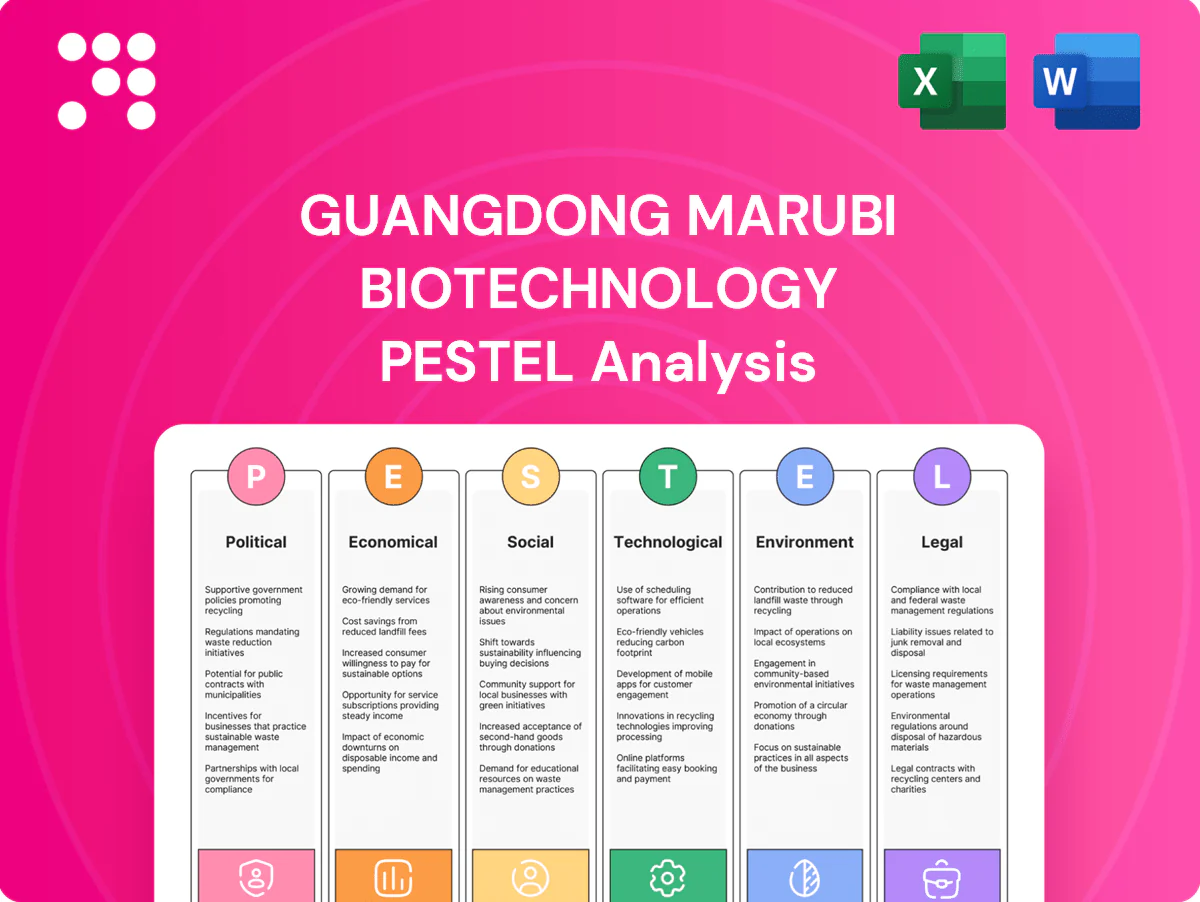
Guangdong Marubi Biotechnology PESTLE Analysis

Make Smarter Strategic Decisions with a Complete PESTEL View
Unlock the external forces shaping Guangdong Marubi Biotechnology with our concise PESTLE snapshot — political shifts, economic pressures, and tech disruption mapped to strategic impact. Use these indicators to anticipate risks and spot growth levers. Purchase the full PESTLE for detailed, actionable insights and ready-to-use recommendations.
Political factors

Regulatory emphasis on product safety
China's Cosmetic Supervision and Administration Regulation took effect on 1 January 2021, intensifying approvals, filings and post-market surveillance under the NMPA; Guangdong Marubi must therefore maintain robust quality systems and safety assessments to avoid enforcement. Heightened scrutiny raises compliance costs and barriers to weaker rivals, while proactive regulatory engagement can smooth new product launches and reduce regulatory delay.
Industrial policy and local incentives
Guangdong, with a 2023 GDP of about 12.76 trillion RMB, and national programs prioritize advanced manufacturing and biotech inputs, offering grants, R&D tax incentives and provincial innovation funds Marubi can tap for automation and product development. Access frequently requires localization of production and meeting performance metrics such as export or employment targets. Recent policy signals through central and Guangdong plans show potential reallocation of support toward strategic consumer biotech segments like dermocosmetics.

Geopolitical tensions and supply security
Global frictions have extended lead times for ingredients, packaging and equipment—supply delays rose as much as 50% during 2021–22—and Marubi should diversify suppliers and hold 3–6 months of buffer stock for critical actives and pumps to maintain production continuity. Domestic substitution policies now prioritize local suppliers, which can initially raise unit costs and require validation time. Robust scenario planning and dual-sourcing mitigate disruption risk.

Consumer nationalism and domestic brand promotion
Authorities and media frequently spotlight domestic champions, and domestic cosmetics hold a majority (>50%) share of China’s mass and mid-tier segments as of 2024, which can lift Marubi’s brand equity and sales reach.
Political campaigns can be volatile, risking sudden pauses in collaborations or celebrity endorsements; balanced, apolitical messaging reduces reputational and commercial risk.
- Benefit: majority (>50%) domestic market share in mass/mid tiers (2024)
- Risk: endorsement/collab volatility from political shifts
- Mitigation: consistent, balanced messaging to protect brand equity
Public health priorities and contingency planning
Episodic public health responses can cut offline retail footfall sharply and disrupt logistics; China’s online retail sales were about 13.3 trillion yuan in 2023, underlining the need for Marubi to pivot fast. Marubi must build agile omnichannel systems to shift sales and fulfillment to digital channels during outbreaks, while government hygiene campaigns lift demand for certified “clean” cosmetics. Robust supply-chain continuity plans are essential to mitigate inventory and distribution shocks.
- Action: invest in omnichannel IT and fulfillment
- Risk: logistics disruption during outbreaks
- Opportunity: higher demand from government hygiene campaigns
- Need: formal supply-chain contingency plans
Stricter NMPA oversight; Guangdong 12.76 tn RMB, >50% market, 3-6M buffer
Stronger NMPA oversight since Jan 2021 raises compliance costs and favors well‑resourced firms; Guangdong Marubi must sustain rigorous QA to avoid enforcement. Guangdong GDP ~12.76 trillion RMB (2023) and >50% domestic share in mass/mid cosmetics (2024) create subsidy and market-access advantages but often require localization. Global supply delays peaked ~+50% (2021–22); hold 3–6 months buffer and diversify suppliers; online retail 13.3 trillion RMB (2023) supports rapid omnichannel shifts.
| Indicator | Value | Implication |
|---|---|---|
| NMPA regulation | Effective 2021 | Higher compliance cost |
| Guangdong GDP | 12.76 tn RMB (2023) | Access to grants/R&D incentives |
| Domestic market share | >50% mass/mid (2024) | Brand uplift |
| Online retail | 13.3 tn RMB (2023) | Digital pivot opportunity |
| Supply delays | +50% peak (2021–22) | Need 3–6M buffer |
What is included in the product
 Detailed Word Document
Explores how Political, Economic, Social, Technological, Environmental and Legal forces uniquely shape Guangdong Marubi Biotechnology, with data-backed insights tied to regional market and regulatory dynamics; designed for executives and investors, formatted for reports and offering forward‑looking implications to identify risks and opportunities.

 Customizable Excel Spreadsheet
A concise, visually segmented PESTLE summary of Guangdong Marubi Biotechnology that highlights regulatory, economic, and technological risks and opportunities for quick reference in meetings or presentations—easily shared, annotated, and dropped into slides for cross-team alignment.
Economic factors

Consumption growth with cyclical softness
China’s beauty segment continues to outgrow national GDP—China GDP rose 5.2% in 2023—yet macro softness and cautious consumers have compressed demand for mid-priced SKUs, forcing Marubi to balance value packs against premiumization. Tying promotions to shopping festivals (Alibaba 11.11 GMV 540.3 billion RMB in 2023) can smooth volatility. Strict inventory discipline and margin-focused stocking protect profitability in weak quarters.
Input cost volatility
Prices for specialty chemicals, natural extracts and packaging remain tied to oil and logistics — Brent averaged roughly $83–88/bbl in 2024, keeping feedstock-linked inputs elevated. Marubi mitigates volatility through multi-sourcing and longer-term purchase contracts. Reformulating toward lower-cost actives helps defend gross margin, while automation and productivity gains offset rising labor costs (minimum wages up about 4–6% in major Chinese provinces in 2024).

RMB moves and import exposure
RMB swings (about a 6% depreciation vs USD from 2022–24) raise costs for imported actives and machinery even for domestic sellers, while a stronger RMB eases capex and raw-material imports. Guangdong Marubi can cut sensitivity by hedging FX exposures and localizing critical inputs. Transparent, formula-linked pricing avoids consumer pushback. China FX reserves remained near USD 3.1 trillion at end-2024, supporting market stability.

E-commerce price competition
Platform-driven discounting, subsidies and live-stream fees (Singles Day GMV 2023 Alibaba 540.3 billion RMB; live-streaming e-commerce ~1.2 trillion RMB 2023) force Marubi to enforce disciplined channel pricing and exclusive bundles to curb cannibalization; prioritize contribution margin over GMV and use data-driven promotions to lift ROI.
- Discounts: 30–50% pressure
- Live fees: rising ad costs
- Focus: contribution-margin not GMV
- Action: exclusive bundles + data-led promos
Market fragmentation and consolidation
Domestic rivals proliferate while market leaders expand share through branding and R&D; China’s cosmetics market surpassed RMB 500 billion in 2023 with domestic brands accounting for roughly 60% and top-players ~40% combined, enabling Marubi to target selective M&A in dermocosmetics and men’s grooming to capture niches.
- Selective M&A: dermocosmetics, men’s grooming
- Scale: lower fulfillment/media CPMs improve unit economics
- Portfolio pruning: reallocates capital to high-ROI SKUs
Stricter NMPA oversight; Guangdong 12.76 tn RMB, >50% market, 3-6M buffer
Slower macro and cautious consumers compress mid-tier demand despite China GDP +5.2% in 2023, forcing Marubi to balance value packs and premiumization; promotions tied to 11.11 (Alibaba GMV 540.3bn RMB 2023) smooth volatility. Input costs remain high (Brent ~83–88 USD/bbl in 2024); RMB depreciated ~6% vs USD (2022–24), raising import costs. Hedge FX, multi-source inputs, margin-focused channels.
| Metric | Value |
|---|---|
| China GDP (2023) | +5.2% |
| Cosmetics market (2023) | ~500bn RMB |
| Domestic share | ~60% |
| Brent (2024) | 83–88 USD/bbl |
| RMB vs USD (2022–24) | ≈-6% |
Same Document Delivered
Guangdong Marubi Biotechnology PESTLE Analysis
The preview shown here is the exact Guangdong Marubi Biotechnology PESTLE analysis you’ll receive after purchase—fully formatted, professionally structured and ready to use. No placeholders or teasers; the content, layout, and structure are identical to the downloadable final file.

Original: $10.00
-65%$10.00
$3.50Product Information
Product Information
Shipping & Returns
Shipping & Returns
Description
Make Smarter Strategic Decisions with a Complete PESTEL View
Unlock the external forces shaping Guangdong Marubi Biotechnology with our concise PESTLE snapshot — political shifts, economic pressures, and tech disruption mapped to strategic impact. Use these indicators to anticipate risks and spot growth levers. Purchase the full PESTLE for detailed, actionable insights and ready-to-use recommendations.
Political factors
Regulatory emphasis on product safety
China's Cosmetic Supervision and Administration Regulation took effect on 1 January 2021, intensifying approvals, filings and post-market surveillance under the NMPA; Guangdong Marubi must therefore maintain robust quality systems and safety assessments to avoid enforcement. Heightened scrutiny raises compliance costs and barriers to weaker rivals, while proactive regulatory engagement can smooth new product launches and reduce regulatory delay.
Industrial policy and local incentives
Guangdong, with a 2023 GDP of about 12.76 trillion RMB, and national programs prioritize advanced manufacturing and biotech inputs, offering grants, R&D tax incentives and provincial innovation funds Marubi can tap for automation and product development. Access frequently requires localization of production and meeting performance metrics such as export or employment targets. Recent policy signals through central and Guangdong plans show potential reallocation of support toward strategic consumer biotech segments like dermocosmetics.
Geopolitical tensions and supply security
Global frictions have extended lead times for ingredients, packaging and equipment—supply delays rose as much as 50% during 2021–22—and Marubi should diversify suppliers and hold 3–6 months of buffer stock for critical actives and pumps to maintain production continuity. Domestic substitution policies now prioritize local suppliers, which can initially raise unit costs and require validation time. Robust scenario planning and dual-sourcing mitigate disruption risk.
Consumer nationalism and domestic brand promotion
Authorities and media frequently spotlight domestic champions, and domestic cosmetics hold a majority (>50%) share of China’s mass and mid-tier segments as of 2024, which can lift Marubi’s brand equity and sales reach.
Political campaigns can be volatile, risking sudden pauses in collaborations or celebrity endorsements; balanced, apolitical messaging reduces reputational and commercial risk.
- Benefit: majority (>50%) domestic market share in mass/mid tiers (2024)
- Risk: endorsement/collab volatility from political shifts
- Mitigation: consistent, balanced messaging to protect brand equity
Public health priorities and contingency planning
Episodic public health responses can cut offline retail footfall sharply and disrupt logistics; China’s online retail sales were about 13.3 trillion yuan in 2023, underlining the need for Marubi to pivot fast. Marubi must build agile omnichannel systems to shift sales and fulfillment to digital channels during outbreaks, while government hygiene campaigns lift demand for certified “clean” cosmetics. Robust supply-chain continuity plans are essential to mitigate inventory and distribution shocks.
- Action: invest in omnichannel IT and fulfillment
- Risk: logistics disruption during outbreaks
- Opportunity: higher demand from government hygiene campaigns
- Need: formal supply-chain contingency plans
Stricter NMPA oversight; Guangdong 12.76 tn RMB, >50% market, 3-6M buffer
Stronger NMPA oversight since Jan 2021 raises compliance costs and favors well‑resourced firms; Guangdong Marubi must sustain rigorous QA to avoid enforcement. Guangdong GDP ~12.76 trillion RMB (2023) and >50% domestic share in mass/mid cosmetics (2024) create subsidy and market-access advantages but often require localization. Global supply delays peaked ~+50% (2021–22); hold 3–6 months buffer and diversify suppliers; online retail 13.3 trillion RMB (2023) supports rapid omnichannel shifts.
| Indicator | Value | Implication |
|---|---|---|
| NMPA regulation | Effective 2021 | Higher compliance cost |
| Guangdong GDP | 12.76 tn RMB (2023) | Access to grants/R&D incentives |
| Domestic market share | >50% mass/mid (2024) | Brand uplift |
| Online retail | 13.3 tn RMB (2023) | Digital pivot opportunity |
| Supply delays | +50% peak (2021–22) | Need 3–6M buffer |
What is included in the product
Detailed Word Document
Explores how Political, Economic, Social, Technological, Environmental and Legal forces uniquely shape Guangdong Marubi Biotechnology, with data-backed insights tied to regional market and regulatory dynamics; designed for executives and investors, formatted for reports and offering forward‑looking implications to identify risks and opportunities.
Customizable Excel Spreadsheet
A concise, visually segmented PESTLE summary of Guangdong Marubi Biotechnology that highlights regulatory, economic, and technological risks and opportunities for quick reference in meetings or presentations—easily shared, annotated, and dropped into slides for cross-team alignment.
Economic factors
Consumption growth with cyclical softness
China’s beauty segment continues to outgrow national GDP—China GDP rose 5.2% in 2023—yet macro softness and cautious consumers have compressed demand for mid-priced SKUs, forcing Marubi to balance value packs against premiumization. Tying promotions to shopping festivals (Alibaba 11.11 GMV 540.3 billion RMB in 2023) can smooth volatility. Strict inventory discipline and margin-focused stocking protect profitability in weak quarters.
Input cost volatility
Prices for specialty chemicals, natural extracts and packaging remain tied to oil and logistics — Brent averaged roughly $83–88/bbl in 2024, keeping feedstock-linked inputs elevated. Marubi mitigates volatility through multi-sourcing and longer-term purchase contracts. Reformulating toward lower-cost actives helps defend gross margin, while automation and productivity gains offset rising labor costs (minimum wages up about 4–6% in major Chinese provinces in 2024).
RMB moves and import exposure
RMB swings (about a 6% depreciation vs USD from 2022–24) raise costs for imported actives and machinery even for domestic sellers, while a stronger RMB eases capex and raw-material imports. Guangdong Marubi can cut sensitivity by hedging FX exposures and localizing critical inputs. Transparent, formula-linked pricing avoids consumer pushback. China FX reserves remained near USD 3.1 trillion at end-2024, supporting market stability.
E-commerce price competition
Platform-driven discounting, subsidies and live-stream fees (Singles Day GMV 2023 Alibaba 540.3 billion RMB; live-streaming e-commerce ~1.2 trillion RMB 2023) force Marubi to enforce disciplined channel pricing and exclusive bundles to curb cannibalization; prioritize contribution margin over GMV and use data-driven promotions to lift ROI.
- Discounts: 30–50% pressure
- Live fees: rising ad costs
- Focus: contribution-margin not GMV
- Action: exclusive bundles + data-led promos
Market fragmentation and consolidation
Domestic rivals proliferate while market leaders expand share through branding and R&D; China’s cosmetics market surpassed RMB 500 billion in 2023 with domestic brands accounting for roughly 60% and top-players ~40% combined, enabling Marubi to target selective M&A in dermocosmetics and men’s grooming to capture niches.
- Selective M&A: dermocosmetics, men’s grooming
- Scale: lower fulfillment/media CPMs improve unit economics
- Portfolio pruning: reallocates capital to high-ROI SKUs
Stricter NMPA oversight; Guangdong 12.76 tn RMB, >50% market, 3-6M buffer
Slower macro and cautious consumers compress mid-tier demand despite China GDP +5.2% in 2023, forcing Marubi to balance value packs and premiumization; promotions tied to 11.11 (Alibaba GMV 540.3bn RMB 2023) smooth volatility. Input costs remain high (Brent ~83–88 USD/bbl in 2024); RMB depreciated ~6% vs USD (2022–24), raising import costs. Hedge FX, multi-source inputs, margin-focused channels.
| Metric | Value |
|---|---|
| China GDP (2023) | +5.2% |
| Cosmetics market (2023) | ~500bn RMB |
| Domestic share | ~60% |
| Brent (2024) | 83–88 USD/bbl |
| RMB vs USD (2022–24) | ≈-6% |
Same Document Delivered
Guangdong Marubi Biotechnology PESTLE Analysis
The preview shown here is the exact Guangdong Marubi Biotechnology PESTLE analysis you’ll receive after purchase—fully formatted, professionally structured and ready to use. No placeholders or teasers; the content, layout, and structure are identical to the downloadable final file.