Maisons du Monde PESTLE Analysis

Skip the Research. Get the Strategy.
Unlock how political shifts, economic trends, social tastes, technological advances, legal changes, and environmental pressures shape Maisons du Monde’s strategy in our concise PESTLE snapshot. Ideal for investors and strategists, this briefing highlights risks and opportunities you can act on today. Purchase the full PESTLE for the detailed data, scenarios, and ready-to-use insights.
Political factors

EU trade and tariff shifts
Changes in EU trade policy raise import costs for furniture, textiles and décor by altering duties and compliance requirements, directly pressuring Maisons du Monde’s input prices and retail margins. Revisions to tariffs on wood, metals or fabrics can shift cost structures and SKU pricing across channels. Diversifying sourcing across Europe and Asia reduces exposure to single-market policy shocks. Active lobbying through retail associations helps the firm anticipate regulatory moves and influence tariff outcomes.
French retail policy and incentives
Domestic rules on retail zoning, Sunday trading and store openings—with municipalities empowered to authorize Sunday openings and local zoning controls—directly shape Maisons du Monde physical expansion and site selection. Incentives for regional development such as Zones de revitalisation rurale and Zones franches urbaines - territoires entrepreneurs provide tax breaks and grants for store setup. France standard VAT is 20%, so any shifts materially affect pricing strategies; close coordination with local authorities speeds permitting and reduces delays.

Geopolitical supply risks
Instability in sourcing regions disrupts lead times and material availability, and Maisons du Monde — which reported ~€1.8bn revenue in 2023 — faces higher fill-rate risk when suppliers are affected. Freight routes can be hit by sanctions or conflicts, pushing logistics costs (container spot volatility remains significantly above pre‑pandemic levels). Maintaining multi‑sourcing and 4–12 week safety stocks buffers shocks. Scenario planning improves agility in assortment and procurement.

Sustainability-driven public policy
EU ecodesign rules and France s AGEC law (anti-waste, 2020) plus the repairability index (introduced 2021) push circularity, reparability and recycled-content requirements; adherence can unlock EU/France green procurement and subsidy channels tied to NextGenerationEU and national grants. Clear labeling mandates raise compliance and transparency costs, but early alignment can become a marketable sustainability differentiator for Maisons du Monde.
- Regulation: ESPR/AGEC enforce repairability and recycled content
- Costs: higher design/supplier standards, labeling expenses
- Benefits: access to subsidies/green procurement
- Strategy: early compliance = brand differentiation
Currency and trade diplomacy
Bilateral agreements, notably the EU's 40+ trade deals covering 68 countries as of 2024, shape customs procedures and non-tariff barriers that affect Maisons du Monde sourcing and lead times. Currency volatility tied to policy decisions (ECB rate moves) alters euro-denominated purchasing power and margins. Active hedging with forwards and options stabilizes import budgets and enables timely price adjustments.
- Bilateral agreements: EU 40+ deals (68 countries) 2024
- Currency risk: ECB-driven euro volatility impacts margins
- Hedging: forwards/options stabilize import costs
- Monitoring: supports timely retail price changes
EU trade shifts, 68 deals and 20% VAT squeeze furniture margins, raising logistics risk
EU trade/tariff shifts and 40+ trade deals (68 countries 2024) directly affect import costs and margins for Maisons du Monde (revenue ~€1.8bn 2023). Local retail rules, VAT 20% and zoning control store expansion and timing. Supply‑chain instability raises logistics risk and safety‑stock needs; ESG laws (AGEC, repairability) add compliance cost but enable subsidies.
| Metric | Value |
|---|---|
| 2023 Revenue | €1.8bn |
| EU deals (2024) | 68 countries |
| France VAT | 20% |
What is included in the product
 Detailed Word Document
Explores how macro-environmental factors (Political, Economic, Social, Technological, Environmental, Legal) uniquely affect Maisons du Monde, with data‑backed trends and region‑specific regulatory context. Designed for executives and investors, it highlights risks and opportunities with forward‑looking insights and detailed sub‑points ready for inclusion in business plans, pitch decks, or internal reports.

 Customizable Excel Spreadsheet
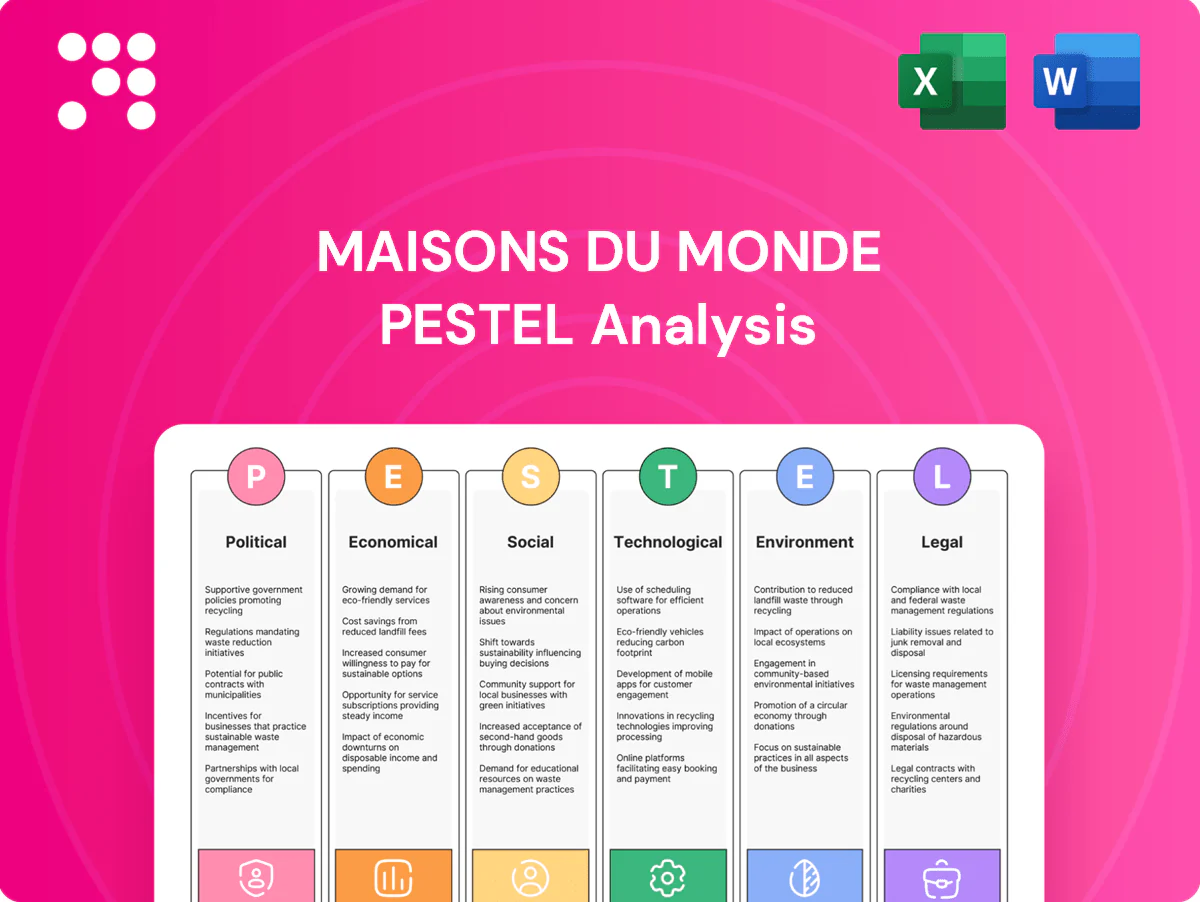
A concise, visually segmented PESTLE summary for Maisons du Monde that can be dropped into presentations, edited with notes per region or business line, and easily shared to align teams and support external risk and market-positioning discussions during planning.
Economic factors

Consumer spending cycles
Furniture demand tracks housing transactions and disposable income; when inflation or recession hit, customers shrink baskets and delay big-ticket buys. Maisons du Monde’s value-for-money positioning helps retain footfall during downturns, while promotions and flexible financing (BNPL, instalments) are used to smooth volume volatility and salvage average order value.
Inflation and input costs
Rising inflation (Euro area HICP 5.6% in 2023) amplified commodity-driven swings in wood, foam, metals and textiles, pressuring Maisons du Monde input costs. Volatile energy and freight rates have a direct impact on landed costs and margin compression. Dynamic pricing and SKU-mix optimization have been used to defend gross margin. Long-term supplier contracts help reduce procurement volatility.

Interest rates and housing activity
Mortgage costs tied to ECB policy (deposit rate 4.00% in June 2025) strongly influence moves and renovation budgets: high borrowing costs have suppressed furnishing demand, while recent easing signals revive purchase intent. Maisons du Monde can boost conversion with targeted campaigns timed to moving/refurb cycles and lift share by partnering with real estate platforms to capture customers at point of move.

E-commerce growth and basket economics
E-commerce expands Maisons du Monde reach but increases delivery and returns complexity; Eurostat 2023 shows 77% of EU individuals buy online, raising fulfillment demand.
Average order value and last-mile efficiency drive profitability—last-mile can represent ~50% of delivery cost—so AOV uplift is crucial.
Click-and-collect and ship-from-store cut fulfillment cost; smarter packaging and product bundling lift contribution margins.
- Reach vs returns complexity
- AOV & last-mile (~50%)
- Click-and-collect/ship-from-store
- Packaging & bundling = higher margins
Labor market and wage trends
Tight 2024 labor markets (EU unemployment ~6.3% per Eurostat) and rising minimum wages pushed retail staffing costs higher, squeezing margins at chains like Maisons du Monde.
Deployment of scheduling analytics and productivity tools partially offset wage pressure, while focused training raised in-store conversion and attachment rates; incentive schemes cut turnover and preserved service quality.
- EU unemployment 2024: 6.3% (Eurostat)
- Scheduling analytics reduce labor hours by up to 10% (industry case studies)
- Training can increase conversion rates 5–15% (retail benchmarks)
- Incentives lower turnover and protect customer experience
EU trade shifts, 68 deals and 20% VAT squeeze furniture margins, raising logistics risk
Demand linked to housing and disposable income; ECB deposit rate 4.00% (Jun 2025) and high borrowing costs have weighed on furnishing spend.
Inflation (Euro area HICP 5.6% in 2023) and commodity, energy and freight volatility raised COGS and margin pressure.
E-commerce growth (77% EU online buyers 2023) raises fulfillment and returns costs; last-mile can be ~50% of delivery cost.
Tight labour (EU unemployment 6.3% 2024) lifted wages; scheduling analytics and training partially offset.
| Metric | Value |
|---|---|
| ECB rate (Jun 2025) | 4.00% |
| Euro area HICP (2023) | 5.6% |
| EU online buyers (2023) | 77% |
| EU unemployment (2024) | 6.3% |
| Last-mile share | ~50% |
Full Version Awaits
Maisons du Monde PESTLE Analysis
The Maisons du Monde PESTLE Analysis preview shown here is the exact document you’ll receive after purchase—fully formatted and ready to use. The layout, content, and structure visible are identical to the downloadable file. No placeholders, no teasers—this is the real, final document you’ll own upon checkout.

Original: $10.00
-65%$10.00
$3.50Product Information
Product Information
Shipping & Returns
Shipping & Returns
Description
Skip the Research. Get the Strategy.
Unlock how political shifts, economic trends, social tastes, technological advances, legal changes, and environmental pressures shape Maisons du Monde’s strategy in our concise PESTLE snapshot. Ideal for investors and strategists, this briefing highlights risks and opportunities you can act on today. Purchase the full PESTLE for the detailed data, scenarios, and ready-to-use insights.
Political factors
EU trade and tariff shifts
Changes in EU trade policy raise import costs for furniture, textiles and décor by altering duties and compliance requirements, directly pressuring Maisons du Monde’s input prices and retail margins. Revisions to tariffs on wood, metals or fabrics can shift cost structures and SKU pricing across channels. Diversifying sourcing across Europe and Asia reduces exposure to single-market policy shocks. Active lobbying through retail associations helps the firm anticipate regulatory moves and influence tariff outcomes.
French retail policy and incentives
Domestic rules on retail zoning, Sunday trading and store openings—with municipalities empowered to authorize Sunday openings and local zoning controls—directly shape Maisons du Monde physical expansion and site selection. Incentives for regional development such as Zones de revitalisation rurale and Zones franches urbaines - territoires entrepreneurs provide tax breaks and grants for store setup. France standard VAT is 20%, so any shifts materially affect pricing strategies; close coordination with local authorities speeds permitting and reduces delays.
Geopolitical supply risks
Instability in sourcing regions disrupts lead times and material availability, and Maisons du Monde — which reported ~€1.8bn revenue in 2023 — faces higher fill-rate risk when suppliers are affected. Freight routes can be hit by sanctions or conflicts, pushing logistics costs (container spot volatility remains significantly above pre‑pandemic levels). Maintaining multi‑sourcing and 4–12 week safety stocks buffers shocks. Scenario planning improves agility in assortment and procurement.
Sustainability-driven public policy
EU ecodesign rules and France s AGEC law (anti-waste, 2020) plus the repairability index (introduced 2021) push circularity, reparability and recycled-content requirements; adherence can unlock EU/France green procurement and subsidy channels tied to NextGenerationEU and national grants. Clear labeling mandates raise compliance and transparency costs, but early alignment can become a marketable sustainability differentiator for Maisons du Monde.
- Regulation: ESPR/AGEC enforce repairability and recycled content
- Costs: higher design/supplier standards, labeling expenses
- Benefits: access to subsidies/green procurement
- Strategy: early compliance = brand differentiation
Currency and trade diplomacy
Bilateral agreements, notably the EU's 40+ trade deals covering 68 countries as of 2024, shape customs procedures and non-tariff barriers that affect Maisons du Monde sourcing and lead times. Currency volatility tied to policy decisions (ECB rate moves) alters euro-denominated purchasing power and margins. Active hedging with forwards and options stabilizes import budgets and enables timely price adjustments.
- Bilateral agreements: EU 40+ deals (68 countries) 2024
- Currency risk: ECB-driven euro volatility impacts margins
- Hedging: forwards/options stabilize import costs
- Monitoring: supports timely retail price changes
EU trade shifts, 68 deals and 20% VAT squeeze furniture margins, raising logistics risk
EU trade/tariff shifts and 40+ trade deals (68 countries 2024) directly affect import costs and margins for Maisons du Monde (revenue ~€1.8bn 2023). Local retail rules, VAT 20% and zoning control store expansion and timing. Supply‑chain instability raises logistics risk and safety‑stock needs; ESG laws (AGEC, repairability) add compliance cost but enable subsidies.
| Metric | Value |
|---|---|
| 2023 Revenue | €1.8bn |
| EU deals (2024) | 68 countries |
| France VAT | 20% |
What is included in the product
Detailed Word Document
Explores how macro-environmental factors (Political, Economic, Social, Technological, Environmental, Legal) uniquely affect Maisons du Monde, with data‑backed trends and region‑specific regulatory context. Designed for executives and investors, it highlights risks and opportunities with forward‑looking insights and detailed sub‑points ready for inclusion in business plans, pitch decks, or internal reports.
Customizable Excel Spreadsheet
A concise, visually segmented PESTLE summary for Maisons du Monde that can be dropped into presentations, edited with notes per region or business line, and easily shared to align teams and support external risk and market-positioning discussions during planning.
Economic factors
Consumer spending cycles
Furniture demand tracks housing transactions and disposable income; when inflation or recession hit, customers shrink baskets and delay big-ticket buys. Maisons du Monde’s value-for-money positioning helps retain footfall during downturns, while promotions and flexible financing (BNPL, instalments) are used to smooth volume volatility and salvage average order value.
Inflation and input costs
Rising inflation (Euro area HICP 5.6% in 2023) amplified commodity-driven swings in wood, foam, metals and textiles, pressuring Maisons du Monde input costs. Volatile energy and freight rates have a direct impact on landed costs and margin compression. Dynamic pricing and SKU-mix optimization have been used to defend gross margin. Long-term supplier contracts help reduce procurement volatility.
Interest rates and housing activity
Mortgage costs tied to ECB policy (deposit rate 4.00% in June 2025) strongly influence moves and renovation budgets: high borrowing costs have suppressed furnishing demand, while recent easing signals revive purchase intent. Maisons du Monde can boost conversion with targeted campaigns timed to moving/refurb cycles and lift share by partnering with real estate platforms to capture customers at point of move.
E-commerce growth and basket economics
E-commerce expands Maisons du Monde reach but increases delivery and returns complexity; Eurostat 2023 shows 77% of EU individuals buy online, raising fulfillment demand.
Average order value and last-mile efficiency drive profitability—last-mile can represent ~50% of delivery cost—so AOV uplift is crucial.
Click-and-collect and ship-from-store cut fulfillment cost; smarter packaging and product bundling lift contribution margins.
- Reach vs returns complexity
- AOV & last-mile (~50%)
- Click-and-collect/ship-from-store
- Packaging & bundling = higher margins
Labor market and wage trends
Tight 2024 labor markets (EU unemployment ~6.3% per Eurostat) and rising minimum wages pushed retail staffing costs higher, squeezing margins at chains like Maisons du Monde.
Deployment of scheduling analytics and productivity tools partially offset wage pressure, while focused training raised in-store conversion and attachment rates; incentive schemes cut turnover and preserved service quality.
- EU unemployment 2024: 6.3% (Eurostat)
- Scheduling analytics reduce labor hours by up to 10% (industry case studies)
- Training can increase conversion rates 5–15% (retail benchmarks)
- Incentives lower turnover and protect customer experience
EU trade shifts, 68 deals and 20% VAT squeeze furniture margins, raising logistics risk
Demand linked to housing and disposable income; ECB deposit rate 4.00% (Jun 2025) and high borrowing costs have weighed on furnishing spend.
Inflation (Euro area HICP 5.6% in 2023) and commodity, energy and freight volatility raised COGS and margin pressure.
E-commerce growth (77% EU online buyers 2023) raises fulfillment and returns costs; last-mile can be ~50% of delivery cost.
Tight labour (EU unemployment 6.3% 2024) lifted wages; scheduling analytics and training partially offset.
| Metric | Value |
|---|---|
| ECB rate (Jun 2025) | 4.00% |
| Euro area HICP (2023) | 5.6% |
| EU online buyers (2023) | 77% |
| EU unemployment (2024) | 6.3% |
| Last-mile share | ~50% |
Full Version Awaits
Maisons du Monde PESTLE Analysis
The Maisons du Monde PESTLE Analysis preview shown here is the exact document you’ll receive after purchase—fully formatted and ready to use. The layout, content, and structure visible are identical to the downloadable file. No placeholders, no teasers—this is the real, final document you’ll own upon checkout.