Macmahon PESTLE Analysis

Skip the Research. Get the Strategy.
Unlock strategic advantage with our PESTLE Analysis of Macmahon—concise, up-to-date insights into political, economic, social, technological, legal and environmental factors shaping the business. Ideal for investors and strategists, it translates trends into actionable risks and opportunities. Buy the full, editable report now for the complete breakdown and immediate use.
Political factors

Australian mining policy shifts
Changes to federal and state mining policies—including the 2023 Critical Minerals focus—affect approvals, royalties and local content expectations; mining made up about 9% of Australian GDP in 2023–24 (ABS). Macmahon must monitor reforms to planning frameworks as statutory approvals often take 12–36 months across jurisdictions. Policy certainty supports long-term contract commitments and capital deployment, while sudden shifts can compress margins or delay mobilization.
Resource nationalism abroad
Operating or bidding in emerging markets exposes Macmahon to license terms, local ownership rules and in‑country value mandates; for example Indonesia’s raw nickel export ban and processing mandates instituted from 2020 show how policy shifts can reshape supply chains. Governments can revise taxes, export rules or contracts as commodity cycles turn, so robust country‑risk assessment and flexible contract clauses are essential; partnering with local firms often improves tender success.

Indigenous affairs and community policy
Government priorities on Indigenous engagement shape procurement and workforce targets, with Aboriginal and Torres Strait Islander people comprising 3.8% of Australia’s population (ABS 2021), prompting many projects to require Indigenous participation plans and benefit‑sharing. Strong relationships with Traditional Owners support access and continuity. Non‑compliance risks reputational harm and tender disadvantages.

Trade relations and geopolitics
Australia’s ties with key commodity importers shape Macmahon project pipelines, with China accounting for about 31% of Australia’s goods exports in 2024, exposing clients to demand swings. Sanctions, tariffs or diplomatic tensions can disrupt supply chains and equipment sourcing, so Macmahon must diversify suppliers, maintain inventory buffers and reflect geopolitical risk pricing in bids.
- China ~31% of AUS exports (2024)
- Diversify suppliers, regional sourcing
- Maintain inventory buffers
- Include geopolitical risk premium in bids
Public investment and infrastructure
Government infrastructure and the Australian Critical Minerals Strategy (released 2023) can unlock enabling works and mine developments, reducing timelines and permitting hurdles for contractors like Macmahon. Co-investment in roads, power and ports via programs such as NAIF (approved over A$3.5 billion since 2016) lowers project risk and capital cost, while tracking grants improves client proposals and alignment with policy boosts tender win rates.
- Critical Minerals Strategy 2023: policy unlocks mine enabling works
- NAIF: >A$3.5 billion approved since 2016 — supports regional infrastructure
- Co-investment in roads/power/ports: reduces capex and delivery risk
- Grant tracking and policy alignment: increases tender competitiveness
Policy shifts and slow approvals raise margin, country and Indigenous engagement risks
Federal/state mining policy shifts (Critical Minerals 2023) and slow statutory approvals (12–36 months) drive contract timing and margin risk. Overseas policy changes (eg Indonesia nickel bans) raise country risk and local‑partner requirements. Indigenous engagement and infrastructure programs (NAIF >A$3.5bn) materially affect access, costs and tender competitiveness.
| Metric | Value |
|---|---|
| Mining % of AUS GDP (2023–24) | ~9% |
| China share of AUS exports (2024) | ~31% |
| NAIF approvals since 2016 | >A$3.5bn |
| Indigenous pop (ABS 2021) | 3.8% |
What is included in the product
 Detailed Word Document
Explores how external macro-environmental factors uniquely affect Macmahon across six dimensions—Political, Economic, Social, Technological, Environmental, and Legal—highlighting region- and industry-specific dynamics. Backed by relevant data and forward-looking insights, it’s designed to help executives, consultants, and investors identify risks, opportunities and inform strategic planning.

 Customizable Excel Spreadsheet
A concise, visually segmented PESTLE summary tailored to Macmahon that’s easily dropped into presentations or shared across teams, streamlining external risk discussions and speeding alignment in strategic planning.
Economic factors

Commodity price cyclicality
Volatile iron ore (62% Fe ~US$100/t), gold (~US$2,200/oz), copper (~US$9,000/t) and battery-mineral markets drive client capex and opex, directly affecting Macmahon’s tender pipelines and contract renewals. Revenue visibility hinges on clients maintaining sustaining spend during downcycles, with historical downturns cutting contractor volumes by 20–40%. Index-linked rates and volume flexibility in contracts help protect margins. Diversification across commodities smooths earnings and reduces single-commodity exposure.
Labor costs and shortages
Tight labor markets in 2024 (unemployment ~4%) push wages and training costs higher, with underground specialists attracting FIFO premiums commonly cited at 20–35%, while regional housing shortages and roster accommodation inflate site costs. Macmahon must prioritise workforce planning and apprenticeships to rebuild pipelines. Productivity gains need to outpace ~3.5–4% wage inflation to protect EBITDA.

FX and equipment inflation
An AUD/USD shift — AUD near 0.64 USD in mid‑2025 — raises costs for imported equipment, parts and consumables used by contractors. Extended OEM lead times (commonly 9–12 months in 2023–24) and fleet price escalation have eroded bid assumptions. Use of FX hedging and contract escalation clauses can materially reduce exposure. Standardising fleets improves procurement leverage and lowers unit capex.

Interest rates and capital intensity
Higher interest rates (RBA cash rate 4.35% peak in 2023) raise financing costs for Macmahon’s yellow fleet and working capital, prompting clients to defer projects and slowing backlog conversion; leasing versus ownership decisions require constant reevaluation while a strong balance sheet enables counter-cyclical bidding and selective M&A.
- Higher funding costs
- Project deferrals hit backlog
- Lease vs buy reassessments
- Balance sheet = opportunity
Client credit and consolidation
Junior miners’ funding risk has driven higher contract cancellations and arrears, with ASX small resources capital raisings down sharply in 2023–24, increasing counterparty credit risk for contractors like Macmahon; consolidation among majors has pressured pricing but often extends contract tenures to 3–7 years, stabilising revenue streams.
Rigorous credit vetting and milestone billing are used to protect cash flow and reduce working capital strain, while a portfolio mix balancing tier‑1 long‑life clients with growth-focused juniors helps manage revenue volatility and preserve margins.
- Credit risk: higher cancellations from juniors
- Consolidation: pricing pressure, longer tenures (3–7 years)
- Cash protection: credit vetting + milestone billing
- Portfolio: balance tier‑1 stability with growth clients
Policy shifts and slow approvals raise margin, country and Indigenous engagement risks
Commodity price volatility (62% Fe ~US$100/t; gold ~US$2,200/oz; copper ~US$9,000/t) and tight 2024 labour (unemployment ~4%) compress margins and elevate site costs. AUD ~0.64 USD in mid‑2025 and higher RBA rates (cash peak 4.35%) raise imported capex and financing costs, prompting lease vs buy tradeoffs. Credit stress among juniors increases cancellations, making tier‑1 diversification and milestone billing critical.
| Metric | Value |
|---|---|
| Iron ore (62% Fe) | ~US$100/t |
| Gold | ~US$2,200/oz |
| AUD/USD | ~0.64 (mid‑2025) |
| Unemployment (2024) | ~4% |
| RBA cash peak | 4.35% |
Preview Before You Purchase
Macmahon PESTLE Analysis
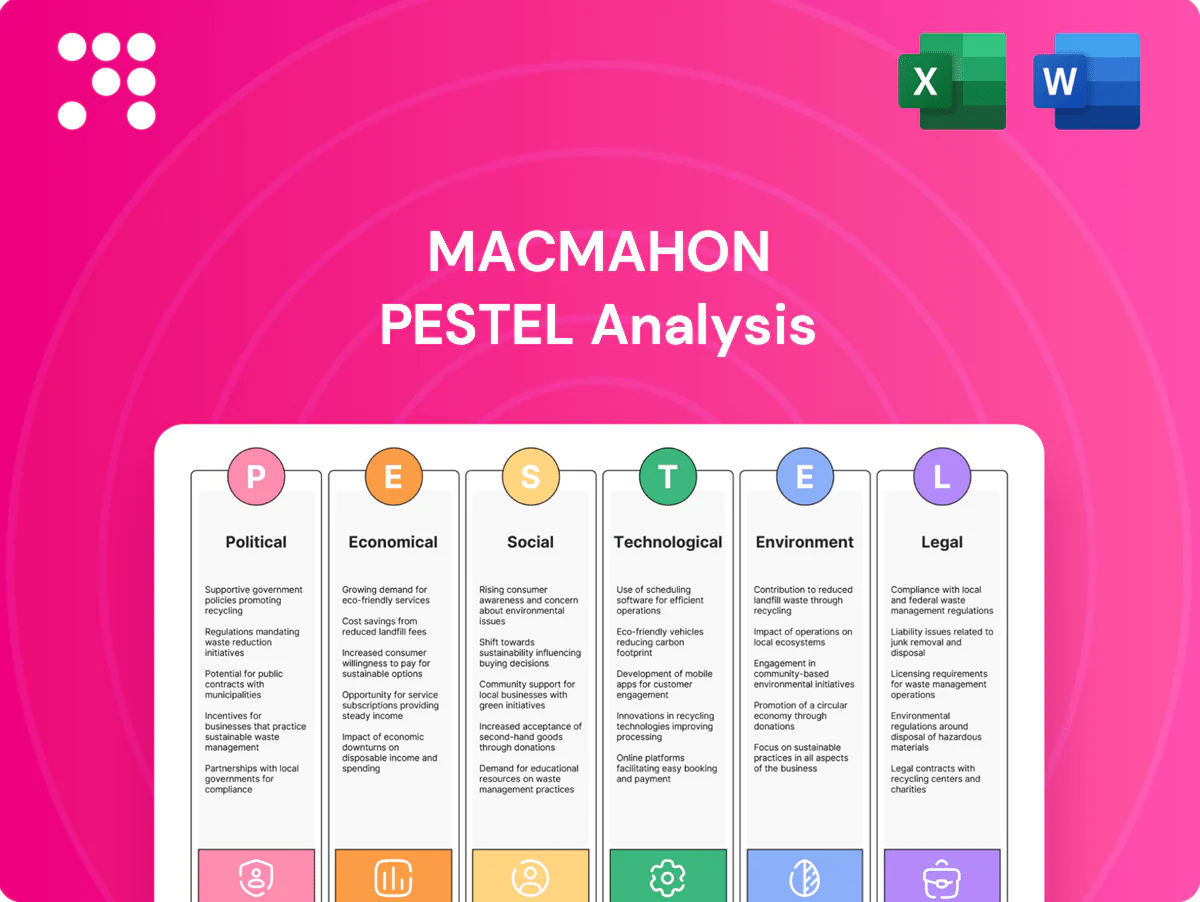
This Macmahon PESTLE Analysis preview is the exact document you’ll receive after purchase—fully formatted, professionally structured, and ready to use. No placeholders or teasers; the file shown is the final version you’ll download immediately after payment.

Original: $10.00
-65%$10.00
$3.50Product Information
Product Information
Shipping & Returns
Shipping & Returns
Description
Skip the Research. Get the Strategy.
Unlock strategic advantage with our PESTLE Analysis of Macmahon—concise, up-to-date insights into political, economic, social, technological, legal and environmental factors shaping the business. Ideal for investors and strategists, it translates trends into actionable risks and opportunities. Buy the full, editable report now for the complete breakdown and immediate use.
Political factors
Australian mining policy shifts
Changes to federal and state mining policies—including the 2023 Critical Minerals focus—affect approvals, royalties and local content expectations; mining made up about 9% of Australian GDP in 2023–24 (ABS). Macmahon must monitor reforms to planning frameworks as statutory approvals often take 12–36 months across jurisdictions. Policy certainty supports long-term contract commitments and capital deployment, while sudden shifts can compress margins or delay mobilization.
Resource nationalism abroad
Operating or bidding in emerging markets exposes Macmahon to license terms, local ownership rules and in‑country value mandates; for example Indonesia’s raw nickel export ban and processing mandates instituted from 2020 show how policy shifts can reshape supply chains. Governments can revise taxes, export rules or contracts as commodity cycles turn, so robust country‑risk assessment and flexible contract clauses are essential; partnering with local firms often improves tender success.
Indigenous affairs and community policy
Government priorities on Indigenous engagement shape procurement and workforce targets, with Aboriginal and Torres Strait Islander people comprising 3.8% of Australia’s population (ABS 2021), prompting many projects to require Indigenous participation plans and benefit‑sharing. Strong relationships with Traditional Owners support access and continuity. Non‑compliance risks reputational harm and tender disadvantages.
Trade relations and geopolitics
Australia’s ties with key commodity importers shape Macmahon project pipelines, with China accounting for about 31% of Australia’s goods exports in 2024, exposing clients to demand swings. Sanctions, tariffs or diplomatic tensions can disrupt supply chains and equipment sourcing, so Macmahon must diversify suppliers, maintain inventory buffers and reflect geopolitical risk pricing in bids.
- China ~31% of AUS exports (2024)
- Diversify suppliers, regional sourcing
- Maintain inventory buffers
- Include geopolitical risk premium in bids
Public investment and infrastructure
Government infrastructure and the Australian Critical Minerals Strategy (released 2023) can unlock enabling works and mine developments, reducing timelines and permitting hurdles for contractors like Macmahon. Co-investment in roads, power and ports via programs such as NAIF (approved over A$3.5 billion since 2016) lowers project risk and capital cost, while tracking grants improves client proposals and alignment with policy boosts tender win rates.
- Critical Minerals Strategy 2023: policy unlocks mine enabling works
- NAIF: >A$3.5 billion approved since 2016 — supports regional infrastructure
- Co-investment in roads/power/ports: reduces capex and delivery risk
- Grant tracking and policy alignment: increases tender competitiveness
Policy shifts and slow approvals raise margin, country and Indigenous engagement risks
Federal/state mining policy shifts (Critical Minerals 2023) and slow statutory approvals (12–36 months) drive contract timing and margin risk. Overseas policy changes (eg Indonesia nickel bans) raise country risk and local‑partner requirements. Indigenous engagement and infrastructure programs (NAIF >A$3.5bn) materially affect access, costs and tender competitiveness.
| Metric | Value |
|---|---|
| Mining % of AUS GDP (2023–24) | ~9% |
| China share of AUS exports (2024) | ~31% |
| NAIF approvals since 2016 | >A$3.5bn |
| Indigenous pop (ABS 2021) | 3.8% |
What is included in the product
Detailed Word Document
Explores how external macro-environmental factors uniquely affect Macmahon across six dimensions—Political, Economic, Social, Technological, Environmental, and Legal—highlighting region- and industry-specific dynamics. Backed by relevant data and forward-looking insights, it’s designed to help executives, consultants, and investors identify risks, opportunities and inform strategic planning.
Customizable Excel Spreadsheet
A concise, visually segmented PESTLE summary tailored to Macmahon that’s easily dropped into presentations or shared across teams, streamlining external risk discussions and speeding alignment in strategic planning.
Economic factors
Commodity price cyclicality
Volatile iron ore (62% Fe ~US$100/t), gold (~US$2,200/oz), copper (~US$9,000/t) and battery-mineral markets drive client capex and opex, directly affecting Macmahon’s tender pipelines and contract renewals. Revenue visibility hinges on clients maintaining sustaining spend during downcycles, with historical downturns cutting contractor volumes by 20–40%. Index-linked rates and volume flexibility in contracts help protect margins. Diversification across commodities smooths earnings and reduces single-commodity exposure.
Labor costs and shortages
Tight labor markets in 2024 (unemployment ~4%) push wages and training costs higher, with underground specialists attracting FIFO premiums commonly cited at 20–35%, while regional housing shortages and roster accommodation inflate site costs. Macmahon must prioritise workforce planning and apprenticeships to rebuild pipelines. Productivity gains need to outpace ~3.5–4% wage inflation to protect EBITDA.
FX and equipment inflation
An AUD/USD shift — AUD near 0.64 USD in mid‑2025 — raises costs for imported equipment, parts and consumables used by contractors. Extended OEM lead times (commonly 9–12 months in 2023–24) and fleet price escalation have eroded bid assumptions. Use of FX hedging and contract escalation clauses can materially reduce exposure. Standardising fleets improves procurement leverage and lowers unit capex.
Interest rates and capital intensity
Higher interest rates (RBA cash rate 4.35% peak in 2023) raise financing costs for Macmahon’s yellow fleet and working capital, prompting clients to defer projects and slowing backlog conversion; leasing versus ownership decisions require constant reevaluation while a strong balance sheet enables counter-cyclical bidding and selective M&A.
- Higher funding costs
- Project deferrals hit backlog
- Lease vs buy reassessments
- Balance sheet = opportunity
Client credit and consolidation
Junior miners’ funding risk has driven higher contract cancellations and arrears, with ASX small resources capital raisings down sharply in 2023–24, increasing counterparty credit risk for contractors like Macmahon; consolidation among majors has pressured pricing but often extends contract tenures to 3–7 years, stabilising revenue streams.
Rigorous credit vetting and milestone billing are used to protect cash flow and reduce working capital strain, while a portfolio mix balancing tier‑1 long‑life clients with growth-focused juniors helps manage revenue volatility and preserve margins.
- Credit risk: higher cancellations from juniors
- Consolidation: pricing pressure, longer tenures (3–7 years)
- Cash protection: credit vetting + milestone billing
- Portfolio: balance tier‑1 stability with growth clients
Policy shifts and slow approvals raise margin, country and Indigenous engagement risks
Commodity price volatility (62% Fe ~US$100/t; gold ~US$2,200/oz; copper ~US$9,000/t) and tight 2024 labour (unemployment ~4%) compress margins and elevate site costs. AUD ~0.64 USD in mid‑2025 and higher RBA rates (cash peak 4.35%) raise imported capex and financing costs, prompting lease vs buy tradeoffs. Credit stress among juniors increases cancellations, making tier‑1 diversification and milestone billing critical.
| Metric | Value |
|---|---|
| Iron ore (62% Fe) | ~US$100/t |
| Gold | ~US$2,200/oz |
| AUD/USD | ~0.64 (mid‑2025) |
| Unemployment (2024) | ~4% |
| RBA cash peak | 4.35% |
Preview Before You Purchase
Macmahon PESTLE Analysis
This Macmahon PESTLE Analysis preview is the exact document you’ll receive after purchase—fully formatted, professionally structured, and ready to use. No placeholders or teasers; the file shown is the final version you’ll download immediately after payment.