Logwin PESTLE Analysis

Plan Smarter. Present Sharper. Compete Stronger.
Unlock how political shifts, economic cycles, and technological trends shape Logwin’s prospects with our concise PESTLE snapshot. This expert analysis highlights risks and growth levers for investors and strategists. Save time and make smarter decisions—buy the full PESTLE now for the complete, editable report.
Political factors

Trade policy volatility
Shifts in tariffs, customs procedures and trade agreements directly affect cross-border lead times and costs, with WTO projecting world merchandise trade volume growth at about 1.2% in 2024, increasing sensitivity to policy moves. Logwin must continuously adapt routings and pricing to stay competitive, diversify lanes and deepen customs-brokerage expertise to mitigate disruption, and pursue proactive lobbying via industry bodies to influence favorable logistics policies.
Geopolitical tensions and conflict
Geopolitical conflicts, piracy risks and port closures reroute air/sea freight, compressing capacity and raising spot rates; about 80% of global trade by volume is seaborne (UNCTAD 2024). Insurance premiums and security compliance costs have risen, increasing operating expenses for forwarders. Scenario planning and multi-origin sourcing help preserve service levels. Real-time risk monitoring is essential for supplier and lane diversification.

Government infrastructure investment
EU NextGenerationEU mobilises €806.9 billion for green and digital infrastructure, while the Global Infrastructure Hub estimated a $94 trillion need for 2016–2040, underscoring large public spending on ports, rail, airports and digitised customs that boosts throughput and reliability. Logwin can leverage upgraded corridors to offer faster, lower-emission services and capture trade via roughly 4,700 global free zones that enable value-added logistics. Strategic PPP engagement secures capacity and long-term concessions for scalable network access.

Sanctions and export controls
Expanding sanctions regimes—over 40 jurisdictions imposed Russia-related measures by 2024—complicate routing, documentation, and screening; mistakes can trigger fines, cargo seizures, and lasting reputational damage. Robust denied-party screening and tariff/classification capabilities are critical, and dedicated compliance operations can materially reduce cycle-time impacts.
- Routing risk: increased screening points
- Enforcement: fines and seizures
- Mitigation: denied-party screening, classification, dedicated compliance
Aviation and bilateral rights
Air cargo capacity for Logwin hinges on traffic rights and slot allocations under more than 3,000 bilateral/MASA frameworks; bellyhold continues to represent roughly 50% of global cargo lift, affecting rates and capacity availability. Policy shifts alter bellyhold supply and yields; strategic carrier alliances hedge access risk. Flexibility across freighter and passenger networks preserves service continuity.
- bilaterals: 3,000+
- bellyhold ≈50% of lift
- alliances hedge access
- freighter/passenger flexibility
Policy shifts (WTO +1.2% 2024) hit 80% seaborne flows
Tariff and trade-policy shifts (WTO trade vol +1.2% 2024) force routings, pricing and customs expertise. Geopolitical disruptions raise insurance/security costs; 80% of trade is seaborne (UNCTAD 2024). Sanctions (40+ jurisdictions) and 3,000+ bilaterals constrain routing and air access (bellyhold ~50%).
| Factor | Metric | Implication |
|---|---|---|
| Trade policy | WTO +1.2% (2024) | Price/routing risk |
| Maritime | 80% volume | Capacity exposure |
| Sanctions | 40+ | Compliance cost |
| Air rights | 3,000+ bilaterals; belly ~50% | Access risk |
What is included in the product
 Detailed Word Document
Explores how macro-environmental factors affect Logwin across Political, Economic, Social, Technological, Environmental and Legal dimensions, with data-backed, region- and industry-specific insights and detailed sub-points. Designed for executives and investors, it offers forward-looking analysis to identify threats, opportunities and strategic responses.

 Customizable Excel Spreadsheet
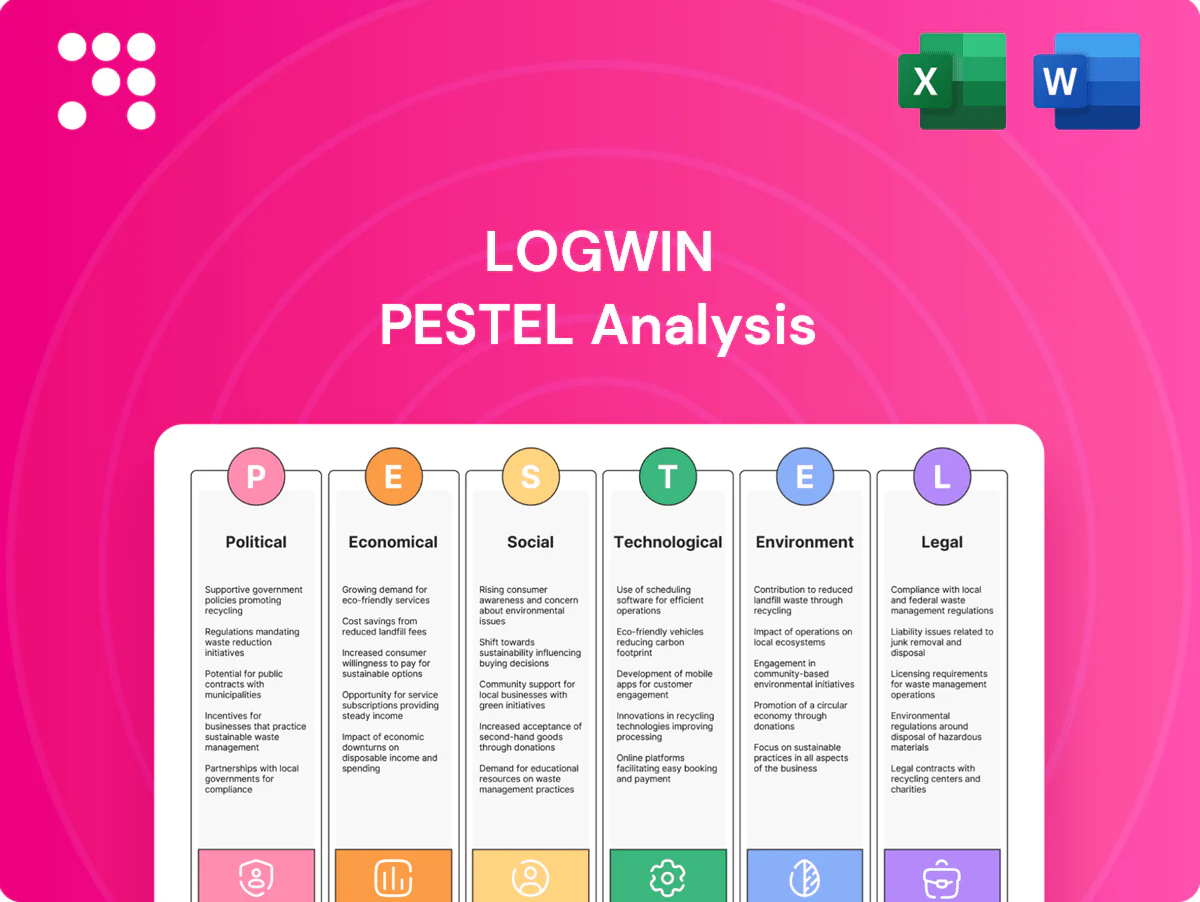
A concise, visually segmented PESTLE summary for Logwin that can be dropped into presentations, edited for region or business line, and easily shared across teams to streamline external risk discussions and strategic planning.
Economic factors

Global trade cycles
Air and sea freight volumes are highly procyclical with industrial output and retail demand; WTO reported merchandise trade volume growth of just 0.5% in 2023, compressing yields and utilization, while the Shanghai Containerized Freight Index fell roughly 70% from its 2021 peak to 2023. Upswings strain capacity and push spot rates higher. Logwin’s diversified industry mix smooths volatility. Contract structures should balance spot exposure with long-term commitments.
Fuel and energy costs
Bunker, jet and diesel prices—with Brent averaging about 86 USD/bbl in 2024 and H1 2025 trading around 80–90 USD/bbl—drive surcharges that can add roughly 10–30% to ocean landed cost and 20–40% to air freight rates. Volatility forces customers to replan budgets and alters route economics as short-term spikes make thin lanes unprofitable. Fuel hedging programs covering 20–60% of consumption and efficiency measures (slow steaming, fleet renewal) protect margins. Modal shifts to rail/shortsea and load‑factor optimization cut fuel exposure and variability.

Currency and interest rates
Multi-currency revenues and costs expose Logwin to FX translation and transaction risks; volatile EUR/USD and emerging market moves can swing reported margins. Rate hikes, with the ECB deposit rate at 4.00% in July 2024 and US policy rates near 5.25–5.50% in 2024, elevate working capital and fleet/warehouse financing costs. Natural hedging and FX derivatives can stabilize cash flows while dynamic pricing and pass-through clauses help preserve profitability.

Labor market tightness
Labor market tightness is squeezing Logwin as driver, warehouse and specialist shortages—Europe's truck driver deficit ~400,000 in 2024—push up wages and threaten service reliability; wage growth in logistics averaged near 6–7% in 2024. Training, retention programs and automation are reducing constraints, while nearshoring trends shift regional labor demand. Partnerships with staffing providers add operational flexibility.
- Driver shortage: ~400,000 (2024)
- Logistics wage growth: ~6–7% (2024)
- Mitigants: training, automation, staffing partners
Freight rate and capacity cycles
Supply-demand imbalances drive sharp swings in ocean and air rates (Drewry WCI swung from a 2021 peak ~10,300 USD/40ft to ~2,500 USD in 2024), and air cargo yields saw double-digit volatility into 2024. Logwin gross margin can move 200–400 basis points with contract mix and procurement timing. Securing carrier allocations remains a key differentiator; data-driven forecasting improves bid accuracy and space planning by ~10–20%.
- Spot rate volatility: Drewry WCI down to ~2,500 USD (2024)
- Margin swing: 200–400 bps by contract timing
- Carrier allocation: competitive edge for capacity
- Forecasting: +10–20% bid/space accuracy
Policy shifts (WTO +1.2% 2024) hit 80% seaborne flows
Merchandise trade growth slowed to 0.5% in 2023, compressing yields while Drewry WCI fell to ~2,500 USD/40ft in 2024; Logwin faces 200–400bps gross margin swing by contract mix. Brent averaged ~86 USD/bbl in 2024, raising fuel surcharges; ECB depo rate 4.00% (Jul 2024) and EUR/USD volatility elevate financing and FX risk. Europe truck driver gap ~400,000 (2024), wage inflation ~6–7%.
| Metric | 2023–2025 |
|---|---|
| Trade growth | 0.5% (2023) |
| Drewry WCI | ~2,500 USD/40ft (2024) |
| Brent | ~86 USD/bbl (2024) |
| ECB rate | 4.00% (Jul 2024) |
| Driver gap | ~400,000 (2024) |
Same Document Delivered
Logwin PESTLE Analysis
The Logwin PESTLE Analysis preview shown here is the exact, fully formatted document you’ll receive after purchase—professionally structured and ready to use. What you see is the final file with complete content, not a teaser or placeholder. After checkout you’ll be able to download this same document immediately and apply it to strategy, research, or presentation needs.

Product Information
Product Information
Shipping & Returns
Shipping & Returns
Description
Plan Smarter. Present Sharper. Compete Stronger.
Unlock how political shifts, economic cycles, and technological trends shape Logwin’s prospects with our concise PESTLE snapshot. This expert analysis highlights risks and growth levers for investors and strategists. Save time and make smarter decisions—buy the full PESTLE now for the complete, editable report.
Political factors
Trade policy volatility
Shifts in tariffs, customs procedures and trade agreements directly affect cross-border lead times and costs, with WTO projecting world merchandise trade volume growth at about 1.2% in 2024, increasing sensitivity to policy moves. Logwin must continuously adapt routings and pricing to stay competitive, diversify lanes and deepen customs-brokerage expertise to mitigate disruption, and pursue proactive lobbying via industry bodies to influence favorable logistics policies.
Geopolitical tensions and conflict
Geopolitical conflicts, piracy risks and port closures reroute air/sea freight, compressing capacity and raising spot rates; about 80% of global trade by volume is seaborne (UNCTAD 2024). Insurance premiums and security compliance costs have risen, increasing operating expenses for forwarders. Scenario planning and multi-origin sourcing help preserve service levels. Real-time risk monitoring is essential for supplier and lane diversification.
Government infrastructure investment
EU NextGenerationEU mobilises €806.9 billion for green and digital infrastructure, while the Global Infrastructure Hub estimated a $94 trillion need for 2016–2040, underscoring large public spending on ports, rail, airports and digitised customs that boosts throughput and reliability. Logwin can leverage upgraded corridors to offer faster, lower-emission services and capture trade via roughly 4,700 global free zones that enable value-added logistics. Strategic PPP engagement secures capacity and long-term concessions for scalable network access.
Sanctions and export controls
Expanding sanctions regimes—over 40 jurisdictions imposed Russia-related measures by 2024—complicate routing, documentation, and screening; mistakes can trigger fines, cargo seizures, and lasting reputational damage. Robust denied-party screening and tariff/classification capabilities are critical, and dedicated compliance operations can materially reduce cycle-time impacts.
- Routing risk: increased screening points
- Enforcement: fines and seizures
- Mitigation: denied-party screening, classification, dedicated compliance
Aviation and bilateral rights
Air cargo capacity for Logwin hinges on traffic rights and slot allocations under more than 3,000 bilateral/MASA frameworks; bellyhold continues to represent roughly 50% of global cargo lift, affecting rates and capacity availability. Policy shifts alter bellyhold supply and yields; strategic carrier alliances hedge access risk. Flexibility across freighter and passenger networks preserves service continuity.
- bilaterals: 3,000+
- bellyhold ≈50% of lift
- alliances hedge access
- freighter/passenger flexibility
Policy shifts (WTO +1.2% 2024) hit 80% seaborne flows
Tariff and trade-policy shifts (WTO trade vol +1.2% 2024) force routings, pricing and customs expertise. Geopolitical disruptions raise insurance/security costs; 80% of trade is seaborne (UNCTAD 2024). Sanctions (40+ jurisdictions) and 3,000+ bilaterals constrain routing and air access (bellyhold ~50%).
| Factor | Metric | Implication |
|---|---|---|
| Trade policy | WTO +1.2% (2024) | Price/routing risk |
| Maritime | 80% volume | Capacity exposure |
| Sanctions | 40+ | Compliance cost |
| Air rights | 3,000+ bilaterals; belly ~50% | Access risk |
What is included in the product
Detailed Word Document
Explores how macro-environmental factors affect Logwin across Political, Economic, Social, Technological, Environmental and Legal dimensions, with data-backed, region- and industry-specific insights and detailed sub-points. Designed for executives and investors, it offers forward-looking analysis to identify threats, opportunities and strategic responses.
Customizable Excel Spreadsheet
A concise, visually segmented PESTLE summary for Logwin that can be dropped into presentations, edited for region or business line, and easily shared across teams to streamline external risk discussions and strategic planning.
Economic factors
Global trade cycles
Air and sea freight volumes are highly procyclical with industrial output and retail demand; WTO reported merchandise trade volume growth of just 0.5% in 2023, compressing yields and utilization, while the Shanghai Containerized Freight Index fell roughly 70% from its 2021 peak to 2023. Upswings strain capacity and push spot rates higher. Logwin’s diversified industry mix smooths volatility. Contract structures should balance spot exposure with long-term commitments.
Fuel and energy costs
Bunker, jet and diesel prices—with Brent averaging about 86 USD/bbl in 2024 and H1 2025 trading around 80–90 USD/bbl—drive surcharges that can add roughly 10–30% to ocean landed cost and 20–40% to air freight rates. Volatility forces customers to replan budgets and alters route economics as short-term spikes make thin lanes unprofitable. Fuel hedging programs covering 20–60% of consumption and efficiency measures (slow steaming, fleet renewal) protect margins. Modal shifts to rail/shortsea and load‑factor optimization cut fuel exposure and variability.
Currency and interest rates
Multi-currency revenues and costs expose Logwin to FX translation and transaction risks; volatile EUR/USD and emerging market moves can swing reported margins. Rate hikes, with the ECB deposit rate at 4.00% in July 2024 and US policy rates near 5.25–5.50% in 2024, elevate working capital and fleet/warehouse financing costs. Natural hedging and FX derivatives can stabilize cash flows while dynamic pricing and pass-through clauses help preserve profitability.
Labor market tightness
Labor market tightness is squeezing Logwin as driver, warehouse and specialist shortages—Europe's truck driver deficit ~400,000 in 2024—push up wages and threaten service reliability; wage growth in logistics averaged near 6–7% in 2024. Training, retention programs and automation are reducing constraints, while nearshoring trends shift regional labor demand. Partnerships with staffing providers add operational flexibility.
- Driver shortage: ~400,000 (2024)
- Logistics wage growth: ~6–7% (2024)
- Mitigants: training, automation, staffing partners
Freight rate and capacity cycles
Supply-demand imbalances drive sharp swings in ocean and air rates (Drewry WCI swung from a 2021 peak ~10,300 USD/40ft to ~2,500 USD in 2024), and air cargo yields saw double-digit volatility into 2024. Logwin gross margin can move 200–400 basis points with contract mix and procurement timing. Securing carrier allocations remains a key differentiator; data-driven forecasting improves bid accuracy and space planning by ~10–20%.
- Spot rate volatility: Drewry WCI down to ~2,500 USD (2024)
- Margin swing: 200–400 bps by contract timing
- Carrier allocation: competitive edge for capacity
- Forecasting: +10–20% bid/space accuracy
Policy shifts (WTO +1.2% 2024) hit 80% seaborne flows
Merchandise trade growth slowed to 0.5% in 2023, compressing yields while Drewry WCI fell to ~2,500 USD/40ft in 2024; Logwin faces 200–400bps gross margin swing by contract mix. Brent averaged ~86 USD/bbl in 2024, raising fuel surcharges; ECB depo rate 4.00% (Jul 2024) and EUR/USD volatility elevate financing and FX risk. Europe truck driver gap ~400,000 (2024), wage inflation ~6–7%.
| Metric | 2023–2025 |
|---|---|
| Trade growth | 0.5% (2023) |
| Drewry WCI | ~2,500 USD/40ft (2024) |
| Brent | ~86 USD/bbl (2024) |
| ECB rate | 4.00% (Jul 2024) |
| Driver gap | ~400,000 (2024) |
Same Document Delivered
Logwin PESTLE Analysis
The Logwin PESTLE Analysis preview shown here is the exact, fully formatted document you’ll receive after purchase—professionally structured and ready to use. What you see is the final file with complete content, not a teaser or placeholder. After checkout you’ll be able to download this same document immediately and apply it to strategy, research, or presentation needs.