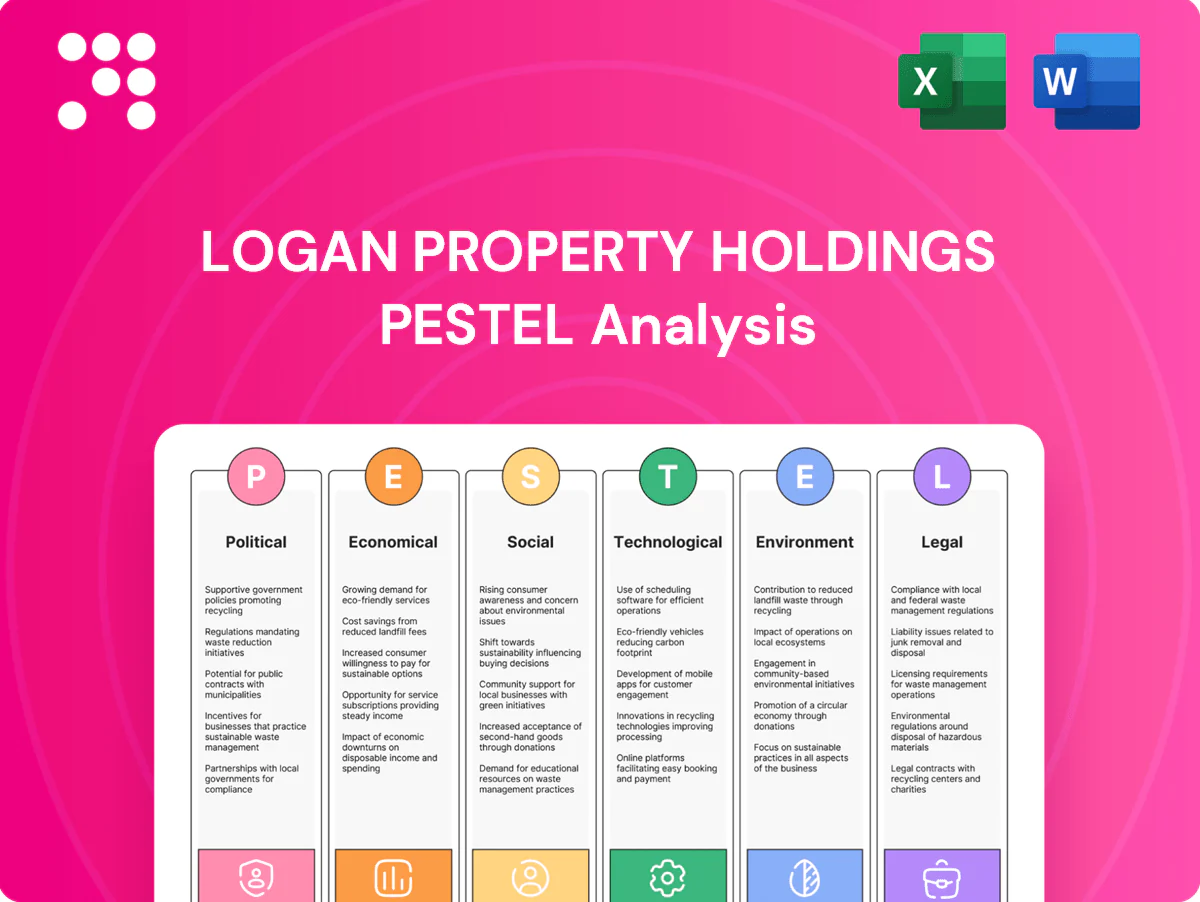
Logan Property Holdings PESTLE Analysis

Plan Smarter. Present Sharper. Compete Stronger.
Explore how political shifts, economic cycles, social trends, technological advances, legal changes, and environmental pressures are shaping Logan Property Holdings' prospects in our concise PESTLE snapshot. This briefing highlights key risks and opportunities to inform your strategy. Purchase the full PESTLE for a detailed, actionable roadmap you can download instantly.
Political factors

Central housing policy direction
China’s central housing policy, anchored by the long-standing principle that houses are for living not speculation, oscillates between tightening and easing, directly influencing developer liquidity and buyer sentiment. Shifts in mortgage terms, down-payment rules and purchase restrictions materially alter sales velocity, especially across the Greater Bay Area’s 11 cities. Logan must stay agile to these policy cycles and coordinate with local authorities to secure timely approvals and incentives.
Land supply and urban planning
Provincial and municipal governments control land auctions and zoning, with Greater Bay Area spanning 11 cities shaping supply dynamics and prioritizing affordable and improvement housing in core cities, which redirects Logan Property (HK: 3380) project pipelines. Access to prime plots hinges on strict regulatory compliance and local government relationships. Transit-oriented development policies in GBA cities can materially boost project values and sales velocity.

Local government finance pressures
Dependence on land-sale revenue leads cities to manage auction cadence and reserve prices, squeezing margins for Logan Property as municipalities prioritize fiscal returns. Fiscal stress has delayed infrastructure handovers and incentives in many jurisdictions, forcing developers to build contingencies for slower municipal payments. PPPs and urban renewal programs provide alternative funding channels and partnership opportunities to mitigate cash-flow timing risks.

Cross-border GBA integration
Policies promoting integration across Shenzhen, Hong Kong and Macau can boost residential demand in Logan projects by tapping the Greater Bay Area population of about 86 million and a 2023 GDP near US$2.0 trillion; streamlined residency and talent schemes expand the buyer pool while rail and links like the 55 km Hong Kong–Zhuhai–Macau Bridge raise site attractiveness. Cross-jurisdiction coordination, however, increases regulatory and compliance complexity for land, taxation and sales.
- GBA pop ~86m
- GBA GDP ~US$2.0T (2023)
- HK–Zhuhai–Macau Bridge 55 km
- Regulatory fragmentation risk
State influence and sector restructuring
China housing policy shifts reshape Greater Bay Area developer sales, financing, land access
China’s buy-not-speculate housing stance and 2024 tightening/relief cycles directly affect Logan Property (HK:3380) sales and financing; mortgage and down-payment shifts change demand across the 11-city Greater Bay Area. Local land-auction rules and SOE-favoring 2024 takeovers alter access to prime plots and competitive dynamics. GBA integration (pop ~86m; 2023 GDP ~US$2.0T) raises market scale but adds regulatory complexity.
| Metric | Value |
|---|---|
| GBA population | ~86m |
| GBA GDP (2023) | ~US$2.0T |
| HK–Zhuhai–Macau Bridge | 55 km |
| Logan ticker | HK:3380 |
What is included in the product
 Detailed Word Document
Explores how external macro-environmental factors uniquely affect Logan Property Holdings across Political, Economic, Social, Technological, Environmental and Legal dimensions, with data-driven sub-points and regional/regulatory specificity. Designed for executives and investors, it offers forward-looking insights and scenario-ready analysis to identify risks, opportunities, and strategic responses.

 Customizable Excel Spreadsheet
Provides a concise, visually segmented PESTLE summary of Logan Property Holdings for quick referencing in meetings or presentations, easily editable for local context and shareable across teams to streamline risk and market-positioning discussions.
Economic factors

Property market downcycle dynamics
Slower sales, price pressure and longer sell-through have tightened cash flow for Logan; in 2024 contracted sales slowed materially, pressuring short-term liquidity and working capital.
Buyer confidence now hinges on job security and delivery credibility—continuing mortgage stress and delayed completions amplify cancellation risk.
Logan must prioritize high-absorption GBA micromarkets where demand remains resilient and use flexible pricing with phased launches to preserve margins.
Credit conditions and deleveraging
Access to bank lending, onshore bond issuance and trust financing remain highly selective for Chinese developers; regulators favor funding for approved projects while scrutinizing developer balance sheets. Lower funding costs—benchmark lending rates fell after 2023 cuts—improve IRR on quality land acquisitions, and strong presales plus timely escrow-release (presales often cover >40% of project cashflow) are critical for Logan’s liquidity and credit access.

Macroeconomic growth and employment
China GDP expanded about 5.0% in 2024 while Guangdong provincial GDP rose roughly 5.5%, supporting household income in the Greater Bay Area and tech manufacturing demand. Robust employment in Shenzhen and Guangzhou, with surveyed urban unemployment near or below 3%, underpins upgrader demand for property. Sluggish export momentum in 2024 has softened wage growth and purchasing power. Logan’s diversified product mix helps mitigate cyclical exposure.

Housing affordability and price-to-income
High price-to-income ratios, often exceeding 15x in core districts in 2023–24, cap near-term price appreciation and steer demand to more affordable segments; Logan’s pivot to smaller units and pragmatic specifications targets first-time buyers priced out of core markets. Targeted local subsidies in 2024 have begun unlocking latent demand, while value engineering preserves margins and delivery quality.
- PTI: >15x in many core districts (2023–24)
- Product: smaller units for first-time buyers
- Policy: targeted subsidies improving affordability
- Strategy: value engineering to maintain quality
RMB, rates, and inflation
Monetary easing in 2024 lowered mortgage and developer borrowing costs after PBOC liquidity measures, supporting sales and project refinancing. Volatile input costs for steel, cement and labor compressed margins intermittently during 2024–H1 2025. RMB traded around 7.0–7.5 per USD in 2024–mid‑2025, affecting imported fixtures and FX debt service; hedging procurement timelines (typically 3–6 months) cuts exposure.
- Rates: lower LPR/borrowing costs
- Inputs: steel/cement/labor price swings
- FX: RMB 7.0–7.5/USD impacts imports/financing
- Mitigation: 3–6m hedged procurement
China housing policy shifts reshape Greater Bay Area developer sales, financing, land access
China GDP ~5.0% (2024), Guangdong ~5.5%; PTI >15x in core districts caps price upside. Presales often >40% of project cashflow; selective bank/bond funding raises liquidity risk despite 2024 monetary easing and LPR cuts. RMB ~7.0–7.5/USD; input volatility (steel, cement) compresses margins; Logan should focus GBA micromarkets, smaller units, phased pricing.
| Metric | 2024–mid‑2025 | Impact |
|---|---|---|
| GDP | China 5.0%, Guangdong 5.5% | Supports demand |
| PTI | >15x | Limits price growth |
| Presales | >40% cashflow | Key liquidity |
| FX | RMB 7.0–7.5/USD | Imported cost risk |
Full Version Awaits
Logan Property Holdings PESTLE Analysis
The preview shown here is the exact Logan Property Holdings PESTLE Analysis you’ll receive after purchase—fully formatted and ready to use. It covers Political, Economic, Social, Technological, Legal and Environmental factors with professional structure and no placeholders. After payment you’ll instantly download this same final file, ready for immediate application.

Original: $10.00
-65%$10.00
$3.50Product Information
Product Information
Shipping & Returns
Shipping & Returns
Description
Plan Smarter. Present Sharper. Compete Stronger.
Explore how political shifts, economic cycles, social trends, technological advances, legal changes, and environmental pressures are shaping Logan Property Holdings' prospects in our concise PESTLE snapshot. This briefing highlights key risks and opportunities to inform your strategy. Purchase the full PESTLE for a detailed, actionable roadmap you can download instantly.
Political factors
Central housing policy direction
China’s central housing policy, anchored by the long-standing principle that houses are for living not speculation, oscillates between tightening and easing, directly influencing developer liquidity and buyer sentiment. Shifts in mortgage terms, down-payment rules and purchase restrictions materially alter sales velocity, especially across the Greater Bay Area’s 11 cities. Logan must stay agile to these policy cycles and coordinate with local authorities to secure timely approvals and incentives.
Land supply and urban planning
Provincial and municipal governments control land auctions and zoning, with Greater Bay Area spanning 11 cities shaping supply dynamics and prioritizing affordable and improvement housing in core cities, which redirects Logan Property (HK: 3380) project pipelines. Access to prime plots hinges on strict regulatory compliance and local government relationships. Transit-oriented development policies in GBA cities can materially boost project values and sales velocity.
Local government finance pressures
Dependence on land-sale revenue leads cities to manage auction cadence and reserve prices, squeezing margins for Logan Property as municipalities prioritize fiscal returns. Fiscal stress has delayed infrastructure handovers and incentives in many jurisdictions, forcing developers to build contingencies for slower municipal payments. PPPs and urban renewal programs provide alternative funding channels and partnership opportunities to mitigate cash-flow timing risks.
Cross-border GBA integration
Policies promoting integration across Shenzhen, Hong Kong and Macau can boost residential demand in Logan projects by tapping the Greater Bay Area population of about 86 million and a 2023 GDP near US$2.0 trillion; streamlined residency and talent schemes expand the buyer pool while rail and links like the 55 km Hong Kong–Zhuhai–Macau Bridge raise site attractiveness. Cross-jurisdiction coordination, however, increases regulatory and compliance complexity for land, taxation and sales.
- GBA pop ~86m
- GBA GDP ~US$2.0T (2023)
- HK–Zhuhai–Macau Bridge 55 km
- Regulatory fragmentation risk
State influence and sector restructuring
China housing policy shifts reshape Greater Bay Area developer sales, financing, land access
China’s buy-not-speculate housing stance and 2024 tightening/relief cycles directly affect Logan Property (HK:3380) sales and financing; mortgage and down-payment shifts change demand across the 11-city Greater Bay Area. Local land-auction rules and SOE-favoring 2024 takeovers alter access to prime plots and competitive dynamics. GBA integration (pop ~86m; 2023 GDP ~US$2.0T) raises market scale but adds regulatory complexity.
| Metric | Value |
|---|---|
| GBA population | ~86m |
| GBA GDP (2023) | ~US$2.0T |
| HK–Zhuhai–Macau Bridge | 55 km |
| Logan ticker | HK:3380 |
What is included in the product
Detailed Word Document
Explores how external macro-environmental factors uniquely affect Logan Property Holdings across Political, Economic, Social, Technological, Environmental and Legal dimensions, with data-driven sub-points and regional/regulatory specificity. Designed for executives and investors, it offers forward-looking insights and scenario-ready analysis to identify risks, opportunities, and strategic responses.
Customizable Excel Spreadsheet
Provides a concise, visually segmented PESTLE summary of Logan Property Holdings for quick referencing in meetings or presentations, easily editable for local context and shareable across teams to streamline risk and market-positioning discussions.
Economic factors
Property market downcycle dynamics
Slower sales, price pressure and longer sell-through have tightened cash flow for Logan; in 2024 contracted sales slowed materially, pressuring short-term liquidity and working capital.
Buyer confidence now hinges on job security and delivery credibility—continuing mortgage stress and delayed completions amplify cancellation risk.
Logan must prioritize high-absorption GBA micromarkets where demand remains resilient and use flexible pricing with phased launches to preserve margins.
Credit conditions and deleveraging
Access to bank lending, onshore bond issuance and trust financing remain highly selective for Chinese developers; regulators favor funding for approved projects while scrutinizing developer balance sheets. Lower funding costs—benchmark lending rates fell after 2023 cuts—improve IRR on quality land acquisitions, and strong presales plus timely escrow-release (presales often cover >40% of project cashflow) are critical for Logan’s liquidity and credit access.
Macroeconomic growth and employment
China GDP expanded about 5.0% in 2024 while Guangdong provincial GDP rose roughly 5.5%, supporting household income in the Greater Bay Area and tech manufacturing demand. Robust employment in Shenzhen and Guangzhou, with surveyed urban unemployment near or below 3%, underpins upgrader demand for property. Sluggish export momentum in 2024 has softened wage growth and purchasing power. Logan’s diversified product mix helps mitigate cyclical exposure.
Housing affordability and price-to-income
High price-to-income ratios, often exceeding 15x in core districts in 2023–24, cap near-term price appreciation and steer demand to more affordable segments; Logan’s pivot to smaller units and pragmatic specifications targets first-time buyers priced out of core markets. Targeted local subsidies in 2024 have begun unlocking latent demand, while value engineering preserves margins and delivery quality.
- PTI: >15x in many core districts (2023–24)
- Product: smaller units for first-time buyers
- Policy: targeted subsidies improving affordability
- Strategy: value engineering to maintain quality
RMB, rates, and inflation
Monetary easing in 2024 lowered mortgage and developer borrowing costs after PBOC liquidity measures, supporting sales and project refinancing. Volatile input costs for steel, cement and labor compressed margins intermittently during 2024–H1 2025. RMB traded around 7.0–7.5 per USD in 2024–mid‑2025, affecting imported fixtures and FX debt service; hedging procurement timelines (typically 3–6 months) cuts exposure.
- Rates: lower LPR/borrowing costs
- Inputs: steel/cement/labor price swings
- FX: RMB 7.0–7.5/USD impacts imports/financing
- Mitigation: 3–6m hedged procurement
China housing policy shifts reshape Greater Bay Area developer sales, financing, land access
China GDP ~5.0% (2024), Guangdong ~5.5%; PTI >15x in core districts caps price upside. Presales often >40% of project cashflow; selective bank/bond funding raises liquidity risk despite 2024 monetary easing and LPR cuts. RMB ~7.0–7.5/USD; input volatility (steel, cement) compresses margins; Logan should focus GBA micromarkets, smaller units, phased pricing.
| Metric | 2024–mid‑2025 | Impact |
|---|---|---|
| GDP | China 5.0%, Guangdong 5.5% | Supports demand |
| PTI | >15x | Limits price growth |
| Presales | >40% cashflow | Key liquidity |
| FX | RMB 7.0–7.5/USD | Imported cost risk |
Full Version Awaits
Logan Property Holdings PESTLE Analysis
The preview shown here is the exact Logan Property Holdings PESTLE Analysis you’ll receive after purchase—fully formatted and ready to use. It covers Political, Economic, Social, Technological, Legal and Environmental factors with professional structure and no placeholders. After payment you’ll instantly download this same final file, ready for immediate application.