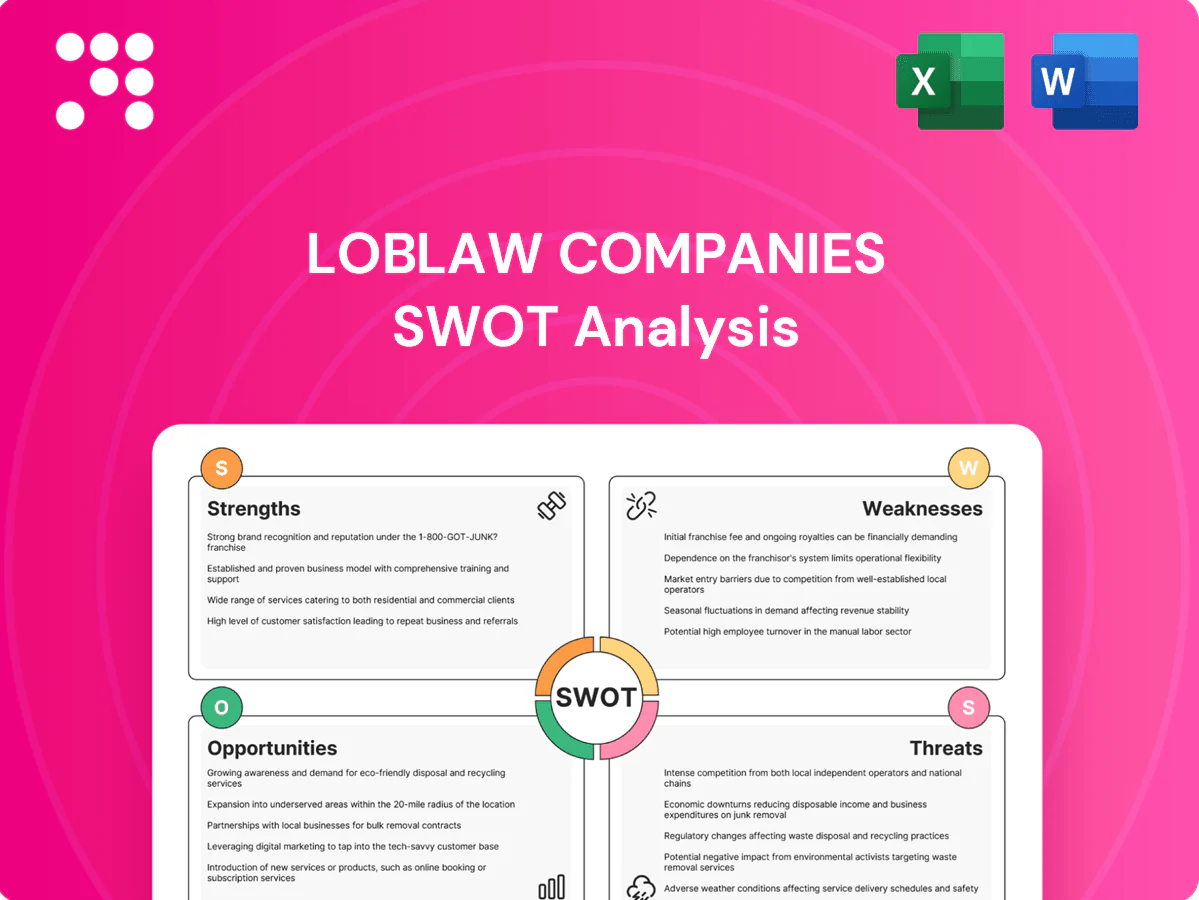
Loblaw Companies SWOT Analysis

Elevate Your Analysis with the Complete SWOT Report
Loblaw Companies sits at the nexus of grocery scale and healthcare expansion, but faces margin pressure and competitive disruption in private label and e-commerce. Our concise preview flags key strengths, weaknesses, opportunities and threats you need to consider. Purchase the full SWOT analysis for a research-backed, editable Word and Excel package to plan, pitch, or invest with confidence.
Strengths

Market-leading scale
As Canada’s largest food and pharmacy retailer, Loblaw leverages annual sales exceeding CAD 50 billion and a network of over 2,400 stores to secure significant purchasing power and supply‑chain efficiencies. Scale delivers better vendor terms, broader assortments and more resilient inventory, supporting roughly 28% share of the Canadian grocery market. It also strengthens bargaining leverage in real estate and retail media, a structural edge smaller rivals struggle to match.
Diverse multi-banner portfolio
Loblaw spans premium to discount grocery, pharmacy and general merchandise through banners like Loblaws, No Frills, Real Canadian Superstore and Shoppers Drug Mart, operating over 2,400 stores and 1,300+ pharmacies; this breadth helped deliver CAD 54.1 billion in revenue in fiscal 2024. The multi-banner mix captures varied demographics and price points, stabilizing traffic and enabling swift shifts in assortment and pricing as preferences change, reducing reliance on any single format.

Private labels and loyalty
President’s Choice and No Name deliver clear differentiation and value perception, with private labels contributing a meaningful share of Loblaw’s food sales and supporting higher margin mix. The PC Optimum program, with over 18 million members as of 2024, deepens engagement and data insights, boosting basket size and visit frequency. Loyalty currency links grocery, pharmacy and financial services to drive cross-sell. These assets increase customer stickiness and price/value credibility.

Pharmacy and health ecosystem
Shoppers Drug Mart provides national pharmacy coverage and front-store retail, operating over 1,300 stores across Canada; its pharmacy and health ecosystem drives higher-frequency trips and resilient demand. Pharmacy and wellness services strengthen customer lifetime value through clinics and prescription services, helping buffer grocery cyclicality and support Loblaw’s FY2024 revenue of CAD 63.3 billion.
- Over 1,300 Shoppers Drug Mart locations nationwide
- Pharmacy/health increases visit frequency and revenue resilience
- Clinic and prescription integration boosts lifetime value
- Health positioning mitigates grocery cyclicality
Adjacencies: financial and mobile
PC Financial and mobile offerings extend Loblaw touchpoints and data, with PC Optimum serving over 10 million members and mobile engagement driving higher visit frequency. Financial services diversify revenue via credit, payments and insurance partnerships, creating fee and interchange income streams. Bundling with loyalty boosts activation and retention and enables cross-category monetization through targeted offers.
- membership: >10 million
- revenue streams: credit, payments, insurance
- benefit: higher activation & retention
Dominant Canadian grocer posts CAD 63.3 billion revenue, ~28% market share
As Canada’s largest food and pharmacy retailer, Loblaw reported CAD 63.3 billion revenue in FY2024, operates 2,400+ stores and 1,300+ Shoppers Drug Mart pharmacies, and holds ~28% grocery market share, delivering scale advantages. Its multi‑banner strategy and private labels (President’s Choice, No Name) improve margins and resilience. PC Optimum exceeds 18 million members and PC Financial adds fee/interchange income, raising lifetime value.
| Metric | Value |
|---|---|
| FY2024 revenue | CAD 63.3 billion |
| Stores | 2,400+ |
| Pharmacies (Shoppers) | 1,300+ |
| Canadian grocery share | ~28% |
| PC Optimum members | 18+ million |
What is included in the product
 Detailed Word Document
Provides a concise SWOT analysis of Loblaw Companies, highlighting its strong market leadership, diversified retail and pharmacy portfolio, and loyalty programs, alongside operational and regulatory weaknesses, growth opportunities in e‑commerce and healthcare, and threats from competition, supply-chain pressures, and changing consumer trends.

 Customizable Excel Spreadsheet
Provides a concise SWOT matrix tailored to Loblaw Companies for fast strategic alignment across retail, pharmacy, and supply chain, ideal for executives needing a clear snapshot of competitive positioning, cost pressures, and growth opportunities.
Weaknesses

Canada-centric concentration
Loblaw's revenue is heavily concentrated in Canada, with over 90% of sales generated from Canadian operations, exposing the company to domestic economic cycles, provincial regulation and intense national competition. This concentration reduces shock absorption from currency or regional demand shocks and limits resilience to Canadian inflation or policy shifts. Geographic concentration also caps long-term growth optionality compared with more diversified peers.
Thin grocery margins
Grocery is structurally low-margin and fiercely price-competitive, with Canadian grocery operating margins typically under 3%, leaving little buffer. Cost inflation and frequent promotional activity can compress profitability despite Loblaw’s scale and buying power. Pharmacy and private-label mix lift average ticket and gross margin but do not eliminate short-term volatility. Achieving sustained margin expansion in grocery remains difficult.

Operational complexity
Multiple formats and banners across 2,400+ stores (≈200,000 employees) raise execution risk for Loblaw, whose scale—≈CAD 56bn revenue in FY2024—magnifies complex supply chains, fresh logistics and in‑store labor variability, increasing cost and service swings; integrating legacy systems and data across divisions is nontrivial, slowing change and lifting overhead.

Public scrutiny on pricing
Perceived greedflation and price-transparency debates have eroded trust in Loblaw, particularly after the 2022 Canada inflation peak near 6.8% and lingering consumer sensitivity as inflation eased toward roughly 3% by 2024. Media, political and watchdog scrutiny raises reputational risk and can limit Loblaw’s ability to pass through cost increases, squeezing margins and loyalty during sensitive periods.
- Reputational risk: high media and watchdog attention
- Pricing constraint: limits pass-through of cost inflation
- Margin pressure: vulnerability during cost spikes
- Customer loyalty: sensitivity after 2022 inflation surge
E-commerce profitability
Online grocery has materially higher fulfillment and last-mile costs, squeezing margins for Loblaw; Canadian online grocery penetration was about 5–6% in 2023–24 (Statista), so scale is still limited. Achieving profitable scale requires dense order volumes, smart slotting and automation investments, while substitution accuracy and service levels add operational complexity. Profitability tends to lag in lower-density markets or during demand swings.
- Higher fulfillment & last-mile costs
- Requires dense orders, slotting, automation
- Substitution/service complexity
- Lagging margins in low-density or volatile demand
Canada-dependent grocer: over 90% sales, ≈CAD 56bn, under 3% margins, 5–6% online
Loblaw is >90% Canada-dependent (≈CAD 56bn revenue FY2024), limiting geographic diversification and growth optionality. Grocery margins are thin (Canadian grocery operating margins <3%), making profits vulnerable to inflation and promotions. Large scale (≈2,400 stores, ≈200,000 employees) raises execution and systems-integration risk. Online penetration ~5–6% (2023–24) keeps last-mile costs high.
| Metric | Value |
|---|---|
| FY2024 revenue | ≈CAD 56bn |
| Canada sales | >90% |
| Grocery margin | <3% |
| Stores / employees | ≈2,400 / ≈200,000 |
| Online penetration | 5–6% (2023–24) |
Full Version Awaits
Loblaw Companies SWOT Analysis
This is the actual SWOT analysis of Loblaw Companies you’ll receive upon purchase—no surprises, just professional quality. The preview below is taken directly from the full report; buy to unlock the complete, editable document. The file shown is the real analysis you'll download after checkout.

Original: $10.00
-65%$10.00
$3.50Product Information
Product Information
Shipping & Returns
Shipping & Returns
Description
Elevate Your Analysis with the Complete SWOT Report
Loblaw Companies sits at the nexus of grocery scale and healthcare expansion, but faces margin pressure and competitive disruption in private label and e-commerce. Our concise preview flags key strengths, weaknesses, opportunities and threats you need to consider. Purchase the full SWOT analysis for a research-backed, editable Word and Excel package to plan, pitch, or invest with confidence.
Strengths
Market-leading scale
As Canada’s largest food and pharmacy retailer, Loblaw leverages annual sales exceeding CAD 50 billion and a network of over 2,400 stores to secure significant purchasing power and supply‑chain efficiencies. Scale delivers better vendor terms, broader assortments and more resilient inventory, supporting roughly 28% share of the Canadian grocery market. It also strengthens bargaining leverage in real estate and retail media, a structural edge smaller rivals struggle to match.
Diverse multi-banner portfolio
Loblaw spans premium to discount grocery, pharmacy and general merchandise through banners like Loblaws, No Frills, Real Canadian Superstore and Shoppers Drug Mart, operating over 2,400 stores and 1,300+ pharmacies; this breadth helped deliver CAD 54.1 billion in revenue in fiscal 2024. The multi-banner mix captures varied demographics and price points, stabilizing traffic and enabling swift shifts in assortment and pricing as preferences change, reducing reliance on any single format.
Private labels and loyalty
President’s Choice and No Name deliver clear differentiation and value perception, with private labels contributing a meaningful share of Loblaw’s food sales and supporting higher margin mix. The PC Optimum program, with over 18 million members as of 2024, deepens engagement and data insights, boosting basket size and visit frequency. Loyalty currency links grocery, pharmacy and financial services to drive cross-sell. These assets increase customer stickiness and price/value credibility.
Pharmacy and health ecosystem
Shoppers Drug Mart provides national pharmacy coverage and front-store retail, operating over 1,300 stores across Canada; its pharmacy and health ecosystem drives higher-frequency trips and resilient demand. Pharmacy and wellness services strengthen customer lifetime value through clinics and prescription services, helping buffer grocery cyclicality and support Loblaw’s FY2024 revenue of CAD 63.3 billion.
- Over 1,300 Shoppers Drug Mart locations nationwide
- Pharmacy/health increases visit frequency and revenue resilience
- Clinic and prescription integration boosts lifetime value
- Health positioning mitigates grocery cyclicality
Adjacencies: financial and mobile
PC Financial and mobile offerings extend Loblaw touchpoints and data, with PC Optimum serving over 10 million members and mobile engagement driving higher visit frequency. Financial services diversify revenue via credit, payments and insurance partnerships, creating fee and interchange income streams. Bundling with loyalty boosts activation and retention and enables cross-category monetization through targeted offers.
- membership: >10 million
- revenue streams: credit, payments, insurance
- benefit: higher activation & retention
Dominant Canadian grocer posts CAD 63.3 billion revenue, ~28% market share
As Canada’s largest food and pharmacy retailer, Loblaw reported CAD 63.3 billion revenue in FY2024, operates 2,400+ stores and 1,300+ Shoppers Drug Mart pharmacies, and holds ~28% grocery market share, delivering scale advantages. Its multi‑banner strategy and private labels (President’s Choice, No Name) improve margins and resilience. PC Optimum exceeds 18 million members and PC Financial adds fee/interchange income, raising lifetime value.
| Metric | Value |
|---|---|
| FY2024 revenue | CAD 63.3 billion |
| Stores | 2,400+ |
| Pharmacies (Shoppers) | 1,300+ |
| Canadian grocery share | ~28% |
| PC Optimum members | 18+ million |
What is included in the product
Detailed Word Document
Provides a concise SWOT analysis of Loblaw Companies, highlighting its strong market leadership, diversified retail and pharmacy portfolio, and loyalty programs, alongside operational and regulatory weaknesses, growth opportunities in e‑commerce and healthcare, and threats from competition, supply-chain pressures, and changing consumer trends.
Customizable Excel Spreadsheet
Provides a concise SWOT matrix tailored to Loblaw Companies for fast strategic alignment across retail, pharmacy, and supply chain, ideal for executives needing a clear snapshot of competitive positioning, cost pressures, and growth opportunities.
Weaknesses
Canada-centric concentration
Loblaw's revenue is heavily concentrated in Canada, with over 90% of sales generated from Canadian operations, exposing the company to domestic economic cycles, provincial regulation and intense national competition. This concentration reduces shock absorption from currency or regional demand shocks and limits resilience to Canadian inflation or policy shifts. Geographic concentration also caps long-term growth optionality compared with more diversified peers.
Thin grocery margins
Grocery is structurally low-margin and fiercely price-competitive, with Canadian grocery operating margins typically under 3%, leaving little buffer. Cost inflation and frequent promotional activity can compress profitability despite Loblaw’s scale and buying power. Pharmacy and private-label mix lift average ticket and gross margin but do not eliminate short-term volatility. Achieving sustained margin expansion in grocery remains difficult.
Operational complexity
Multiple formats and banners across 2,400+ stores (≈200,000 employees) raise execution risk for Loblaw, whose scale—≈CAD 56bn revenue in FY2024—magnifies complex supply chains, fresh logistics and in‑store labor variability, increasing cost and service swings; integrating legacy systems and data across divisions is nontrivial, slowing change and lifting overhead.
Public scrutiny on pricing
Perceived greedflation and price-transparency debates have eroded trust in Loblaw, particularly after the 2022 Canada inflation peak near 6.8% and lingering consumer sensitivity as inflation eased toward roughly 3% by 2024. Media, political and watchdog scrutiny raises reputational risk and can limit Loblaw’s ability to pass through cost increases, squeezing margins and loyalty during sensitive periods.
- Reputational risk: high media and watchdog attention
- Pricing constraint: limits pass-through of cost inflation
- Margin pressure: vulnerability during cost spikes
- Customer loyalty: sensitivity after 2022 inflation surge
E-commerce profitability
Online grocery has materially higher fulfillment and last-mile costs, squeezing margins for Loblaw; Canadian online grocery penetration was about 5–6% in 2023–24 (Statista), so scale is still limited. Achieving profitable scale requires dense order volumes, smart slotting and automation investments, while substitution accuracy and service levels add operational complexity. Profitability tends to lag in lower-density markets or during demand swings.
- Higher fulfillment & last-mile costs
- Requires dense orders, slotting, automation
- Substitution/service complexity
- Lagging margins in low-density or volatile demand
Canada-dependent grocer: over 90% sales, ≈CAD 56bn, under 3% margins, 5–6% online
Loblaw is >90% Canada-dependent (≈CAD 56bn revenue FY2024), limiting geographic diversification and growth optionality. Grocery margins are thin (Canadian grocery operating margins <3%), making profits vulnerable to inflation and promotions. Large scale (≈2,400 stores, ≈200,000 employees) raises execution and systems-integration risk. Online penetration ~5–6% (2023–24) keeps last-mile costs high.
| Metric | Value |
|---|---|
| FY2024 revenue | ≈CAD 56bn |
| Canada sales | >90% |
| Grocery margin | <3% |
| Stores / employees | ≈2,400 / ≈200,000 |
| Online penetration | 5–6% (2023–24) |
Full Version Awaits
Loblaw Companies SWOT Analysis
This is the actual SWOT analysis of Loblaw Companies you’ll receive upon purchase—no surprises, just professional quality. The preview below is taken directly from the full report; buy to unlock the complete, editable document. The file shown is the real analysis you'll download after checkout.