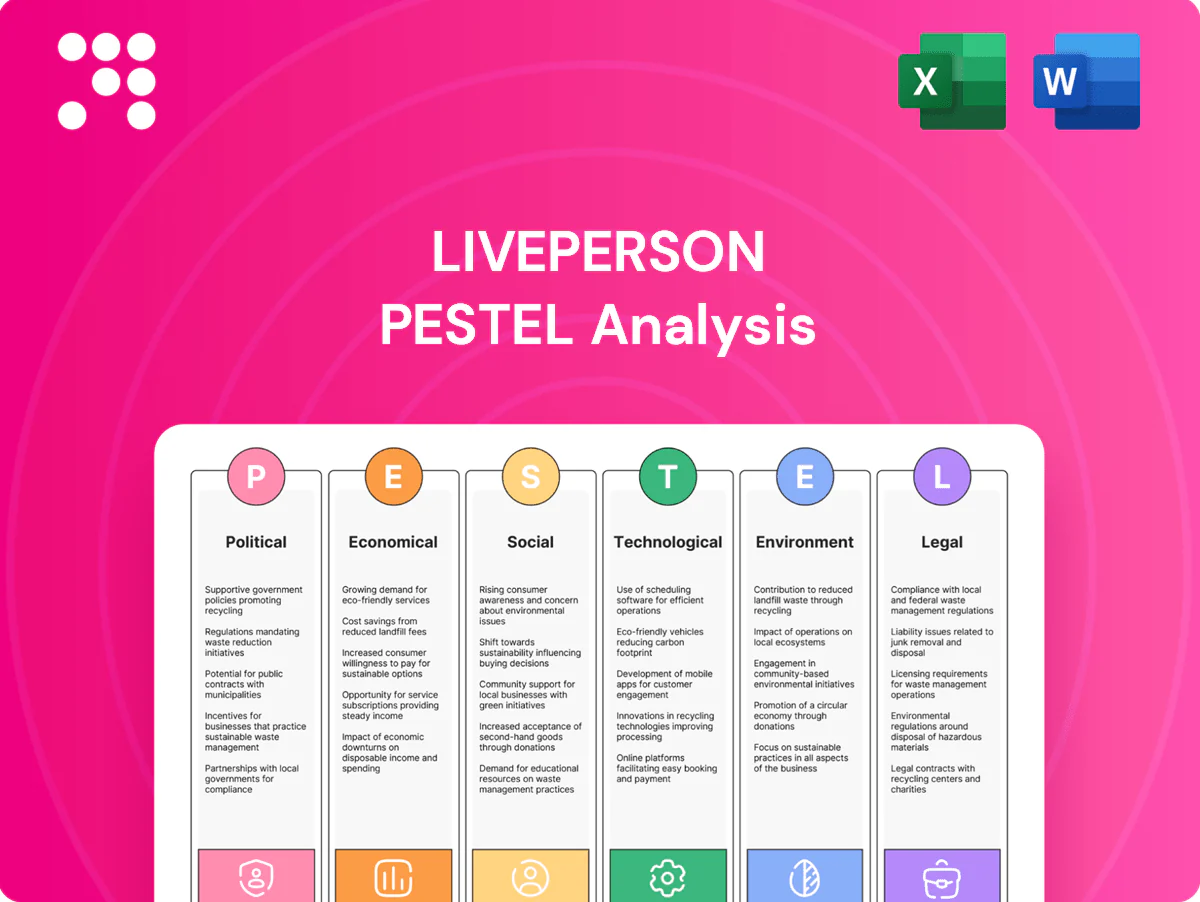
LivePerson PESTLE Analysis

Plan Smarter. Present Sharper. Compete Stronger.
Gain a strategic advantage with our PESTLE analysis of LivePerson—three concise sections reveal how political, economic, social, technological, legal, and environmental forces shape its outlook. Use these insights to anticipate risks, pinpoint growth opportunities, and refine your investment or competitive strategy. Purchase the full report for the complete, ready-to-use intelligence.
Political factors

AI governance and national policies
Governments worldwide are publishing AI strategies—the EU AI Act was finalized in 2024 and over 70 countries had national AI plans by 2024—shaping safety, transparency and accountability standards; LivePerson, which serves roughly 18,000 customers, must align product roadmaps with evolving frameworks as divergent US, EU, UK and APAC policies can fragment features and timelines, so proactive engagement and compliance-by-design mitigate disruption.
Data sovereignty and localization
Countries increasingly mandate local data storage and processing; over 60 countries now have data residency or localization requirements, forcing LivePerson to reconsider hosting regions. This drives adoption of regional cloud instances, edge processing and modular deployments to reduce conversational-data latency and meet sovereignty rules. Infrastructure and operational costs rise, but compliance opens public-sector and regulated-market procurement and contracting opportunities.

Geopolitical tensions and supply chain
Cross-border restrictions on advanced chips and AI exports since 2023 threaten LivePerson’s training and inference capacity, while cloud providers (Microsoft Azure had 60+ regions by 2024) may face regional vendor limits; sanctions and export controls can constrain model sourcing and partnerships. LivePerson should diversify infrastructure and model providers and use scenario planning to maintain service continuity and limit revenue disruption.

Public-sector digital transformation
Public-sector digital transformation, backed by EU NextGenerationEU recovery funds of about €806.9bn and the Digital Decade target of 80% citizen e‑government use by 2030, expands the addressable market for LivePerson's conversational AI; procurement rules, security certifications and accessibility standards raise entry hurdles, while framework agreements can secure multi-year revenue, making clear cost‑to‑serve and satisfaction value cases essential.
- Market expansion: EU €806.9bn fund, 80% e‑gov target
- Barriers: procurement, security, accessibility
- Revenue: framework agreements = long-term contracts
- Sales focus: cost-to-serve reduction + satisfaction metrics
Tax and incentives for AI R&D
R&D tax credits and innovation grants can materially subsidize LivePerson’s AI model development and tooling, while 2024 jurisdictional shifts in incentive regimes change net returns on research spend. LivePerson can optimize its legal and operational footprint to capture credits and grants. Transparent reporting of eligible R&D strengthens grant eligibility and investor trust.
- Leverage credits/grants
- Optimize jurisdictional footprint
- Enhance R&D reporting
EU AI Act, data-residency rules and chip export controls reshape enterprise and public AI demand
EU AI Act finalized 2024 and 70+ national AI plans (2024) force LivePerson (≈18,000 customers) to align features; 60+ countries now have data residency rules raising infrastructure costs; export controls on AI chips since 2023 risk model sourcing; EU NextGenerationEU €806.9bn and 80% e‑gov by 2030 expand public-sector demand.
| Factor | 2024/25 data | Impact |
|---|---|---|
| Regulation | EU AI Act (2024) | Compliance cost |
| Data residency | 60+ countries | Regional infra |
| Market | €806.9bn fund | Public sales |
What is included in the product
 Detailed Word Document
Explores how macro-environmental factors uniquely affect LivePerson across Political, Economic, Social, Technological, Environmental, and Legal dimensions, with data-driven trends and forward-looking insights to inform executives, investors, and strategists; ready for business plans, decks, and scenario planning.

 Customizable Excel Spreadsheet
A concise, visually segmented LivePerson PESTLE that condenses external risks and opportunities for quick meeting reference, easily editable for region- or product-specific notes and drop-in ready for presentations to align teams fast.
Economic factors

IT spending cycles and budgets
Macro conditions drive enterprise CX and automation budgets: Gartner estimated global IT spending at about $5.1 trillion in 2024, and demand for cost-saving automation often rises in slowdowns while discretionary projects stall. LivePerson benefits from clear ROI and rapid payback, with customers reporting months-to-payback for conversational AI deployments. Flexible pricing and modular adoption reduce sales friction and support incremental expansion.
Labor cost arbitrage via automation
Rising contact-center wages have made AI deflection and agent-assist materially more attractive, with industry studies citing per-interaction savings of roughly $4–12 when chats are deflected or automated. LivePerson can package automation with measurable quality gains and reported CSAT uplifts typically in the 3–8 percentage-point range. Outcome-based pricing—tying fees to deflection rates or CSAT—aligns incentives and accelerates adoption among cost-sensitive clients.

Cloud infrastructure and compute costs
GPU/CPU pricing and cloud egress rates (e.g., AWS data transfer out ~$0.09 per GB) materially squeeze gross margins for AI workloads. Efficient model selection and inference optimization raise utilization and lower per-inference costs. Multi-cloud strategies and reserved capacity/Savings Plans (up to ~72% claimed discounts) stabilize spend. Passing realized savings to clients strengthens LivePerson’s competitiveness.

Customer concentration and churn
Enterprise SaaS like LivePerson faces customer concentration risk where a small set of large accounts can drive a significant share of ARR; economic stress heightens churn and downsell pressure, making renewals vulnerable. Broadening industry verticals and selling higher-value automation and AI services can raise ARPU and reduce client-level risk. Proactive customer success and adoption metrics materially defend renewal rates.
- concentration: reduce top-account share
- churn: mitigate via value expansion
- ARPU: move up the value chain
- retention: invest in success teams
Currency and international expansion
Multi-currency contracts expose LivePerson revenue to FX swings, which can move reported top-line by several percentage points; local pricing and billing reduce customer friction but add invoicing and compliance complexity. Hedging programs using forwards and options can stabilize cash flows; prioritizing high-growth regions such as APAC and LATAM balances FX risk and revenue opportunity—IDC projects digital CX spend CAGR ~13–15% to 2025.
- FX exposure: revenue sensitivity
- Local billing: reduces churn, adds complexity
- Hedging: stabilizes cash flow
- Focus: APAC/LATAM growth
EU AI Act, data-residency rules and chip export controls reshape enterprise and public AI demand
Macro IT spend ~$5.1T (2024) supports CX automation; customers report months-to-payback. Agent wage pressure makes AI deflection worth ~$4–12 per interaction; CSAT +3–8 pts. Cloud egress ~$0.09/GB and model costs squeeze margins; Savings Plans up to ~72% help. FX can move revenue by several percentage points; IDC CX spend CAGR ~13–15% to 2025.
| Metric | Value |
|---|---|
| Global IT spend (2024) | $5.1T |
| Per-interaction saving | $4–12 |
| AWS egress | $0.09/GB |
| IDC CX CAGR | 13–15% to 2025 |
Preview the Actual Deliverable
LivePerson PESTLE Analysis
The LivePerson PESTLE Analysis preview shown here is the exact document you’ll receive after purchase—fully formatted and ready to use. This is the real file, with complete content and professional structure, not a placeholder or teaser. Everything displayed is the final version you’ll be able to download immediately after checkout.

Original: $10.00
-65%$10.00
$3.50Product Information
Product Information
Shipping & Returns
Shipping & Returns
Description
Plan Smarter. Present Sharper. Compete Stronger.
Gain a strategic advantage with our PESTLE analysis of LivePerson—three concise sections reveal how political, economic, social, technological, legal, and environmental forces shape its outlook. Use these insights to anticipate risks, pinpoint growth opportunities, and refine your investment or competitive strategy. Purchase the full report for the complete, ready-to-use intelligence.
Political factors
AI governance and national policies
Governments worldwide are publishing AI strategies—the EU AI Act was finalized in 2024 and over 70 countries had national AI plans by 2024—shaping safety, transparency and accountability standards; LivePerson, which serves roughly 18,000 customers, must align product roadmaps with evolving frameworks as divergent US, EU, UK and APAC policies can fragment features and timelines, so proactive engagement and compliance-by-design mitigate disruption.
Data sovereignty and localization
Countries increasingly mandate local data storage and processing; over 60 countries now have data residency or localization requirements, forcing LivePerson to reconsider hosting regions. This drives adoption of regional cloud instances, edge processing and modular deployments to reduce conversational-data latency and meet sovereignty rules. Infrastructure and operational costs rise, but compliance opens public-sector and regulated-market procurement and contracting opportunities.
Geopolitical tensions and supply chain
Cross-border restrictions on advanced chips and AI exports since 2023 threaten LivePerson’s training and inference capacity, while cloud providers (Microsoft Azure had 60+ regions by 2024) may face regional vendor limits; sanctions and export controls can constrain model sourcing and partnerships. LivePerson should diversify infrastructure and model providers and use scenario planning to maintain service continuity and limit revenue disruption.
Public-sector digital transformation
Public-sector digital transformation, backed by EU NextGenerationEU recovery funds of about €806.9bn and the Digital Decade target of 80% citizen e‑government use by 2030, expands the addressable market for LivePerson's conversational AI; procurement rules, security certifications and accessibility standards raise entry hurdles, while framework agreements can secure multi-year revenue, making clear cost‑to‑serve and satisfaction value cases essential.
- Market expansion: EU €806.9bn fund, 80% e‑gov target
- Barriers: procurement, security, accessibility
- Revenue: framework agreements = long-term contracts
- Sales focus: cost-to-serve reduction + satisfaction metrics
Tax and incentives for AI R&D
R&D tax credits and innovation grants can materially subsidize LivePerson’s AI model development and tooling, while 2024 jurisdictional shifts in incentive regimes change net returns on research spend. LivePerson can optimize its legal and operational footprint to capture credits and grants. Transparent reporting of eligible R&D strengthens grant eligibility and investor trust.
- Leverage credits/grants
- Optimize jurisdictional footprint
- Enhance R&D reporting
EU AI Act, data-residency rules and chip export controls reshape enterprise and public AI demand
EU AI Act finalized 2024 and 70+ national AI plans (2024) force LivePerson (≈18,000 customers) to align features; 60+ countries now have data residency rules raising infrastructure costs; export controls on AI chips since 2023 risk model sourcing; EU NextGenerationEU €806.9bn and 80% e‑gov by 2030 expand public-sector demand.
| Factor | 2024/25 data | Impact |
|---|---|---|
| Regulation | EU AI Act (2024) | Compliance cost |
| Data residency | 60+ countries | Regional infra |
| Market | €806.9bn fund | Public sales |
What is included in the product
Detailed Word Document
Explores how macro-environmental factors uniquely affect LivePerson across Political, Economic, Social, Technological, Environmental, and Legal dimensions, with data-driven trends and forward-looking insights to inform executives, investors, and strategists; ready for business plans, decks, and scenario planning.
Customizable Excel Spreadsheet
A concise, visually segmented LivePerson PESTLE that condenses external risks and opportunities for quick meeting reference, easily editable for region- or product-specific notes and drop-in ready for presentations to align teams fast.
Economic factors
IT spending cycles and budgets
Macro conditions drive enterprise CX and automation budgets: Gartner estimated global IT spending at about $5.1 trillion in 2024, and demand for cost-saving automation often rises in slowdowns while discretionary projects stall. LivePerson benefits from clear ROI and rapid payback, with customers reporting months-to-payback for conversational AI deployments. Flexible pricing and modular adoption reduce sales friction and support incremental expansion.
Labor cost arbitrage via automation
Rising contact-center wages have made AI deflection and agent-assist materially more attractive, with industry studies citing per-interaction savings of roughly $4–12 when chats are deflected or automated. LivePerson can package automation with measurable quality gains and reported CSAT uplifts typically in the 3–8 percentage-point range. Outcome-based pricing—tying fees to deflection rates or CSAT—aligns incentives and accelerates adoption among cost-sensitive clients.
Cloud infrastructure and compute costs
GPU/CPU pricing and cloud egress rates (e.g., AWS data transfer out ~$0.09 per GB) materially squeeze gross margins for AI workloads. Efficient model selection and inference optimization raise utilization and lower per-inference costs. Multi-cloud strategies and reserved capacity/Savings Plans (up to ~72% claimed discounts) stabilize spend. Passing realized savings to clients strengthens LivePerson’s competitiveness.
Customer concentration and churn
Enterprise SaaS like LivePerson faces customer concentration risk where a small set of large accounts can drive a significant share of ARR; economic stress heightens churn and downsell pressure, making renewals vulnerable. Broadening industry verticals and selling higher-value automation and AI services can raise ARPU and reduce client-level risk. Proactive customer success and adoption metrics materially defend renewal rates.
- concentration: reduce top-account share
- churn: mitigate via value expansion
- ARPU: move up the value chain
- retention: invest in success teams
Currency and international expansion
Multi-currency contracts expose LivePerson revenue to FX swings, which can move reported top-line by several percentage points; local pricing and billing reduce customer friction but add invoicing and compliance complexity. Hedging programs using forwards and options can stabilize cash flows; prioritizing high-growth regions such as APAC and LATAM balances FX risk and revenue opportunity—IDC projects digital CX spend CAGR ~13–15% to 2025.
- FX exposure: revenue sensitivity
- Local billing: reduces churn, adds complexity
- Hedging: stabilizes cash flow
- Focus: APAC/LATAM growth
EU AI Act, data-residency rules and chip export controls reshape enterprise and public AI demand
Macro IT spend ~$5.1T (2024) supports CX automation; customers report months-to-payback. Agent wage pressure makes AI deflection worth ~$4–12 per interaction; CSAT +3–8 pts. Cloud egress ~$0.09/GB and model costs squeeze margins; Savings Plans up to ~72% help. FX can move revenue by several percentage points; IDC CX spend CAGR ~13–15% to 2025.
| Metric | Value |
|---|---|
| Global IT spend (2024) | $5.1T |
| Per-interaction saving | $4–12 |
| AWS egress | $0.09/GB |
| IDC CX CAGR | 13–15% to 2025 |
Preview the Actual Deliverable
LivePerson PESTLE Analysis
The LivePerson PESTLE Analysis preview shown here is the exact document you’ll receive after purchase—fully formatted and ready to use. This is the real file, with complete content and professional structure, not a placeholder or teaser. Everything displayed is the final version you’ll be able to download immediately after checkout.