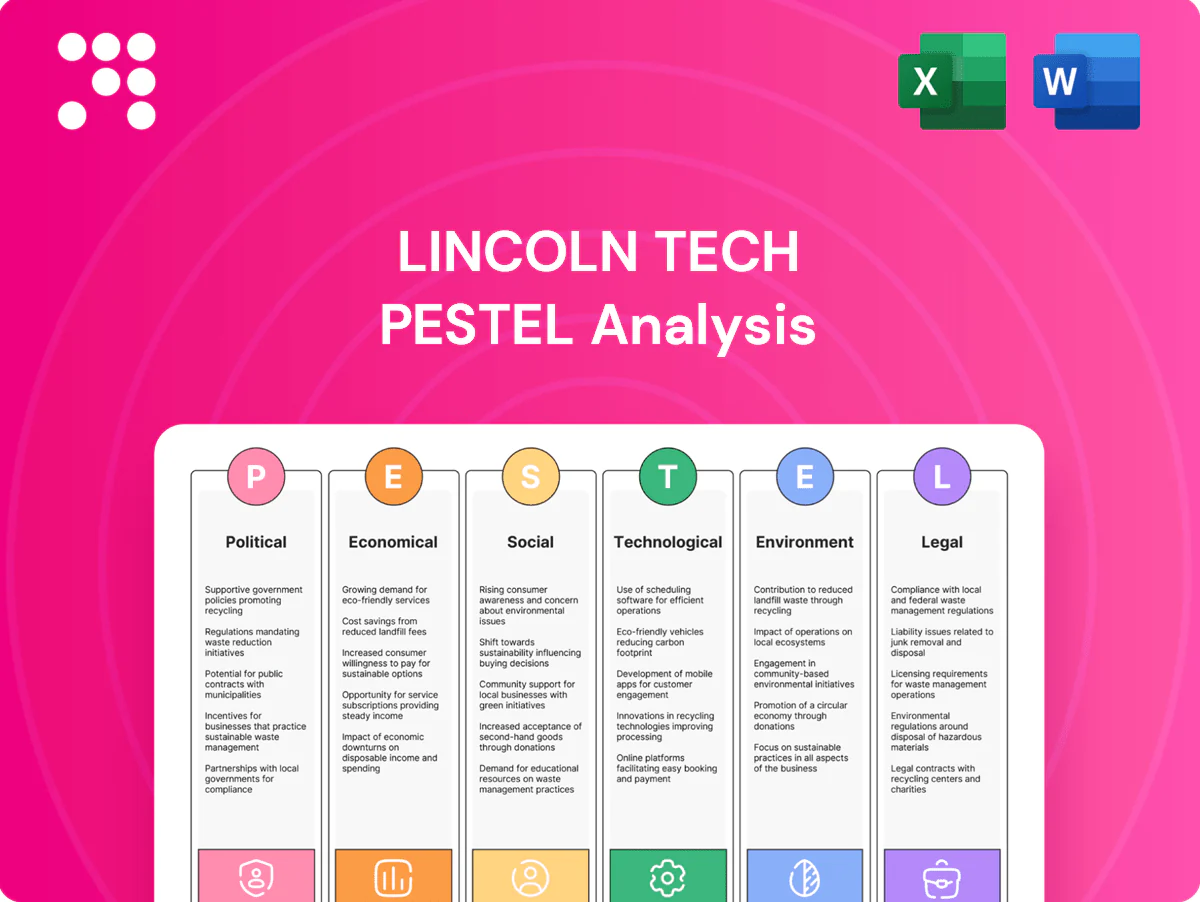
Lincoln Tech PESTLE Analysis

Skip the Research. Get the Strategy.
Unlock how political shifts, economic cycles, social trends, technological advances, legal pressures, and environmental factors are reshaping Lincoln Tech’s prospects—our concise PESTLE highlights risks and opportunities you need to know. Ideal for investors and strategists, it’s a ready-made briefing to inform decisions. Buy the full PESTLE for the complete, actionable analysis and downloadable files.
Political factors

Federal aid dependence & policy shifts
As a for-profit educator Lincoln Tech is highly sensitive to Title IV funding and the 90/10 rule limiting reliance on federal aid; shifts in federal policy can materially impact operations. The Pell Grant maximum stood at 7,395 for 2024–25, so cuts or eligibility tightening would depress enrollment and cash flow. Political cycles shape CTE support and targeted grants, making advocacy and robust compliance readiness essential to mitigate abrupt changes.
Gainful Employment & accountability rules
Renewed Gainful Employment/Financial Value Transparency rules (DOE) revive debt-to-earnings tests—historically failing if annual loan payments exceed 20% of earnings or 8% of discretionary income—intensifying scrutiny of Lincoln Tech program outcomes. Programs must meet these D/E metrics to retain Title IV aid; persistent poor performance risks sanctions or closure. Transparent, audited reporting now is strategically essential to justify pricing and curriculum choices.

90/10 rule and workforce grants
The revised 90/10 rule broadens which federal funds count toward the 90% threshold, tightening reliance limits and reinforcing the requirement that at least 10% of revenue come from non-federal sources. Lincoln Tech may pursue state and employer-funded upskilling grants and WIOA-linked contracts to rebalance revenue. Participation in workforce development initiatives diversifies funding and strategic state partnerships can offset policy risk.

State-level CTE priorities
Governors and legislatures drive funding for apprenticeships, licensing, and CTE pipelines, with federal Perkins V funding at about $1.4 billion in FY2024 influencing state allocations. Favorable state policies—scholarships and employer incentives—can boost enrollment, while budget austerity can curtail support. Lincoln Tech's multi-state campus footprint increases both exposure to varying state policies and opportunity to capture reform-driven demand.
- Perkins V FY2024: ~$1.4B
- State policy swings directly affect apprenticeship and scholarship availability
- Multi-state campuses raise policy risk and market opportunity
Trade policy & infrastructure agendas
National infrastructure and reshoring agendas, backed by the Bipartisan Infrastructure Law's roughly $550 billion in new spending, elevate demand for skilled trades; Lincoln Tech can scale programs for construction, electrical and HVAC roles. Political support for EVs (IRA up to $7,500 tax credit), the CHIPS Act ($52 billion) and a projected ~14% BLS growth in healthcare jobs to 2032 amplify training needs. Shifts in priorities or funding reallocations could quickly redirect enrollment momentum.
- Infrastructure: $550B new spending
- Semiconductors: $52B CHIPS funding
- EVs: up to $7,500 credit
- Healthcare: ~14% BLS growth
Federal aid and CHIPS/Infra investments spark skilled-trade and healthcare job surge
Lincoln Tech faces Title IV/90/10 and revived Gainful Employment tests that tie aid to program debt-to-earnings; Pell max $7,395 (2024–25) and Perkins V ~$1.4B shape state funding. Infrastructure/reshoring (Bipartisan Infrastructure ~$550B) plus CHIPS $52B and EV credit $7,500 boost skilled-trade demand; healthcare jobs ~14% growth to 2032.
| Policy | 2024/25 |
|---|---|
| Pell/Perkins/Infra | $7,395 / $1.4B / $550B |
| CHIPS/EV/Healthcare | $52B / $7,500 / ~14% |
What is included in the product
 Detailed Word Document
Explores how Political, Economic, Social, Technological, Environmental and Legal forces uniquely affect Lincoln Tech, with data-backed trends and region/industry relevance; designed for executives and investors to identify risks, opportunities and forward-looking scenarios ready for inclusion in plans, decks, or reports.

 Customizable Excel Spreadsheet
A concise, visually segmented PESTLE summary tailored to Lincoln Tech that clarifies external risks and opportunities for quick inclusion in presentations, team alignment, or client reports, with editable notes to adapt regional or program-specific impacts.
Economic factors

Labor market demand for skilled trades
Tight labor markets and an aging workforce—workers 55+ comprised about 24% of the U.S. labor force in 2024 (BLS)—are lifting demand for technicians, welders, HVAC and healthcare support. Strong employer demand has sustained higher placement rates and pricing power for vocational providers, though cyclical slowdowns compress hiring and externship availability, and wide regional variance forces a flexible program mix.
Tuition affordability & inflation
Rising costs for materials, faculty and facilities—outpacing the US CPI rise of about 3.4% in 2024—continue to pressure Lincoln Tech to raise tuition. Price sensitivity among prospective students reduces conversion and retention, especially vs career alternatives. Scholarships (Pell max $7,395 for 2024–25), employer tuition assistance ($5,250 tax-free) and flexible payment plans mitigate affordability. Cost control and modular programs sustain perceived value.

Interest rates & student financing
Higher policy rates (Fed funds 5.25-5.50% in 2024–25) raise borrowing costs and can deter enrollment; with outstanding federal student debt roughly $1.6 trillion (2024), financing availability and tighter credit standards shape yield and completion. Lincoln Tech can expand alternative and income-aligned options and use transparent ROI messaging to mitigate rate headwinds.

Employer partnerships & apprenticeships
Employer partnerships create direct hiring pipelines that improve placement and lower marketing spend; sponsored cohorts and equipment donations can cut capex, while apprenticeships blend paid work with instruction to boost completion (U.S. registered apprentices ~700,000 in 2023; completion ≈50% per DOL 2022). Economic downturns can reduce employer commitments, so Lincoln Tech must diversify employer sources.
- Direct pipelines: lower placement cost
- Sponsored cohorts/equipment: reduce capex
- Apprenticeships: paid+instruction; ≈50% completion
- Risk: downturns → diversify employers
Regional economic cycles
Campus performance mirrors local auto, construction, healthcare and hospitality cycles; booms raise demand for rapid upskilling while busts increase retraining interest; multi-state campus portfolio provides partial hedge; data-driven seat planning refines exposure. Healthcare occupations expected to add about 2.6 million jobs 2022–32 (BLS).
- Local industry sensitivity
- Demand spikes in booms
- Retraining in downturns
- State diversification hedge
- Seat planning via data
Federal aid and CHIPS/Infra investments spark skilled-trade and healthcare job surge
Tight labor markets and an aging workforce (24% 55+ in 2024, BLS) lift demand for technicians and sustain placement/pricing but regional variance requires flexible program mix. Rising costs outpaced CPI 3.4% (2024), pushing tuition up; Pell max $7,395 (2024–25) and $5,250 employer assistance aid affordability. Fed funds 5.25–5.50% (2024–25) raises borrowing costs; apprenticeships (~700,000 reg. 2023; ≈50% completion) and employer partnerships cut capex and improve outcomes.
| Metric | Value | Source |
|---|---|---|
| 55+ share | 24% | BLS 2024 |
| CPI 2024 | 3.4% | BLS/Census 2024 |
| Pell max | $7,395 | ED 2024–25 |
| Fed funds | 5.25–5.50% | Fed 2024–25 |
Preview the Actual Deliverable
Lincoln Tech PESTLE Analysis
The preview shown here is the exact Lincoln Tech PESTLE Analysis document you’ll receive after purchase—fully formatted and ready to use. This is the real file with complete content, structure, and professional layout, not a teaser or placeholder. After checkout you’ll be able to download this same finished document instantly.

Product Information
Product Information
Shipping & Returns
Shipping & Returns
Description
Skip the Research. Get the Strategy.
Unlock how political shifts, economic cycles, social trends, technological advances, legal pressures, and environmental factors are reshaping Lincoln Tech’s prospects—our concise PESTLE highlights risks and opportunities you need to know. Ideal for investors and strategists, it’s a ready-made briefing to inform decisions. Buy the full PESTLE for the complete, actionable analysis and downloadable files.
Political factors
Federal aid dependence & policy shifts
As a for-profit educator Lincoln Tech is highly sensitive to Title IV funding and the 90/10 rule limiting reliance on federal aid; shifts in federal policy can materially impact operations. The Pell Grant maximum stood at 7,395 for 2024–25, so cuts or eligibility tightening would depress enrollment and cash flow. Political cycles shape CTE support and targeted grants, making advocacy and robust compliance readiness essential to mitigate abrupt changes.
Gainful Employment & accountability rules
Renewed Gainful Employment/Financial Value Transparency rules (DOE) revive debt-to-earnings tests—historically failing if annual loan payments exceed 20% of earnings or 8% of discretionary income—intensifying scrutiny of Lincoln Tech program outcomes. Programs must meet these D/E metrics to retain Title IV aid; persistent poor performance risks sanctions or closure. Transparent, audited reporting now is strategically essential to justify pricing and curriculum choices.
90/10 rule and workforce grants
The revised 90/10 rule broadens which federal funds count toward the 90% threshold, tightening reliance limits and reinforcing the requirement that at least 10% of revenue come from non-federal sources. Lincoln Tech may pursue state and employer-funded upskilling grants and WIOA-linked contracts to rebalance revenue. Participation in workforce development initiatives diversifies funding and strategic state partnerships can offset policy risk.
State-level CTE priorities
Governors and legislatures drive funding for apprenticeships, licensing, and CTE pipelines, with federal Perkins V funding at about $1.4 billion in FY2024 influencing state allocations. Favorable state policies—scholarships and employer incentives—can boost enrollment, while budget austerity can curtail support. Lincoln Tech's multi-state campus footprint increases both exposure to varying state policies and opportunity to capture reform-driven demand.
- Perkins V FY2024: ~$1.4B
- State policy swings directly affect apprenticeship and scholarship availability
- Multi-state campuses raise policy risk and market opportunity
Trade policy & infrastructure agendas
National infrastructure and reshoring agendas, backed by the Bipartisan Infrastructure Law's roughly $550 billion in new spending, elevate demand for skilled trades; Lincoln Tech can scale programs for construction, electrical and HVAC roles. Political support for EVs (IRA up to $7,500 tax credit), the CHIPS Act ($52 billion) and a projected ~14% BLS growth in healthcare jobs to 2032 amplify training needs. Shifts in priorities or funding reallocations could quickly redirect enrollment momentum.
- Infrastructure: $550B new spending
- Semiconductors: $52B CHIPS funding
- EVs: up to $7,500 credit
- Healthcare: ~14% BLS growth
Federal aid and CHIPS/Infra investments spark skilled-trade and healthcare job surge
Lincoln Tech faces Title IV/90/10 and revived Gainful Employment tests that tie aid to program debt-to-earnings; Pell max $7,395 (2024–25) and Perkins V ~$1.4B shape state funding. Infrastructure/reshoring (Bipartisan Infrastructure ~$550B) plus CHIPS $52B and EV credit $7,500 boost skilled-trade demand; healthcare jobs ~14% growth to 2032.
| Policy | 2024/25 |
|---|---|
| Pell/Perkins/Infra | $7,395 / $1.4B / $550B |
| CHIPS/EV/Healthcare | $52B / $7,500 / ~14% |
What is included in the product
Detailed Word Document
Explores how Political, Economic, Social, Technological, Environmental and Legal forces uniquely affect Lincoln Tech, with data-backed trends and region/industry relevance; designed for executives and investors to identify risks, opportunities and forward-looking scenarios ready for inclusion in plans, decks, or reports.
Customizable Excel Spreadsheet
A concise, visually segmented PESTLE summary tailored to Lincoln Tech that clarifies external risks and opportunities for quick inclusion in presentations, team alignment, or client reports, with editable notes to adapt regional or program-specific impacts.
Economic factors
Labor market demand for skilled trades
Tight labor markets and an aging workforce—workers 55+ comprised about 24% of the U.S. labor force in 2024 (BLS)—are lifting demand for technicians, welders, HVAC and healthcare support. Strong employer demand has sustained higher placement rates and pricing power for vocational providers, though cyclical slowdowns compress hiring and externship availability, and wide regional variance forces a flexible program mix.
Tuition affordability & inflation
Rising costs for materials, faculty and facilities—outpacing the US CPI rise of about 3.4% in 2024—continue to pressure Lincoln Tech to raise tuition. Price sensitivity among prospective students reduces conversion and retention, especially vs career alternatives. Scholarships (Pell max $7,395 for 2024–25), employer tuition assistance ($5,250 tax-free) and flexible payment plans mitigate affordability. Cost control and modular programs sustain perceived value.
Interest rates & student financing
Higher policy rates (Fed funds 5.25-5.50% in 2024–25) raise borrowing costs and can deter enrollment; with outstanding federal student debt roughly $1.6 trillion (2024), financing availability and tighter credit standards shape yield and completion. Lincoln Tech can expand alternative and income-aligned options and use transparent ROI messaging to mitigate rate headwinds.
Employer partnerships & apprenticeships
Employer partnerships create direct hiring pipelines that improve placement and lower marketing spend; sponsored cohorts and equipment donations can cut capex, while apprenticeships blend paid work with instruction to boost completion (U.S. registered apprentices ~700,000 in 2023; completion ≈50% per DOL 2022). Economic downturns can reduce employer commitments, so Lincoln Tech must diversify employer sources.
- Direct pipelines: lower placement cost
- Sponsored cohorts/equipment: reduce capex
- Apprenticeships: paid+instruction; ≈50% completion
- Risk: downturns → diversify employers
Regional economic cycles
Campus performance mirrors local auto, construction, healthcare and hospitality cycles; booms raise demand for rapid upskilling while busts increase retraining interest; multi-state campus portfolio provides partial hedge; data-driven seat planning refines exposure. Healthcare occupations expected to add about 2.6 million jobs 2022–32 (BLS).
- Local industry sensitivity
- Demand spikes in booms
- Retraining in downturns
- State diversification hedge
- Seat planning via data
Federal aid and CHIPS/Infra investments spark skilled-trade and healthcare job surge
Tight labor markets and an aging workforce (24% 55+ in 2024, BLS) lift demand for technicians and sustain placement/pricing but regional variance requires flexible program mix. Rising costs outpaced CPI 3.4% (2024), pushing tuition up; Pell max $7,395 (2024–25) and $5,250 employer assistance aid affordability. Fed funds 5.25–5.50% (2024–25) raises borrowing costs; apprenticeships (~700,000 reg. 2023; ≈50% completion) and employer partnerships cut capex and improve outcomes.
| Metric | Value | Source |
|---|---|---|
| 55+ share | 24% | BLS 2024 |
| CPI 2024 | 3.4% | BLS/Census 2024 |
| Pell max | $7,395 | ED 2024–25 |
| Fed funds | 5.25–5.50% | Fed 2024–25 |
Preview the Actual Deliverable
Lincoln Tech PESTLE Analysis
The preview shown here is the exact Lincoln Tech PESTLE Analysis document you’ll receive after purchase—fully formatted and ready to use. This is the real file with complete content, structure, and professional layout, not a teaser or placeholder. After checkout you’ll be able to download this same finished document instantly.











