Lincoln Electric PESTLE Analysis

Your Competitive Advantage Starts with This Report
Gain a strategic advantage with our PESTLE Analysis of Lincoln Electric—concise, actionable insights on political, economic, social, technological, legal and environmental forces shaping its future. Ideal for investors and strategists; buy the full report to download the complete, editable analysis and make smarter decisions now.
Political factors

Trade policy and tariffs
Shifts in tariffs—notably US Section 232 levies of 25% on steel and 10% on aluminum—directly raise input costs and squeeze margins for Lincoln Electric’s welding equipment and consumables. Trade tensions (eg US-China tariffs introduced in 2018 with peak duties up to 25%) disrupt cross-border component flows and build inventory volatility. Preferential agreements like USMCA (effective 2020) can open markets or shield rivals, so proactive supply-chain diversification lowers geopolitical exposure.
Industrial policy and infrastructure
Government-funded infrastructure and energy projects drive welding demand, highlighted by the US Infrastructure Investment and Jobs Act's roughly $550 billion in new federal spending; state-level programs add further pipelines. Stimulus and reshoring incentives such as the CHIPS Act ($52 billion) and clean energy tax credits (~$370 billion IRA) bolster fabrication capex. Defense procurement budgets above $800 billion influence robotic welding uptake. Monitoring announced public capex pipelines aligns capacity and sales focus.

Export controls and sanctions
Export controls on advanced welding technologies and evolving sanctions regimes constrain Lincoln Electric sales to restricted entities/regions; Lincoln Electric reported net sales of $4.4 billion in fiscal 2024, exposing material revenue to trade limits. Compliance requires screening distributors and end-users across global supply chains and added due-diligence costs. Rapid policy shifts can alter backlog and quarterly forecasts within weeks; localizing production in key markets can mitigate some restrictions and preserve revenues.

Political stability in key regions
Political instability in emerging markets can delay projects and impair receivables, and IMF projected 2025 emerging market growth at about 4.1% increases sensitivity to sudden policy swings; currency controls and abrupt trade policies can alter project viability and margin realization. Stable regions support long-cycle automation investments, while rigorous country risk assessment guides channel strategy and inventory placement for Lincoln Electric (NASDAQ: LECO).
Public procurement and standards diplomacy
Government-set technical standards (ISO, AWS) determine Lincoln Electric product specs and certification needs; aligning to them speeds adoption in markets where public procurement accounts for an estimated 10–15% of GDP and US federal contracts approach 700 billion USD annually.
- Standards bodies shape market access
- Public tenders favor local content/certifications
- Alignment accelerates adoption
Tariffs squeeze margins; US capex and defense spending boost welding demand amid export controls
Section 232 tariffs (25% steel, 10% aluminum) and US-China trade duties raise input costs and margin pressure. US public capex (Infrastructure Act ~$550B, IRA ~370B, CHIPS $52B) and >$800B defense budget drive welding demand. Lincoln Electric net sales $4.4B FY2024 face export-control and sanction constraints. 2025 EM growth ~4.1% and political instability elevate receivable and project risks.
| Factor | Metric |
|---|---|
| Tariffs | 25% steel / 10% Al |
| Public spend | $550B Infra / $370B IRA / $52B CHIPS |
| Exposure | $4.4B sales FY2024 |
What is included in the product
 Detailed Word Document
Explores how Political, Economic, Social, Technological, Environmental and Legal forces uniquely affect Lincoln Electric, with data-backed insights and trend analysis to identify risks and opportunities; designed for executives and investors and includes forward-looking implications for strategy and scenario planning.

 Customizable Excel Spreadsheet
A concise, visually segmented Lincoln Electric PESTLE summary that relieves research fatigue by highlighting key political, economic, social, technological, legal and environmental risks for quick inclusion in presentations and strategy sessions.
Economic factors

Industrial cycle sensitivity
Welding demand closely follows manufacturing PMI, construction activity and energy capex, so cyclical downturns compress capital-equipment orders while consumables and service sales show relative resilience; recoveries typically drive customer investments in robotics and automation to boost productivity, and Lincoln Electric’s diversified mix of consumables, equipment and automation helps smooth cyclical volatility.
Commodity prices and input costs
Steel, copper and specialty alloys drive BOM for Lincoln Electric: LME copper averaged roughly $9,000/tonne in 2024 and U.S. hot‑rolled coil hovered near $1,000/short ton, lifting machine and consumable input costs. Rising energy and electricity (U.S. industrial ~0.10 USD/kWh in 2024) squeeze fabrication customers’ budgets and utilization. Lincoln’s pricing power therefore hinges on product differentiation and service value; hedging and design‑to‑cost programs are used to protect margins.

FX volatility
Multi-currency operations expose Lincoln Electric to exchange swings, with over 50% of revenue generated outside the US, so currency moves directly affect reported sales and margins. A strong dollar pressures exports and translates foreign earnings lower, potentially compressing consolidated results. Natural hedges from local sourcing and regional production footprints reduce translation and transaction risk. Pricing clauses in contracts and financial hedges (forwards/options) are used to stabilize near-term performance.

Labor market dynamics
Customer capex and financing
Rising policy rates (Federal funds target 5.25–5.50% mid‑2025) can delay capital equipment purchases and push customers toward leasing, while vendor financing programs shorten payback and accelerate adoption of high‑ticket welding systems; demand follows health of end‑markets such as automotive (global light‑vehicle output ~78 million units in 2024) and energy capex, and flexible commercial models boost win rates.
- Rates: Fed 5.25–5.50% (mid‑2025)
- Auto: ~78M global light‑vehicles (2024)
- Vendor financing: increases adoption of high‑ticket systems
- Flexible models: improve win rates
Tariffs squeeze margins; US capex and defense spending boost welding demand amid export controls
Welding demand tracks manufacturing PMI and construction; cyclicality hits equipment orders while consumables stay resilient, and recoveries boost automation spending. Input costs rose in 2024 (LME copper ≈ 9,000 USD/tonne; U.S. HRC ≈ 1,000 USD/short ton) pressuring margins; Lincoln offsets via pricing, hedges and design‑to‑cost. FX and rates (Fed 5.25–5.50% mid‑2025) affect reported results and capex timing.
| Metric | Value |
|---|---|
| Fed funds (mid‑2025) | 5.25–5.50% |
| LME copper (2024) | ≈ 9,000 USD/tonne |
| U.S. HRC (2024) | ≈ 1,000 USD/short ton |
| Global light vehicles (2024) | ≈ 78M units |
| Revenue outside US | >50% |
Full Version Awaits
Lincoln Electric PESTLE Analysis
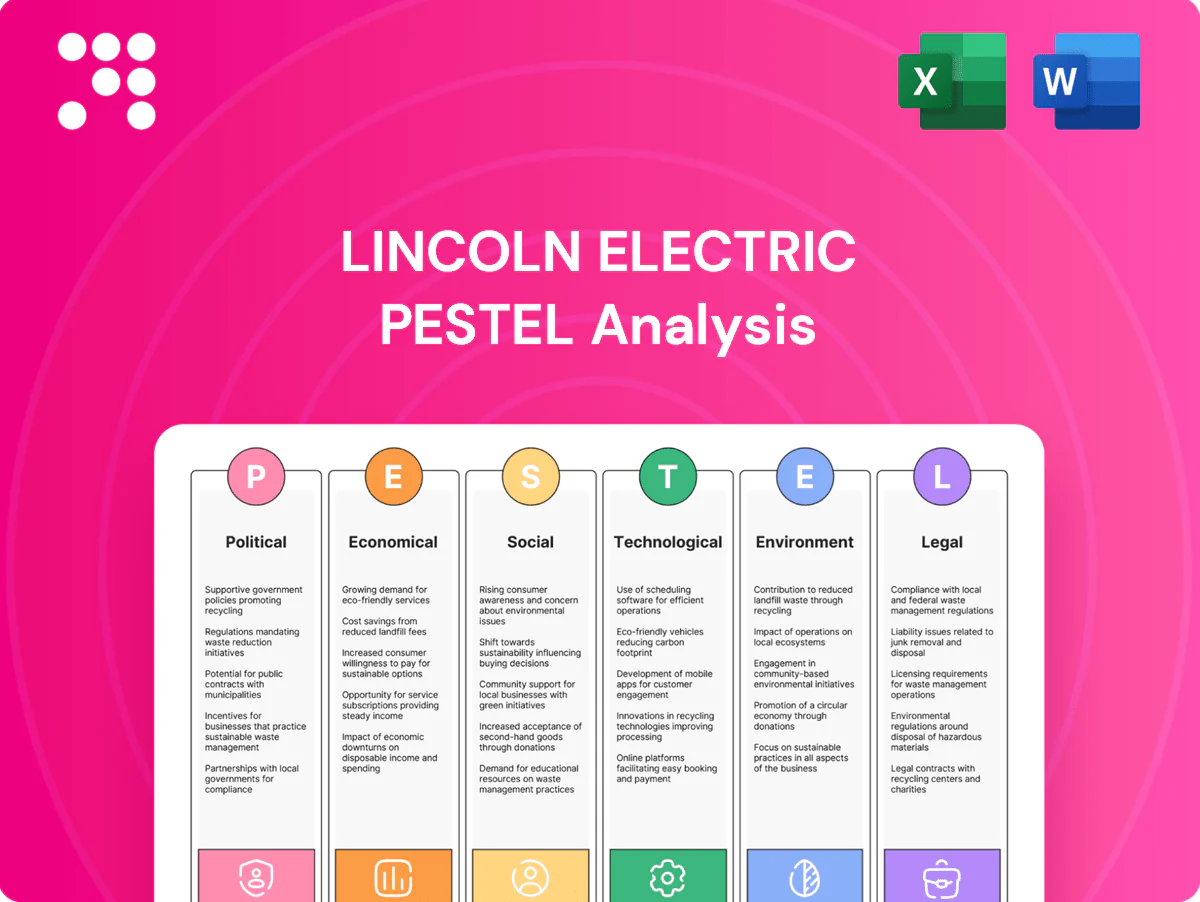
This Lincoln Electric PESTLE Analysis provides a concise evaluation of political, economic, social, technological, legal, and environmental factors affecting the company. The preview shown here is the exact document you’ll receive after purchase—fully formatted and ready to use. No placeholders or teasers; the file is final and downloadable immediately.

Product Information
Product Information
Shipping & Returns
Shipping & Returns
Description
Your Competitive Advantage Starts with This Report
Gain a strategic advantage with our PESTLE Analysis of Lincoln Electric—concise, actionable insights on political, economic, social, technological, legal and environmental forces shaping its future. Ideal for investors and strategists; buy the full report to download the complete, editable analysis and make smarter decisions now.
Political factors
Trade policy and tariffs
Shifts in tariffs—notably US Section 232 levies of 25% on steel and 10% on aluminum—directly raise input costs and squeeze margins for Lincoln Electric’s welding equipment and consumables. Trade tensions (eg US-China tariffs introduced in 2018 with peak duties up to 25%) disrupt cross-border component flows and build inventory volatility. Preferential agreements like USMCA (effective 2020) can open markets or shield rivals, so proactive supply-chain diversification lowers geopolitical exposure.
Industrial policy and infrastructure
Government-funded infrastructure and energy projects drive welding demand, highlighted by the US Infrastructure Investment and Jobs Act's roughly $550 billion in new federal spending; state-level programs add further pipelines. Stimulus and reshoring incentives such as the CHIPS Act ($52 billion) and clean energy tax credits (~$370 billion IRA) bolster fabrication capex. Defense procurement budgets above $800 billion influence robotic welding uptake. Monitoring announced public capex pipelines aligns capacity and sales focus.
Export controls and sanctions
Export controls on advanced welding technologies and evolving sanctions regimes constrain Lincoln Electric sales to restricted entities/regions; Lincoln Electric reported net sales of $4.4 billion in fiscal 2024, exposing material revenue to trade limits. Compliance requires screening distributors and end-users across global supply chains and added due-diligence costs. Rapid policy shifts can alter backlog and quarterly forecasts within weeks; localizing production in key markets can mitigate some restrictions and preserve revenues.
Political stability in key regions
Political instability in emerging markets can delay projects and impair receivables, and IMF projected 2025 emerging market growth at about 4.1% increases sensitivity to sudden policy swings; currency controls and abrupt trade policies can alter project viability and margin realization. Stable regions support long-cycle automation investments, while rigorous country risk assessment guides channel strategy and inventory placement for Lincoln Electric (NASDAQ: LECO).
Public procurement and standards diplomacy
Government-set technical standards (ISO, AWS) determine Lincoln Electric product specs and certification needs; aligning to them speeds adoption in markets where public procurement accounts for an estimated 10–15% of GDP and US federal contracts approach 700 billion USD annually.
- Standards bodies shape market access
- Public tenders favor local content/certifications
- Alignment accelerates adoption
Tariffs squeeze margins; US capex and defense spending boost welding demand amid export controls
Section 232 tariffs (25% steel, 10% aluminum) and US-China trade duties raise input costs and margin pressure. US public capex (Infrastructure Act ~$550B, IRA ~370B, CHIPS $52B) and >$800B defense budget drive welding demand. Lincoln Electric net sales $4.4B FY2024 face export-control and sanction constraints. 2025 EM growth ~4.1% and political instability elevate receivable and project risks.
| Factor | Metric |
|---|---|
| Tariffs | 25% steel / 10% Al |
| Public spend | $550B Infra / $370B IRA / $52B CHIPS |
| Exposure | $4.4B sales FY2024 |
What is included in the product
Detailed Word Document
Explores how Political, Economic, Social, Technological, Environmental and Legal forces uniquely affect Lincoln Electric, with data-backed insights and trend analysis to identify risks and opportunities; designed for executives and investors and includes forward-looking implications for strategy and scenario planning.
Customizable Excel Spreadsheet
A concise, visually segmented Lincoln Electric PESTLE summary that relieves research fatigue by highlighting key political, economic, social, technological, legal and environmental risks for quick inclusion in presentations and strategy sessions.
Economic factors
Industrial cycle sensitivity
Welding demand closely follows manufacturing PMI, construction activity and energy capex, so cyclical downturns compress capital-equipment orders while consumables and service sales show relative resilience; recoveries typically drive customer investments in robotics and automation to boost productivity, and Lincoln Electric’s diversified mix of consumables, equipment and automation helps smooth cyclical volatility.
Commodity prices and input costs
Steel, copper and specialty alloys drive BOM for Lincoln Electric: LME copper averaged roughly $9,000/tonne in 2024 and U.S. hot‑rolled coil hovered near $1,000/short ton, lifting machine and consumable input costs. Rising energy and electricity (U.S. industrial ~0.10 USD/kWh in 2024) squeeze fabrication customers’ budgets and utilization. Lincoln’s pricing power therefore hinges on product differentiation and service value; hedging and design‑to‑cost programs are used to protect margins.
FX volatility
Multi-currency operations expose Lincoln Electric to exchange swings, with over 50% of revenue generated outside the US, so currency moves directly affect reported sales and margins. A strong dollar pressures exports and translates foreign earnings lower, potentially compressing consolidated results. Natural hedges from local sourcing and regional production footprints reduce translation and transaction risk. Pricing clauses in contracts and financial hedges (forwards/options) are used to stabilize near-term performance.
Labor market dynamics
Customer capex and financing
Rising policy rates (Federal funds target 5.25–5.50% mid‑2025) can delay capital equipment purchases and push customers toward leasing, while vendor financing programs shorten payback and accelerate adoption of high‑ticket welding systems; demand follows health of end‑markets such as automotive (global light‑vehicle output ~78 million units in 2024) and energy capex, and flexible commercial models boost win rates.
- Rates: Fed 5.25–5.50% (mid‑2025)
- Auto: ~78M global light‑vehicles (2024)
- Vendor financing: increases adoption of high‑ticket systems
- Flexible models: improve win rates
Tariffs squeeze margins; US capex and defense spending boost welding demand amid export controls
Welding demand tracks manufacturing PMI and construction; cyclicality hits equipment orders while consumables stay resilient, and recoveries boost automation spending. Input costs rose in 2024 (LME copper ≈ 9,000 USD/tonne; U.S. HRC ≈ 1,000 USD/short ton) pressuring margins; Lincoln offsets via pricing, hedges and design‑to‑cost. FX and rates (Fed 5.25–5.50% mid‑2025) affect reported results and capex timing.
| Metric | Value |
|---|---|
| Fed funds (mid‑2025) | 5.25–5.50% |
| LME copper (2024) | ≈ 9,000 USD/tonne |
| U.S. HRC (2024) | ≈ 1,000 USD/short ton |
| Global light vehicles (2024) | ≈ 78M units |
| Revenue outside US | >50% |
Full Version Awaits
Lincoln Electric PESTLE Analysis
This Lincoln Electric PESTLE Analysis provides a concise evaluation of political, economic, social, technological, legal, and environmental factors affecting the company. The preview shown here is the exact document you’ll receive after purchase—fully formatted and ready to use. No placeholders or teasers; the file is final and downloadable immediately.