Lifestyle International Holdings PESTLE Analysis

Your Shortcut to Market Insight Starts Here
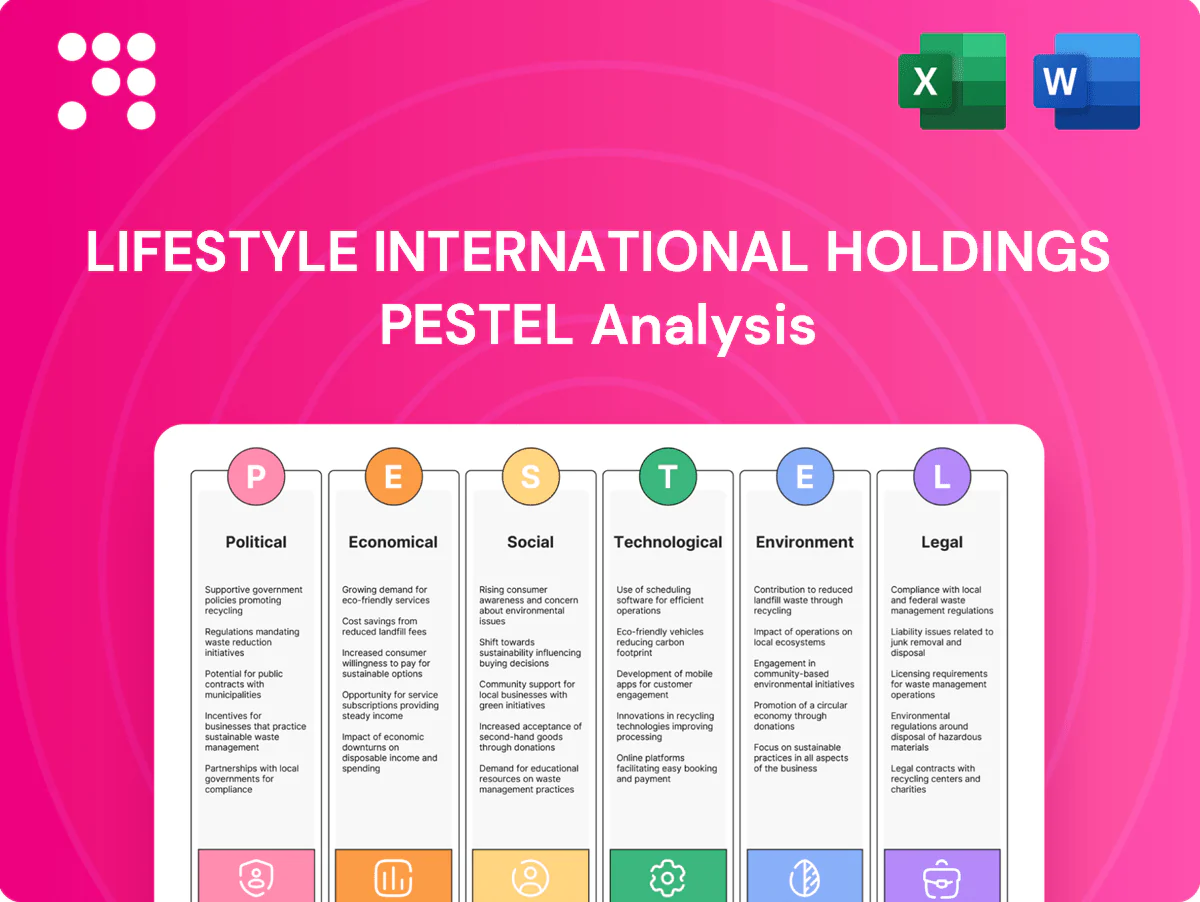
Discover how political shifts, economic cycles, social trends, technological advances, legal changes, and environmental pressures are shaping Lifestyle International Holdings’ strategic outlook—our concise PESTLE highlights key external risks and opportunities. Ideal for investors and strategists, the full analysis delivers actionable intelligence and ready-to-use insights; purchase the complete report to dive deeper.
Political factors

HKSAR–Mainland policy dynamics
Alignment with Mainland policy shapes cross-border shopper flows and logistics: Mainland visitors drove the 2023 tourism rebound to about 31.5 million arrivals, underpinning SOGO mall traffic. Rapid shifts in travel permits or quarantine rules have shown ability to swing footfall and sales within weeks, affecting event ROI. Close tracking of Greater Bay Area initiatives and predictable policy reduces operational risk and unlocks sourcing and collaboration opportunities.
Public order and social stability
Retail performance in Causeway Bay, one of Hong Kongs top three retail districts, is highly sensitive to demonstrations and disruptions; past unrest and the 2020 pandemic saw tourist arrivals plunge by over 70% year‑on‑year, sharply cutting footfall. Prolonged instability dampens consumer sentiment and tourist arrivals, reducing Sales and percent occupancy in high‑street stores. Contingency plans for staff safety, store operations and robust insurance coverages, plus clear crisis communication, are essential to mitigate downside impacts.

Government retail support measures
Government consumption vouchers (HK$5,000 per eligible resident in earlier rounds) and SME relief programs shift discretionary spending toward department stores, creating measurable uplifts during distribution windows. Time-limited subsidies often produce short-term sales spikes that Lifestyle can capture with targeted promotions. Ongoing engagement with trade chambers clarifies eligibility and timelines, while aligning inventory and campaign calendars to stimulus windows improves conversion rates.

Trade and import regulations
Tariffs, rules of origin and customs procedures shape Lifestyle International’s merchandise mix and pricing; Hong Kong applies near-zero tariffs on most consumer imports while RCEP, covering ~30% of global GDP, can lower landed costs for targeted categories and suppliers.
- Tariffs affect margins and retail prices
- RCEP lowers landed costs for select SKUs
- Origin rules dictate supplier eligibility
- Strong compliance cuts delays and markdown risk
Geopolitical tensions and sanctions
Geopolitical tensions and sanctions—notably continued restrictions related to Russia/Ukraine and expanded 2024 export controls affecting China tech supply chains—can disrupt branded suppliers, payments and logistics, constrain assortment and financing channels, and transmit FX and capital-market volatility into Hong Kong consumer confidence; IMF 2024 global growth at 3.2% raises scenario-planning importance to preserve margins and brand ties.
- Supply chain disruption: targeted export controls 2024
- Financing constraint: sanctions narrow banking corridors
- Market risk: IMF 2024 growth 3.2%
- Mitigation: scenario planning to protect margins/brands
Mainland policy sent 31.5m visitors 2023; vouchers and controls risk sales
Alignment with Mainland policy drove ~31.5m arrivals in 2023, boosting SOGO traffic; policy reversals can swing weekly sales. Causeway Bay performance remains sensitive—tourist arrivals fell >70% in 2020—so unrest risks occupancy and revenue. Stimulus (HK$5,000 vouchers) delivers short spikes; 2024 export controls and IMF 2024 growth 3.2% require scenario planning.
| Indicator | Value |
|---|---|
| Mainland arrivals 2023 | 31.5m |
| Voucher amount | HK$5,000 |
| IMF 2024 GDP | 3.2% |
| Tourism drop 2020 | >70% |
What is included in the product
 Detailed Word Document
Provides a concise PESTLE evaluation of Lifestyle International Holdings across Political, Economic, Social, Technological, Environmental and Legal dimensions, each backed by data and current trends to highlight region- and industry-specific risks and opportunities; designed for executives, advisors and investors with forward-looking insights for scenario planning and strategic decision-making.

 Customizable Excel Spreadsheet
A concise, visually segmented PESTLE summary for Lifestyle International Holdings that streamlines stakeholder briefings, is easy to drop into slides or reports, and supports quick alignment on external risks, market positioning and region-specific notes during planning sessions.
Economic factors

Tourism and inbound spending
Visitor arrivals underpin SOGO’s luxury and premium sales—Hong Kong recorded about 31.5 million inbound visitors in 2023 with mainland tourists constituting roughly 63% of the total, directly lifting basket size and high-value category mix. Mainland traffic trends drive spending per trip and product mix at SOGO, while currency differentials between RMB and HKD materially affect perceived value and conversion. Strategic partnerships with travel platforms and duty-free channels can capture ongoing recovery tailwinds and higher-margin tourist spend.
HKD-USD peg and interest rates
The HKD-USD peg imports US monetary policy—US federal funds target is about 5.25–5.50% (July 2025), lifting local borrowing costs and consumer credit servicing. Higher rates have put upward pressure on property cap rates and retail rents, compressing valuations and raising yield thresholds. Financing costs for redevelopment or refurbishment increase required ROI, so flexible leasing and phased capex are used to protect cash flow.

Consumer sentiment and employment
Household income and job stability drive Lifestyle International sales: Hong Kong median monthly household income was about HKD 34,800 in 2023 and unemployment trended near 3.1% in 2024, constraining discretionary spend. Promotions, loyalty schemes and private labels help protect margin and volume during downturns. Category mix shifts to essentials in weak cycles, while real-time POS analytics (increasingly adopted across retailers) enable dynamic pricing and inventory tuning to limit markdowns.

Rents and retail space economics
Prime Causeway Bay rents are highly cyclical and materially compress Lifestyle International margins during downturns, as the district remains one of Hong Kong's most expensive retail micro-markets. Negotiating turnover-based leases ties landlord and tenant incentives, stabilizing cash flow and sharing upside in peak periods. Store layout optimization lifts sales per square foot and improves rent productivity, while a property investment arm offers a hedge against occupancy cost volatility.
- rents: high and cyclical
- leases: turnover-based to align incentives
- operations: layout drives sales/sqft
- hedge: property arm reduces occupancy risk
FX and sourcing costs
Global currency moves shift COGS for imported luxury goods, and Lifestyle benefits from the HKD peg to USD maintained since 1983 which limits local FX pass-through.
- Hedging and multi-currency supplier contracts stabilize gross margins
- Diversified sourcing reduces concentration risk
- Dynamic pricing protects contribution during volatility
Mainland policy sent 31.5m visitors 2023; vouchers and controls risk sales
Visitor recovery (31.5M arrivals in 2023; mainland ≈63%) and HKD-USD peg drive tourist spend and FX-driven price competitiveness. Elevated global rates (US funds 5.25–5.50% Jul 2025) raise borrowing and retail rents, compressing margins; median household income HKD 34,800 (2023) and unemployment ~3.1% (2024) constrain discretionary demand. Turnover leases, hedging and dynamic pricing protect cash flow.
| Indicator | Value |
|---|---|
| Inbound visitors (2023) | 31.5M |
| Mainland share | ~63% |
| Median household income (2023) | HKD 34,800 |
| Unemployment (2024) | ~3.1% |
| US federal funds (Jul 2025) | 5.25–5.50% |
What You See Is What You Get
Lifestyle International Holdings PESTLE Analysis
The Lifestyle International Holdings PESTLE Analysis preview shown here is the exact document you’ll receive after purchase—fully formatted and ready to use. It contains the complete political, economic, social, technological, legal, and environmental assessment with the same layout, charts, and insights visible now. No placeholders or teasers—this is the final, professionally structured file you’ll download immediately after payment.

Original: $10.00
-65%$10.00
$3.50Product Information
Product Information
Shipping & Returns
Shipping & Returns
Description
Your Shortcut to Market Insight Starts Here
Discover how political shifts, economic cycles, social trends, technological advances, legal changes, and environmental pressures are shaping Lifestyle International Holdings’ strategic outlook—our concise PESTLE highlights key external risks and opportunities. Ideal for investors and strategists, the full analysis delivers actionable intelligence and ready-to-use insights; purchase the complete report to dive deeper.
Political factors
HKSAR–Mainland policy dynamics
Alignment with Mainland policy shapes cross-border shopper flows and logistics: Mainland visitors drove the 2023 tourism rebound to about 31.5 million arrivals, underpinning SOGO mall traffic. Rapid shifts in travel permits or quarantine rules have shown ability to swing footfall and sales within weeks, affecting event ROI. Close tracking of Greater Bay Area initiatives and predictable policy reduces operational risk and unlocks sourcing and collaboration opportunities.
Public order and social stability
Retail performance in Causeway Bay, one of Hong Kongs top three retail districts, is highly sensitive to demonstrations and disruptions; past unrest and the 2020 pandemic saw tourist arrivals plunge by over 70% year‑on‑year, sharply cutting footfall. Prolonged instability dampens consumer sentiment and tourist arrivals, reducing Sales and percent occupancy in high‑street stores. Contingency plans for staff safety, store operations and robust insurance coverages, plus clear crisis communication, are essential to mitigate downside impacts.
Government retail support measures
Government consumption vouchers (HK$5,000 per eligible resident in earlier rounds) and SME relief programs shift discretionary spending toward department stores, creating measurable uplifts during distribution windows. Time-limited subsidies often produce short-term sales spikes that Lifestyle can capture with targeted promotions. Ongoing engagement with trade chambers clarifies eligibility and timelines, while aligning inventory and campaign calendars to stimulus windows improves conversion rates.
Trade and import regulations
Tariffs, rules of origin and customs procedures shape Lifestyle International’s merchandise mix and pricing; Hong Kong applies near-zero tariffs on most consumer imports while RCEP, covering ~30% of global GDP, can lower landed costs for targeted categories and suppliers.
- Tariffs affect margins and retail prices
- RCEP lowers landed costs for select SKUs
- Origin rules dictate supplier eligibility
- Strong compliance cuts delays and markdown risk
Geopolitical tensions and sanctions
Geopolitical tensions and sanctions—notably continued restrictions related to Russia/Ukraine and expanded 2024 export controls affecting China tech supply chains—can disrupt branded suppliers, payments and logistics, constrain assortment and financing channels, and transmit FX and capital-market volatility into Hong Kong consumer confidence; IMF 2024 global growth at 3.2% raises scenario-planning importance to preserve margins and brand ties.
- Supply chain disruption: targeted export controls 2024
- Financing constraint: sanctions narrow banking corridors
- Market risk: IMF 2024 growth 3.2%
- Mitigation: scenario planning to protect margins/brands
Mainland policy sent 31.5m visitors 2023; vouchers and controls risk sales
Alignment with Mainland policy drove ~31.5m arrivals in 2023, boosting SOGO traffic; policy reversals can swing weekly sales. Causeway Bay performance remains sensitive—tourist arrivals fell >70% in 2020—so unrest risks occupancy and revenue. Stimulus (HK$5,000 vouchers) delivers short spikes; 2024 export controls and IMF 2024 growth 3.2% require scenario planning.
| Indicator | Value |
|---|---|
| Mainland arrivals 2023 | 31.5m |
| Voucher amount | HK$5,000 |
| IMF 2024 GDP | 3.2% |
| Tourism drop 2020 | >70% |
What is included in the product
Detailed Word Document
Provides a concise PESTLE evaluation of Lifestyle International Holdings across Political, Economic, Social, Technological, Environmental and Legal dimensions, each backed by data and current trends to highlight region- and industry-specific risks and opportunities; designed for executives, advisors and investors with forward-looking insights for scenario planning and strategic decision-making.
Customizable Excel Spreadsheet
A concise, visually segmented PESTLE summary for Lifestyle International Holdings that streamlines stakeholder briefings, is easy to drop into slides or reports, and supports quick alignment on external risks, market positioning and region-specific notes during planning sessions.
Economic factors
Tourism and inbound spending
Visitor arrivals underpin SOGO’s luxury and premium sales—Hong Kong recorded about 31.5 million inbound visitors in 2023 with mainland tourists constituting roughly 63% of the total, directly lifting basket size and high-value category mix. Mainland traffic trends drive spending per trip and product mix at SOGO, while currency differentials between RMB and HKD materially affect perceived value and conversion. Strategic partnerships with travel platforms and duty-free channels can capture ongoing recovery tailwinds and higher-margin tourist spend.
HKD-USD peg and interest rates
The HKD-USD peg imports US monetary policy—US federal funds target is about 5.25–5.50% (July 2025), lifting local borrowing costs and consumer credit servicing. Higher rates have put upward pressure on property cap rates and retail rents, compressing valuations and raising yield thresholds. Financing costs for redevelopment or refurbishment increase required ROI, so flexible leasing and phased capex are used to protect cash flow.
Consumer sentiment and employment
Household income and job stability drive Lifestyle International sales: Hong Kong median monthly household income was about HKD 34,800 in 2023 and unemployment trended near 3.1% in 2024, constraining discretionary spend. Promotions, loyalty schemes and private labels help protect margin and volume during downturns. Category mix shifts to essentials in weak cycles, while real-time POS analytics (increasingly adopted across retailers) enable dynamic pricing and inventory tuning to limit markdowns.
Rents and retail space economics
Prime Causeway Bay rents are highly cyclical and materially compress Lifestyle International margins during downturns, as the district remains one of Hong Kong's most expensive retail micro-markets. Negotiating turnover-based leases ties landlord and tenant incentives, stabilizing cash flow and sharing upside in peak periods. Store layout optimization lifts sales per square foot and improves rent productivity, while a property investment arm offers a hedge against occupancy cost volatility.
- rents: high and cyclical
- leases: turnover-based to align incentives
- operations: layout drives sales/sqft
- hedge: property arm reduces occupancy risk
FX and sourcing costs
Global currency moves shift COGS for imported luxury goods, and Lifestyle benefits from the HKD peg to USD maintained since 1983 which limits local FX pass-through.
- Hedging and multi-currency supplier contracts stabilize gross margins
- Diversified sourcing reduces concentration risk
- Dynamic pricing protects contribution during volatility
Mainland policy sent 31.5m visitors 2023; vouchers and controls risk sales
Visitor recovery (31.5M arrivals in 2023; mainland ≈63%) and HKD-USD peg drive tourist spend and FX-driven price competitiveness. Elevated global rates (US funds 5.25–5.50% Jul 2025) raise borrowing and retail rents, compressing margins; median household income HKD 34,800 (2023) and unemployment ~3.1% (2024) constrain discretionary demand. Turnover leases, hedging and dynamic pricing protect cash flow.
| Indicator | Value |
|---|---|
| Inbound visitors (2023) | 31.5M |
| Mainland share | ~63% |
| Median household income (2023) | HKD 34,800 |
| Unemployment (2024) | ~3.1% |
| US federal funds (Jul 2025) | 5.25–5.50% |
What You See Is What You Get
Lifestyle International Holdings PESTLE Analysis
The Lifestyle International Holdings PESTLE Analysis preview shown here is the exact document you’ll receive after purchase—fully formatted and ready to use. It contains the complete political, economic, social, technological, legal, and environmental assessment with the same layout, charts, and insights visible now. No placeholders or teasers—this is the final, professionally structured file you’ll download immediately after payment.