LifeMD SWOT Analysis

Go Beyond the Preview—Access the Full Strategic Report
LifeMD shows strong telehealth momentum and diversified virtual care services, but faces regulatory, reimbursement, and competitive pressures that could constrain growth; our concise SWOT highlights key strategic levers and vulnerabilities. Want the full picture? Purchase the complete, editable SWOT (Word + Excel) for actionable insights and investor-ready analysis.
Strengths

Multi-specialty portfolio
Offering men's, women's, dermatology, and weight management broadens LifeMDs addressable market and reduces reliance on any single product line. Year-round demand across chronic and acute conditions smooths revenue seasonality and boosts utilization. Cross-discipline referrals increase lifetime value and create stickier patient relationships, positioning LifeMD as a fuller telehealth alternative to niche rivals.
DTC convenience
Direct-to-consumer virtual care removes scheduling friction and enables consultations, diagnoses and treatment plans from home, boosting conversion and adherence—studies show telehealth can raise adherence ~20–30% and conversion similarly. Telehealth peaked >30% of visits in 2020 and stabilized ~10–15% by 2024, letting LifeMD reach the ~333M US population without heavy brick-and-mortar costs.

Integrated care journey
Connection to licensed providers plus on-platform prescription fulfillment streamlines end-to-end care, cutting handoffs and reported drop-off by up to 20% and improving adherence ~15–25%. Fewer handoffs raise outcomes and patient satisfaction—telehealth satisfaction commonly exceeds 85%—and increase lifetime value through repeat visits. Integrated systems create data feedback loops that refine protocols and reduce costs per episode.

Recurring Rx revenue
Chronic and maintenance therapies map well to subscription-like refills, and with 60% of US adults living with at least one chronic condition (CDC 2023) the addressable base is large. Predictable refill cadence improves revenue visibility and unit economics, while auto-ship and care plans materially reduce churn and stabilize margins. Improved predictability aids cash-flow planning and more efficient scaling.
- Recurring Rx: predictable unit economics
- 60% US adults: chronic care demand (CDC 2023)
- Auto-ship/care plans: lower churn, better cash flow
Scalable tech platform
LifeMD's scalable tech platform standardizes digital triage, scheduling, and telehealth workflows across conditions, leveraging software to lower marginal cost per visit and support rapid feature rollouts.
Data-driven personalization can boost conversion and adherence—telehealth visits grew 32x during COVID (CDC) and stabilized at roughly 8–10% of outpatient visits by 2023, creating scale benefits for partners and monetization.
- Digital triage: replicable workflows
- Lower marginal cost: software leverage
- Personalization: higher conversion/adherence
- Scalability: fast feature/partnership rollout
Multi-specialty telehealth expands reach: 333M, 60% chronic, >85% satisfaction
LifeMD's multi-specialty telehealth model expands addressable market (US pop ~333M), reduces single-line risk, and taps 60%+ adults with chronic conditions (CDC 2023). Integrated prescribing and subscriptions drive predictable unit economics and lower churn. Telehealth scale and >85% satisfaction boost retention and per-patient LTV.
| Metric | Value |
|---|---|
| US pop reach | 333M |
| Chronic prevalence | 60% (CDC 2023) |
| Telehealth satisfaction | >85% |
What is included in the product
 Detailed Word Document
Delivers a strategic overview of LifeMD’s internal and external business factors, outlining strengths, weaknesses, opportunities, and threats to assess its competitive position, growth drivers, operational gaps, and market risks.

 Customizable Excel Spreadsheet
Provides a concise LifeMD SWOT matrix to quickly surface and address clinical, regulatory, and operational pain points for faster remediation.
Weaknesses

High CAC dependence
Customer acquisition for LifeMD relies heavily on paid digital channels and brand marketing, concentrating spend in search, social and programmatic. Rising ad auction costs across major platforms can compress margins and raise CAC. Dependence on performance marketing creates volatility in growth when bid prices or platform algorithms shift, and limited organic brand equity may slow efficient scaling.
Limited clinical scope
Virtual care is constrained for conditions needing labs, imaging, or procedures, so LifeMD’s model limits acuity and scope and relies on referrals for in-person diagnostics. McKinsey estimates roughly 20%–25% of outpatient care can be delivered virtually, capping average revenue per user versus higher-margin in-person services. Frequent hand-offs risk fragmented care and complicate payer integration and outcomes tracking.

Regulatory complexity
LifeMD faces 51 separate state/DC licensure regimes and shifting telehealth rules since the COVID PHE ended May 11, 2023, which increases operational burden and limits prescribing of controlled substances. Compliance costs and process changes can be material; HIPAA penalties can reach up to 1.5 million USD per year per violation category. Variability complicates uniform product design and errors risk fines, reputational harm, or service disruption.

Third-party dependencies
LifeMDs reliance on external pharmacies, fulfillment carriers, and payment rails creates chokepoints where vendor outages or carrier disruptions directly delay prescriptions and revenue recognition. Vendor performance variability has measurable impact on delivery times and patient satisfaction, and supply constraints can force cancellations or treatment delays. High switching costs and integration work increase friction when replacing underperforming partners.
- Dependence on external pharmacies
- Carrier/vendor performance risk
- Supply-driven cancellations
- High switching/integration costs
Churn and adherence risk
Consumer telehealth shows materially higher churn than traditional primary care, with industry studies reporting 90-day retention often below 30% (2022–24), reducing LTV and stretching CAC payback beyond typical 12–18 month targets.
Poor adherence in chronic-care programs—adherence rates frequently under 50% at 6–12 months—undermines clinical outcomes and revenue predictability, forcing ongoing engagement spend to preserve retention.
- Churn: 90-day retention <30%
- Adherence: <50% at 6–12 months
- Financial impact: CAC payback >12–18 months
- Mitigation: sustained engagement spend required
Telehealth growth constrained by rising CAC, 90-day retention under 30%, addressable care 20-25%
LifeMD’s growth is sensitive to rising paid-media costs and concentrated performance marketing, pushing CAC and compressing margins; industry 90-day retention often <30% and CAC payback frequently exceeds 12–18 months. Telehealth caps addressable care at ~20–25% (McKinsey), limiting ARPU versus in-person services. Regulatory complexity (51 states/DC) and HIPAA exposure (penalties up to 1.5M USD per violation category) raise compliance costs. Vendor/pharmacy dependencies create fulfillment chokepoints and service risk.
| Metric | Value |
|---|---|
| Telehealth addressable care | 20–25% |
| 90-day retention | <30% |
| Adherence 6–12 mo | <50% |
| HIPAA max penalty | 1.5M USD/violation category/yr |
| Licensure burden | 51 states/DC |
Preview the Actual Deliverable
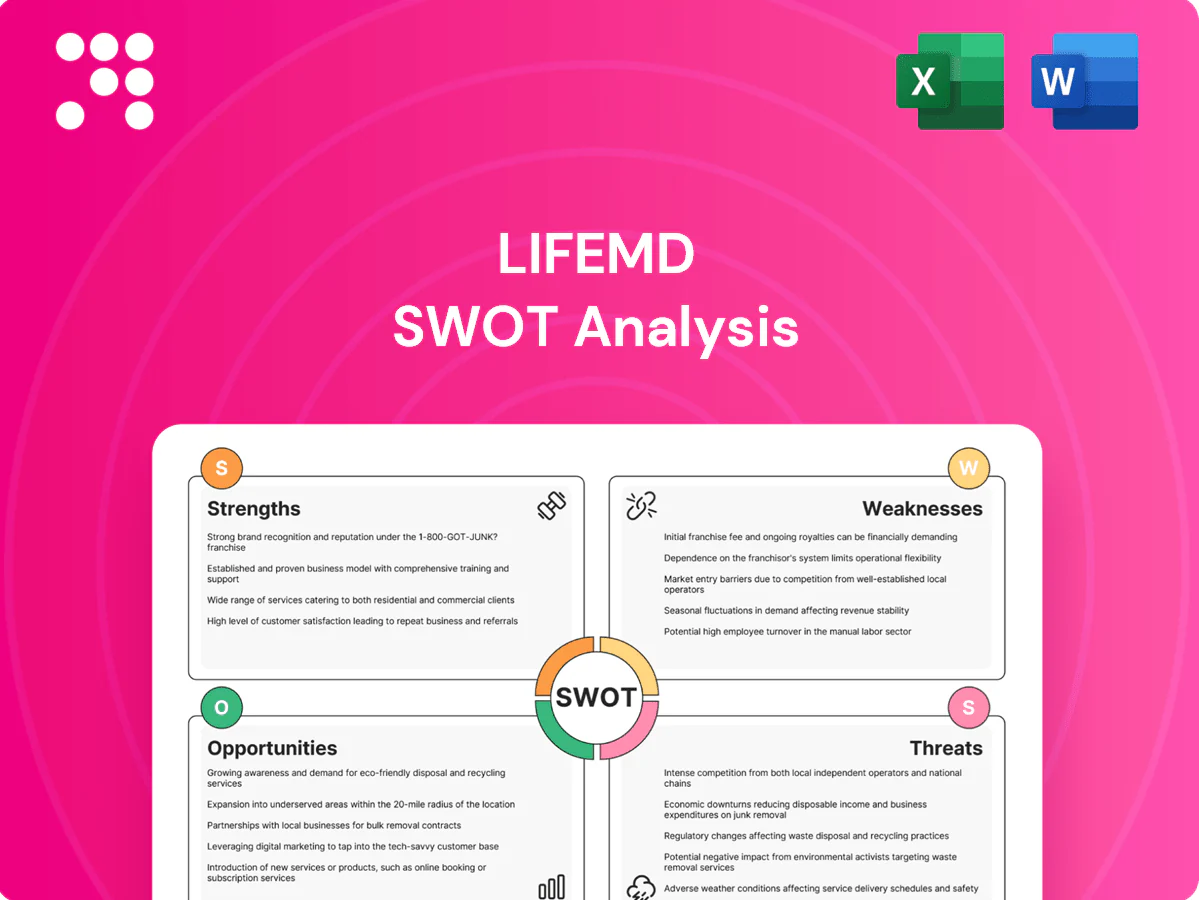
LifeMD SWOT Analysis
This is the actual LifeMD SWOT analysis document you’ll receive upon purchase—no surprises, just professional quality. The preview below is pulled directly from the complete, editable report, showing the same structure, findings, and data you’ll download after checkout. Purchase unlocks the full, detailed version ready for use in strategic planning and valuation.

Original: $10.00
-65%$10.00
$3.50Product Information
Product Information
Shipping & Returns
Shipping & Returns
Description
Go Beyond the Preview—Access the Full Strategic Report
LifeMD shows strong telehealth momentum and diversified virtual care services, but faces regulatory, reimbursement, and competitive pressures that could constrain growth; our concise SWOT highlights key strategic levers and vulnerabilities. Want the full picture? Purchase the complete, editable SWOT (Word + Excel) for actionable insights and investor-ready analysis.
Strengths
Multi-specialty portfolio
Offering men's, women's, dermatology, and weight management broadens LifeMDs addressable market and reduces reliance on any single product line. Year-round demand across chronic and acute conditions smooths revenue seasonality and boosts utilization. Cross-discipline referrals increase lifetime value and create stickier patient relationships, positioning LifeMD as a fuller telehealth alternative to niche rivals.
DTC convenience
Direct-to-consumer virtual care removes scheduling friction and enables consultations, diagnoses and treatment plans from home, boosting conversion and adherence—studies show telehealth can raise adherence ~20–30% and conversion similarly. Telehealth peaked >30% of visits in 2020 and stabilized ~10–15% by 2024, letting LifeMD reach the ~333M US population without heavy brick-and-mortar costs.
Integrated care journey
Connection to licensed providers plus on-platform prescription fulfillment streamlines end-to-end care, cutting handoffs and reported drop-off by up to 20% and improving adherence ~15–25%. Fewer handoffs raise outcomes and patient satisfaction—telehealth satisfaction commonly exceeds 85%—and increase lifetime value through repeat visits. Integrated systems create data feedback loops that refine protocols and reduce costs per episode.
Recurring Rx revenue
Chronic and maintenance therapies map well to subscription-like refills, and with 60% of US adults living with at least one chronic condition (CDC 2023) the addressable base is large. Predictable refill cadence improves revenue visibility and unit economics, while auto-ship and care plans materially reduce churn and stabilize margins. Improved predictability aids cash-flow planning and more efficient scaling.
- Recurring Rx: predictable unit economics
- 60% US adults: chronic care demand (CDC 2023)
- Auto-ship/care plans: lower churn, better cash flow
Scalable tech platform
LifeMD's scalable tech platform standardizes digital triage, scheduling, and telehealth workflows across conditions, leveraging software to lower marginal cost per visit and support rapid feature rollouts.
Data-driven personalization can boost conversion and adherence—telehealth visits grew 32x during COVID (CDC) and stabilized at roughly 8–10% of outpatient visits by 2023, creating scale benefits for partners and monetization.
- Digital triage: replicable workflows
- Lower marginal cost: software leverage
- Personalization: higher conversion/adherence
- Scalability: fast feature/partnership rollout
Multi-specialty telehealth expands reach: 333M, 60% chronic, >85% satisfaction
LifeMD's multi-specialty telehealth model expands addressable market (US pop ~333M), reduces single-line risk, and taps 60%+ adults with chronic conditions (CDC 2023). Integrated prescribing and subscriptions drive predictable unit economics and lower churn. Telehealth scale and >85% satisfaction boost retention and per-patient LTV.
| Metric | Value |
|---|---|
| US pop reach | 333M |
| Chronic prevalence | 60% (CDC 2023) |
| Telehealth satisfaction | >85% |
What is included in the product
Detailed Word Document
Delivers a strategic overview of LifeMD’s internal and external business factors, outlining strengths, weaknesses, opportunities, and threats to assess its competitive position, growth drivers, operational gaps, and market risks.
Customizable Excel Spreadsheet
Provides a concise LifeMD SWOT matrix to quickly surface and address clinical, regulatory, and operational pain points for faster remediation.
Weaknesses
High CAC dependence
Customer acquisition for LifeMD relies heavily on paid digital channels and brand marketing, concentrating spend in search, social and programmatic. Rising ad auction costs across major platforms can compress margins and raise CAC. Dependence on performance marketing creates volatility in growth when bid prices or platform algorithms shift, and limited organic brand equity may slow efficient scaling.
Limited clinical scope
Virtual care is constrained for conditions needing labs, imaging, or procedures, so LifeMD’s model limits acuity and scope and relies on referrals for in-person diagnostics. McKinsey estimates roughly 20%–25% of outpatient care can be delivered virtually, capping average revenue per user versus higher-margin in-person services. Frequent hand-offs risk fragmented care and complicate payer integration and outcomes tracking.
Regulatory complexity
LifeMD faces 51 separate state/DC licensure regimes and shifting telehealth rules since the COVID PHE ended May 11, 2023, which increases operational burden and limits prescribing of controlled substances. Compliance costs and process changes can be material; HIPAA penalties can reach up to 1.5 million USD per year per violation category. Variability complicates uniform product design and errors risk fines, reputational harm, or service disruption.
Third-party dependencies
LifeMDs reliance on external pharmacies, fulfillment carriers, and payment rails creates chokepoints where vendor outages or carrier disruptions directly delay prescriptions and revenue recognition. Vendor performance variability has measurable impact on delivery times and patient satisfaction, and supply constraints can force cancellations or treatment delays. High switching costs and integration work increase friction when replacing underperforming partners.
- Dependence on external pharmacies
- Carrier/vendor performance risk
- Supply-driven cancellations
- High switching/integration costs
Churn and adherence risk
Consumer telehealth shows materially higher churn than traditional primary care, with industry studies reporting 90-day retention often below 30% (2022–24), reducing LTV and stretching CAC payback beyond typical 12–18 month targets.
Poor adherence in chronic-care programs—adherence rates frequently under 50% at 6–12 months—undermines clinical outcomes and revenue predictability, forcing ongoing engagement spend to preserve retention.
- Churn: 90-day retention <30%
- Adherence: <50% at 6–12 months
- Financial impact: CAC payback >12–18 months
- Mitigation: sustained engagement spend required
Telehealth growth constrained by rising CAC, 90-day retention under 30%, addressable care 20-25%
LifeMD’s growth is sensitive to rising paid-media costs and concentrated performance marketing, pushing CAC and compressing margins; industry 90-day retention often <30% and CAC payback frequently exceeds 12–18 months. Telehealth caps addressable care at ~20–25% (McKinsey), limiting ARPU versus in-person services. Regulatory complexity (51 states/DC) and HIPAA exposure (penalties up to 1.5M USD per violation category) raise compliance costs. Vendor/pharmacy dependencies create fulfillment chokepoints and service risk.
| Metric | Value |
|---|---|
| Telehealth addressable care | 20–25% |
| 90-day retention | <30% |
| Adherence 6–12 mo | <50% |
| HIPAA max penalty | 1.5M USD/violation category/yr |
| Licensure burden | 51 states/DC |
Preview the Actual Deliverable
LifeMD SWOT Analysis
This is the actual LifeMD SWOT analysis document you’ll receive upon purchase—no surprises, just professional quality. The preview below is pulled directly from the complete, editable report, showing the same structure, findings, and data you’ll download after checkout. Purchase unlocks the full, detailed version ready for use in strategic planning and valuation.