Bank Leumi PESTLE Analysis

Make Smarter Strategic Decisions with a Complete PESTEL View
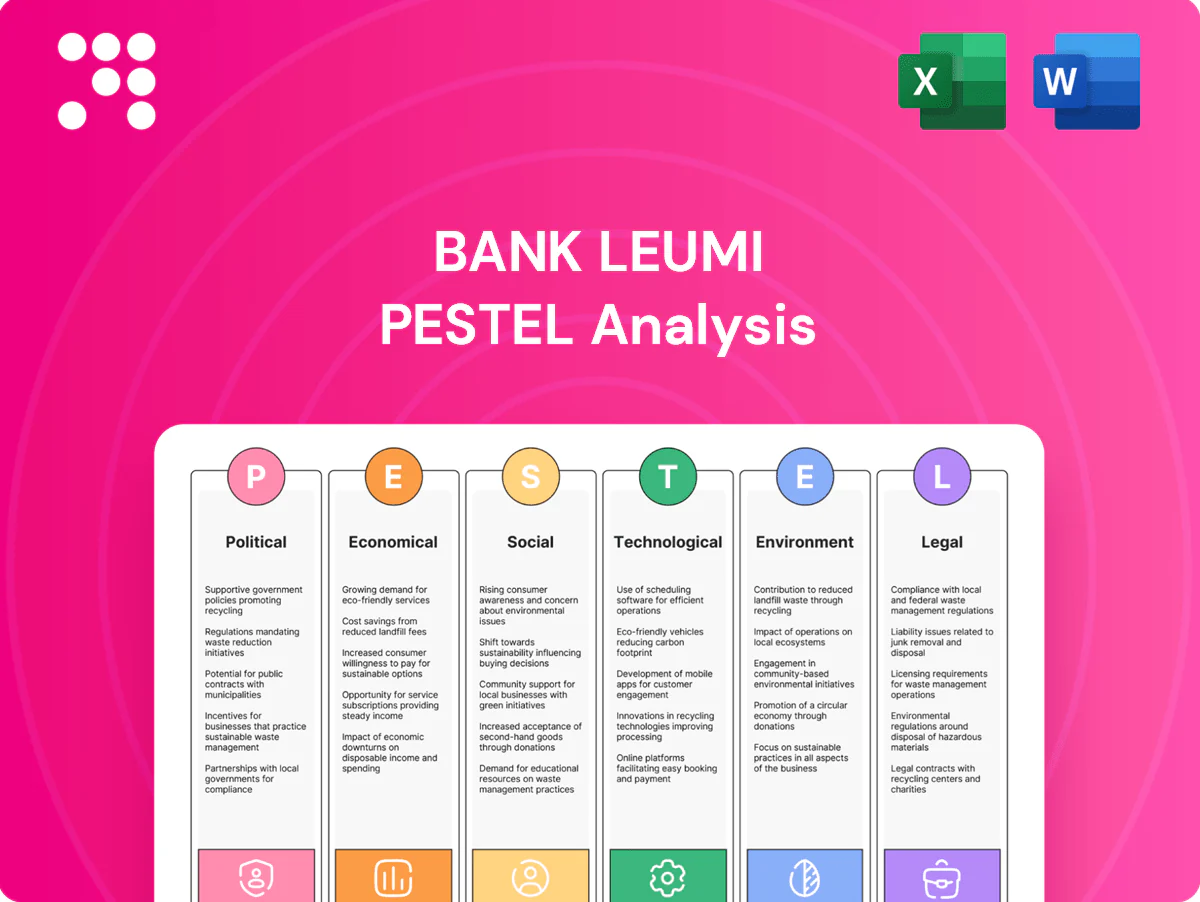
Gain a strategic edge with our PESTLE analysis of Bank Leumi—concise, evidence-based insights into political, economic, social, technological, legal and environmental forces shaping its future. Ideal for investors and strategists, it turns external trends into actionable risks and opportunities. Buy the full report for the complete breakdown and ready-to-use slides.
Political factors

Geopolitical instability and security risk
Regional conflict, terrorism and military escalations disrupt Bank Leumi operations, depress sentiment and force higher credit risk assessments, liquidity buffers and provisioning; Israeli 10-year yields widened roughly 80 basis points during major 2023–24 flare-ups, lifting funding spreads. Cross-border business faces heightened KYC, correspondent de-risking and compliance costs. Robust contingency plans for branch continuity, staff safety and payment flows are essential. Investor risk premiums widen sharply in crises.
Government policy and fiscal stance
Large post-October 2023 defense and reconstruction appropriations—exceeding NIS 100 billion in emergency packages through 2024—have widened fiscal deficits, risking crowding out private credit and steepening local yield curves that affect Bank Leumi funding costs. State guarantees and subsidy programs for SMEs and mortgages have boosted loan demand while reallocating credit risk to taxpayers. Public-sector wage and procurement hikes constrain corporate cash flows and loan servicing capacity. Political turnover could accelerate or delay privatization and banking-competition reforms, altering long-term market structure.

Regulatory authority posture (Bank of Israel)
Regulatory posture: macroprudential tools—countercyclical buffers and mortgage LTV/DTI caps—directly shape Bank Leumi’s growth and risk appetite; BoI guidance tightened investor LTVs to roughly 70–75% in 2023–24. Supervisory stress tests and concentration/cyber guidance have shifted capital to resilience and IT; BoI policy rate near 4.25% in 2025 pressures NIM and deposit migration. Open banking and payments modernization intensify fintech competition.

International relations and sanctions alignment
Alignment with US/EU/OFAC sanctions forces Bank Leumi to maintain enhanced screening that can block counterparties and restrict business lines; sanctions on Russia and Iran since 2022 continue to shape exposure. Shifts in trade alliances affect FX flows and hedging needs within a global FX market of roughly $7.5 trillion/day (BIS 2022). Diplomatic tensions have contributed to a long-term decline in correspondent banking relationships (~20% drop since 2011, World Bank), and compliance breaches risk heavy penalties and reputational loss.
- Sanctions screening: restricts counterparties
- FX impact: $7.5T/day market (BIS 2022)
- Corr. banking: ~20% decline since 2011 (World Bank)
- Risk: regulatory fines and reputational damage
Judicial and governance debates
Institutional reform controversies and 2023–24 mass protests (hundreds of thousands nationwide) have strained rule-of-law perceptions, denting investor confidence and slowing FDI flows into Israel; market volatility spiked, raising banks' VaR and potential collateral calls. Corporate governance expectations for banks like Bank Leumi are tightening, and stakeholder scrutiny of ethical lending has heightened.
- rule-of-law: protests – hundreds of thousands
- market risk: higher VaR / collateral pressure
- governance: tighter bank oversight
- ESG: elevated ethical-lending scrutiny
Funding spreads widen 80bps; BoI 4.25% squeezes NIM
Regional conflict and post-2023 fiscal packages (NIS 100bn+) raised funding spreads—Israeli 10y widened ~80bps—forcing higher provisioning and liquidity. Tightened BoI macroprudentials and a 4.25% policy rate (2025) squeeze NIM while boosting mortgage demand via state guarantees. Sanctions, KYC costs and a ~20% drop in correspondent relationships since 2011 elevate compliance and FX hedging needs (FX market ~$7.5T/day).
| Metric | Value |
|---|---|
| Emergency packages | NIS 100bn+ |
| Israeli 10y move | ~80bps (2023–24) |
| BoI policy rate | 4.25% (2025) |
| Corr. banking change | -20% since 2011 |
What is included in the product
 Detailed Word Document
Explores how Political, Economic, Social, Technological, Environmental and Legal forces uniquely impact Bank Leumi, with data-backed trends and region-specific regulatory context to identify strategic risks and opportunities. Designed for executives, investors and consultants, the analysis offers forward-looking insights and ready-to-use findings for planning, funding pitches and competitive strategy.

 Customizable Excel Spreadsheet
A clean, visually segmented PESTLE summary of Bank Leumi that can be dropped into presentations, annotated with region- or business-specific notes, and easily shared across teams to streamline external risk assessment and market-position discussions.
Economic factors

Interest-rate cycle and NIM sensitivity
High-for-long policy rates (Bank of Israel 4.75% in 2024; US Fed funds 5.25–5.50% in 2024) lift asset yields but force faster deposit repricing, compressing NIM and challenging beta management. Mortgage and SME customers face clear affordability pressure with credit stress and potential delinquency upticks. Balance-sheet duration positioning is pivotal to stabilize NII. Active hedging and fee-income diversification reduce cyclicality.
Tech-led export cycle dependence
Israel’s growth remains tightly coupled to the global tech cycle, with high-tech contributing roughly 15% of GDP and representing over 40% of export receipts, shaping corporate cash balances and the IPO/M&A pipeline. Slowdowns compress transaction banking volumes and advisory fees as deal flow drops. Concentration risk prompts Bank Leumi to enforce sectoral exposure limits. Tech-related FX inflows/outflows heighten shekel volatility and client hedging demand.

Housing market dynamics
Mortgage portfolio health for Bank Leumi depends on housing prices, construction pace and borrower affordability amid higher policy rates (Bank of Israel 4.75% mid‑2025), pressuring serviceability. Regulatory loan-to-value caps and mortgage insurance requirements tighten origination risk and limit credit growth. Development finance exposure is sensitive to permit backlogs and supply constraints, making early-warning indicators and restructuring capabilities critical.

War-related disruptions and inflation
War-related supply shocks—with over 300,000 reservists mobilized—compressed labor supply, raised operational costs for Bank Leumi’s SME clients and increased claims and government support flows that disrupted cash cycles; consumer inflation in Israel hovered around 4–5% in 2023–24, squeezing real deposit growth and raising fee sensitivity, while elevated uncertainty lifted credit costs and tightened underwriting standards.
- Reservist mobilization: >300,000
- Inflation (2023–24): ~4–5%
- SME cost pressure: higher wages, supply-chain shocks
- Credit/underwriting: tighter, higher risk premia
Funding mix and liquidity
Bank Leumi’s funding mix—core deposits, wholesale markets and covered bonds—shapes cost and tenor stability; market stress can widen spreads and pressure LCR/NSFR buffers. Securitization and repo lines provide funding flexibility but increase operational and market complexity. Diversified FX funding reduces concentration risk and improves resilience to currency-specific shocks.
- Core deposits: stable low-cost base
- Wholesale/covered bonds: tenor vs cost trade-off
- Securitization/repo: flexibility + complexity
- FX diversification: lowers concentration risk
Funding spreads widen 80bps; BoI 4.25% squeezes NIM
High-for-long rates (BoI 4.75% mid‑2025; US Fed 5.25–5.50% 2024) raise yields but compress NIM and stress deposit repricing. Tech cycle (≈15% GDP; >40% exports) drives corporate flows and FX volatility. Mortgage/SME affordability and reservist mobilization (>300,000) elevate credit risk; inflation ~4–5% (2023–24) tightens margins.
| Metric | Value |
|---|---|
| BoI rate | 4.75% |
| Fed funds | 5.25–5.50% |
| Tech % GDP | ≈15% |
| Inflation | ~4–5% |
| Reservists | >300,000 |
What You See Is What You Get
Bank Leumi PESTLE Analysis
The preview shown here is the exact Bank Leumi PESTLE Analysis you’ll receive after purchase—fully formatted, professionally structured, and ready to use. No placeholders or teasers; this is the final file. After checkout you can download this same document instantly.

Original: $10.00
-65%$10.00
$3.50Product Information
Product Information
Shipping & Returns
Shipping & Returns
Description
Make Smarter Strategic Decisions with a Complete PESTEL View
Gain a strategic edge with our PESTLE analysis of Bank Leumi—concise, evidence-based insights into political, economic, social, technological, legal and environmental forces shaping its future. Ideal for investors and strategists, it turns external trends into actionable risks and opportunities. Buy the full report for the complete breakdown and ready-to-use slides.
Political factors
Geopolitical instability and security risk
Regional conflict, terrorism and military escalations disrupt Bank Leumi operations, depress sentiment and force higher credit risk assessments, liquidity buffers and provisioning; Israeli 10-year yields widened roughly 80 basis points during major 2023–24 flare-ups, lifting funding spreads. Cross-border business faces heightened KYC, correspondent de-risking and compliance costs. Robust contingency plans for branch continuity, staff safety and payment flows are essential. Investor risk premiums widen sharply in crises.
Government policy and fiscal stance
Large post-October 2023 defense and reconstruction appropriations—exceeding NIS 100 billion in emergency packages through 2024—have widened fiscal deficits, risking crowding out private credit and steepening local yield curves that affect Bank Leumi funding costs. State guarantees and subsidy programs for SMEs and mortgages have boosted loan demand while reallocating credit risk to taxpayers. Public-sector wage and procurement hikes constrain corporate cash flows and loan servicing capacity. Political turnover could accelerate or delay privatization and banking-competition reforms, altering long-term market structure.
Regulatory authority posture (Bank of Israel)
Regulatory posture: macroprudential tools—countercyclical buffers and mortgage LTV/DTI caps—directly shape Bank Leumi’s growth and risk appetite; BoI guidance tightened investor LTVs to roughly 70–75% in 2023–24. Supervisory stress tests and concentration/cyber guidance have shifted capital to resilience and IT; BoI policy rate near 4.25% in 2025 pressures NIM and deposit migration. Open banking and payments modernization intensify fintech competition.
International relations and sanctions alignment
Alignment with US/EU/OFAC sanctions forces Bank Leumi to maintain enhanced screening that can block counterparties and restrict business lines; sanctions on Russia and Iran since 2022 continue to shape exposure. Shifts in trade alliances affect FX flows and hedging needs within a global FX market of roughly $7.5 trillion/day (BIS 2022). Diplomatic tensions have contributed to a long-term decline in correspondent banking relationships (~20% drop since 2011, World Bank), and compliance breaches risk heavy penalties and reputational loss.
- Sanctions screening: restricts counterparties
- FX impact: $7.5T/day market (BIS 2022)
- Corr. banking: ~20% decline since 2011 (World Bank)
- Risk: regulatory fines and reputational damage
Judicial and governance debates
Institutional reform controversies and 2023–24 mass protests (hundreds of thousands nationwide) have strained rule-of-law perceptions, denting investor confidence and slowing FDI flows into Israel; market volatility spiked, raising banks' VaR and potential collateral calls. Corporate governance expectations for banks like Bank Leumi are tightening, and stakeholder scrutiny of ethical lending has heightened.
- rule-of-law: protests – hundreds of thousands
- market risk: higher VaR / collateral pressure
- governance: tighter bank oversight
- ESG: elevated ethical-lending scrutiny
Funding spreads widen 80bps; BoI 4.25% squeezes NIM
Regional conflict and post-2023 fiscal packages (NIS 100bn+) raised funding spreads—Israeli 10y widened ~80bps—forcing higher provisioning and liquidity. Tightened BoI macroprudentials and a 4.25% policy rate (2025) squeeze NIM while boosting mortgage demand via state guarantees. Sanctions, KYC costs and a ~20% drop in correspondent relationships since 2011 elevate compliance and FX hedging needs (FX market ~$7.5T/day).
| Metric | Value |
|---|---|
| Emergency packages | NIS 100bn+ |
| Israeli 10y move | ~80bps (2023–24) |
| BoI policy rate | 4.25% (2025) |
| Corr. banking change | -20% since 2011 |
What is included in the product
Detailed Word Document
Explores how Political, Economic, Social, Technological, Environmental and Legal forces uniquely impact Bank Leumi, with data-backed trends and region-specific regulatory context to identify strategic risks and opportunities. Designed for executives, investors and consultants, the analysis offers forward-looking insights and ready-to-use findings for planning, funding pitches and competitive strategy.
Customizable Excel Spreadsheet
A clean, visually segmented PESTLE summary of Bank Leumi that can be dropped into presentations, annotated with region- or business-specific notes, and easily shared across teams to streamline external risk assessment and market-position discussions.
Economic factors
Interest-rate cycle and NIM sensitivity
High-for-long policy rates (Bank of Israel 4.75% in 2024; US Fed funds 5.25–5.50% in 2024) lift asset yields but force faster deposit repricing, compressing NIM and challenging beta management. Mortgage and SME customers face clear affordability pressure with credit stress and potential delinquency upticks. Balance-sheet duration positioning is pivotal to stabilize NII. Active hedging and fee-income diversification reduce cyclicality.
Tech-led export cycle dependence
Israel’s growth remains tightly coupled to the global tech cycle, with high-tech contributing roughly 15% of GDP and representing over 40% of export receipts, shaping corporate cash balances and the IPO/M&A pipeline. Slowdowns compress transaction banking volumes and advisory fees as deal flow drops. Concentration risk prompts Bank Leumi to enforce sectoral exposure limits. Tech-related FX inflows/outflows heighten shekel volatility and client hedging demand.
Housing market dynamics
Mortgage portfolio health for Bank Leumi depends on housing prices, construction pace and borrower affordability amid higher policy rates (Bank of Israel 4.75% mid‑2025), pressuring serviceability. Regulatory loan-to-value caps and mortgage insurance requirements tighten origination risk and limit credit growth. Development finance exposure is sensitive to permit backlogs and supply constraints, making early-warning indicators and restructuring capabilities critical.
War-related disruptions and inflation
War-related supply shocks—with over 300,000 reservists mobilized—compressed labor supply, raised operational costs for Bank Leumi’s SME clients and increased claims and government support flows that disrupted cash cycles; consumer inflation in Israel hovered around 4–5% in 2023–24, squeezing real deposit growth and raising fee sensitivity, while elevated uncertainty lifted credit costs and tightened underwriting standards.
- Reservist mobilization: >300,000
- Inflation (2023–24): ~4–5%
- SME cost pressure: higher wages, supply-chain shocks
- Credit/underwriting: tighter, higher risk premia
Funding mix and liquidity
Bank Leumi’s funding mix—core deposits, wholesale markets and covered bonds—shapes cost and tenor stability; market stress can widen spreads and pressure LCR/NSFR buffers. Securitization and repo lines provide funding flexibility but increase operational and market complexity. Diversified FX funding reduces concentration risk and improves resilience to currency-specific shocks.
- Core deposits: stable low-cost base
- Wholesale/covered bonds: tenor vs cost trade-off
- Securitization/repo: flexibility + complexity
- FX diversification: lowers concentration risk
Funding spreads widen 80bps; BoI 4.25% squeezes NIM
High-for-long rates (BoI 4.75% mid‑2025; US Fed 5.25–5.50% 2024) raise yields but compress NIM and stress deposit repricing. Tech cycle (≈15% GDP; >40% exports) drives corporate flows and FX volatility. Mortgage/SME affordability and reservist mobilization (>300,000) elevate credit risk; inflation ~4–5% (2023–24) tightens margins.
| Metric | Value |
|---|---|
| BoI rate | 4.75% |
| Fed funds | 5.25–5.50% |
| Tech % GDP | ≈15% |
| Inflation | ~4–5% |
| Reservists | >300,000 |
What You See Is What You Get
Bank Leumi PESTLE Analysis
The preview shown here is the exact Bank Leumi PESTLE Analysis you’ll receive after purchase—fully formatted, professionally structured, and ready to use. No placeholders or teasers; this is the final file. After checkout you can download this same document instantly.