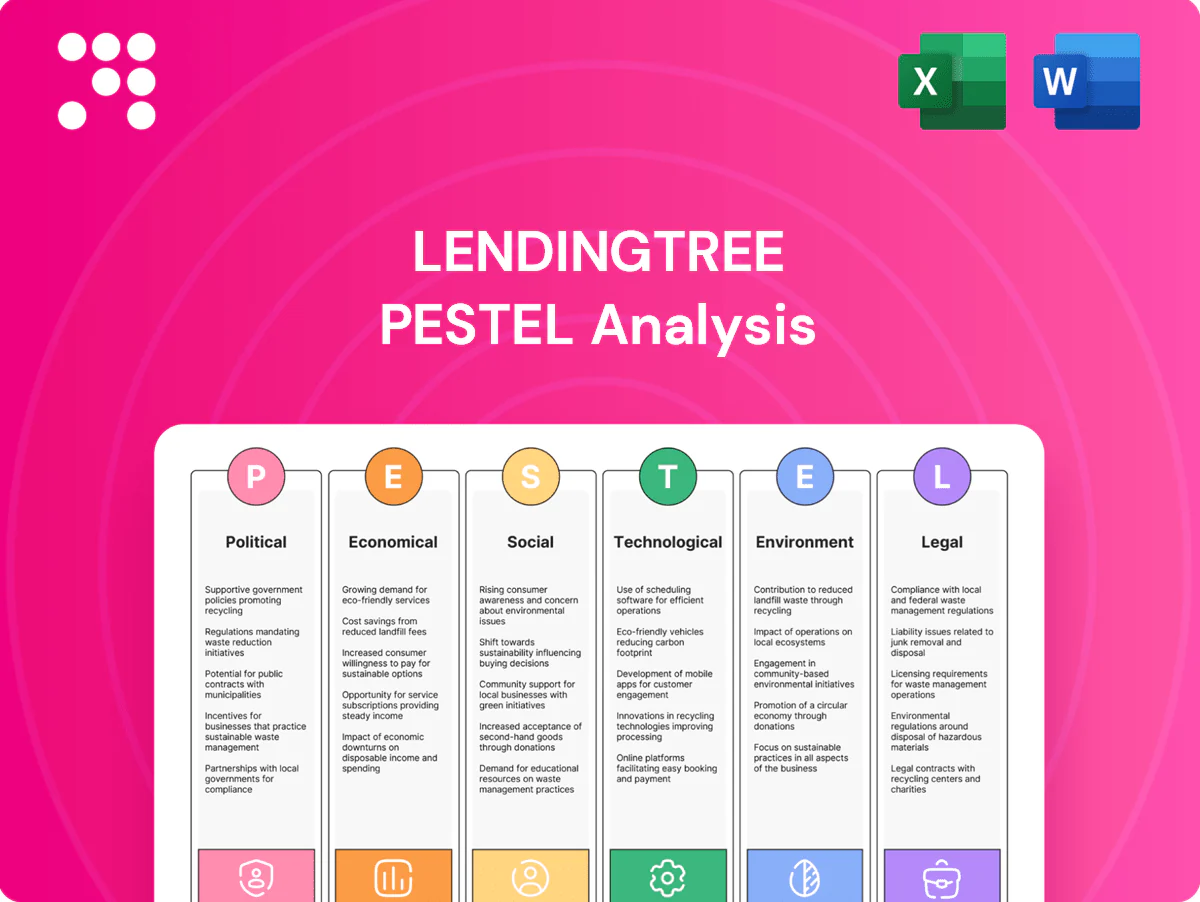
LendingTree PESTLE Analysis

Skip the Research. Get the Strategy.
Unlock strategic clarity with our PESTLE Analysis of LendingTree—three to five expert perspectives on political, economic, social, technological, legal, and environmental forces shaping its future. Use these insights to forecast risks, identify growth opportunities, and refine investment theses. Buy the full report for the complete, editable breakdown and actionable intelligence you can deploy immediately.
Political factors

Shifts in consumer-finance policy priorities
Changes in U.S. administration priorities after the 2024 election can tighten or loosen oversight of lending and lead-generation practices under authorities created by the Dodd-Frank Act (2010). Greater emphasis on consumer protection from the CFPB and FTC raises compliance expectations for partners and platforms. Pro-business agendas can accelerate innovation sandboxes and alternative-data pilots. LendingTree must track and adapt messaging, disclosures, and partner curation accordingly.
Housing and mortgage-related government programs
Policies affecting FHA, VA, GSEs and first-time buyer incentives directly shift mortgage demand on LendingTree’s marketplace; for example the conforming loan limit (recently at $726,200 for most areas) alters purchase affordability and pipeline composition. Expanded guarantees or subsidy programs historically raise lead volumes, while pullbacks soften activity and lower conversion rates. Changes to mortgage insurance premiums and VA/GSE eligibility skew LendingTree’s traffic mix and revenue per lead, increasing sensitivity to policy moves.

Data privacy and cross-border data transfer stances
Evolving political stances on data sovereignty—exemplified by GDPR (2018), CCPA (2020) and the EU‑US Data Privacy Framework (Oct 2022)—can constrain cross‑border flows and vendor choices, pushing firms toward domestic hosting and stricter tracking controls. Heightened ad‑tech scrutiny and Google’s phased removal of third‑party cookies (delayed into late 2024) reduce targeting efficiency. LendingTree must keep modular data architectures and robust consent frameworks to adapt.

Antitrust and platform accountability scrutiny
Fiscal/monetary coordination visibility
Political pressure on rates and liquidity facilities—with the federal funds target around 5.25%–5.50% (mid-2025) and 30-year mortgage ~7.2%—directly shapes credit availability and cost for LendingTree users. Uncertainty around fiscal programs reduces consumer confidence and borrowing; government shutdowns can delay housing data, IRS verifications and mortgage processing, creating policy-driven volume volatility that LendingTree must plan for.
- Rate pressure: federal funds 5.25%–5.50%
- Mortgage cost: 30-yr ~7.2%
- Risk: shutdowns delay IRS/mortgage processing
- Implication: plan for policy-driven volume swings
Policy shifts tighten compliance; rates raise credit costs — $726,200, 5.25–5.50%, 7.2%
Political shifts alter oversight, lending demand and data rules—CFPB/FTC tightening raises compliance; conforming loan limit $726,200 shifts mortgage mix; federal funds 5.25–5.50% and 30‑yr ~7.2% affect credit cost and volumes.
| Policy | Impact |
|---|---|
| DMA/GDPR/CCPA | Fines up to 10%/20%; stricter data controls |
What is included in the product
 Detailed Word Document
Explores how macro-environmental factors uniquely impact LendingTree across Political, Economic, Social, Technological, Environmental, and Legal dimensions, with data-backed trends and region-specific regulatory context; designed to help executives and investors identify risks, opportunities, and forward-looking strategic responses.

 Customizable Excel Spreadsheet
A concise, visually segmented LendingTree PESTLE summary that clarifies regulatory, economic, and technological risks at a glance, easing discussion in meetings; editable and exportable for quick inclusion in decks or team briefs to align strategy and mitigate external threats.
Economic factors

Interest-rate cycles and refinancing waves
Rate moves directly drive LendingTree mortgage origination and refinance demand: with the 30-year fixed near 7.2% in 2024 (Freddie Mac) refinance applications fell roughly 80–90% versus 2020 levels (MBA), cutting referral volume. Higher rates push consumers toward personal loans and credit cards, changing product mix and lifetime value. Volatility increases comparison-shopping but reduces close rates, while revenue per lead and partner marketing budgets swing by double-digit percentages with the rate cycle.
Credit cycle and lender risk appetite
Tightening underwriting reported in the Federal Reserve SLOOS (Q4 2024) has reduced approval odds and conversion, pressuring yields, while looser consumer credit windows expand addressable audiences and partner bids. Rising 90+ day credit card delinquencies (~3.6% Q4 2024, New York Fed) drives marketing pullbacks or surges, so LendingTree must dynamically route, score, and price leads by real‑time risk conditions.

Housing market supply, prices, and mobility
Low inventory (roughly 2.5 months supply in 2024) and a median existing‑home price near $390,000 in 2024 boost purchase mortgage demand in high‑growth markets while squeezing affordability elsewhere. Affordability constraints have driven more borrowers toward HELOCs and personal loans as stopgaps. Regional migration to Sun Belt metros shifts lender mix and payout rates by market. Localized SEO/SEM and partner networks help capture these pockets of strength.

Employment, income, and consumer confidence
Job gains and wage growth—US unemployment 3.7% at end‑2024 and average hourly earnings +4.2% YoY—support borrowing intent and creditworthiness; conversely weak labor markets suppress demand and raise delinquencies. Consumer Confidence (Conference Board ~104 in Dec‑2024) swings affect discretionary borrowing such as debt consolidation, so messaging and product emphasis should track sentiment indicators.
- Labor: unemployment 3.7% (Dec‑2024); AHE +4.2% YoY
- Confidence: Conference Board ~104 (Dec‑2024)
- Impact: drives credit demand, delinquency risk
- Action: align marketing/product with sentiment data
Marketing cost inflation and partner CAC targets
Rising paid-media costs—CPCs in the finance vertical rose about 15% in 2024—compress LendingTree margins and lower partner ROI, forcing lenders to tighten bids and reallocate budgets based on lifetime value and higher charge-off forecasts.
- Rebalance bids vs LTV
- Invest in SEO/direct traffic
- Optimize funnel to cut CAC
- Pricing algos must use real-time monetization signals
Policy shifts tighten compliance; rates raise credit costs — $726,200, 5.25–5.50%, 7.2%
Higher rates (30‑yr ~7.2% 2024, Freddie Mac) cut refi apps ~80–90% vs 2020 (MBA), shifting mix to personal loans/credit cards; tight underwriting and 90+ day delinquencies ~3.6% (Q4‑2024, NY Fed) lower close rates. Low inventory (~2.5 months) and median home price ~$390,000 (2024) sustain purchase demand; CPCs in finance +15% (2024), pressuring CAC and margins.
| Metric | 2024 |
|---|---|
| 30‑yr rate | ~7.2% |
| Refi apps vs 2020 | -80–90% |
| Unemployment | 3.7% (Dec‑2024) |
| 90+ delinq | ~3.6% |
| Inventory | ~2.5 months |
| Median home price | ~$390,000 |
| Finance CPC | +15% |
Preview the Actual Deliverable
LendingTree PESTLE Analysis
The preview shown here is the exact LendingTree PESTLE Analysis document you’ll receive after purchase—fully formatted and ready to use. The content, structure, and layout displayed are the final version with no placeholders. Download the same file immediately after checkout.

Original: $10.00
-65%$10.00
$3.50Product Information
Product Information
Shipping & Returns
Shipping & Returns
Description
Skip the Research. Get the Strategy.
Unlock strategic clarity with our PESTLE Analysis of LendingTree—three to five expert perspectives on political, economic, social, technological, legal, and environmental forces shaping its future. Use these insights to forecast risks, identify growth opportunities, and refine investment theses. Buy the full report for the complete, editable breakdown and actionable intelligence you can deploy immediately.
Political factors
Shifts in consumer-finance policy priorities
Changes in U.S. administration priorities after the 2024 election can tighten or loosen oversight of lending and lead-generation practices under authorities created by the Dodd-Frank Act (2010). Greater emphasis on consumer protection from the CFPB and FTC raises compliance expectations for partners and platforms. Pro-business agendas can accelerate innovation sandboxes and alternative-data pilots. LendingTree must track and adapt messaging, disclosures, and partner curation accordingly.
Housing and mortgage-related government programs
Policies affecting FHA, VA, GSEs and first-time buyer incentives directly shift mortgage demand on LendingTree’s marketplace; for example the conforming loan limit (recently at $726,200 for most areas) alters purchase affordability and pipeline composition. Expanded guarantees or subsidy programs historically raise lead volumes, while pullbacks soften activity and lower conversion rates. Changes to mortgage insurance premiums and VA/GSE eligibility skew LendingTree’s traffic mix and revenue per lead, increasing sensitivity to policy moves.
Data privacy and cross-border data transfer stances
Evolving political stances on data sovereignty—exemplified by GDPR (2018), CCPA (2020) and the EU‑US Data Privacy Framework (Oct 2022)—can constrain cross‑border flows and vendor choices, pushing firms toward domestic hosting and stricter tracking controls. Heightened ad‑tech scrutiny and Google’s phased removal of third‑party cookies (delayed into late 2024) reduce targeting efficiency. LendingTree must keep modular data architectures and robust consent frameworks to adapt.
Antitrust and platform accountability scrutiny
Fiscal/monetary coordination visibility
Political pressure on rates and liquidity facilities—with the federal funds target around 5.25%–5.50% (mid-2025) and 30-year mortgage ~7.2%—directly shapes credit availability and cost for LendingTree users. Uncertainty around fiscal programs reduces consumer confidence and borrowing; government shutdowns can delay housing data, IRS verifications and mortgage processing, creating policy-driven volume volatility that LendingTree must plan for.
- Rate pressure: federal funds 5.25%–5.50%
- Mortgage cost: 30-yr ~7.2%
- Risk: shutdowns delay IRS/mortgage processing
- Implication: plan for policy-driven volume swings
Policy shifts tighten compliance; rates raise credit costs — $726,200, 5.25–5.50%, 7.2%
Political shifts alter oversight, lending demand and data rules—CFPB/FTC tightening raises compliance; conforming loan limit $726,200 shifts mortgage mix; federal funds 5.25–5.50% and 30‑yr ~7.2% affect credit cost and volumes.
| Policy | Impact |
|---|---|
| DMA/GDPR/CCPA | Fines up to 10%/20%; stricter data controls |
What is included in the product
Detailed Word Document
Explores how macro-environmental factors uniquely impact LendingTree across Political, Economic, Social, Technological, Environmental, and Legal dimensions, with data-backed trends and region-specific regulatory context; designed to help executives and investors identify risks, opportunities, and forward-looking strategic responses.
Customizable Excel Spreadsheet
A concise, visually segmented LendingTree PESTLE summary that clarifies regulatory, economic, and technological risks at a glance, easing discussion in meetings; editable and exportable for quick inclusion in decks or team briefs to align strategy and mitigate external threats.
Economic factors
Interest-rate cycles and refinancing waves
Rate moves directly drive LendingTree mortgage origination and refinance demand: with the 30-year fixed near 7.2% in 2024 (Freddie Mac) refinance applications fell roughly 80–90% versus 2020 levels (MBA), cutting referral volume. Higher rates push consumers toward personal loans and credit cards, changing product mix and lifetime value. Volatility increases comparison-shopping but reduces close rates, while revenue per lead and partner marketing budgets swing by double-digit percentages with the rate cycle.
Credit cycle and lender risk appetite
Tightening underwriting reported in the Federal Reserve SLOOS (Q4 2024) has reduced approval odds and conversion, pressuring yields, while looser consumer credit windows expand addressable audiences and partner bids. Rising 90+ day credit card delinquencies (~3.6% Q4 2024, New York Fed) drives marketing pullbacks or surges, so LendingTree must dynamically route, score, and price leads by real‑time risk conditions.
Housing market supply, prices, and mobility
Low inventory (roughly 2.5 months supply in 2024) and a median existing‑home price near $390,000 in 2024 boost purchase mortgage demand in high‑growth markets while squeezing affordability elsewhere. Affordability constraints have driven more borrowers toward HELOCs and personal loans as stopgaps. Regional migration to Sun Belt metros shifts lender mix and payout rates by market. Localized SEO/SEM and partner networks help capture these pockets of strength.
Employment, income, and consumer confidence
Job gains and wage growth—US unemployment 3.7% at end‑2024 and average hourly earnings +4.2% YoY—support borrowing intent and creditworthiness; conversely weak labor markets suppress demand and raise delinquencies. Consumer Confidence (Conference Board ~104 in Dec‑2024) swings affect discretionary borrowing such as debt consolidation, so messaging and product emphasis should track sentiment indicators.
- Labor: unemployment 3.7% (Dec‑2024); AHE +4.2% YoY
- Confidence: Conference Board ~104 (Dec‑2024)
- Impact: drives credit demand, delinquency risk
- Action: align marketing/product with sentiment data
Marketing cost inflation and partner CAC targets
Rising paid-media costs—CPCs in the finance vertical rose about 15% in 2024—compress LendingTree margins and lower partner ROI, forcing lenders to tighten bids and reallocate budgets based on lifetime value and higher charge-off forecasts.
- Rebalance bids vs LTV
- Invest in SEO/direct traffic
- Optimize funnel to cut CAC
- Pricing algos must use real-time monetization signals
Policy shifts tighten compliance; rates raise credit costs — $726,200, 5.25–5.50%, 7.2%
Higher rates (30‑yr ~7.2% 2024, Freddie Mac) cut refi apps ~80–90% vs 2020 (MBA), shifting mix to personal loans/credit cards; tight underwriting and 90+ day delinquencies ~3.6% (Q4‑2024, NY Fed) lower close rates. Low inventory (~2.5 months) and median home price ~$390,000 (2024) sustain purchase demand; CPCs in finance +15% (2024), pressuring CAC and margins.
| Metric | 2024 |
|---|---|
| 30‑yr rate | ~7.2% |
| Refi apps vs 2020 | -80–90% |
| Unemployment | 3.7% (Dec‑2024) |
| 90+ delinq | ~3.6% |
| Inventory | ~2.5 months |
| Median home price | ~$390,000 |
| Finance CPC | +15% |
Preview the Actual Deliverable
LendingTree PESTLE Analysis
The preview shown here is the exact LendingTree PESTLE Analysis document you’ll receive after purchase—fully formatted and ready to use. The content, structure, and layout displayed are the final version with no placeholders. Download the same file immediately after checkout.