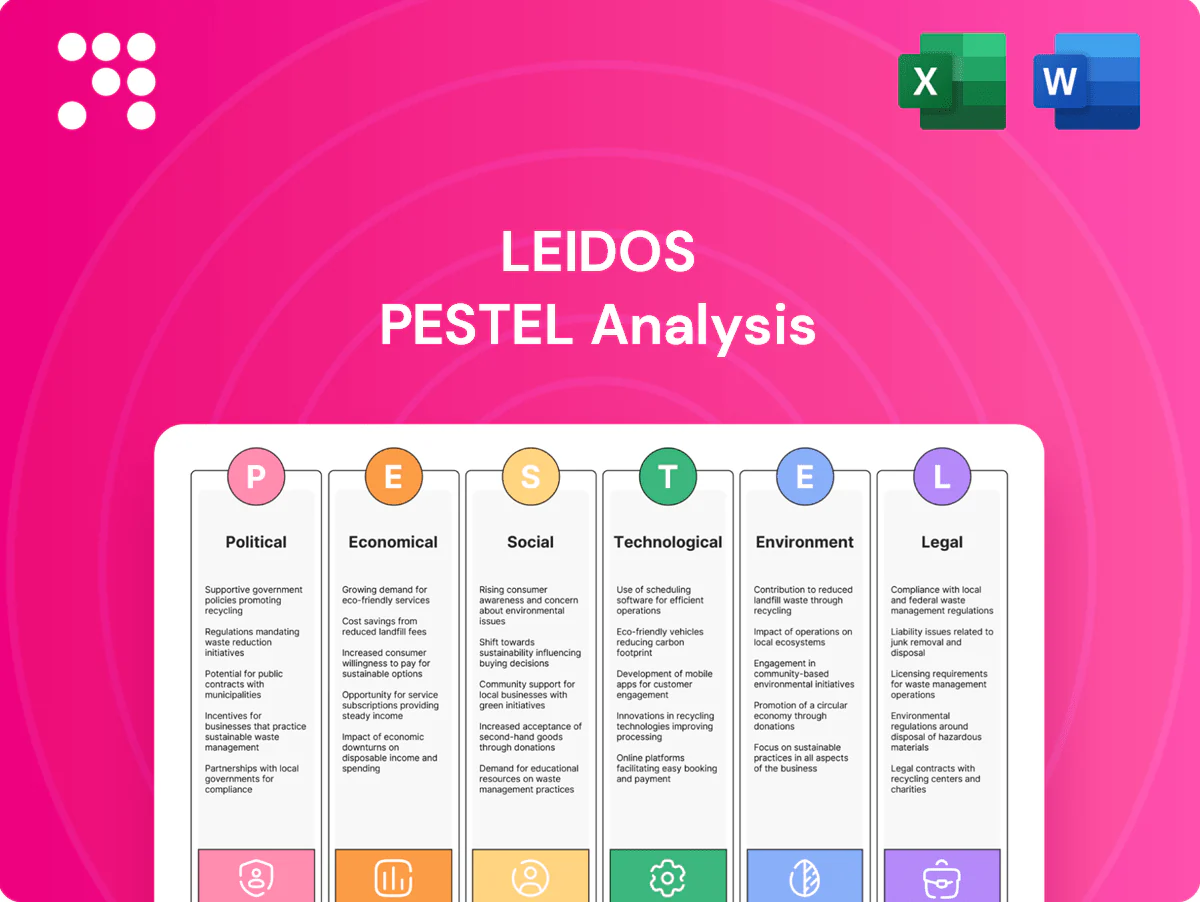
Leidos PESTLE Analysis

Skip the Research. Get the Strategy.
Gain a competitive edge with our targeted PESTLE analysis of Leidos. Uncover how political, economic, social, technological, legal and environmental forces shape its strategy and risks, with concise insights ready for investors and strategists. Purchase the full report to download actionable, editable intelligence now.
Political factors

Defense budget cycles
Leidos' revenue is closely tied to U.S. and allied defense appropriations. Shifts in Congress or administration priorities can accelerate or delay program funding, with FY2024 U.S. defense discretionary spending about $858 billion affecting award timing. Continuing resolutions and shutdown risks create cash‑flow uncertainty, while multi‑year procurements improve backlog visibility for contractors like Leidos.
Geopolitical tensions
Conflict hotspots and great‑power competition drive demand for ISR, cyber, and mission systems, supported by global military spending of about 2.3 trillion USD in 2023 (SIPRI) and US defense discretionary spending near 858 billion USD in FY2024. Rapid threat evolution favors agile, deployable contractors that capture accelerated procurement cycles. Escalation often triggers supplements (eg, ~113 billion USD US Ukraine aid 2022), while detente can compress pipelines. Export permissions and ITAR shape international deal flow and timing.

Procurement policy changes
Acquisition reforms like OTAs and modular contracting, accelerated by DoD guidance (CMMC 2.0 finalized 2023), can shorten sales cycles by months for Leidos’ innovative tech and enable faster prototypes-to-production. Buy‑American rules and the federal 23% small‑business goal (small firms captured ~26% of federal contract dollars in FY2023) plus CMMC drive teaming and subcontracting choices. Shifts in evaluation weighting toward best value versus lowest price directly affect margins, while compliance burden varies across DoD, DHS, IC and civil agencies.

Allied collaboration
AUKUS (US, UK, Australia), Five Eyes (5 nations) and NATO interoperability programs expand Leidos addressable markets as allied supply chains and joint standards make systems more exportable; NATO members' combined defense spending exceeds 1 trillion USD annually, shaping demand. Partner‑nation budgets and reciprocal access agreements directly influence pipeline quality and program timing, while offsets and local‑content rules force adjusted pricing and delivery models.
- AUKUS: 3 partners, deeper naval/ASW markets
- Five Eyes: 5 partners, shared ISR/CTI programs
- NATO: >1 trillion USD collective spend
- Offsets/local content: alter margins and delivery timelines
Political scrutiny and ethics
Surveillance, AI, and defense work draw heightened congressional and public oversight, exposing Leidos (FY2024 revenue $14.4B, backlog ~$34.2B) to reputational risk and mid‑stream requirement changes that can affect contract value and timelines.
- NIST AI RMF v1.0 (2023) raises compliance expectations
- Program visibility increases oversight and repricing risk
- Strong governance and transparency protect contract positions
- Ethical AI practices can be bid differentiators
Defense ~858B USD, global ~2.3T USD boost ISR & cyber
Leidos revenue is tied to U.S. and allied defense appropriations; FY2024 U.S. defense discretionary ~858 billion USD and global military spending ~2.3 trillion USD (2023) drive program timing. Conflict and great‑power competition boost ISR, cyber and mission systems demand, while export controls and ITAR shape international deals. FY2024 Leidos revenue 14.4B USD, backlog ~34.2B USD increases exposure to oversight and procurement shifts.
| Tag | Value |
|---|---|
| US DoD FY2024 | ~858B USD |
| Global military 2023 | ~2.3T USD (SIPRI) |
| NATO collective | >1T USD |
| Leidos FY2024 rev | 14.4B USD |
| Leidos backlog | ~34.2B USD |
What is included in the product
 Detailed Word Document
Concise PESTLE analysis of Leidos examining Political, Economic, Social, Technological, Environmental and Legal drivers, each supported by current data and trends to reveal risks and opportunities; formatted for executives and investors, region- and industry-specific, with forward-looking insights to inform strategy, scenario planning and funding pitches.

 Customizable Excel Spreadsheet
A concise, visually segmented Leidos PESTLE summary that’s easily dropped into slides, shared across teams, and editable for regional or business-line notes—streamlining discussions on external risks and market positioning during planning sessions.
Economic factors

Macroeconomic cycles
Defense spending is relatively countercyclical—U.S. discretionary defense outlays stayed near $800–850 billion in 2023–25 even as GDP softened—while civil and health projects track GDP and tax receipts, with Medicaid and state health spending rising in downturns. Recessions squeeze discretionary agency budgets and delay modernizations; growth phases enable multi‑year digital investments. Inflation (CPI ~3–4% in 2024) erodes real contract value unless escalation clauses apply.
Inflation and labor costs
Wage inflation for cleared STEM talent is acute — ClearanceJobs reported a 6.7% year‑over‑year pay increase in 2024, which compresses fixed‑price margins for Leidos on programs with static rates. Cost‑plus contracts provide protection but cap upside, making escalation clauses and proactive rate negotiations critical. Productivity tooling and automation have reclaimed multiple percentage points of labor cost, partially offsetting pressure.

Interest rates and capital
Higher interest rates (US fed funds target ~5.25–5.50% in mid‑2025) raise borrowing costs for working capital and M&A, compressing deal volumes. Higher discount rates lift DCF valuations' discount and increase internal hurdle rates for R&D. Federal Prompt Payment Act targets ~30 days, so government payment timing materially affects cash conversion. A strong balance sheet supports bid bonding and large program execution.

Foreign exchange exposure
Foreign contracts expose Leidos to USD/partner-currency volatility, risking margin erosion on multi‑year programs; the company uses documented hedging and contract clauses to stabilize long‑dated program margins and manage cash‑flow variability.
- FX volatility raises bid competitiveness vs local incumbents
- Hedging mitigates long‑term margin risk
- Currency translation affects consolidated results
Industry consolidation
Industry consolidation through M&A reshapes competitive dynamics and capabilities; Leidos, with FY2024 revenue ≈ $14.6 billion, gains cross‑sell and bid overhead leverage from scale. Antitrust scrutiny since 2022 has lengthened deal timelines and sometimes required divestitures, increasing transaction costs. Partnerships and JVs (notably several 2023–24 tech alliances) are used to close capability gaps without full acquisitions.
- Scale: FY2024 revenue ≈ $14.6B
- Cross‑sell/overhead leverage: improved bid competitiveness
- Antitrust: longer approvals, potential divestitures since 2022
- Alternatives: rise in JVs/partnerships in 2023–24
Defense ~858B USD, global ~2.3T USD boost ISR & cyber
Defense spending steady (~$800–850B 2023–25) cushions Leidos; civil/health tied to GDP and Medicaid. Wage inflation (cleared STEM +6.7% 2024) and CPI (~3–4% 2024) compress margins; cost‑plus and automation mitigate. Higher rates (fed funds ~5.25–5.50% mid‑2025) raise financing costs; FY2024 revenue ≈ $14.6B supports bids.
| Metric | Value |
|---|---|
| FY2024 revenue | $14.6B |
| US defense spend (2023–25) | $800–850B |
| CPI (2024) | ~3–4% |
| Cleared STEM pay (2024) | +6.7% |
| Fed funds (mid‑2025) | 5.25–5.50% |
Full Version Awaits
Leidos PESTLE Analysis
The preview shown here is the exact Leidos PESTLE Analysis you’ll receive after purchase—fully formatted and ready to use. This is the real, finished document with the same layout, content, and structure visible now. No placeholders or surprises—download immediately after checkout.

Product Information
Product Information
Shipping & Returns
Shipping & Returns
Description
Skip the Research. Get the Strategy.
Gain a competitive edge with our targeted PESTLE analysis of Leidos. Uncover how political, economic, social, technological, legal and environmental forces shape its strategy and risks, with concise insights ready for investors and strategists. Purchase the full report to download actionable, editable intelligence now.
Political factors
Defense budget cycles
Leidos' revenue is closely tied to U.S. and allied defense appropriations. Shifts in Congress or administration priorities can accelerate or delay program funding, with FY2024 U.S. defense discretionary spending about $858 billion affecting award timing. Continuing resolutions and shutdown risks create cash‑flow uncertainty, while multi‑year procurements improve backlog visibility for contractors like Leidos.
Geopolitical tensions
Conflict hotspots and great‑power competition drive demand for ISR, cyber, and mission systems, supported by global military spending of about 2.3 trillion USD in 2023 (SIPRI) and US defense discretionary spending near 858 billion USD in FY2024. Rapid threat evolution favors agile, deployable contractors that capture accelerated procurement cycles. Escalation often triggers supplements (eg, ~113 billion USD US Ukraine aid 2022), while detente can compress pipelines. Export permissions and ITAR shape international deal flow and timing.
Procurement policy changes
Acquisition reforms like OTAs and modular contracting, accelerated by DoD guidance (CMMC 2.0 finalized 2023), can shorten sales cycles by months for Leidos’ innovative tech and enable faster prototypes-to-production. Buy‑American rules and the federal 23% small‑business goal (small firms captured ~26% of federal contract dollars in FY2023) plus CMMC drive teaming and subcontracting choices. Shifts in evaluation weighting toward best value versus lowest price directly affect margins, while compliance burden varies across DoD, DHS, IC and civil agencies.
Allied collaboration
AUKUS (US, UK, Australia), Five Eyes (5 nations) and NATO interoperability programs expand Leidos addressable markets as allied supply chains and joint standards make systems more exportable; NATO members' combined defense spending exceeds 1 trillion USD annually, shaping demand. Partner‑nation budgets and reciprocal access agreements directly influence pipeline quality and program timing, while offsets and local‑content rules force adjusted pricing and delivery models.
- AUKUS: 3 partners, deeper naval/ASW markets
- Five Eyes: 5 partners, shared ISR/CTI programs
- NATO: >1 trillion USD collective spend
- Offsets/local content: alter margins and delivery timelines
Political scrutiny and ethics
Surveillance, AI, and defense work draw heightened congressional and public oversight, exposing Leidos (FY2024 revenue $14.4B, backlog ~$34.2B) to reputational risk and mid‑stream requirement changes that can affect contract value and timelines.
- NIST AI RMF v1.0 (2023) raises compliance expectations
- Program visibility increases oversight and repricing risk
- Strong governance and transparency protect contract positions
- Ethical AI practices can be bid differentiators
Defense ~858B USD, global ~2.3T USD boost ISR & cyber
Leidos revenue is tied to U.S. and allied defense appropriations; FY2024 U.S. defense discretionary ~858 billion USD and global military spending ~2.3 trillion USD (2023) drive program timing. Conflict and great‑power competition boost ISR, cyber and mission systems demand, while export controls and ITAR shape international deals. FY2024 Leidos revenue 14.4B USD, backlog ~34.2B USD increases exposure to oversight and procurement shifts.
| Tag | Value |
|---|---|
| US DoD FY2024 | ~858B USD |
| Global military 2023 | ~2.3T USD (SIPRI) |
| NATO collective | >1T USD |
| Leidos FY2024 rev | 14.4B USD |
| Leidos backlog | ~34.2B USD |
What is included in the product
Detailed Word Document
Concise PESTLE analysis of Leidos examining Political, Economic, Social, Technological, Environmental and Legal drivers, each supported by current data and trends to reveal risks and opportunities; formatted for executives and investors, region- and industry-specific, with forward-looking insights to inform strategy, scenario planning and funding pitches.
Customizable Excel Spreadsheet
A concise, visually segmented Leidos PESTLE summary that’s easily dropped into slides, shared across teams, and editable for regional or business-line notes—streamlining discussions on external risks and market positioning during planning sessions.
Economic factors
Macroeconomic cycles
Defense spending is relatively countercyclical—U.S. discretionary defense outlays stayed near $800–850 billion in 2023–25 even as GDP softened—while civil and health projects track GDP and tax receipts, with Medicaid and state health spending rising in downturns. Recessions squeeze discretionary agency budgets and delay modernizations; growth phases enable multi‑year digital investments. Inflation (CPI ~3–4% in 2024) erodes real contract value unless escalation clauses apply.
Inflation and labor costs
Wage inflation for cleared STEM talent is acute — ClearanceJobs reported a 6.7% year‑over‑year pay increase in 2024, which compresses fixed‑price margins for Leidos on programs with static rates. Cost‑plus contracts provide protection but cap upside, making escalation clauses and proactive rate negotiations critical. Productivity tooling and automation have reclaimed multiple percentage points of labor cost, partially offsetting pressure.
Interest rates and capital
Higher interest rates (US fed funds target ~5.25–5.50% in mid‑2025) raise borrowing costs for working capital and M&A, compressing deal volumes. Higher discount rates lift DCF valuations' discount and increase internal hurdle rates for R&D. Federal Prompt Payment Act targets ~30 days, so government payment timing materially affects cash conversion. A strong balance sheet supports bid bonding and large program execution.
Foreign exchange exposure
Foreign contracts expose Leidos to USD/partner-currency volatility, risking margin erosion on multi‑year programs; the company uses documented hedging and contract clauses to stabilize long‑dated program margins and manage cash‑flow variability.
- FX volatility raises bid competitiveness vs local incumbents
- Hedging mitigates long‑term margin risk
- Currency translation affects consolidated results
Industry consolidation
Industry consolidation through M&A reshapes competitive dynamics and capabilities; Leidos, with FY2024 revenue ≈ $14.6 billion, gains cross‑sell and bid overhead leverage from scale. Antitrust scrutiny since 2022 has lengthened deal timelines and sometimes required divestitures, increasing transaction costs. Partnerships and JVs (notably several 2023–24 tech alliances) are used to close capability gaps without full acquisitions.
- Scale: FY2024 revenue ≈ $14.6B
- Cross‑sell/overhead leverage: improved bid competitiveness
- Antitrust: longer approvals, potential divestitures since 2022
- Alternatives: rise in JVs/partnerships in 2023–24
Defense ~858B USD, global ~2.3T USD boost ISR & cyber
Defense spending steady (~$800–850B 2023–25) cushions Leidos; civil/health tied to GDP and Medicaid. Wage inflation (cleared STEM +6.7% 2024) and CPI (~3–4% 2024) compress margins; cost‑plus and automation mitigate. Higher rates (fed funds ~5.25–5.50% mid‑2025) raise financing costs; FY2024 revenue ≈ $14.6B supports bids.
| Metric | Value |
|---|---|
| FY2024 revenue | $14.6B |
| US defense spend (2023–25) | $800–850B |
| CPI (2024) | ~3–4% |
| Cleared STEM pay (2024) | +6.7% |
| Fed funds (mid‑2025) | 5.25–5.50% |
Full Version Awaits
Leidos PESTLE Analysis
The preview shown here is the exact Leidos PESTLE Analysis you’ll receive after purchase—fully formatted and ready to use. This is the real, finished document with the same layout, content, and structure visible now. No placeholders or surprises—download immediately after checkout.