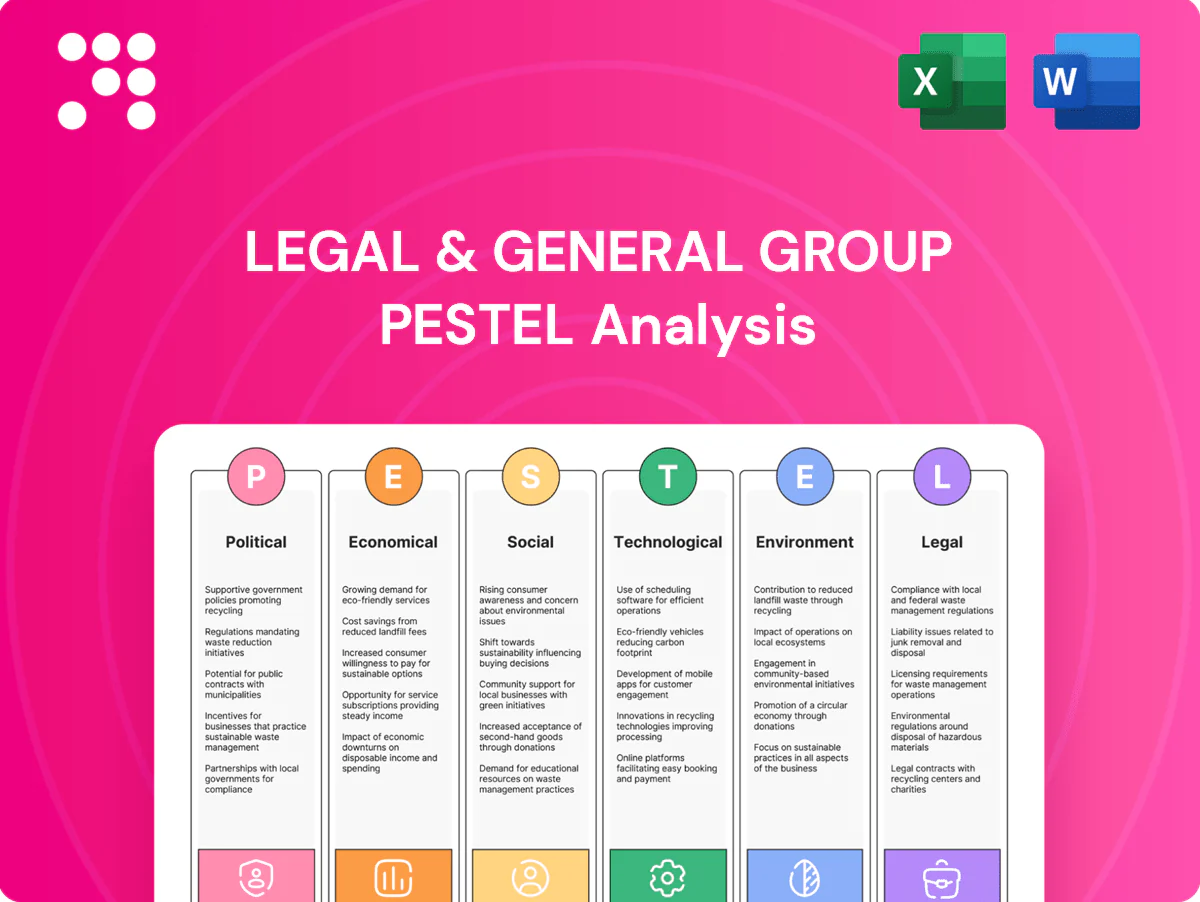
Legal & General Group PESTLE Analysis

Skip the Research. Get the Strategy.
Gain a strategic advantage with our PESTLE analysis of Legal & General Group. We map political, economic, social, technological, legal and environmental forces shaping growth, risks and opportunities. Ideal for investors and strategists, this brief highlights actionable insights. Buy the full report for the detailed, editable analysis and forward-looking forecasts.
Political factors

UK regulatory oversight (FCA/PRA)
FCA and PRA direction shapes capital, conduct and product governance across Legal & General’s life, retirement and investment units, with LGIM managing about £1.3tn AUM (2024) adding scale to regulatory impact. Changes to Solvency II matching adjustment or internal model approvals can materially reduce balance-sheet capacity and force repricing. The Consumer Duty, effective July 2023, raises compliance costs but can boost customer trust and value-for-money in pensions. Ongoing engagement with regulators helps anticipate rule shifts and preserve strategic flexibility.
Government housing & infrastructure policy
Public initiatives such as the UK target of 300,000 homes per year and Levelling Up Fund allocations totalling about £4.8bn create co-investment opportunities aligned with L&G’s long-term asset strategy. Planning policy and housing targets shape pipeline and returns for build-to-rent and modular homes. Political cycles can delay approvals or funding, slowing deployment cadence. Partnerships with local authorities mitigate delivery risk and enhance societal impact.

Pension and social care reforms
Auto-enrolment, now covering over 10 million workers since its 2012 rollout, and pot-for-life proposals alongside tighter defined benefit funding rules are shifting flows into DC consolidation and annuity markets. Changes to state pension and social care funding—affecting lifetime income need—are likely to alter annuity demand. Clear decumulation pathways could expand advice-lite lifetime income products, and policy stability would reduce customer inertia, lifting uptake.

Geopolitical and trade dynamics
Brexit legacy and evolving trade deals continue to reshape cross-border distribution and capital-market access for Legal & General, with group assets under management and administration at about £1.3trn (30 June 2024) exposing operations to market volatility from Russia-Ukraine and Middle East tensions. Sanctions and strengthened AML regimes have materially increased compliance costs for institutional mandates; currency swings drive reported results and hedging expense.
- Brexit: increased distribution friction, passporting loss
- Sanctions/AML: higher compliance burden on mandates
- FX impact: sterling moves affect reported earnings, hedging costs
- Diversification: geographic spread reduces concentration risk
Public ESG agenda and stewardship expectations
Government net-zero targets (UK 2050) and the updated UK Stewardship Code (2020) push expectations for responsible investment; Legal & General, with ~£1.3tn AUM (2024), channels capital into impact-led clean energy and regeneration projects. Heightened scrutiny of green claims raises reporting and due-diligence demands. Active policy advocacy helps define investable criteria.
- Net-zero target: UK 2050
- Stewardship Code: 2020 (FRC)
- L&G AUM: ~£1.3tn (2024)
- Implication: more reporting, stricter eligibility
Regulation, housing targets and pensions reforms reshape UK asset management opportunities
FCA/PRA rules and Consumer Duty (July 2023) increase compliance costs but affect product governance across L&G (~£1.3tn AUM, 2024). Housing targets (300,000/yr) and £4.8bn Levelling Up create build-to-rent investment opportunities. Auto-enrolment (>10m savers) and DC reforms shift flows to L&G’s annuity and DC products. Net-zero 2050 and stewardship rules raise reporting demands.
| Metric | Value |
|---|---|
| L&G AUM (2024) | £1.3tn |
| UK housing target | 300,000/yr |
| Levelling Up funds | £4.8bn |
| Auto-enrolment | >10m |
What is included in the product
 Detailed Word Document
Explores how macro-environmental forces—Political, Economic, Social, Technological, Environmental and Legal—specifically impact Legal & General Group’s insurance, asset management and retirement businesses, combining data-driven trends, sector-specific examples and forward-looking insights to support strategic planning, risk mitigation and investor communications.

 Customizable Excel Spreadsheet
A concise, visually segmented PESTLE summary tailored for Legal & General Group that simplifies external risk assessment and can be dropped into decks or shared across teams, enabling quick alignment in planning sessions and client reports.
Economic factors

Interest rate and inflation cycles
Bank Rate at 5.25% and CPI around 2.3% (May 2025) materially shape annuity pricing, solvency metrics and asset‑liability matching economics for Legal & General, compressing new business margins when yields fall. Persistently elevated inflation raises operating costs and squeezes household affordability, increasing lapse risk. Yield curve shifts drive mark‑to‑market volatility of reserves and transfers to profit. Robust ALM and dynamic hedging are essential to stabilise earnings.
Market volatility and asset valuations
Equity volatility and credit spread moves materially affect Legal & General’s c.£1.3tn AUM via mark‑to‑market impacts on fee income and require higher solvency buffers for the insurance businesses. Illiquid asset revaluations, notably in private credit and real estate, shift reported IFRS results and economic capital metrics. Tight liquidity conditions constrain deployment into housing, infrastructure and private credit; diversified mandates and rigorous scenario testing are used to manage drawdowns.

Labour market and wage trends
UK employment rate around 76% (ONS 2024) and modest real wage recovery in 2024 affect member contributions to workplace pensions. Employer covenant strength drives pricing and the bulk annuity pipeline amid ongoing DB de‑risking. Tight labour markets with roughly 1.0–1.2m vacancies in 2024 increase hiring and retention costs for actuarial, tech and investment roles, though automation and productivity gains can offset expense pressure.

Client saving behaviour and affordability
Cost-of-living pressure—UK CPI averaged about 3.4% in 2024—compresses discretionary saving and contributed to a household saving ratio near 3.8% (ONS Q4 2024), raising lapse risk while boosting demand for guaranteed income solutions amid uncertainty.
- Reduced discretionary saving: household saving ratio ~3.8% (ONS Q4 2024)
- Inflation backdrop: CPI ~3.4% (2024)
- Advice nudges increase retirement flows: advised customers demonstrably more likely to buy guaranteed income
- Simple, value offerings sustain net inflows
Global growth and energy transition capex
IEA data show clean energy investment reached about 1.7 trillion USD in 2023 and global infrastructure needs exceed roughly 3 trillion USD annually through 2030, creating long-duration asset opportunities for Legal & General; IMF forecasts around 3.0% world GDP growth in 2025, and slower growth can compress fees and delay project timelines; World Bank/G20 estimate a 1.5–2.5 trillion USD annual financing gap, enhancing institutional capital’s role, while sensible risk-sharing (guarantees, co-investment) supports stable returns.
- long-duration assets: clean energy & infra
- growth risk: IMF ~3.0% 2025
- financing gap: 1.5–2.5tn USD pa
- 2023 clean-energy spend: ~1.7tn USD
- mitigation: co-invest, guarantees, blended finance
Regulation, housing targets and pensions reforms reshape UK asset management opportunities
Bank Rate 5.25% and CPI 2.3% (May 2025) compress annuity margins and raise ALM demands; AUM c.£1.3tn means equity/credit moves materially affect fees and capital. Household saving ratio ~3.8% (ONS Q4 2024) and CPI ~3.4% (2024) lift lapse risk but increase guaranteed-income demand. Global GDP ~3.0% (IMF 2025) and clean‑energy spend ~$1.7tn (2023) create long‑duration investment opportunities.
| Metric | Value |
|---|---|
| Bank Rate | 5.25% |
| CPI (May 2025) | 2.3% |
| AUM | £1.3tn |
| Household saving ratio | 3.8% (Q4 2024) |
| Global GDP 2025 | ~3.0% |
| Clean‑energy spend 2023 | $1.7tn |
What You See Is What You Get
Legal & General Group PESTLE Analysis
The preview shown here is the exact Legal & General Group PESTLE Analysis you’ll receive after purchase—fully formatted and ready to use. This is the real, finished file with no placeholders. The layout, content, and structure visible now are exactly what you’ll download immediately after payment.

Original: $10.00
-65%$10.00
$3.50Product Information
Product Information
Shipping & Returns
Shipping & Returns
Description
Skip the Research. Get the Strategy.
Gain a strategic advantage with our PESTLE analysis of Legal & General Group. We map political, economic, social, technological, legal and environmental forces shaping growth, risks and opportunities. Ideal for investors and strategists, this brief highlights actionable insights. Buy the full report for the detailed, editable analysis and forward-looking forecasts.
Political factors
UK regulatory oversight (FCA/PRA)
FCA and PRA direction shapes capital, conduct and product governance across Legal & General’s life, retirement and investment units, with LGIM managing about £1.3tn AUM (2024) adding scale to regulatory impact. Changes to Solvency II matching adjustment or internal model approvals can materially reduce balance-sheet capacity and force repricing. The Consumer Duty, effective July 2023, raises compliance costs but can boost customer trust and value-for-money in pensions. Ongoing engagement with regulators helps anticipate rule shifts and preserve strategic flexibility.
Government housing & infrastructure policy
Public initiatives such as the UK target of 300,000 homes per year and Levelling Up Fund allocations totalling about £4.8bn create co-investment opportunities aligned with L&G’s long-term asset strategy. Planning policy and housing targets shape pipeline and returns for build-to-rent and modular homes. Political cycles can delay approvals or funding, slowing deployment cadence. Partnerships with local authorities mitigate delivery risk and enhance societal impact.
Pension and social care reforms
Auto-enrolment, now covering over 10 million workers since its 2012 rollout, and pot-for-life proposals alongside tighter defined benefit funding rules are shifting flows into DC consolidation and annuity markets. Changes to state pension and social care funding—affecting lifetime income need—are likely to alter annuity demand. Clear decumulation pathways could expand advice-lite lifetime income products, and policy stability would reduce customer inertia, lifting uptake.
Geopolitical and trade dynamics
Brexit legacy and evolving trade deals continue to reshape cross-border distribution and capital-market access for Legal & General, with group assets under management and administration at about £1.3trn (30 June 2024) exposing operations to market volatility from Russia-Ukraine and Middle East tensions. Sanctions and strengthened AML regimes have materially increased compliance costs for institutional mandates; currency swings drive reported results and hedging expense.
- Brexit: increased distribution friction, passporting loss
- Sanctions/AML: higher compliance burden on mandates
- FX impact: sterling moves affect reported earnings, hedging costs
- Diversification: geographic spread reduces concentration risk
Public ESG agenda and stewardship expectations
Government net-zero targets (UK 2050) and the updated UK Stewardship Code (2020) push expectations for responsible investment; Legal & General, with ~£1.3tn AUM (2024), channels capital into impact-led clean energy and regeneration projects. Heightened scrutiny of green claims raises reporting and due-diligence demands. Active policy advocacy helps define investable criteria.
- Net-zero target: UK 2050
- Stewardship Code: 2020 (FRC)
- L&G AUM: ~£1.3tn (2024)
- Implication: more reporting, stricter eligibility
Regulation, housing targets and pensions reforms reshape UK asset management opportunities
FCA/PRA rules and Consumer Duty (July 2023) increase compliance costs but affect product governance across L&G (~£1.3tn AUM, 2024). Housing targets (300,000/yr) and £4.8bn Levelling Up create build-to-rent investment opportunities. Auto-enrolment (>10m savers) and DC reforms shift flows to L&G’s annuity and DC products. Net-zero 2050 and stewardship rules raise reporting demands.
| Metric | Value |
|---|---|
| L&G AUM (2024) | £1.3tn |
| UK housing target | 300,000/yr |
| Levelling Up funds | £4.8bn |
| Auto-enrolment | >10m |
What is included in the product
Detailed Word Document
Explores how macro-environmental forces—Political, Economic, Social, Technological, Environmental and Legal—specifically impact Legal & General Group’s insurance, asset management and retirement businesses, combining data-driven trends, sector-specific examples and forward-looking insights to support strategic planning, risk mitigation and investor communications.
Customizable Excel Spreadsheet
A concise, visually segmented PESTLE summary tailored for Legal & General Group that simplifies external risk assessment and can be dropped into decks or shared across teams, enabling quick alignment in planning sessions and client reports.
Economic factors
Interest rate and inflation cycles
Bank Rate at 5.25% and CPI around 2.3% (May 2025) materially shape annuity pricing, solvency metrics and asset‑liability matching economics for Legal & General, compressing new business margins when yields fall. Persistently elevated inflation raises operating costs and squeezes household affordability, increasing lapse risk. Yield curve shifts drive mark‑to‑market volatility of reserves and transfers to profit. Robust ALM and dynamic hedging are essential to stabilise earnings.
Market volatility and asset valuations
Equity volatility and credit spread moves materially affect Legal & General’s c.£1.3tn AUM via mark‑to‑market impacts on fee income and require higher solvency buffers for the insurance businesses. Illiquid asset revaluations, notably in private credit and real estate, shift reported IFRS results and economic capital metrics. Tight liquidity conditions constrain deployment into housing, infrastructure and private credit; diversified mandates and rigorous scenario testing are used to manage drawdowns.
Labour market and wage trends
UK employment rate around 76% (ONS 2024) and modest real wage recovery in 2024 affect member contributions to workplace pensions. Employer covenant strength drives pricing and the bulk annuity pipeline amid ongoing DB de‑risking. Tight labour markets with roughly 1.0–1.2m vacancies in 2024 increase hiring and retention costs for actuarial, tech and investment roles, though automation and productivity gains can offset expense pressure.
Client saving behaviour and affordability
Cost-of-living pressure—UK CPI averaged about 3.4% in 2024—compresses discretionary saving and contributed to a household saving ratio near 3.8% (ONS Q4 2024), raising lapse risk while boosting demand for guaranteed income solutions amid uncertainty.
- Reduced discretionary saving: household saving ratio ~3.8% (ONS Q4 2024)
- Inflation backdrop: CPI ~3.4% (2024)
- Advice nudges increase retirement flows: advised customers demonstrably more likely to buy guaranteed income
- Simple, value offerings sustain net inflows
Global growth and energy transition capex
IEA data show clean energy investment reached about 1.7 trillion USD in 2023 and global infrastructure needs exceed roughly 3 trillion USD annually through 2030, creating long-duration asset opportunities for Legal & General; IMF forecasts around 3.0% world GDP growth in 2025, and slower growth can compress fees and delay project timelines; World Bank/G20 estimate a 1.5–2.5 trillion USD annual financing gap, enhancing institutional capital’s role, while sensible risk-sharing (guarantees, co-investment) supports stable returns.
- long-duration assets: clean energy & infra
- growth risk: IMF ~3.0% 2025
- financing gap: 1.5–2.5tn USD pa
- 2023 clean-energy spend: ~1.7tn USD
- mitigation: co-invest, guarantees, blended finance
Regulation, housing targets and pensions reforms reshape UK asset management opportunities
Bank Rate 5.25% and CPI 2.3% (May 2025) compress annuity margins and raise ALM demands; AUM c.£1.3tn means equity/credit moves materially affect fees and capital. Household saving ratio ~3.8% (ONS Q4 2024) and CPI ~3.4% (2024) lift lapse risk but increase guaranteed-income demand. Global GDP ~3.0% (IMF 2025) and clean‑energy spend ~$1.7tn (2023) create long‑duration investment opportunities.
| Metric | Value |
|---|---|
| Bank Rate | 5.25% |
| CPI (May 2025) | 2.3% |
| AUM | £1.3tn |
| Household saving ratio | 3.8% (Q4 2024) |
| Global GDP 2025 | ~3.0% |
| Clean‑energy spend 2023 | $1.7tn |
What You See Is What You Get
Legal & General Group PESTLE Analysis
The preview shown here is the exact Legal & General Group PESTLE Analysis you’ll receive after purchase—fully formatted and ready to use. This is the real, finished file with no placeholders. The layout, content, and structure visible now are exactly what you’ll download immediately after payment.