Lecta SA PESTLE Analysis

Plan Smarter. Present Sharper. Compete Stronger.
Unlock strategic clarity with our PESTLE Analysis of Lecta SA—concise, current, and focused on the political, economic, social, technological, legal, and environmental forces shaping the company’s outlook. Use these insights to anticipate risks and seize opportunities. Purchase the full report for the complete, editable breakdown and immediate download.
Political factors

EU industrial policy
Shifts in EU industrial priorities directly affect grants, carbon pricing and decarbonisation incentives for pulp and paper, altering margins and investment returns. Alignment with Green Deal roadmaps can unlock Innovation Fund resources (~€38bn to 2030) and RRF-linked support from the €723.8bn recovery envelope for energy efficiency and circularity projects. Policy divergence raises compliance costs and market risk. Lecta must track EU ETS cycles (around €95/t in 2025) to time capex.
Trade and tariffs
Anti‑dumping measures and tariff changes across the EU, UK and global markets have raised input costs for paper and pulp; EU investigations since 2019 have led to duties on some imports, pressuring margins. Trade barriers can shield EU producers but limit export options and raised costs by an estimated 5–10% for cross‑border paper flows. Post‑Brexit rules of origin and customs add frictions and delays. Diversified sourcing and logistics buffers have cut supply shock exposure for groups like Lecta.

Energy security policies
Government interventions in gas and electricity markets materially shape Lecta SA’s mill economics: EU rules require 90% gas storage by Nov 1 (energy security) and Spain targets ~74% renewable electricity by 2030, affecting price volatility and availability. Strategic reserves, temporary price caps or subsidies can stabilise costs but are time-limited. Grid decarbonisation lowers grid emission factors and boosts PPA options, so clear policy signals are critical for fuel-switching investments.

Regional stability
Geopolitical tensions reshape freight lanes, fiber flows and chemical supplies for Lecta; Russian pipeline gas deliveries to the EU fell about 70% in 2022 vs 2021, forcing energy and feedstock rerouting into 2023–24. Sanctions regimes have altered wood pulp and energy trade patterns, raising input cost volatility and lead times. Political risk in supplier countries can cascade into EU mills, so scenario planning must include route and supplier substitutions.
- Freight lanes: rerouting raises costs and transit times
- Sanctions: disrupt pulp/energy trade
- Supplier risk: EU mill exposure
- Action: include route/supplier substitutions in scenarios
Public procurement
Government demand for sustainable print and labeling standards favors certified paper suppliers as public procurement—about 14% of EU GDP—shifts toward low-carbon, recyclable products under policies tied to the EU Green Deal aiming for a 55% GHG reduction by 2030; winning these tenders builds volume and market credibility, but requires transparent, verifiable sustainability claims to avoid greenwashing risks.
- Public procurement ≈ 14% of EU GDP
- EU Green Deal: −55% GHG by 2030
- Certified paper boosts tender success
- Transparent claims required to win and scale
EU Green Deal funds, ETS €95/t and 14% public procurement reshape low‑carbon paper market
EU Green Deal funding (Innovation Fund ≈€38bn; Recovery ≈€723.8bn) and ETS (~€95/t in 2025) shape grants, carbon costs and capex timing; public procurement (~14% GDP) favors certified low‑carbon paper. Energy rules (90% gas storage, Spain ~74% RES by 2030) and geopolitics (Russian gas −70% in 2022) drive price and supply risk.
| Metric | Value |
|---|---|
| Innovation Fund | €38bn |
| Recovery | €723.8bn |
| EU ETS (2025) | €95/t |
| Public procurement | 14% GDP |
| Russian gas change (2022) | −70% |
What is included in the product
 Detailed Word Document
Explores how Political, Economic, Social, Technological, Environmental, and Legal forces uniquely impact Lecta SA, combining data-driven trends and region-specific regulatory context to identify risks and opportunities; designed for executives and investors seeking actionable, forward-looking insights for strategy and financing.

 Customizable Excel Spreadsheet
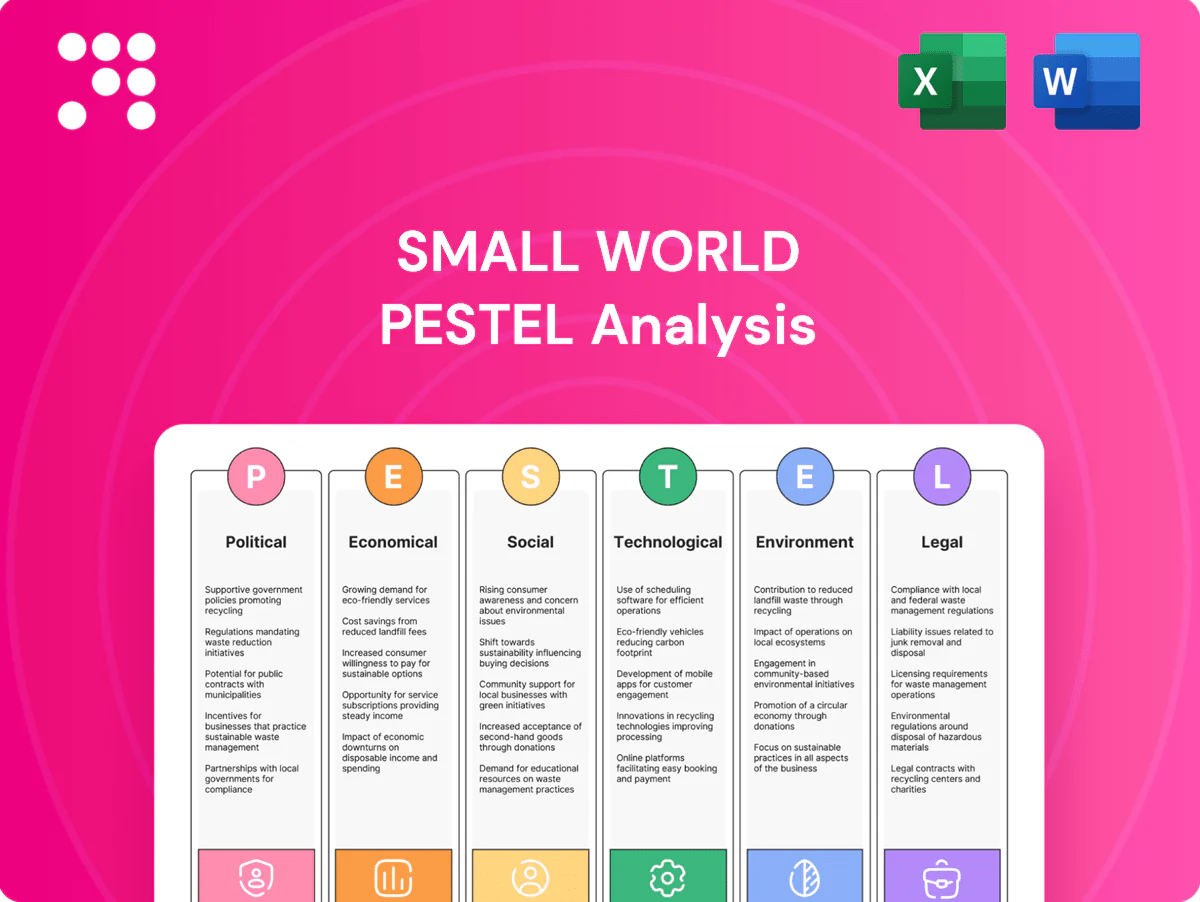
A compact, visually segmented PESTLE summary of Lecta SA that highlights external risks and market positioning for quick sharing in presentations, meetings, or consulting reports—editable for local context and easily dropped into PowerPoints or strategy packs.
Economic factors

Energy price volatility
Electricity and gas are major cost drivers in papermaking, with EU industrial electricity averaging roughly €70–90/MWh and TTF gas €30–40/MWh in 2024, so price spikes can compress margins and force temporary downtime. Long-term hedging and on-site generation (cogeneration, biomass) smooth costs. Pricing clauses with customers help share volatility and protect cash flow.
Demand cycles
Coated/uncoated publishing grades closely follow advertising spend and GDP, with European graphic paper demand down c.40–50% over the past two decades, pressuring volumes and prices. Labels and packaging align with FMCG volumes, which supported c.2–3% annual growth pre-2024. Secular decline in graphic paper contrasts with resilient specialty demand for labels, release and security papers. Active mix-shift management is crucial to stabilize revenue; counter-cyclical niches can buffer downturns.

Inflation and rates
Input inflation in chemicals (+10% y/y in 2024), transport (+9%) and wages (+4%) has lifted Lecta SA’s working capital needs, stretching inventory and receivables. Higher interest rates (ECB deposit rate ~3.75% mid‑2025) raise financing costs for inventory and capex. Dynamic pricing, productivity gains and strict cash discipline are required to defend margins and preserve financial flexibility.

FX exposure
Lecta faces FX exposure as EUR-denominated costs contrast with multi-currency sales, creating translation and transaction risk; EUR/USD averaged about 1.09 in H1 2025, while pulp and many chemicals remain USD-priced, adding basis risk. Company hedging policies and natural offsets in the value chain reduce earnings volatility; aligning contract currencies further mitigates mismatch.
- EUR costs vs multi-currency sales
- Pulp/chemicals priced in USD — basis risk
- Hedging and natural offsets lower volatility
- Contract currency alignment recommended
Customer consolidation
Customer consolidation concentrates purchasing with large converters and brand owners, increasing procurement leverage over suppliers like Lecta and pressuring margins.
Consolidation typically compresses selling prices and extends payment terms—buyers often push terms to 60–120 days—straining working capital.
Differentiated specifications, service SLAs and strategic partnerships help secure volumes, protect per-unit value and support joint innovation pipelines.
- Procurement power: large converters dominate negotiations
- Price pressure: margin compression and 60–120 day terms
- Defense: differentiated specs and SLAs retain value
- Growth: partnerships lock volumes and innovation
EU Green Deal funds, ETS €95/t and 14% public procurement reshape low‑carbon paper market
Energy costs (EU electricity €70–90/MWh, TTF gas €30–40/MWh in 2024) and input inflation (chemicals +10% y/y 2024) squeeze margins; ECB rate ~3.75% mid‑2025 lifts financing costs. Graphic paper demand down c.40–50% over 20 years while labels/packaging grew c.2–3% pre‑2024, driving mix shift. EUR/USD ~1.09 H1 2025 and USD‑priced pulp add FX basis risk; customer consolidation pressures prices and terms.
| Factor | Metric | Impact |
|---|---|---|
| Energy | €70–90/MWh; €30–40/MWh | Margin volatility |
| Demand mix | Graphic -40–50%; Labels +2–3% | Revenue shift |
| Inputs & rates | Chemicals +10%; ECB 3.75% | Working capital strain |
| FX & procurement | EUR/USD 1.09; USD pulp | Basis risk; pricing pressure |
Preview Before You Purchase
Lecta SA PESTLE Analysis
The preview shown here is the exact Lecta SA PESTLE Analysis you’ll receive after purchase—fully formatted and ready to use. The content, layout, and structure visible are the final file available for immediate download. No placeholders, no surprises.

Product Information
Product Information
Shipping & Returns
Shipping & Returns
Description
Plan Smarter. Present Sharper. Compete Stronger.
Unlock strategic clarity with our PESTLE Analysis of Lecta SA—concise, current, and focused on the political, economic, social, technological, legal, and environmental forces shaping the company’s outlook. Use these insights to anticipate risks and seize opportunities. Purchase the full report for the complete, editable breakdown and immediate download.
Political factors
EU industrial policy
Shifts in EU industrial priorities directly affect grants, carbon pricing and decarbonisation incentives for pulp and paper, altering margins and investment returns. Alignment with Green Deal roadmaps can unlock Innovation Fund resources (~€38bn to 2030) and RRF-linked support from the €723.8bn recovery envelope for energy efficiency and circularity projects. Policy divergence raises compliance costs and market risk. Lecta must track EU ETS cycles (around €95/t in 2025) to time capex.
Trade and tariffs
Anti‑dumping measures and tariff changes across the EU, UK and global markets have raised input costs for paper and pulp; EU investigations since 2019 have led to duties on some imports, pressuring margins. Trade barriers can shield EU producers but limit export options and raised costs by an estimated 5–10% for cross‑border paper flows. Post‑Brexit rules of origin and customs add frictions and delays. Diversified sourcing and logistics buffers have cut supply shock exposure for groups like Lecta.
Energy security policies
Government interventions in gas and electricity markets materially shape Lecta SA’s mill economics: EU rules require 90% gas storage by Nov 1 (energy security) and Spain targets ~74% renewable electricity by 2030, affecting price volatility and availability. Strategic reserves, temporary price caps or subsidies can stabilise costs but are time-limited. Grid decarbonisation lowers grid emission factors and boosts PPA options, so clear policy signals are critical for fuel-switching investments.
Regional stability
Geopolitical tensions reshape freight lanes, fiber flows and chemical supplies for Lecta; Russian pipeline gas deliveries to the EU fell about 70% in 2022 vs 2021, forcing energy and feedstock rerouting into 2023–24. Sanctions regimes have altered wood pulp and energy trade patterns, raising input cost volatility and lead times. Political risk in supplier countries can cascade into EU mills, so scenario planning must include route and supplier substitutions.
- Freight lanes: rerouting raises costs and transit times
- Sanctions: disrupt pulp/energy trade
- Supplier risk: EU mill exposure
- Action: include route/supplier substitutions in scenarios
Public procurement
Government demand for sustainable print and labeling standards favors certified paper suppliers as public procurement—about 14% of EU GDP—shifts toward low-carbon, recyclable products under policies tied to the EU Green Deal aiming for a 55% GHG reduction by 2030; winning these tenders builds volume and market credibility, but requires transparent, verifiable sustainability claims to avoid greenwashing risks.
- Public procurement ≈ 14% of EU GDP
- EU Green Deal: −55% GHG by 2030
- Certified paper boosts tender success
- Transparent claims required to win and scale
EU Green Deal funds, ETS €95/t and 14% public procurement reshape low‑carbon paper market
EU Green Deal funding (Innovation Fund ≈€38bn; Recovery ≈€723.8bn) and ETS (~€95/t in 2025) shape grants, carbon costs and capex timing; public procurement (~14% GDP) favors certified low‑carbon paper. Energy rules (90% gas storage, Spain ~74% RES by 2030) and geopolitics (Russian gas −70% in 2022) drive price and supply risk.
| Metric | Value |
|---|---|
| Innovation Fund | €38bn |
| Recovery | €723.8bn |
| EU ETS (2025) | €95/t |
| Public procurement | 14% GDP |
| Russian gas change (2022) | −70% |
What is included in the product
Detailed Word Document
Explores how Political, Economic, Social, Technological, Environmental, and Legal forces uniquely impact Lecta SA, combining data-driven trends and region-specific regulatory context to identify risks and opportunities; designed for executives and investors seeking actionable, forward-looking insights for strategy and financing.
Customizable Excel Spreadsheet
A compact, visually segmented PESTLE summary of Lecta SA that highlights external risks and market positioning for quick sharing in presentations, meetings, or consulting reports—editable for local context and easily dropped into PowerPoints or strategy packs.
Economic factors
Energy price volatility
Electricity and gas are major cost drivers in papermaking, with EU industrial electricity averaging roughly €70–90/MWh and TTF gas €30–40/MWh in 2024, so price spikes can compress margins and force temporary downtime. Long-term hedging and on-site generation (cogeneration, biomass) smooth costs. Pricing clauses with customers help share volatility and protect cash flow.
Demand cycles
Coated/uncoated publishing grades closely follow advertising spend and GDP, with European graphic paper demand down c.40–50% over the past two decades, pressuring volumes and prices. Labels and packaging align with FMCG volumes, which supported c.2–3% annual growth pre-2024. Secular decline in graphic paper contrasts with resilient specialty demand for labels, release and security papers. Active mix-shift management is crucial to stabilize revenue; counter-cyclical niches can buffer downturns.
Inflation and rates
Input inflation in chemicals (+10% y/y in 2024), transport (+9%) and wages (+4%) has lifted Lecta SA’s working capital needs, stretching inventory and receivables. Higher interest rates (ECB deposit rate ~3.75% mid‑2025) raise financing costs for inventory and capex. Dynamic pricing, productivity gains and strict cash discipline are required to defend margins and preserve financial flexibility.
FX exposure
Lecta faces FX exposure as EUR-denominated costs contrast with multi-currency sales, creating translation and transaction risk; EUR/USD averaged about 1.09 in H1 2025, while pulp and many chemicals remain USD-priced, adding basis risk. Company hedging policies and natural offsets in the value chain reduce earnings volatility; aligning contract currencies further mitigates mismatch.
- EUR costs vs multi-currency sales
- Pulp/chemicals priced in USD — basis risk
- Hedging and natural offsets lower volatility
- Contract currency alignment recommended
Customer consolidation
Customer consolidation concentrates purchasing with large converters and brand owners, increasing procurement leverage over suppliers like Lecta and pressuring margins.
Consolidation typically compresses selling prices and extends payment terms—buyers often push terms to 60–120 days—straining working capital.
Differentiated specifications, service SLAs and strategic partnerships help secure volumes, protect per-unit value and support joint innovation pipelines.
- Procurement power: large converters dominate negotiations
- Price pressure: margin compression and 60–120 day terms
- Defense: differentiated specs and SLAs retain value
- Growth: partnerships lock volumes and innovation
EU Green Deal funds, ETS €95/t and 14% public procurement reshape low‑carbon paper market
Energy costs (EU electricity €70–90/MWh, TTF gas €30–40/MWh in 2024) and input inflation (chemicals +10% y/y 2024) squeeze margins; ECB rate ~3.75% mid‑2025 lifts financing costs. Graphic paper demand down c.40–50% over 20 years while labels/packaging grew c.2–3% pre‑2024, driving mix shift. EUR/USD ~1.09 H1 2025 and USD‑priced pulp add FX basis risk; customer consolidation pressures prices and terms.
| Factor | Metric | Impact |
|---|---|---|
| Energy | €70–90/MWh; €30–40/MWh | Margin volatility |
| Demand mix | Graphic -40–50%; Labels +2–3% | Revenue shift |
| Inputs & rates | Chemicals +10%; ECB 3.75% | Working capital strain |
| FX & procurement | EUR/USD 1.09; USD pulp | Basis risk; pricing pressure |
Preview Before You Purchase
Lecta SA PESTLE Analysis
The preview shown here is the exact Lecta SA PESTLE Analysis you’ll receive after purchase—fully formatted and ready to use. The content, layout, and structure visible are the final file available for immediate download. No placeholders, no surprises.