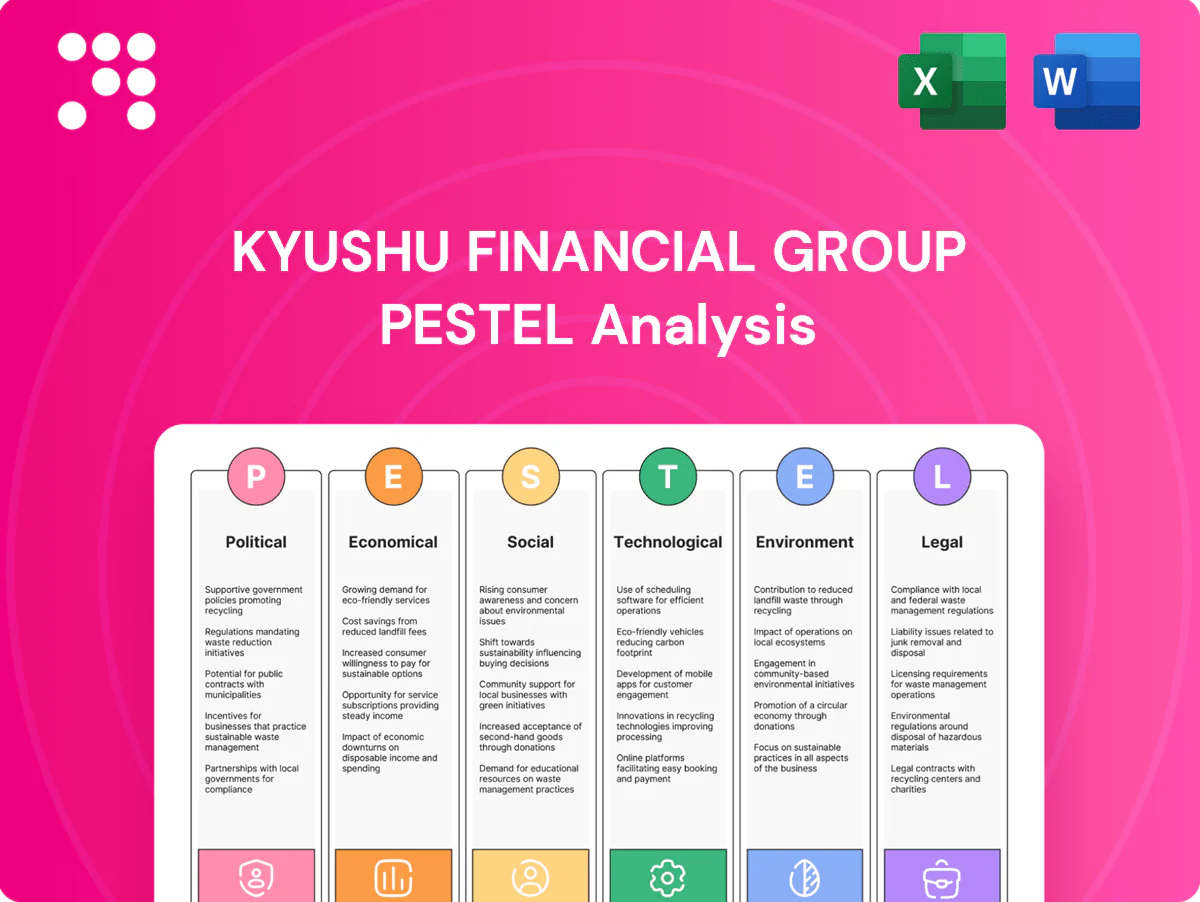
Kyushu Financial Group PESTLE Analysis

Make Smarter Strategic Decisions with a Complete PESTEL View
Unlock how political shifts, regional economics, and evolving tech trends shape Kyushu Financial Group's strategic outlook in our concise PESTLE snapshot. This analysis reveals regulatory risks, demographic pressures, and innovation opportunities that matter to investors and planners. Purchase the full PESTLE for the complete, actionable breakdown and ready-to-use data.
Political factors

Regional revitalization and government support
National and prefectural programs bolster local industry and SME financing in Kyushu, where about 13 million people live and SMEs account for 99.7% of firms and roughly 70% of employment. Subsidies and credit guarantees from government schemes reduce credit risk and enable higher lending volumes for regional banks. Active participation improves Kyushu Financial Group's reputation and mission alignment. Reliance on policy budgets creates volatility if government priorities change.
Monetary policy normalization by the Bank of Japan
BOJ monetary normalization, with the 10-year JGB near 1.0% by mid-2025, pushes deposit betas higher and, after deposit repricing, lifted regional NIMs (Kyushu peers reported ~+15 bps in FY2024) while inflating unrealized securities losses as holdings mark-to-market. Rising yields can boost lending margins but create ALM mismatches and higher hedging costs for regional banks. Clear, frequent communication with customers and investors is essential to manage expectations and funding costs.

Disaster preparedness and public investment
Government infrastructure spending for earthquake, flood and typhoon resilience in FY2024 is embedded in Japan’s ¥114.7 trillion general account budget, driving regional credit demand in Kyushu as public works stimulate construction and supply chains. Kyushu Financial Group can finance contractors and suppliers, while disaster-response policies increase demand for robust business-continuity planning and liquidity lines.

Geopolitical risk and supply-chain policy
Japan’s economic security push is reshaping manufacturing and energy projects in Kyushu, offering banks new capex financing as firms reshore or diversify supply chains; China accounted for about 20% of Japan’s exports in 2023, so East Asian tensions could materially reduce regional trade and inbound tourism. Robust scenario planning helps KFG manage sector exposures and credit concentrations.
- capex financing: reshoring/diversification
- export risk: ~20% exposure to China (2023)
- tourism sensitivity: inbound demand vulnerable
- risk control: scenario planning for sector concentrations
Local political dynamics and municipal partnerships
Relationships with seven Kyushu prefectures and roughly 13 million residents (2024 est.) shape public deposits, mandates and regional development projects; municipal partnerships can secure stable deposit flows and underwriting mandates. Collaborative programs increase SME mentoring and financial literacy, boosting credit demand and fee income. Changes in local leadership may shift procurement and project priorities, while transparent governance supports continuity and trust.
- 7 prefectures; ~13M residents (2024)
- Municipal deposits: strategic source of stable funding
- SME mentoring & literacy: pipeline for loans and fees
- Leadership turnover: potential policy/priority shifts
- Transparent governance: continuity and risk reduction
Policy push boosts Kyushu SME lending and NIMs, but raises ALM and concentration risk
Policy support and prefectural partnerships boost SME lending and deposits across Kyushu (13M residents; SMEs 99.7% of firms; ~70% employment), reducing credit risk via guarantees but exposing KFG to fiscal-priority shifts. BOJ normalization (10y JGB ~1.0% mid-2025) raised regional NIMs (~+15bps FY2024) while increasing ALM and securities MTM losses. Infrastructure and economic-security spending (¥114.7tn national budget) plus reshoring/China exposure (~20% of Japan exports 2023) drive capex demand and concentration risk.
| Metric | Value |
|---|---|
| Population (2024) | 13M |
| SMEs | 99.7% |
| SME employment | ~70% |
| 10y JGB (mid-2025) | ~1.0% |
| Regional NIM change (FY2024) | +~15bps |
| Budget (FY2024) | ¥114.7tn |
| China share (2023) | ~20% |
| Prefectures | 7 |
What is included in the product
 Detailed Word Document
Explores how Political, Economic, Social, Technological, Environmental, and Legal forces specifically shape Kyushu Financial Group's opportunities and risks, with each section supported by current regional data and trends to inform strategic, regulatory and investment decisions. Delivered in clean, investor-ready format to aid executives, advisors and scenario planning.

 Customizable Excel Spreadsheet
A clean, summarized PESTLE of Kyushu Financial Group, visually segmented for quick interpretation and easily dropped into presentations or shared across teams to align on external risks and market positioning.
Economic factors

Aging demographics and shrinking regional population
Kyushu faces declining population and household formation, pressuring loan growth as regional demand contracts and age cohorts shrink. Elderly depositors rise, increasing low-cost funding but shifting product mix toward deposits and annuities; Japan’s 65+ share reached about 29% in 2023. Wealth transfer and inheritance services gain importance for estate planning and asset management. Branch utilization patterns are changing, with fewer in-person transactions and rising digital adoption.
SME-dominated regional economy
Kyushu's economy is SME-dominated—Japan-wide SMEs make up 99.7% of firms and account for about 70% of employment, driving strong demand for working capital and equipment finance from Kyushu Financial Group. Credit risk fluctuates with local cycles in tourism, agriculture and construction, sectors that suffered sharp COVID-era swings and remain sensitive to seasonal shocks. Cross-sell advisory, leasing and invoice finance deepen client ties and lift fee income. Tailored credit models and sector overlays are critical to keep nonperforming loan ratios controlled.

Tourism and service-sector cyclicality
Inbound tourism recovery—Japan arrivals ~31.9 million in 2019 and ~32.1 million in 2023—boosts Kyushu hospitality, retail and transport revenues, lifting seasonal card spend and occupancy-linked fee income. Seasonal cash-flow peaks create demand for short-term lending and merchant acquiring solutions. External shocks, however, can reverse momentum quickly, so diversification across corporate, agri and retail lending reduces earnings volatility.

Interest rate and margin dynamics
Gradual rate rises can widen Kyushu Financial Groups net interest margin if deposit repricing lags, but intense regional competition and fight for retail deposits compress spreads; repricing of fixed-rate loan books and active duration management remain pivotal to protect earnings. Fee income from cards, leasing and advisory increasingly offsets margin pressure, while sensitivity analysis—scenario PV and NII shocks—guides ALM and pricing strategy.
- Rate-pass-through risk: deposit lag vs loan repricing
- Repricing focus: fixed-rate book and duration hedging
- Fee diversification: cards, leasing, advisory
- Governance: sensitivity analysis for NII, EVE
Energy costs and inflation trends
Import-dependent energy shocks (Japan sources over 90% of primary energy) squeeze household spending and SME margins, raising impairment risks and dampening loan demand; higher wholesale costs historically correlate with elevated corporate default rates. Renewable buildout (Japan target 36–38% renewables by 2030) creates new financing flows, while strict pricing discipline and loan covenants preserve returns.
- Energy import dependence: over 90%
- Renewables target: 36–38% by 2030
- Impacts: higher credit risk, lower loan demand
- Mitigants: pricing discipline, tight covenants, project finance
Policy push boosts Kyushu SME lending and NIMs, but raises ALM and concentration risk
Demographic shrinkage and 29% 65+ (2023) cut loan demand but boost low-cost deposits and estate services; SMEs (≈99.7% nationwide) sustain working-capital lending. Tourism recovery (31.9M arrivals 2019; 32.1M 2023) raises seasonal fees while energy import dependence (>90%) and renewables push (36–38% by 2030) reshape credit and project finance flows.
| Metric | Value |
|---|---|
| 65+ share (2023) | 29% |
| Tourism arrivals | 31.9M (2019), 32.1M (2023) |
| Energy import | >90% |
| Renewables target | 36–38% by 2030 |
Same Document Delivered
Kyushu Financial Group PESTLE Analysis
This Kyushu Financial Group PESTLE analysis preview is the exact document you’ll receive after purchase—fully formatted, professionally structured, and ready to use. The content, layout, and findings shown here are the final version with no placeholders. After checkout you’ll instantly download this same file and can begin applying the insights immediately.

Product Information
Product Information
Shipping & Returns
Shipping & Returns
Description
Make Smarter Strategic Decisions with a Complete PESTEL View
Unlock how political shifts, regional economics, and evolving tech trends shape Kyushu Financial Group's strategic outlook in our concise PESTLE snapshot. This analysis reveals regulatory risks, demographic pressures, and innovation opportunities that matter to investors and planners. Purchase the full PESTLE for the complete, actionable breakdown and ready-to-use data.
Political factors
Regional revitalization and government support
National and prefectural programs bolster local industry and SME financing in Kyushu, where about 13 million people live and SMEs account for 99.7% of firms and roughly 70% of employment. Subsidies and credit guarantees from government schemes reduce credit risk and enable higher lending volumes for regional banks. Active participation improves Kyushu Financial Group's reputation and mission alignment. Reliance on policy budgets creates volatility if government priorities change.
Monetary policy normalization by the Bank of Japan
BOJ monetary normalization, with the 10-year JGB near 1.0% by mid-2025, pushes deposit betas higher and, after deposit repricing, lifted regional NIMs (Kyushu peers reported ~+15 bps in FY2024) while inflating unrealized securities losses as holdings mark-to-market. Rising yields can boost lending margins but create ALM mismatches and higher hedging costs for regional banks. Clear, frequent communication with customers and investors is essential to manage expectations and funding costs.
Disaster preparedness and public investment
Government infrastructure spending for earthquake, flood and typhoon resilience in FY2024 is embedded in Japan’s ¥114.7 trillion general account budget, driving regional credit demand in Kyushu as public works stimulate construction and supply chains. Kyushu Financial Group can finance contractors and suppliers, while disaster-response policies increase demand for robust business-continuity planning and liquidity lines.
Geopolitical risk and supply-chain policy
Japan’s economic security push is reshaping manufacturing and energy projects in Kyushu, offering banks new capex financing as firms reshore or diversify supply chains; China accounted for about 20% of Japan’s exports in 2023, so East Asian tensions could materially reduce regional trade and inbound tourism. Robust scenario planning helps KFG manage sector exposures and credit concentrations.
- capex financing: reshoring/diversification
- export risk: ~20% exposure to China (2023)
- tourism sensitivity: inbound demand vulnerable
- risk control: scenario planning for sector concentrations
Local political dynamics and municipal partnerships
Relationships with seven Kyushu prefectures and roughly 13 million residents (2024 est.) shape public deposits, mandates and regional development projects; municipal partnerships can secure stable deposit flows and underwriting mandates. Collaborative programs increase SME mentoring and financial literacy, boosting credit demand and fee income. Changes in local leadership may shift procurement and project priorities, while transparent governance supports continuity and trust.
- 7 prefectures; ~13M residents (2024)
- Municipal deposits: strategic source of stable funding
- SME mentoring & literacy: pipeline for loans and fees
- Leadership turnover: potential policy/priority shifts
- Transparent governance: continuity and risk reduction
Policy push boosts Kyushu SME lending and NIMs, but raises ALM and concentration risk
Policy support and prefectural partnerships boost SME lending and deposits across Kyushu (13M residents; SMEs 99.7% of firms; ~70% employment), reducing credit risk via guarantees but exposing KFG to fiscal-priority shifts. BOJ normalization (10y JGB ~1.0% mid-2025) raised regional NIMs (~+15bps FY2024) while increasing ALM and securities MTM losses. Infrastructure and economic-security spending (¥114.7tn national budget) plus reshoring/China exposure (~20% of Japan exports 2023) drive capex demand and concentration risk.
| Metric | Value |
|---|---|
| Population (2024) | 13M |
| SMEs | 99.7% |
| SME employment | ~70% |
| 10y JGB (mid-2025) | ~1.0% |
| Regional NIM change (FY2024) | +~15bps |
| Budget (FY2024) | ¥114.7tn |
| China share (2023) | ~20% |
| Prefectures | 7 |
What is included in the product
Detailed Word Document
Explores how Political, Economic, Social, Technological, Environmental, and Legal forces specifically shape Kyushu Financial Group's opportunities and risks, with each section supported by current regional data and trends to inform strategic, regulatory and investment decisions. Delivered in clean, investor-ready format to aid executives, advisors and scenario planning.
Customizable Excel Spreadsheet
A clean, summarized PESTLE of Kyushu Financial Group, visually segmented for quick interpretation and easily dropped into presentations or shared across teams to align on external risks and market positioning.
Economic factors
Aging demographics and shrinking regional population
Kyushu faces declining population and household formation, pressuring loan growth as regional demand contracts and age cohorts shrink. Elderly depositors rise, increasing low-cost funding but shifting product mix toward deposits and annuities; Japan’s 65+ share reached about 29% in 2023. Wealth transfer and inheritance services gain importance for estate planning and asset management. Branch utilization patterns are changing, with fewer in-person transactions and rising digital adoption.
SME-dominated regional economy
Kyushu's economy is SME-dominated—Japan-wide SMEs make up 99.7% of firms and account for about 70% of employment, driving strong demand for working capital and equipment finance from Kyushu Financial Group. Credit risk fluctuates with local cycles in tourism, agriculture and construction, sectors that suffered sharp COVID-era swings and remain sensitive to seasonal shocks. Cross-sell advisory, leasing and invoice finance deepen client ties and lift fee income. Tailored credit models and sector overlays are critical to keep nonperforming loan ratios controlled.
Tourism and service-sector cyclicality
Inbound tourism recovery—Japan arrivals ~31.9 million in 2019 and ~32.1 million in 2023—boosts Kyushu hospitality, retail and transport revenues, lifting seasonal card spend and occupancy-linked fee income. Seasonal cash-flow peaks create demand for short-term lending and merchant acquiring solutions. External shocks, however, can reverse momentum quickly, so diversification across corporate, agri and retail lending reduces earnings volatility.
Interest rate and margin dynamics
Gradual rate rises can widen Kyushu Financial Groups net interest margin if deposit repricing lags, but intense regional competition and fight for retail deposits compress spreads; repricing of fixed-rate loan books and active duration management remain pivotal to protect earnings. Fee income from cards, leasing and advisory increasingly offsets margin pressure, while sensitivity analysis—scenario PV and NII shocks—guides ALM and pricing strategy.
- Rate-pass-through risk: deposit lag vs loan repricing
- Repricing focus: fixed-rate book and duration hedging
- Fee diversification: cards, leasing, advisory
- Governance: sensitivity analysis for NII, EVE
Energy costs and inflation trends
Import-dependent energy shocks (Japan sources over 90% of primary energy) squeeze household spending and SME margins, raising impairment risks and dampening loan demand; higher wholesale costs historically correlate with elevated corporate default rates. Renewable buildout (Japan target 36–38% renewables by 2030) creates new financing flows, while strict pricing discipline and loan covenants preserve returns.
- Energy import dependence: over 90%
- Renewables target: 36–38% by 2030
- Impacts: higher credit risk, lower loan demand
- Mitigants: pricing discipline, tight covenants, project finance
Policy push boosts Kyushu SME lending and NIMs, but raises ALM and concentration risk
Demographic shrinkage and 29% 65+ (2023) cut loan demand but boost low-cost deposits and estate services; SMEs (≈99.7% nationwide) sustain working-capital lending. Tourism recovery (31.9M arrivals 2019; 32.1M 2023) raises seasonal fees while energy import dependence (>90%) and renewables push (36–38% by 2030) reshape credit and project finance flows.
| Metric | Value |
|---|---|
| 65+ share (2023) | 29% |
| Tourism arrivals | 31.9M (2019), 32.1M (2023) |
| Energy import | >90% |
| Renewables target | 36–38% by 2030 |
Same Document Delivered
Kyushu Financial Group PESTLE Analysis
This Kyushu Financial Group PESTLE analysis preview is the exact document you’ll receive after purchase—fully formatted, professionally structured, and ready to use. The content, layout, and findings shown here are the final version with no placeholders. After checkout you’ll instantly download this same file and can begin applying the insights immediately.











