Kumiai Chemical PESTLE Analysis

Skip the Research. Get the Strategy.
Unlock decisive insights with our PESTLE Analysis tailored to Kumiai Chemical—identify regulatory pressures, market trends, and technological shifts shaping its future. Perfect for investors and strategists who need clarity fast. Purchase the full report to get the complete, actionable breakdown now.
Political factors

Ag subsidy directions
Changes in national farm support and crop insurance reshape herbicide and fungicide demand as subsidy-linked crop mixes and input intensity shift across markets. EU Common Agricultural Policy budget for 2021–27 is about €387 billion, steering EU growers toward subsidy-eligible practices; similar US and Japan shifts favor sustainable, low-residue solutions. Policy moves reallocating spend to sustainable and bio-solutions force Kumiai to align R&D and product portfolios to subsidy-eligible technologies.
Regulatory diplomacy
Bilateral trade deals such as the 11-member CPTPP and the EU–Japan EPA (in force since 2019) shape pesticide registrations and push for MRL alignment, while non-tariff barriers still complicate approvals.
Faster mutual recognition between jurisdictions accelerates market entry; divergence in standards delays sales across key markets.
Active engagement with regulators and industry bodies reduces approval friction, and strategic partnerships in priority markets mitigate political risk.

Geopolitical supply shocks
Conflicts and sanctions since Russia’s 2022 invasion have disrupted chemical intermediates and solvent flows from Eastern Europe and parts of Asia, aggravating supply chain risk. Logistics bottlenecks and energy-price volatility—Europe TTF gas spiked over 500% in 2022 and container rates topped $20,000/FEU in 2021—have elevated COGS. Dual-sourcing and buffer inventories serve as political-risk hedges, while geographic diversification of tolling reduces single-region exposure.

Food security agendas
- Policy: govt self-sufficiency targets increase demand
- Regulatory: emergency approvals = faster market entry
- Risk: bans limit portfolios
- Strategy: tie products to national yield programs
Public sector R&D tie-ups
Public sector R&D tie-ups, supported by initiatives like Japan’s Green Innovation Fund (about 2 trillion JPY), catalyze precision ag and IPM co-development; such grants lower development costs and accelerate field validation timelines. Participation with public partners boosts Kumiai Chemical’s credibility, may impose local manufacturing or data-sharing requirements, and offers a pathway to expand in Asia and LATAM markets.
- Grants: access to large public funds (eg Green Innovation Fund 2 trillion JPY)
- Benefit: faster field validation and credibility
- Condition: potential local manufacturing/data-sharing
- Strategy: leverage for Asia and LATAM expansion
Policy shifts and trade deals push crop protection toward sustainable, subsidy-eligible tech
Shifts in subsidy regimes (EU CAP €387bn 2021–27) and food-security policies (FAO +70% demand by 2050) redirect herbicide/fungicide demand toward sustainable, subsidy-eligible solutions. Trade accords (CPTPP, EU–Japan EPA) and MRL harmonization speed market access while non-tariff barriers persist. Energy/logistics shocks since 2021–22 raised COGS, prompting dual-sourcing and regional tolling.
| Factor | Key datapoint |
|---|---|
| EU CAP | €387bn (2021–27) |
| Japan fund | 2tn JPY |
| Food demand | +70% by 2050 (FAO) |
What is included in the product
 Detailed Word Document
Explores how external macro-environmental factors uniquely affect Kumiai Chemical across Political, Economic, Social, Technological, Environmental and Legal dimensions, with data-driven trends and region-specific regulatory context. Designed for executives and investors, the analysis offers detailed sub-points, forward-looking insights and scenario-ready recommendations to identify threats and opportunities.

 Customizable Excel Spreadsheet
A clean, summarized Kumiai Chemical PESTLE analysis, visually segmented by factors for quick interpretation and easily shareable/editable for meetings, presentations or cross‑team alignment.
Economic factors

Farmer income cycles
Commodity price swings—notably elevated grain markets in 2023–24—directly reshape farmer input budgets, lifting demand for premium herbicide/insecticide formulations in upswings and favoring generics in downturns. Credit availability and higher policy rates (major markets averaging near 4% in 2024) constrained pre-season purchases. Offering flexible payment terms and seasonal financing smooths demand and stabilizes Kumiai Chemical sales.
FX volatility (JPY)
Yen depreciation (USD/JPY rallied from ~115 in 2021 to a wide 140–160 range since 2023) boosts Kumiai Chemical’s export competitiveness but raises import costs for intermediates, squeezing gross margins. Active hedging programs and seasonal FX contracts protect margins across cycles, while pricing corridors must allow timely currency pass-through. Increasing localized sourcing lowers FX sensitivity.

Raw material inflation
Aromatics, fluorinated intermediates and specialty solvents remain the largest drivers of Kumiai Chemical’s COGS in agrochemical and electronic-materials lines, often representing roughly 30–50% of input cost in industry benchmarks; benzene and fluorochemicals price volatility pushed upstream costs in 2024. Energy inflation (Brent ~86 USD/bbl 2024; regional industrial power up low‑double digits) ripples through synthesis and formulation. Long‑term supply contracts and shifting to green feedstocks (bio‑based solvents) have been used to stabilize input cost volatility. Ongoing value engineering programs have protected gross margins by reducing unit input usage and improving yield.

Market mix diversification
Kumiai Chemical’s market mix diversification into specialty chemicals and electronics reduces exposure to agricultural cyclicality, while cross-selling intermediates into pharmaceuticals and electronics helps stabilize revenue and margins; management should allocate capex preferentially to higher-ROIC segments and pursue portfolio pruning to improve asset turns.
- diversification cushions cyclicality
- cross-selling stabilizes revenue
- capex to higher-ROIC segments
- prune low-turn assets to boost turns
Consolidated distribution
- Pricing pressure: major retailers (Walmart $611B FY2024)
- Joint planning: shelf space & promotions
- Private-label risk: ~40% EU share
- CRM analytics: optimize channel margins
Policy shifts and trade deals push crop protection toward sustainable, subsidy-eligible tech
Commodity-led demand swings (high grain in 2023–24) and tighter credit with major policy rates ≈4% in 2024 shifted farmer buy patterns; flexible payment and seasonal finance smooth sales. USD/JPY 140–160 since 2023 improves exports but raises import COGS; active hedging and local sourcing necessary. Brent ≈86 USD/bbl (2024) and fluorochemicals drove 30–50% of COGS; prioritize capex to higher-ROIC specialties.
| Metric | Value |
|---|---|
| Policy rates (major markets, 2024) | ≈4% |
| USD/JPY (since 2023) | 140–160 |
| Brent (2024) | ≈86 USD/bbl |
| Retailer pressure (Walmart FY2024) | 611 B USD |
| Input share (aromatics/fluoro) | 30–50% |
Preview the Actual Deliverable
Kumiai Chemical PESTLE Analysis
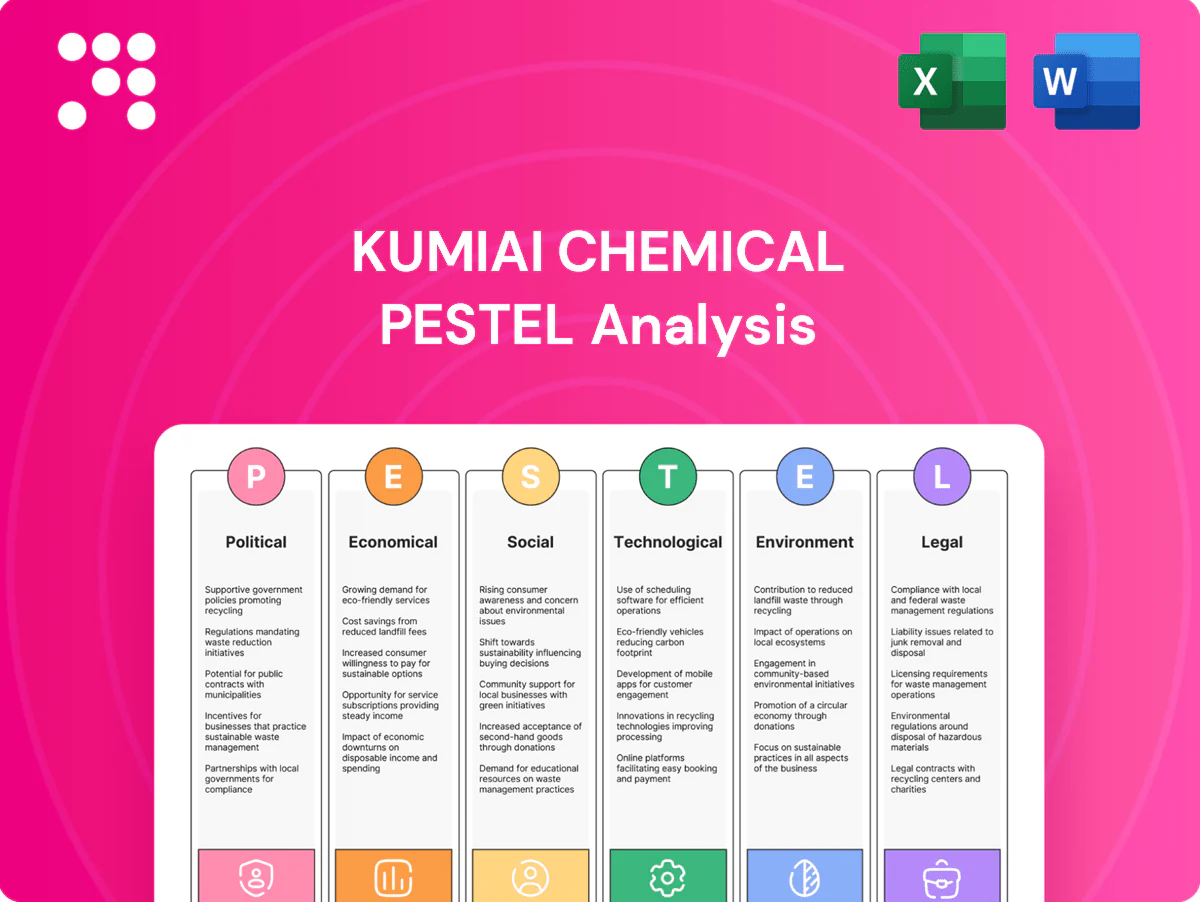
The Kumiai Chemical PESTLE Analysis provides a concise, professionally structured review of political, economic, social, technological, legal and environmental factors affecting the company. The preview shown here is the exact document you’ll receive after purchase—fully formatted and ready to use. No placeholders or teasers: the file you see is the final version available immediately after checkout.

Product Information
Product Information
Shipping & Returns
Shipping & Returns
Description
Skip the Research. Get the Strategy.
Unlock decisive insights with our PESTLE Analysis tailored to Kumiai Chemical—identify regulatory pressures, market trends, and technological shifts shaping its future. Perfect for investors and strategists who need clarity fast. Purchase the full report to get the complete, actionable breakdown now.
Political factors
Ag subsidy directions
Changes in national farm support and crop insurance reshape herbicide and fungicide demand as subsidy-linked crop mixes and input intensity shift across markets. EU Common Agricultural Policy budget for 2021–27 is about €387 billion, steering EU growers toward subsidy-eligible practices; similar US and Japan shifts favor sustainable, low-residue solutions. Policy moves reallocating spend to sustainable and bio-solutions force Kumiai to align R&D and product portfolios to subsidy-eligible technologies.
Regulatory diplomacy
Bilateral trade deals such as the 11-member CPTPP and the EU–Japan EPA (in force since 2019) shape pesticide registrations and push for MRL alignment, while non-tariff barriers still complicate approvals.
Faster mutual recognition between jurisdictions accelerates market entry; divergence in standards delays sales across key markets.
Active engagement with regulators and industry bodies reduces approval friction, and strategic partnerships in priority markets mitigate political risk.
Geopolitical supply shocks
Conflicts and sanctions since Russia’s 2022 invasion have disrupted chemical intermediates and solvent flows from Eastern Europe and parts of Asia, aggravating supply chain risk. Logistics bottlenecks and energy-price volatility—Europe TTF gas spiked over 500% in 2022 and container rates topped $20,000/FEU in 2021—have elevated COGS. Dual-sourcing and buffer inventories serve as political-risk hedges, while geographic diversification of tolling reduces single-region exposure.
Food security agendas
- Policy: govt self-sufficiency targets increase demand
- Regulatory: emergency approvals = faster market entry
- Risk: bans limit portfolios
- Strategy: tie products to national yield programs
Public sector R&D tie-ups
Public sector R&D tie-ups, supported by initiatives like Japan’s Green Innovation Fund (about 2 trillion JPY), catalyze precision ag and IPM co-development; such grants lower development costs and accelerate field validation timelines. Participation with public partners boosts Kumiai Chemical’s credibility, may impose local manufacturing or data-sharing requirements, and offers a pathway to expand in Asia and LATAM markets.
- Grants: access to large public funds (eg Green Innovation Fund 2 trillion JPY)
- Benefit: faster field validation and credibility
- Condition: potential local manufacturing/data-sharing
- Strategy: leverage for Asia and LATAM expansion
Policy shifts and trade deals push crop protection toward sustainable, subsidy-eligible tech
Shifts in subsidy regimes (EU CAP €387bn 2021–27) and food-security policies (FAO +70% demand by 2050) redirect herbicide/fungicide demand toward sustainable, subsidy-eligible solutions. Trade accords (CPTPP, EU–Japan EPA) and MRL harmonization speed market access while non-tariff barriers persist. Energy/logistics shocks since 2021–22 raised COGS, prompting dual-sourcing and regional tolling.
| Factor | Key datapoint |
|---|---|
| EU CAP | €387bn (2021–27) |
| Japan fund | 2tn JPY |
| Food demand | +70% by 2050 (FAO) |
What is included in the product
Detailed Word Document
Explores how external macro-environmental factors uniquely affect Kumiai Chemical across Political, Economic, Social, Technological, Environmental and Legal dimensions, with data-driven trends and region-specific regulatory context. Designed for executives and investors, the analysis offers detailed sub-points, forward-looking insights and scenario-ready recommendations to identify threats and opportunities.
Customizable Excel Spreadsheet
A clean, summarized Kumiai Chemical PESTLE analysis, visually segmented by factors for quick interpretation and easily shareable/editable for meetings, presentations or cross‑team alignment.
Economic factors
Farmer income cycles
Commodity price swings—notably elevated grain markets in 2023–24—directly reshape farmer input budgets, lifting demand for premium herbicide/insecticide formulations in upswings and favoring generics in downturns. Credit availability and higher policy rates (major markets averaging near 4% in 2024) constrained pre-season purchases. Offering flexible payment terms and seasonal financing smooths demand and stabilizes Kumiai Chemical sales.
FX volatility (JPY)
Yen depreciation (USD/JPY rallied from ~115 in 2021 to a wide 140–160 range since 2023) boosts Kumiai Chemical’s export competitiveness but raises import costs for intermediates, squeezing gross margins. Active hedging programs and seasonal FX contracts protect margins across cycles, while pricing corridors must allow timely currency pass-through. Increasing localized sourcing lowers FX sensitivity.
Raw material inflation
Aromatics, fluorinated intermediates and specialty solvents remain the largest drivers of Kumiai Chemical’s COGS in agrochemical and electronic-materials lines, often representing roughly 30–50% of input cost in industry benchmarks; benzene and fluorochemicals price volatility pushed upstream costs in 2024. Energy inflation (Brent ~86 USD/bbl 2024; regional industrial power up low‑double digits) ripples through synthesis and formulation. Long‑term supply contracts and shifting to green feedstocks (bio‑based solvents) have been used to stabilize input cost volatility. Ongoing value engineering programs have protected gross margins by reducing unit input usage and improving yield.
Market mix diversification
Kumiai Chemical’s market mix diversification into specialty chemicals and electronics reduces exposure to agricultural cyclicality, while cross-selling intermediates into pharmaceuticals and electronics helps stabilize revenue and margins; management should allocate capex preferentially to higher-ROIC segments and pursue portfolio pruning to improve asset turns.
- diversification cushions cyclicality
- cross-selling stabilizes revenue
- capex to higher-ROIC segments
- prune low-turn assets to boost turns
Consolidated distribution
- Pricing pressure: major retailers (Walmart $611B FY2024)
- Joint planning: shelf space & promotions
- Private-label risk: ~40% EU share
- CRM analytics: optimize channel margins
Policy shifts and trade deals push crop protection toward sustainable, subsidy-eligible tech
Commodity-led demand swings (high grain in 2023–24) and tighter credit with major policy rates ≈4% in 2024 shifted farmer buy patterns; flexible payment and seasonal finance smooth sales. USD/JPY 140–160 since 2023 improves exports but raises import COGS; active hedging and local sourcing necessary. Brent ≈86 USD/bbl (2024) and fluorochemicals drove 30–50% of COGS; prioritize capex to higher-ROIC specialties.
| Metric | Value |
|---|---|
| Policy rates (major markets, 2024) | ≈4% |
| USD/JPY (since 2023) | 140–160 |
| Brent (2024) | ≈86 USD/bbl |
| Retailer pressure (Walmart FY2024) | 611 B USD |
| Input share (aromatics/fluoro) | 30–50% |
Preview the Actual Deliverable
Kumiai Chemical PESTLE Analysis
The Kumiai Chemical PESTLE Analysis provides a concise, professionally structured review of political, economic, social, technological, legal and environmental factors affecting the company. The preview shown here is the exact document you’ll receive after purchase—fully formatted and ready to use. No placeholders or teasers: the file you see is the final version available immediately after checkout.