Kreate PESTLE Analysis

Your Competitive Advantage Starts with This Report
Unlock strategic clarity with our Kreate PESTLE Analysis—three to five expert-backed insights showing how political, economic, social, technological, legal, and environmental forces shape Kreate’s trajectory. Perfect for investors and strategists, this concise preview points to risk and opportunity—purchase the full analysis for the complete, actionable breakdown and editable deliverables.
Political factors

Nordic policy stability
Finland’s stable, consensus-driven governance—current Orpo coalition formed June 2023—supports long-term infrastructure planning and predictable budgets that reduce project-start risk; parliamentary terms are four years (next elections 2027), but electoral cycles can reshuffle priorities and timing, so Kreate should align its pipeline with multi-year national transport plans to smooth volatility.
Public procurement rules
EU and Finnish procurement frameworks emphasize transparency, competition and value-for-money, with EU public procurement representing roughly 14% of GDP (about €2 trillion annually) and Finland’s public procurement around €40bn a year. Pre-qualification, scoring models and tight tender timelines materially affect win rates and drive bid costs. Strong compliance, documentation and bid discipline are critical levers to avoid exclusions and penalties. Framework agreements can lock recurring volumes and cut tender churn, improving revenue predictability.

EU/Nordic funding priorities
EU cohesion policy (≈€373bn for 2021–27) plus instruments like the RRF (€723.8bn) and green transition funds (Just Transition Fund ≈€17.5bn) prioritize rail, bridges and low‑carbon mobility; CEF transport allocations (~€25–26bn) further favor TEN‑T projects. Co‑financing accelerates complex builds but imposes heavy reporting and compliance costs. Nordic cross‑border initiatives offer regional co‑funding windows; Kreate should target shovel‑ready, green‑aligned packages to secure grants.

Infrastructure security & NATO
Critical infrastructure hardening, redundancy and designated military-mobility corridors are rising priorities as NATO and partners scale collective defence (NATO defense spending exceeded 1 trillion dollars in recent years) and the EU’s NIS2 framework (in force 2024) increases mandatory documentation and site controls.
- Security-driven capex creates specialized demand for robust structures
- Stricter documentation and access controls raise compliance costs
- Pre-qualification on security clearances becomes a market differentiator
Regional & municipal politics
Decentralized local decision-making shapes permits, zoning and co-finance, with subnational authorities delivering ~60% of public investment (OECD) and the US municipal bond market outstanding ~4 trillion (2024), meaning local approvals directly impact capital access and timelines. Municipal fiscal stress can accelerate or stall projects; early stakeholder engagement reduces NIMBY delays and local partnerships improve social license and schedule certainty.
- Permits/zoning: local control
- Public investment: ~60% by subnationals (OECD)
- Capital: US muni market ~4 trillion (2024)
- Mitigation: early engagement cuts opposition
- Benefit: local partnerships = schedule certainty
Finland transport investment: stable politics, EU funds and tougher procurement boost green projects
Finland’s stable Orpo coalition (since June 2023) and four-year parliamentary cycle (next elections 2027) favor predictable multi-year transport planning but electoral shifts can reprioritize projects. EU/Finnish procurement (~€2trn EU public procurement; Finland ~€40bn/y) demand strict compliance and raise bid costs; framework agreements improve revenue visibility. EU funding (Cohesion €373bn 2021–27; RRF €723.8bn) and CEF (~€25bn) favor green, shovel-ready transport projects; NIS2 (2024) and NATO-driven resilience increase security-related capex and documentation burdens.
| Metric | Value/Year |
|---|---|
| EU public procurement | ~€2tn/yr |
| Finland public procurement | ~€40bn/yr |
| Cohesion Fund | €373bn (2021–27) |
| RRF | €723.8bn |
| CEF Transport | ~€25bn |
| Subnational public investment | ~60% (OECD) |
What is included in the product
 Detailed Word Document
Explores how macro-environmental factors uniquely affect Kreate across Political, Economic, Social, Technological, Environmental, and Legal dimensions, with each category expanded into detailed, business-specific subpoints. Every section is data-backed, forward-looking, and formatted for executives, consultants, and investors to inform strategy, scenario planning, and funding decisions.

 Customizable Excel Spreadsheet
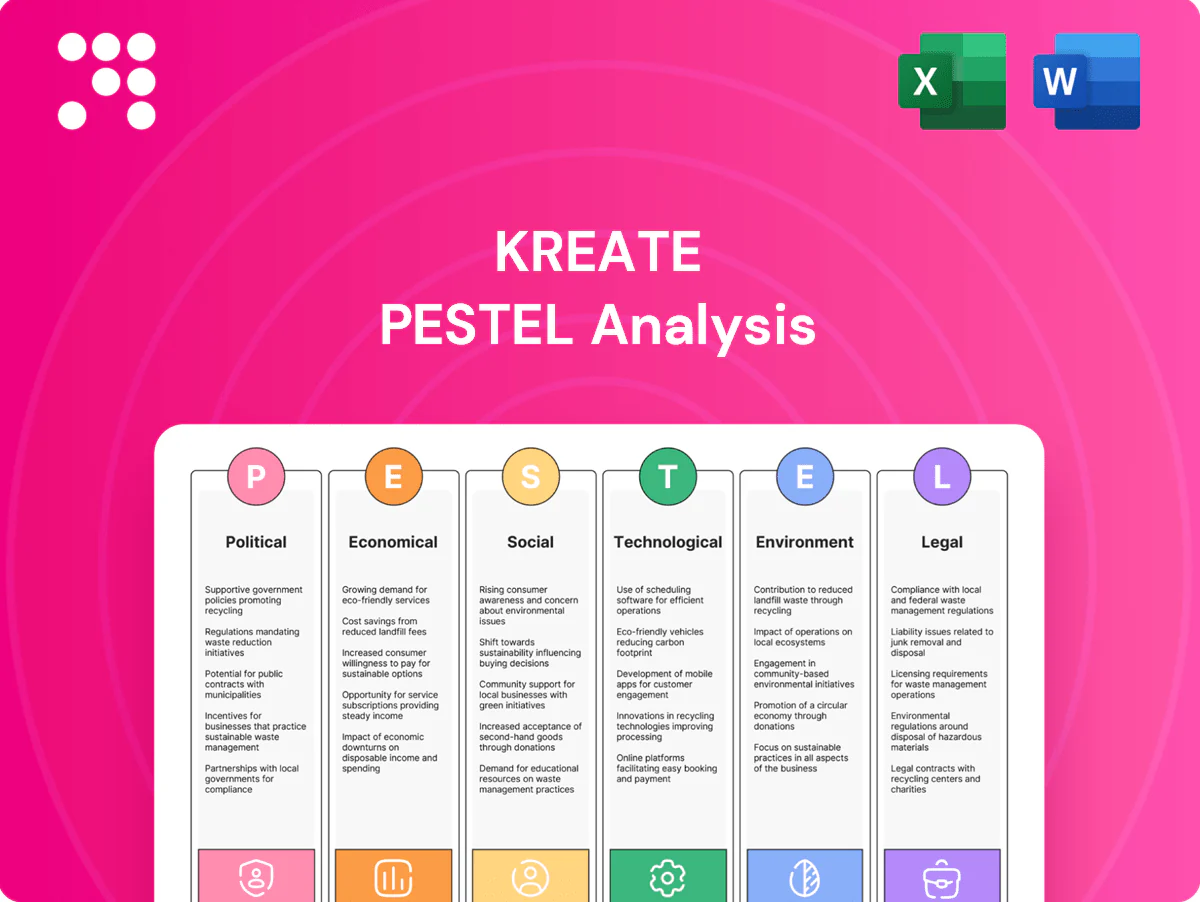
Kreate PESTLE delivers a clean, visually segmented summary of external risks and opportunities that’s easily dropped into presentations or shared across teams, with editable notes for local context and clear language to support quick alignment and planning.
Economic factors

Capex cycles & GDP
Public infrastructure spend is countercyclical but constrained by fiscal space; IMF WEO Apr 2024 projects global GDP growth at 3.1%, limiting discretionary capex in some markets. Private maintenance and logistics projects closely track GDP and trade volumes, which rose modestly in 2024. Diversifying between new-build and maintenance smooths revenue, and scenario planning should stress-test backlog under downside GDP shocks using quantitative backlog erosion models.
Input cost inflation
Rising input costs — steel ($600–900/t in 2024 spot HRC markets), cement ($80–120/t), asphalt ($500–700/t), Brent crude ($75–95/bbl) and higher electricity tariffs — compress Kreate’s margins unless passed through. Indexation clauses and commodity hedges have historically covered a large share of spikes, while dual-sourcing reduces single-supplier disruption risk. Value engineering and offsite prefabrication can cut material use and labor, partially offsetting volatility.

Labor market & wages
Skilled labor scarcity in tunneling, rail and bridge works is driving wage inflation—site craft wages rose about 6% in 2024—while collective agreements continue to set minimum pay and site conditions across projects. Investment in productivity tools and certified training programs has preserved bid competitiveness by raising output per hour. Tight subcontractor markets make rigorous supplier selection and management essential to control costs and ensure quality.

Interest rates & financing
- Client financing costs up with FF 5.25–5.50%
- 10‑yr yield ~4.2% → PPP repricing
- Optimize working capital & bonding for bid cadence
- Maintenance cash conversion = cyclical buffer
Currency & regional exposure
EUR base limits domestic FX risk, but cross-Nordic procurement introduces SEK/NOK exposure (EUR/SEK ~11.8, EUR/NOK ~11.6 as of mid‑2025). Imported materials (≈30% of COGS) amplify currency swings; simple 6–12 month forwards on major packages can protect margins. Contracts should shift FX risk via clear price‑revision clauses tied to EUR/SEK/NOK moves.
- FX_EXPOSURE: EUR base + SEK/NOK pockets
- RATE_REF: EUR/SEK 11.8, EUR/NOK 11.6 (mid‑2025)
- IMPORT_SHARE: ~30% COGS
- HEDGE: 6–12m forwards
- CONTRACT: price revision alignment
Finland transport investment: stable politics, EU funds and tougher procurement boost green projects
Global GDP at 3.1% (IMF WEO Apr 2024) limits discretionary capex; maintenance/logistics track trade gains and smooth revenue. Input costs (HRC 600–900/t, cement 80–120/t, Brent 75–95/bbl) and wage inflation (~6% site wages 2024) compress margins unless passed through. FF 5.25–5.50% and 10y ~4.2% (Jul 2025) raises client financing costs; FX pockets EUR/SEK 11.8, EUR/NOK 11.6.
| Metric | Value |
|---|---|
| Global GDP (IMF) | 3.1% |
| HRC | 600–900 $/t |
| Brent | 75–95 $/bbl |
| FF / 10y | 5.25–5.50% / 4.2% |
| EUR/SEK, EUR/NOK | 11.8, 11.6 |
Preview Before You Purchase
Kreate PESTLE Analysis
The preview shown here is the exact Kreate PESTLE Analysis document you’ll receive after purchase—fully formatted and ready to use. It’s professionally structured with complete content and the same layout you see. No placeholders or surprises: this is the final file you’ll download instantly after checkout.

Product Information
Product Information
Shipping & Returns
Shipping & Returns
Description
Your Competitive Advantage Starts with This Report
Unlock strategic clarity with our Kreate PESTLE Analysis—three to five expert-backed insights showing how political, economic, social, technological, legal, and environmental forces shape Kreate’s trajectory. Perfect for investors and strategists, this concise preview points to risk and opportunity—purchase the full analysis for the complete, actionable breakdown and editable deliverables.
Political factors
Nordic policy stability
Finland’s stable, consensus-driven governance—current Orpo coalition formed June 2023—supports long-term infrastructure planning and predictable budgets that reduce project-start risk; parliamentary terms are four years (next elections 2027), but electoral cycles can reshuffle priorities and timing, so Kreate should align its pipeline with multi-year national transport plans to smooth volatility.
Public procurement rules
EU and Finnish procurement frameworks emphasize transparency, competition and value-for-money, with EU public procurement representing roughly 14% of GDP (about €2 trillion annually) and Finland’s public procurement around €40bn a year. Pre-qualification, scoring models and tight tender timelines materially affect win rates and drive bid costs. Strong compliance, documentation and bid discipline are critical levers to avoid exclusions and penalties. Framework agreements can lock recurring volumes and cut tender churn, improving revenue predictability.
EU/Nordic funding priorities
EU cohesion policy (≈€373bn for 2021–27) plus instruments like the RRF (€723.8bn) and green transition funds (Just Transition Fund ≈€17.5bn) prioritize rail, bridges and low‑carbon mobility; CEF transport allocations (~€25–26bn) further favor TEN‑T projects. Co‑financing accelerates complex builds but imposes heavy reporting and compliance costs. Nordic cross‑border initiatives offer regional co‑funding windows; Kreate should target shovel‑ready, green‑aligned packages to secure grants.
Infrastructure security & NATO
Critical infrastructure hardening, redundancy and designated military-mobility corridors are rising priorities as NATO and partners scale collective defence (NATO defense spending exceeded 1 trillion dollars in recent years) and the EU’s NIS2 framework (in force 2024) increases mandatory documentation and site controls.
- Security-driven capex creates specialized demand for robust structures
- Stricter documentation and access controls raise compliance costs
- Pre-qualification on security clearances becomes a market differentiator
Regional & municipal politics
Decentralized local decision-making shapes permits, zoning and co-finance, with subnational authorities delivering ~60% of public investment (OECD) and the US municipal bond market outstanding ~4 trillion (2024), meaning local approvals directly impact capital access and timelines. Municipal fiscal stress can accelerate or stall projects; early stakeholder engagement reduces NIMBY delays and local partnerships improve social license and schedule certainty.
- Permits/zoning: local control
- Public investment: ~60% by subnationals (OECD)
- Capital: US muni market ~4 trillion (2024)
- Mitigation: early engagement cuts opposition
- Benefit: local partnerships = schedule certainty
Finland transport investment: stable politics, EU funds and tougher procurement boost green projects
Finland’s stable Orpo coalition (since June 2023) and four-year parliamentary cycle (next elections 2027) favor predictable multi-year transport planning but electoral shifts can reprioritize projects. EU/Finnish procurement (~€2trn EU public procurement; Finland ~€40bn/y) demand strict compliance and raise bid costs; framework agreements improve revenue visibility. EU funding (Cohesion €373bn 2021–27; RRF €723.8bn) and CEF (~€25bn) favor green, shovel-ready transport projects; NIS2 (2024) and NATO-driven resilience increase security-related capex and documentation burdens.
| Metric | Value/Year |
|---|---|
| EU public procurement | ~€2tn/yr |
| Finland public procurement | ~€40bn/yr |
| Cohesion Fund | €373bn (2021–27) |
| RRF | €723.8bn |
| CEF Transport | ~€25bn |
| Subnational public investment | ~60% (OECD) |
What is included in the product
Detailed Word Document
Explores how macro-environmental factors uniquely affect Kreate across Political, Economic, Social, Technological, Environmental, and Legal dimensions, with each category expanded into detailed, business-specific subpoints. Every section is data-backed, forward-looking, and formatted for executives, consultants, and investors to inform strategy, scenario planning, and funding decisions.
Customizable Excel Spreadsheet
Kreate PESTLE delivers a clean, visually segmented summary of external risks and opportunities that’s easily dropped into presentations or shared across teams, with editable notes for local context and clear language to support quick alignment and planning.
Economic factors
Capex cycles & GDP
Public infrastructure spend is countercyclical but constrained by fiscal space; IMF WEO Apr 2024 projects global GDP growth at 3.1%, limiting discretionary capex in some markets. Private maintenance and logistics projects closely track GDP and trade volumes, which rose modestly in 2024. Diversifying between new-build and maintenance smooths revenue, and scenario planning should stress-test backlog under downside GDP shocks using quantitative backlog erosion models.
Input cost inflation
Rising input costs — steel ($600–900/t in 2024 spot HRC markets), cement ($80–120/t), asphalt ($500–700/t), Brent crude ($75–95/bbl) and higher electricity tariffs — compress Kreate’s margins unless passed through. Indexation clauses and commodity hedges have historically covered a large share of spikes, while dual-sourcing reduces single-supplier disruption risk. Value engineering and offsite prefabrication can cut material use and labor, partially offsetting volatility.
Labor market & wages
Skilled labor scarcity in tunneling, rail and bridge works is driving wage inflation—site craft wages rose about 6% in 2024—while collective agreements continue to set minimum pay and site conditions across projects. Investment in productivity tools and certified training programs has preserved bid competitiveness by raising output per hour. Tight subcontractor markets make rigorous supplier selection and management essential to control costs and ensure quality.
Interest rates & financing
- Client financing costs up with FF 5.25–5.50%
- 10‑yr yield ~4.2% → PPP repricing
- Optimize working capital & bonding for bid cadence
- Maintenance cash conversion = cyclical buffer
Currency & regional exposure
EUR base limits domestic FX risk, but cross-Nordic procurement introduces SEK/NOK exposure (EUR/SEK ~11.8, EUR/NOK ~11.6 as of mid‑2025). Imported materials (≈30% of COGS) amplify currency swings; simple 6–12 month forwards on major packages can protect margins. Contracts should shift FX risk via clear price‑revision clauses tied to EUR/SEK/NOK moves.
- FX_EXPOSURE: EUR base + SEK/NOK pockets
- RATE_REF: EUR/SEK 11.8, EUR/NOK 11.6 (mid‑2025)
- IMPORT_SHARE: ~30% COGS
- HEDGE: 6–12m forwards
- CONTRACT: price revision alignment
Finland transport investment: stable politics, EU funds and tougher procurement boost green projects
Global GDP at 3.1% (IMF WEO Apr 2024) limits discretionary capex; maintenance/logistics track trade gains and smooth revenue. Input costs (HRC 600–900/t, cement 80–120/t, Brent 75–95/bbl) and wage inflation (~6% site wages 2024) compress margins unless passed through. FF 5.25–5.50% and 10y ~4.2% (Jul 2025) raises client financing costs; FX pockets EUR/SEK 11.8, EUR/NOK 11.6.
| Metric | Value |
|---|---|
| Global GDP (IMF) | 3.1% |
| HRC | 600–900 $/t |
| Brent | 75–95 $/bbl |
| FF / 10y | 5.25–5.50% / 4.2% |
| EUR/SEK, EUR/NOK | 11.8, 11.6 |
Preview Before You Purchase
Kreate PESTLE Analysis
The preview shown here is the exact Kreate PESTLE Analysis document you’ll receive after purchase—fully formatted and ready to use. It’s professionally structured with complete content and the same layout you see. No placeholders or surprises: this is the final file you’ll download instantly after checkout.