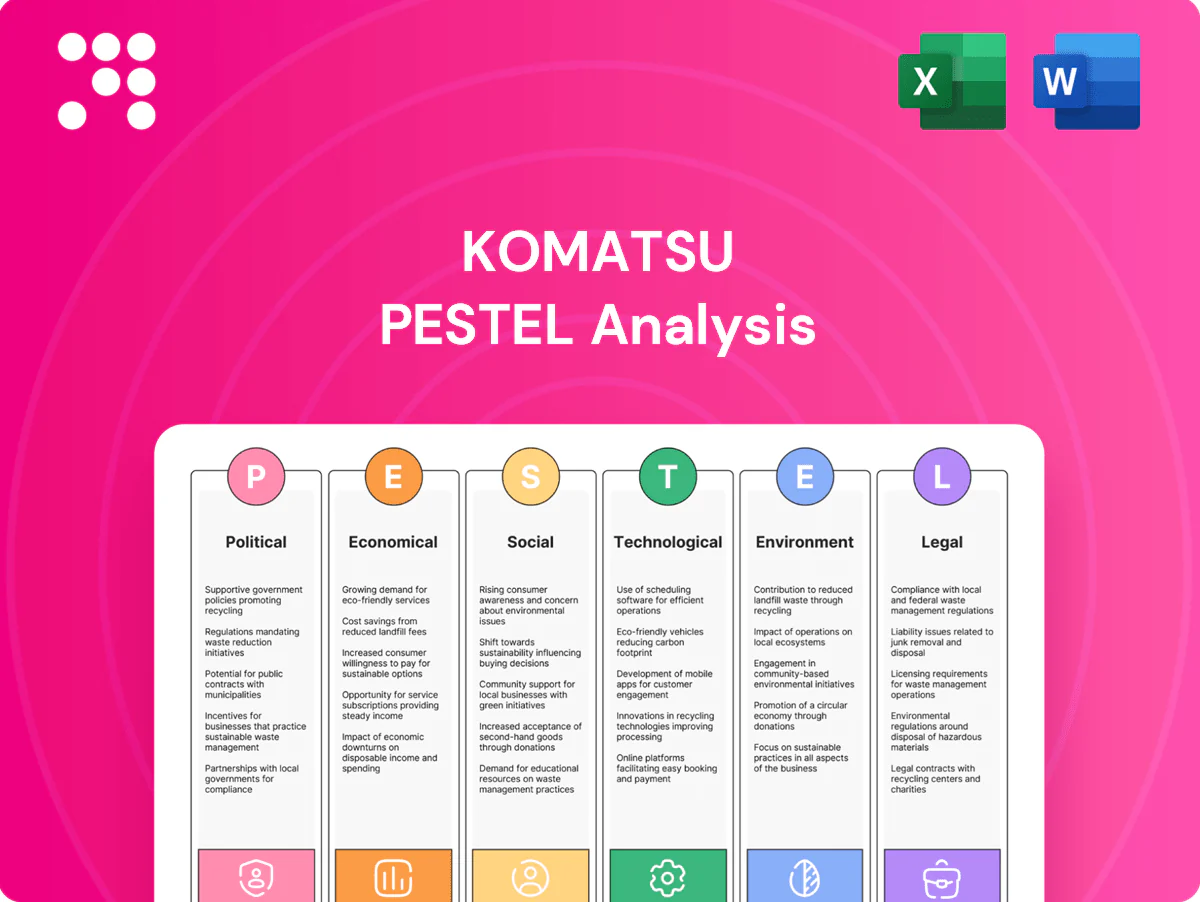
Komatsu PESTLE Analysis

Make Smarter Strategic Decisions with a Complete PESTEL View
Discover how political, economic, and environmental trends are reshaping Komatsu’s market position and long-term outlook. This expert PESTLE highlights regulatory risks, supply-chain pressures, and technological opportunities to inform investment and strategic decisions. Purchase the full report for a complete, downloadable breakdown and actionable recommendations.
Political factors

Trade policy volatility
Shifts in tariffs, sanctions and export controls—notably US Section 301 tariffs on many Chinese goods of up to 25%—disrupt Komatsu’s cross‑border equipment flows and component sourcing. US–China–EU trade frictions have raised costs and delayed deliveries on recent large projects. Proactive supply‑chain mapping and alternate‑source qualification reduce disruption risk. Localizing production where feasible lowers political exposure.
Government infrastructure spending
Public CAPEX in roads, mining, energy and housing drives equipment cycles; the US Bipartisan Infrastructure Law provides about 550 billion USD in new federal funding, India’s National Infrastructure Pipeline totals Rs111 lakh crore (≈US$1.4 trillion for 2020–25), and ADB estimates ASEAN needs ≈US$210 billion/year. Fiscal stimulus boosts Komatsu order books; austerity or budget delays compress utilization and parts sales, so close agency engagement aligns product availability with tenders.

Resource nationalism
Resource nationalism—shifts in mining policies, higher royalties and stricter local-content rules—directly reshape Komatsu equipment sales and service models; Komatsu reported about JPY 2.2 trillion in consolidated net sales FY2024, underscoring scale at risk. Countries may require in-country assembly or supplier preference, so Komatsu forms local partnerships to comply while keeping quality. Active policy monitoring in Africa and Latin America is critical for bid strategies and margin protection.

Geopolitical security risks
Conflicts and unrest can halt mining and construction sites, sever logistics corridors and strain dealer networks, forcing Komatsu to prioritize insurance cover, prepositioned inventories and strict workforce safety protocols. Komatsu’s global footprint in 150+ countries and its Komtrax telematics fleet of 600,000+ units help cushion single-country shocks and sustain uptime when travel is restricted.
- 150+ countries: diversified regional revenue mix
- 600,000+ Komtrax units: remote monitoring/support
- Insurance & inventory positioning: risk mitigation
- Workforce safety protocols: operational continuity
Industrial policy and subsidies
Industrial policies and subsidies—notably the US Inflation Reduction Act with roughly $369 billion in clean-energy incentives, the Bipartisan Infrastructure Law’s $7.5 billion EV charging program, DOE’s ~$7 billion hydrogen hubs and the EU Fit for 55 -55% 2030 target—drive Komatsu’s electrification, hydrogen and automation roadmaps, favor local manufacturing under made-in-country schemes, enable R&D/pilot grants and speed customer uptake of low-emission fleets.
- Incentives: IRA $369B
- Charging: BIL $7.5B
- Hydrogen hubs: ~$7B
- EU target: -55% by 2030
Tariffs and subsidies drive localization, higher component costs and faster electrification
Tariffs, sanctions and trade frictions (US Section 301, 25%) raise component costs and delay cross‑border flows. Public CAPEX (US BIL ≈$550B; India NIP Rs111 lakh crore ≈$1.4T; ADB ASEAN need ≈$210B/yr) and industrial subsidies (IRA $369B) drive electrification and local manufacturing. Resource nationalism, conflicts and procurement rules force localization, insurance and inventory positioning; Komatsu: 150+ countries, 600,000+ Komtrax units.
| Metric | Value |
|---|---|
| Countries | 150+ |
| Komtrax units | 600,000+ |
| US BIL | $550B |
| IRA | $369B |
| India NIP | ≈$1.4T (2020–25) |
What is included in the product
 Detailed Word Document
Explores how macro-environmental forces uniquely affect Komatsu across six dimensions—Political, Economic, Social, Technological, Environmental, and Legal—using current data and trends to identify risks, opportunities and strategic implications for executives, investors and planners.

 Customizable Excel Spreadsheet
Clean, summarized Komatsu PESTLE analysis presented by category for quick reference in meetings or presentations, helping teams grasp external risks and market positioning at a glance.
Economic factors

Commodity price cycles
Commodity cycles—iron ore about US$110/t (62% Fe CFR China, mid-2025), copper near US$10,000/t (LME), coal roughly US$150/t and gold around US$2,300/oz—directly drive mining CAPEX and fleet renewals. High prices in 2024–25 have spurred truck and shovel demand, while downturns pivot Komatsu sales toward parts and rebuilds. Scenario planning aligns production to commodity outlooks and long-term service contracts smooth earnings through cycles.
Interest rates and financing
Higher global policy rates—US federal funds at 5.25–5.50% in 2024–25—raise customer borrowing costs and make lease approvals more difficult for heavy-equipment buyers.
Komatsu Financial, Komatsu’s captive lender, can bridge affordability with tailored loan and lease terms to sustain sales during rate cycles.
Active residual value management helps keep Komatsu lease rates competitive while credit-risk assessment tightens in weaker macro periods to limit defaults.

FX fluctuations
Yen moves (≈150 in 2023 to ≈140 in 2024, ~6.7% appreciation) affect Komatsu export competitiveness and translated overseas earnings. The company’s hedging program covers roughly 60–70% of near-term currency exposures to protect margins on imported components and overseas revenues. Pricing discipline and increased local-cost bases mitigate volatility. Transparent FX clauses with dealers enable systematic pass-through.

Construction demand and housing
Residential and non-residential starts remain primary drivers of excavator and loader demand; US housing starts averaged about 1.4 million annualized in 2024, amplifying equipment cycles. Urbanization and megaprojects—especially in Asia and Africa—support steady utilization in emerging markets. Developed markets are more cyclical and rate-sensitive, while Komatsu’s balanced channel mix reduces exposure to any single segment.
- Residential + non-residential starts: primary demand
- US starts ~1.4M (2024 annualized)
- Emerging-market megaprojects sustain utilization
- Developed markets: rate-sensitive cyclicality
- Balanced channel mix lowers segment risk
Supply chain cost inflation
Rising input costs—HRC steel around $700/ton in 2024, battery packs ~120 USD/kWh (2024 BNEF), semiconductor lead times ~12 weeks and spot freight ~1,500 USD/FEU—pressure unit economics, while dual-sourcing and design-to-cost protect margins; inventory optimization reduces working capital strain in volatile lead-time environments and supplier partnerships secure critical EV components.
- Steel: $700/ton (2024)
- Batteries: $120/kWh (2024)
- Chips: ~12-week lead times (2024)
- Freight: ~$1,500/FEU (2024)
Tariffs and subsidies drive localization, higher component costs and faster electrification
Commodity upswings (iron ore ~US$110/t, copper ~US$10k/t) drive mining CAPEX and fleet orders. Higher policy rates (US 5.25–5.50%) raise borrowing costs; Komatsu Financial and residual-value tools support leasing. Yen ~140 with 60–70% hedges and US starts ~1.4M moderate FX and construction demand.
| Metric | Value |
|---|---|
| Iron ore | ~US$110/t |
| US rates | 5.25–5.50% |
| Yen | ~140 |
| US starts | ~1.4M |
Full Version Awaits
Komatsu PESTLE Analysis
The preview shown here is the exact Komatsu PESTLE document you’ll receive after purchase—fully formatted and ready to use. It delivers structured analysis of political, economic, social, technological, legal, and environmental factors affecting Komatsu. No placeholders or teasers—this is the final file, available for immediate download.

Original: $10.00
-65%$10.00
$3.50Product Information
Product Information
Shipping & Returns
Shipping & Returns
Description
Make Smarter Strategic Decisions with a Complete PESTEL View
Discover how political, economic, and environmental trends are reshaping Komatsu’s market position and long-term outlook. This expert PESTLE highlights regulatory risks, supply-chain pressures, and technological opportunities to inform investment and strategic decisions. Purchase the full report for a complete, downloadable breakdown and actionable recommendations.
Political factors
Trade policy volatility
Shifts in tariffs, sanctions and export controls—notably US Section 301 tariffs on many Chinese goods of up to 25%—disrupt Komatsu’s cross‑border equipment flows and component sourcing. US–China–EU trade frictions have raised costs and delayed deliveries on recent large projects. Proactive supply‑chain mapping and alternate‑source qualification reduce disruption risk. Localizing production where feasible lowers political exposure.
Government infrastructure spending
Public CAPEX in roads, mining, energy and housing drives equipment cycles; the US Bipartisan Infrastructure Law provides about 550 billion USD in new federal funding, India’s National Infrastructure Pipeline totals Rs111 lakh crore (≈US$1.4 trillion for 2020–25), and ADB estimates ASEAN needs ≈US$210 billion/year. Fiscal stimulus boosts Komatsu order books; austerity or budget delays compress utilization and parts sales, so close agency engagement aligns product availability with tenders.
Resource nationalism
Resource nationalism—shifts in mining policies, higher royalties and stricter local-content rules—directly reshape Komatsu equipment sales and service models; Komatsu reported about JPY 2.2 trillion in consolidated net sales FY2024, underscoring scale at risk. Countries may require in-country assembly or supplier preference, so Komatsu forms local partnerships to comply while keeping quality. Active policy monitoring in Africa and Latin America is critical for bid strategies and margin protection.
Geopolitical security risks
Conflicts and unrest can halt mining and construction sites, sever logistics corridors and strain dealer networks, forcing Komatsu to prioritize insurance cover, prepositioned inventories and strict workforce safety protocols. Komatsu’s global footprint in 150+ countries and its Komtrax telematics fleet of 600,000+ units help cushion single-country shocks and sustain uptime when travel is restricted.
- 150+ countries: diversified regional revenue mix
- 600,000+ Komtrax units: remote monitoring/support
- Insurance & inventory positioning: risk mitigation
- Workforce safety protocols: operational continuity
Industrial policy and subsidies
Industrial policies and subsidies—notably the US Inflation Reduction Act with roughly $369 billion in clean-energy incentives, the Bipartisan Infrastructure Law’s $7.5 billion EV charging program, DOE’s ~$7 billion hydrogen hubs and the EU Fit for 55 -55% 2030 target—drive Komatsu’s electrification, hydrogen and automation roadmaps, favor local manufacturing under made-in-country schemes, enable R&D/pilot grants and speed customer uptake of low-emission fleets.
- Incentives: IRA $369B
- Charging: BIL $7.5B
- Hydrogen hubs: ~$7B
- EU target: -55% by 2030
Tariffs and subsidies drive localization, higher component costs and faster electrification
Tariffs, sanctions and trade frictions (US Section 301, 25%) raise component costs and delay cross‑border flows. Public CAPEX (US BIL ≈$550B; India NIP Rs111 lakh crore ≈$1.4T; ADB ASEAN need ≈$210B/yr) and industrial subsidies (IRA $369B) drive electrification and local manufacturing. Resource nationalism, conflicts and procurement rules force localization, insurance and inventory positioning; Komatsu: 150+ countries, 600,000+ Komtrax units.
| Metric | Value |
|---|---|
| Countries | 150+ |
| Komtrax units | 600,000+ |
| US BIL | $550B |
| IRA | $369B |
| India NIP | ≈$1.4T (2020–25) |
What is included in the product
Detailed Word Document
Explores how macro-environmental forces uniquely affect Komatsu across six dimensions—Political, Economic, Social, Technological, Environmental, and Legal—using current data and trends to identify risks, opportunities and strategic implications for executives, investors and planners.
Customizable Excel Spreadsheet
Clean, summarized Komatsu PESTLE analysis presented by category for quick reference in meetings or presentations, helping teams grasp external risks and market positioning at a glance.
Economic factors
Commodity price cycles
Commodity cycles—iron ore about US$110/t (62% Fe CFR China, mid-2025), copper near US$10,000/t (LME), coal roughly US$150/t and gold around US$2,300/oz—directly drive mining CAPEX and fleet renewals. High prices in 2024–25 have spurred truck and shovel demand, while downturns pivot Komatsu sales toward parts and rebuilds. Scenario planning aligns production to commodity outlooks and long-term service contracts smooth earnings through cycles.
Interest rates and financing
Higher global policy rates—US federal funds at 5.25–5.50% in 2024–25—raise customer borrowing costs and make lease approvals more difficult for heavy-equipment buyers.
Komatsu Financial, Komatsu’s captive lender, can bridge affordability with tailored loan and lease terms to sustain sales during rate cycles.
Active residual value management helps keep Komatsu lease rates competitive while credit-risk assessment tightens in weaker macro periods to limit defaults.
FX fluctuations
Yen moves (≈150 in 2023 to ≈140 in 2024, ~6.7% appreciation) affect Komatsu export competitiveness and translated overseas earnings. The company’s hedging program covers roughly 60–70% of near-term currency exposures to protect margins on imported components and overseas revenues. Pricing discipline and increased local-cost bases mitigate volatility. Transparent FX clauses with dealers enable systematic pass-through.
Construction demand and housing
Residential and non-residential starts remain primary drivers of excavator and loader demand; US housing starts averaged about 1.4 million annualized in 2024, amplifying equipment cycles. Urbanization and megaprojects—especially in Asia and Africa—support steady utilization in emerging markets. Developed markets are more cyclical and rate-sensitive, while Komatsu’s balanced channel mix reduces exposure to any single segment.
- Residential + non-residential starts: primary demand
- US starts ~1.4M (2024 annualized)
- Emerging-market megaprojects sustain utilization
- Developed markets: rate-sensitive cyclicality
- Balanced channel mix lowers segment risk
Supply chain cost inflation
Rising input costs—HRC steel around $700/ton in 2024, battery packs ~120 USD/kWh (2024 BNEF), semiconductor lead times ~12 weeks and spot freight ~1,500 USD/FEU—pressure unit economics, while dual-sourcing and design-to-cost protect margins; inventory optimization reduces working capital strain in volatile lead-time environments and supplier partnerships secure critical EV components.
- Steel: $700/ton (2024)
- Batteries: $120/kWh (2024)
- Chips: ~12-week lead times (2024)
- Freight: ~$1,500/FEU (2024)
Tariffs and subsidies drive localization, higher component costs and faster electrification
Commodity upswings (iron ore ~US$110/t, copper ~US$10k/t) drive mining CAPEX and fleet orders. Higher policy rates (US 5.25–5.50%) raise borrowing costs; Komatsu Financial and residual-value tools support leasing. Yen ~140 with 60–70% hedges and US starts ~1.4M moderate FX and construction demand.
| Metric | Value |
|---|---|
| Iron ore | ~US$110/t |
| US rates | 5.25–5.50% |
| Yen | ~140 |
| US starts | ~1.4M |
Full Version Awaits
Komatsu PESTLE Analysis
The preview shown here is the exact Komatsu PESTLE document you’ll receive after purchase—fully formatted and ready to use. It delivers structured analysis of political, economic, social, technological, legal, and environmental factors affecting Komatsu. No placeholders or teasers—this is the final file, available for immediate download.