Korea Gas PESTLE Analysis

Make Smarter Strategic Decisions with a Complete PESTEL View
Discover how political shifts, economic trends, social behavior, technology advances, legal changes, and environmental pressures are shaping Korea Gas’s strategic path. Our concise PESTLE snapshot highlights key external risks and opportunities to inform smarter decisions. Purchase the full analysis for the complete, editable report—actionable insights ready for investors, consultants, and strategists.
Political factors

Energy security policy
South Korea imports nearly 100% of its natural gas, anchoring KOGAS’s state mandate to secure LNG supply as insurance against nuclear and coal risks. Strategic reserve targets and diversification mandates drive long-term contracting and infrastructure investment. Policy continuity underpins multi-decade offtake deals, though administration shifts can reprioritize fuel mix. Geopolitical tensions in supplier regions raise state-led portfolio balancing and risk premiums.
Government ownership influence
KOGAS is 100% state-owned, aligning its commercial goals with South Korea’s national energy strategy and price-stability objectives. State backing facilitates financing and execution of mega-projects via sovereign credit support. Government ownership can force social tariffs or delay cost pass-through, squeezing margins, while political cycles often shift capex timing and dividend policy.

Geopolitics and alliances
South Korea, the world’s third-largest LNG importer at about 45 million tonnes in 2023, relies on US, Qatar and Australian supplies and emerging exporters to shape pricing and contract flexibility; sanctions bar meaningful Russian or Iranian engagement; Indo-Pacific security tensions raise rerouting and insurance costs; diplomatic energy ties create JV and equity gas investment opportunities.

North Korea risk
Peninsula tensions raise national security risks that force Korea Gas to prioritize infrastructure contingency planning; South Korea increased defense spending to about 61.2 trillion won in 2024, underscoring elevated preparedness costs. Disruptions to coastal terminals or maritime lanes could materially affect LNG throughput—South Korea imports roughly 90% of its natural gas as LNG. Elevated geopolitical risk has raised war-risk surcharges and financing spreads for regional projects, while sustained détente could enable long-term cross-border pipeline concepts.
- Risk: coastal terminal & maritime lane disruption
- Fact: ~90% of gas imported as LNG
- Cost: 2024 defense budget ~61.2 trillion won
- Implication: higher insurance/finance premiums; potential for pipelines if détente
Subsidies and price controls
Socially sensitive retail pricing often forces tariffs below import cost during price spikes, while South Korea relies on roughly 98 percent imported natural gas, squeezing KOGAS margins; government relief packages have partially offset costs but timing gaps have caused cash-flow pressure. Policy tools such as fuel tax shifts or consumer vouchers reshape demand patterns, forcing KOGAS to balance political expectations with securing LNG supply.
- Import dependence: 98%
- Regulated tariffs can fall below spot/import cost
- Relief timing gaps → cash-flow stress
- Tax shifts/vouchers alter short-term demand
≈45 mt LNG imports (90–98%) force state gas utility into long-term deals as security costs rise
South Korea imports ~90–98% of natural gas (≈45 mt LNG in 2023), forcing KOGAS toward long-term LNG contracts and supplier diversification; 100% state ownership aligns company with national energy policy but constrains tariffs and margins. 2024 defense budget ~61.2 trillion won elevates security premiums and financing costs.
| Factor | Metric | Implication |
|---|---|---|
| Import dependence | ≈45 mt LNG; 90–98% | Long-term contracts, price risk |
| State ownership | 100% KOGAS | Policy-driven tariffs, financing support |
What is included in the product
 Detailed Word Document
Explores how macro-environmental factors uniquely affect Korea Gas across Political, Economic, Social, Technological, Environmental, and Legal dimensions, with each section backed by current data and trend analysis; designed for executives, consultants, and investors, it highlights risks, opportunities, and forward-looking scenarios to support strategy, funding, and operational planning.

 Customizable Excel Spreadsheet
A clean, summarized Korea Gas PESTLE that’s visually segmented by category for quick interpretation during meetings, easily dropped into PowerPoints, shared across teams, and annotated with region- or business-specific notes to streamline external risk and market-positioning discussions.
Economic factors

LNG price volatility
Spot vs long-term indexed contracts drive Korea Gas earnings variability, as seen when JKM spiked above 60 USD/MMBtu in 2022 while mid-2024 JKM averaged near 20 USD/MMBtu, widening procurement cost swings. Global supply additions and weather-driven demand shifts keep JKM volatile, pressuring short-cycle purchases. Hedging and portfolio optimization blunt but do not eliminate exposure. Price spikes test offtaker affordability and elevate credit risk.
Demand growth and elasticity
Seasonal peaks and industrial cycles drive Korea Gas throughput and utilization, with South Korea importing about 44 million tonnes of LNG in 2023 and gas-fired plants accounting for roughly 23% of power generation that year. Efficiency gains and electrification trends threaten to cap long-run gas demand. Economic slowdowns cut power and industrial gas use, pressuring volumes. Structural shifts to renewables introduce mid-term demand uncertainty.

Currency exposure
Korea Gas faces significant currency exposure because over 90% of LNG procurement is USD-denominated while revenues are invoiced in KRW; USD/KRW averaged about 1,310 in July 2025, amplifying import cost volatility. FX swings hinder timely cost pass-through and can raise leverage ratios when KRW weakens. The company uses natural hedges and USD/FX derivatives to limit volatility, adding treasury complexity and margin risk. Rising global rates and a BOK policy rate near 3.5% in mid-2025 increase refinancing costs and constrain capex affordability.

Capital intensity
Capital intensity for Korea Gas is high: terminals, storage and pipelines need multiyear, billion-dollar builds; returns hinge on regulated tariffs and throughput certainty. Cost overruns or schedule delays can stress balance sheets for state-backed buyers in a top-5 LNG-importing market. Access to green-linked financing has lowered funding spreads in 2024–25, trimming WACC for low-carbon projects.
- Large up-front capex: onshore LNG terminals often 0.5–2bn USD
- Revenue risk: tariff + throughput dependency
- Delay risk: balance-sheet strain from overruns
- Green finance: 2024–25 yields lower spreads, cutting WACC
Global supply dynamics
Qatar's North Field expansion targets about 110 mtpa by 2026, while US export capacity surpassed 12 Bcf/d in 2024, and African projects (e.g., Mozambique) add incremental volumes—these shifts push shorter, more flexible contracts and destination-free cargoes. Shipping bottlenecks (Panama/Suez draft limits) and higher freight pushed delivered LNG premiums in 2023–24, tightening margins as portfolio players compete and China/Europe demand drives regional arbitrage.
- Qatar: ~110 mtpa target by 2026
- US: >12 Bcf/d export capacity (2024)
- Shipping limits raise delivered cost
- Portfolio competition compresses margins
- China/Europe demand dictates arbitrage
≈45 mt LNG imports (90–98%) force state gas utility into long-term deals as security costs rise
Spot vs long-term contracts drive earnings volatility; JKM >60 USD/MMBtu in 2022 vs ~20 in mid‑2024. South Korea imported ~44 mt LNG in 2023; gas ~23% of power. Over 90% of costs are USD-denominated; USD/KRW ~1,310 (Jul 2025) and BOK rate ~3.5% raise FX and refinancing risk. Qatar ~110 mtpa by 2026; US export >12 Bcf/d (2024) widens flexible supply.
| Metric | Value |
|---|---|
| LNG imports (2023) | ~44 mt |
| Gas share of power (2023) | ~23% |
| USD/KRW | ~1,310 (Jul 2025) |
| BOK policy rate | ~3.5% (mid‑2025) |
| Qatar capacity target | ~110 mtpa (by 2026) |
| US export capacity | >12 Bcf/d (2024) |
Full Version Awaits
Korea Gas PESTLE Analysis
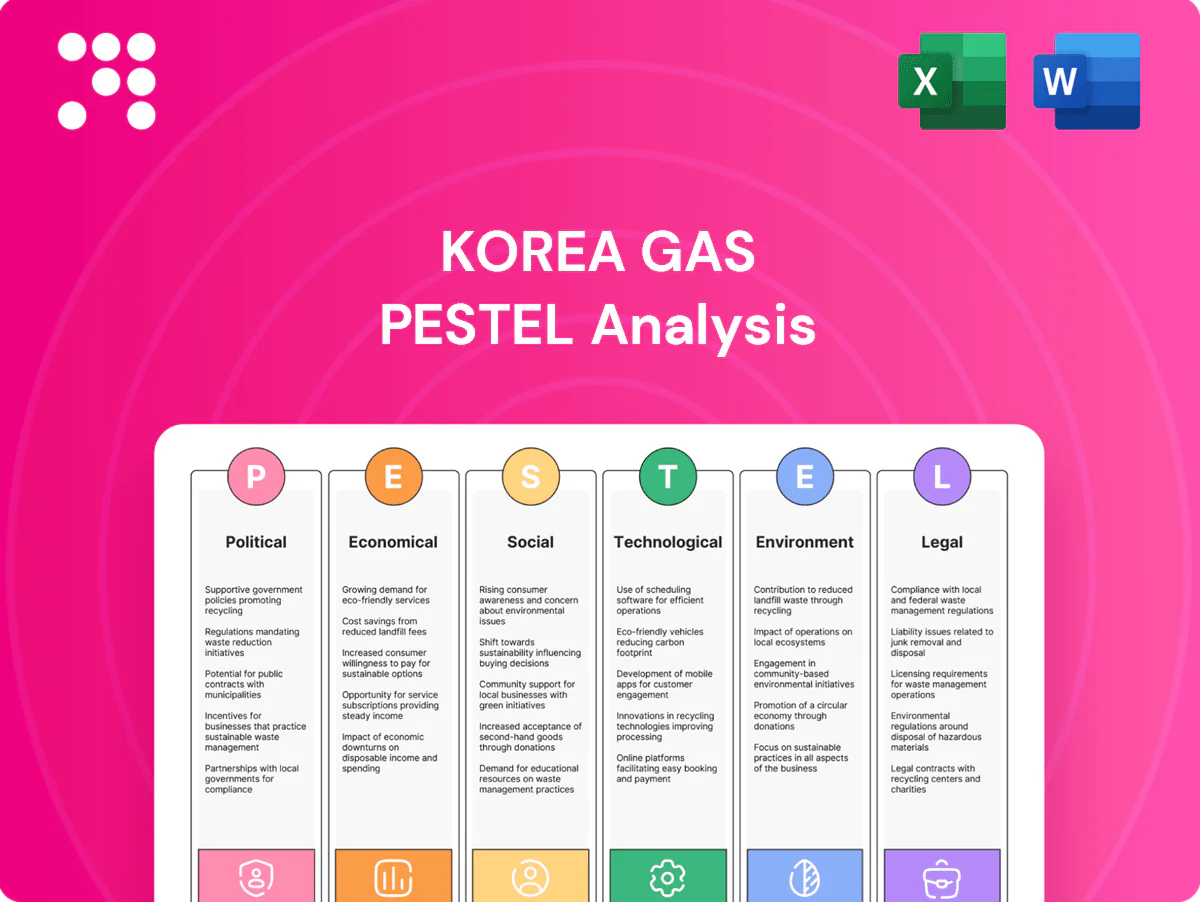
The Korea Gas PESTLE Analysis preview shown here is the exact document you’ll receive after purchase—fully formatted and ready to use. It presents concise Political, Economic, Social, Technological, Legal and Environmental insights specific to Korea Gas. No placeholders or teasers—this is the final file delivered as shown.

Product Information
Product Information
Shipping & Returns
Shipping & Returns
Description
Make Smarter Strategic Decisions with a Complete PESTEL View
Discover how political shifts, economic trends, social behavior, technology advances, legal changes, and environmental pressures are shaping Korea Gas’s strategic path. Our concise PESTLE snapshot highlights key external risks and opportunities to inform smarter decisions. Purchase the full analysis for the complete, editable report—actionable insights ready for investors, consultants, and strategists.
Political factors
Energy security policy
South Korea imports nearly 100% of its natural gas, anchoring KOGAS’s state mandate to secure LNG supply as insurance against nuclear and coal risks. Strategic reserve targets and diversification mandates drive long-term contracting and infrastructure investment. Policy continuity underpins multi-decade offtake deals, though administration shifts can reprioritize fuel mix. Geopolitical tensions in supplier regions raise state-led portfolio balancing and risk premiums.
Government ownership influence
KOGAS is 100% state-owned, aligning its commercial goals with South Korea’s national energy strategy and price-stability objectives. State backing facilitates financing and execution of mega-projects via sovereign credit support. Government ownership can force social tariffs or delay cost pass-through, squeezing margins, while political cycles often shift capex timing and dividend policy.
Geopolitics and alliances
South Korea, the world’s third-largest LNG importer at about 45 million tonnes in 2023, relies on US, Qatar and Australian supplies and emerging exporters to shape pricing and contract flexibility; sanctions bar meaningful Russian or Iranian engagement; Indo-Pacific security tensions raise rerouting and insurance costs; diplomatic energy ties create JV and equity gas investment opportunities.
North Korea risk
Peninsula tensions raise national security risks that force Korea Gas to prioritize infrastructure contingency planning; South Korea increased defense spending to about 61.2 trillion won in 2024, underscoring elevated preparedness costs. Disruptions to coastal terminals or maritime lanes could materially affect LNG throughput—South Korea imports roughly 90% of its natural gas as LNG. Elevated geopolitical risk has raised war-risk surcharges and financing spreads for regional projects, while sustained détente could enable long-term cross-border pipeline concepts.
- Risk: coastal terminal & maritime lane disruption
- Fact: ~90% of gas imported as LNG
- Cost: 2024 defense budget ~61.2 trillion won
- Implication: higher insurance/finance premiums; potential for pipelines if détente
Subsidies and price controls
Socially sensitive retail pricing often forces tariffs below import cost during price spikes, while South Korea relies on roughly 98 percent imported natural gas, squeezing KOGAS margins; government relief packages have partially offset costs but timing gaps have caused cash-flow pressure. Policy tools such as fuel tax shifts or consumer vouchers reshape demand patterns, forcing KOGAS to balance political expectations with securing LNG supply.
- Import dependence: 98%
- Regulated tariffs can fall below spot/import cost
- Relief timing gaps → cash-flow stress
- Tax shifts/vouchers alter short-term demand
≈45 mt LNG imports (90–98%) force state gas utility into long-term deals as security costs rise
South Korea imports ~90–98% of natural gas (≈45 mt LNG in 2023), forcing KOGAS toward long-term LNG contracts and supplier diversification; 100% state ownership aligns company with national energy policy but constrains tariffs and margins. 2024 defense budget ~61.2 trillion won elevates security premiums and financing costs.
| Factor | Metric | Implication |
|---|---|---|
| Import dependence | ≈45 mt LNG; 90–98% | Long-term contracts, price risk |
| State ownership | 100% KOGAS | Policy-driven tariffs, financing support |
What is included in the product
Detailed Word Document
Explores how macro-environmental factors uniquely affect Korea Gas across Political, Economic, Social, Technological, Environmental, and Legal dimensions, with each section backed by current data and trend analysis; designed for executives, consultants, and investors, it highlights risks, opportunities, and forward-looking scenarios to support strategy, funding, and operational planning.
Customizable Excel Spreadsheet
A clean, summarized Korea Gas PESTLE that’s visually segmented by category for quick interpretation during meetings, easily dropped into PowerPoints, shared across teams, and annotated with region- or business-specific notes to streamline external risk and market-positioning discussions.
Economic factors
LNG price volatility
Spot vs long-term indexed contracts drive Korea Gas earnings variability, as seen when JKM spiked above 60 USD/MMBtu in 2022 while mid-2024 JKM averaged near 20 USD/MMBtu, widening procurement cost swings. Global supply additions and weather-driven demand shifts keep JKM volatile, pressuring short-cycle purchases. Hedging and portfolio optimization blunt but do not eliminate exposure. Price spikes test offtaker affordability and elevate credit risk.
Demand growth and elasticity
Seasonal peaks and industrial cycles drive Korea Gas throughput and utilization, with South Korea importing about 44 million tonnes of LNG in 2023 and gas-fired plants accounting for roughly 23% of power generation that year. Efficiency gains and electrification trends threaten to cap long-run gas demand. Economic slowdowns cut power and industrial gas use, pressuring volumes. Structural shifts to renewables introduce mid-term demand uncertainty.
Currency exposure
Korea Gas faces significant currency exposure because over 90% of LNG procurement is USD-denominated while revenues are invoiced in KRW; USD/KRW averaged about 1,310 in July 2025, amplifying import cost volatility. FX swings hinder timely cost pass-through and can raise leverage ratios when KRW weakens. The company uses natural hedges and USD/FX derivatives to limit volatility, adding treasury complexity and margin risk. Rising global rates and a BOK policy rate near 3.5% in mid-2025 increase refinancing costs and constrain capex affordability.
Capital intensity
Capital intensity for Korea Gas is high: terminals, storage and pipelines need multiyear, billion-dollar builds; returns hinge on regulated tariffs and throughput certainty. Cost overruns or schedule delays can stress balance sheets for state-backed buyers in a top-5 LNG-importing market. Access to green-linked financing has lowered funding spreads in 2024–25, trimming WACC for low-carbon projects.
- Large up-front capex: onshore LNG terminals often 0.5–2bn USD
- Revenue risk: tariff + throughput dependency
- Delay risk: balance-sheet strain from overruns
- Green finance: 2024–25 yields lower spreads, cutting WACC
Global supply dynamics
Qatar's North Field expansion targets about 110 mtpa by 2026, while US export capacity surpassed 12 Bcf/d in 2024, and African projects (e.g., Mozambique) add incremental volumes—these shifts push shorter, more flexible contracts and destination-free cargoes. Shipping bottlenecks (Panama/Suez draft limits) and higher freight pushed delivered LNG premiums in 2023–24, tightening margins as portfolio players compete and China/Europe demand drives regional arbitrage.
- Qatar: ~110 mtpa target by 2026
- US: >12 Bcf/d export capacity (2024)
- Shipping limits raise delivered cost
- Portfolio competition compresses margins
- China/Europe demand dictates arbitrage
≈45 mt LNG imports (90–98%) force state gas utility into long-term deals as security costs rise
Spot vs long-term contracts drive earnings volatility; JKM >60 USD/MMBtu in 2022 vs ~20 in mid‑2024. South Korea imported ~44 mt LNG in 2023; gas ~23% of power. Over 90% of costs are USD-denominated; USD/KRW ~1,310 (Jul 2025) and BOK rate ~3.5% raise FX and refinancing risk. Qatar ~110 mtpa by 2026; US export >12 Bcf/d (2024) widens flexible supply.
| Metric | Value |
|---|---|
| LNG imports (2023) | ~44 mt |
| Gas share of power (2023) | ~23% |
| USD/KRW | ~1,310 (Jul 2025) |
| BOK policy rate | ~3.5% (mid‑2025) |
| Qatar capacity target | ~110 mtpa (by 2026) |
| US export capacity | >12 Bcf/d (2024) |
Full Version Awaits
Korea Gas PESTLE Analysis
The Korea Gas PESTLE Analysis preview shown here is the exact document you’ll receive after purchase—fully formatted and ready to use. It presents concise Political, Economic, Social, Technological, Legal and Environmental insights specific to Korea Gas. No placeholders or teasers—this is the final file delivered as shown.