KITZ PESTLE Analysis

Your Competitive Advantage Starts with This Report
Unlock strategic clarity with our focused PESTLE Analysis of KITZ—three to five precise insights into political, economic, social, technological, legal, and environmental forces shaping the company’s trajectory. Ideal for investors, consultants, and planners seeking quick, actionable context. Purchase the full report to access the complete, fully editable analysis and make confident, data-driven decisions.
Political factors

Trade policies and tariffs
Valve exports face shifting tariff regimes—notably US 25% tariffs on many Chinese industrial goods since 2018—while EU and China apply varying sectoral duties and ASEAN markets operate under RCEP (covers ~30% of world GDP) and CPTPP (~13% GDP). Rapid trade-agreement changes can swing landed costs and margins materially; KITZ must diversify manufacturing, use FTAs to cut duties, and employ proactive customs planning plus supplier localization to reduce exposure.
Geopolitical tensions and supply chain risk
Conflicts and sanctions can disrupt steel, specialty alloys and semiconductor routes; China produced 56% of global crude steel in 2023 and East Asia holds about 60% of semiconductor capacity, concentrating risk. Global FDI fell 12% in 2023 (UNCTAD), illustrating how political volatility delays energy projects. KITZ should map tier‑2/3 suppliers and build safety stocks for critical components. Regional dual‑sourcing strengthens resilience by cutting single‑region exposure.

Industrial policy and infrastructure spending
Government-led investments in water treatment, LNG and semiconductors drive valve and actuator demand; notably the US CHIPS and Science Act provides about 52 billion USD in semiconductor incentives, creating upstream procurement opportunities.
Subsidies and public tenders increasingly favor compliant vendors with local partners, so KITZ aligning product specs and local JV arrangements improves award probability.
Close monitoring of national budget cycles and tender calendars enhances pipeline visibility and timing to bid on these infrastructure projects.

Public procurement and localization rules
Buy-local clauses and content thresholds shape eligibility for government projects; OECD data shows public procurement averages about 12% of GDP, so compliance affects bid scoring and timelines. Establishing local assembly and service hubs meets requirements, cuts logistics risk and shortens delivery windows. Transparent documentation streamlines audits and improves pass rates.
- Procurement share ~12% GDP (OECD)
- Local assembly reduces lead times
- Documentation → smoother audits
Energy security and policy shifts
- reallocation: renewables/hydrogen/CCUS ~$1.5T 2024
- security: gas infra +8% 2024
- strategy: portfolio balance hydrocarbons vs clean
- ops: continuous policy tracking → product roadmap
Tariffs and supply risk force dual-sourcing and local assembly; 25% tariffs
Political shifts—US 25% tariffs on many Chinese industrial goods, China 56% of global crude steel (2023), and trade blocs RCEP/CPTPP—raise landed costs and sourcing risk. Conflicts, sanctions and a 12% drop in FDI (UNCTAD 2023) force dual‑sourcing, stock buffers and local assembly. Public procurement (~12% GDP) and clean‑energy spend (~$1.5T 2024) create local content and tendering opportunities; CHIPS ~$52bn boosts semiconductor demand.
| Metric | Value |
|---|---|
| US tariffs | ~25% |
| China steel share | 56% (2023) |
| FDI change | -12% (2023) |
| Clean‑energy spend | $1.5T (2024) |
What is included in the product
 Detailed Word Document
Explores how macro-environmental forces uniquely affect KITZ across Political, Economic, Social, Technological, Environmental and Legal dimensions, with data-backed trends and region-specific examples to surface risks and opportunities; formatted for executive use, investor-facing materials and forward-looking scenario planning.

 Customizable Excel Spreadsheet
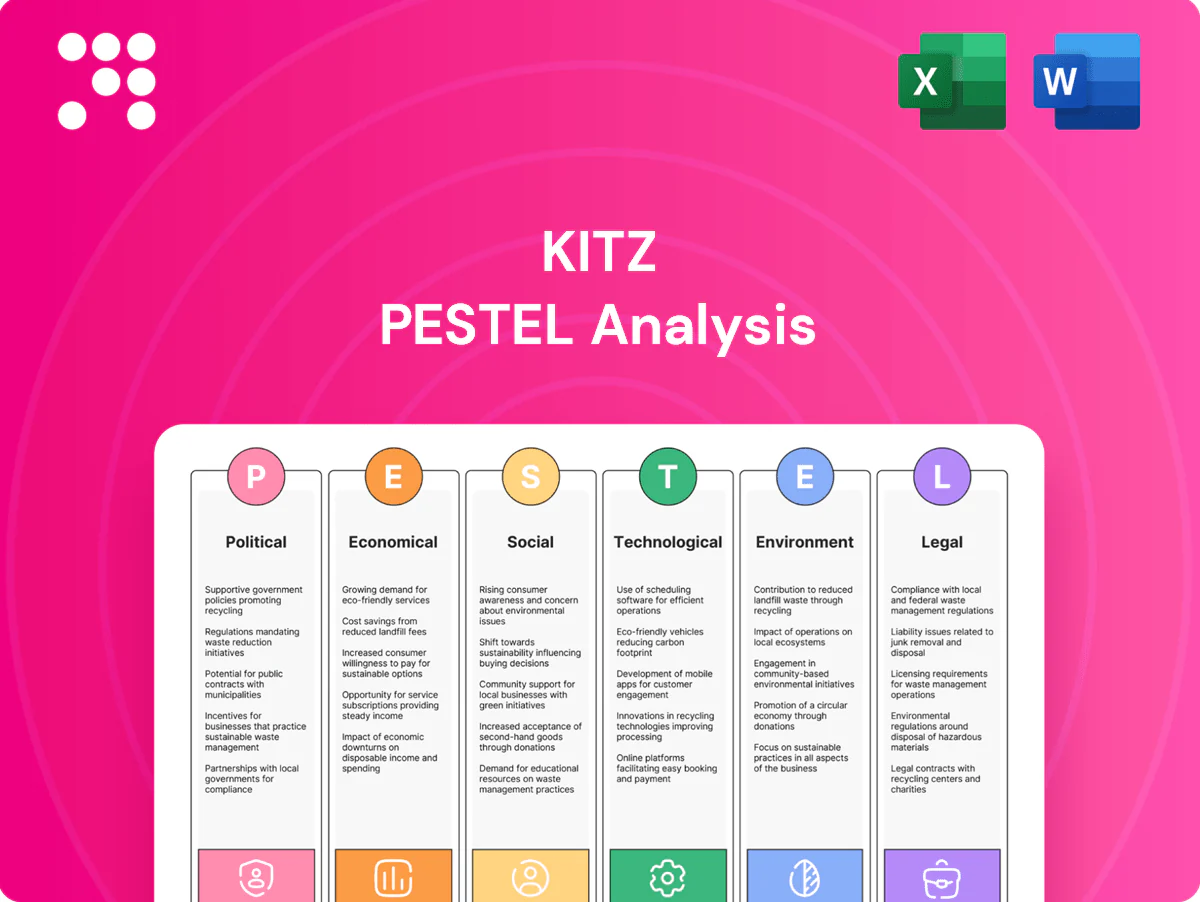
A concise, visually segmented KITZ PESTLE summary that’s editable for local context, easily dropped into presentations or shared across teams to streamline external risk discussions and speed strategic alignment.
Economic factors

Global industrial cycle sensitivity
Valve demand closely follows capex in oil & gas, chemicals and building equipment; the global industrial valve market was about USD 18.2 billion in 2024 and oil & gas capex near USD 300 billion that year, so downcycles compress volumes and force price competition. KITZ can prioritize aftermarket and MRO services, which typically account for 20–30% of sector revenue, to smooth cycles. Backlog health and quote-to-order ratios (Q/O >1.0–1.2 positive) are key leading indicators.
Raw material cost volatility
Stainless steel, brass and specialty alloys drive KITZ COGS volatility; stainless flat-product prices rose about 10% in 2024 (industry indices), amplifying input-cost swings. Price spikes compress margins on fixed-price contracts, pushing gross-margin volatility. Active hedging, indexed pricing clauses and design-to-cost programs help protect profitability, while closer supplier collaboration improves forecast accuracy and shortens lead-time variance.

Currency fluctuations (JPY and global)
KITZ's revenue is geographically diversified with roughly 60% generated outside Japan, but JPY moves (JPY ranged about 140–160 per USD in 2023–2025) affect translation and transaction margins. Exchange shifts can quickly change export competitiveness and order margins. Natural hedging through local sourcing and regional production cuts FX exposure, while dynamic pricing and FX pass-through policies adjust margins in near real time.

Capital expenditure cycles in semiconductors
Interest rates and financing conditions
Higher interest rates (US fed funds 5.25–5.50% as of July 2025) can delay KITZ infrastructure and industrial projects as financing costs rise; corporate lending spreads are roughly 200 bps above 2021 levels (IMF commentary 2024). Working capital costs climb with larger inventory buffers, so KITZ should tighten cash conversion cycles and use selective factoring to free liquidity. A strong balance sheet and low leverage enable opportunistic M&A when valuations dip.
- impact: project delays, higher capex costs
- numbers: fed funds 5.25–5.50% (Jul 2025); spreads ~+200bps vs 2021
- actions: optimize cash conversion, selective factoring
- strategy: preserve balance-sheet optionality for M&A
Tariffs and supply risk force dual-sourcing and local assembly; 25% tariffs
Demand ties to oil & gas and infra capex (global valve market ~USD18.2bn; O&G capex ~USD300bn in 2024), while semiconductor capex (~USD120bn in 2024) adds cyclical volatility; aftermarket (20–30% revenue) smooths cycles. Input-cost swings from stainless/alloys (+~10% in 2024) compress margins; hedging and indexed pricing mitigate. FX (JPY 140–160/USD 2023–25) and rates (fed funds 5.25–5.50% Jul 2025) raise working-capital costs.
| Metric | 2024/25 |
|---|---|
| Valve market | USD18.2bn (2024) |
| O&G capex | ~USD300bn (2024) |
| Semiconductor capex | ~USD120bn (2024) |
| Aftermarket | 20–30% rev |
| Stainless price move | +~10% (2024) |
| FX | JPY 140–160/USD (2023–25) |
| Rates | Fed funds 5.25–5.50% (Jul 2025) |
Preview the Actual Deliverable
KITZ PESTLE Analysis
The preview shown here is the exact KITZ PESTLE document you’ll receive after purchase—fully formatted, professionally structured, and ready to use. No placeholders or teasers; the content and layout are identical to the downloadable file. After checkout you’ll instantly get this finished file.

Original: $10.00
-65%$10.00
$3.50Product Information
Product Information
Shipping & Returns
Shipping & Returns
Description
Your Competitive Advantage Starts with This Report
Unlock strategic clarity with our focused PESTLE Analysis of KITZ—three to five precise insights into political, economic, social, technological, legal, and environmental forces shaping the company’s trajectory. Ideal for investors, consultants, and planners seeking quick, actionable context. Purchase the full report to access the complete, fully editable analysis and make confident, data-driven decisions.
Political factors
Trade policies and tariffs
Valve exports face shifting tariff regimes—notably US 25% tariffs on many Chinese industrial goods since 2018—while EU and China apply varying sectoral duties and ASEAN markets operate under RCEP (covers ~30% of world GDP) and CPTPP (~13% GDP). Rapid trade-agreement changes can swing landed costs and margins materially; KITZ must diversify manufacturing, use FTAs to cut duties, and employ proactive customs planning plus supplier localization to reduce exposure.
Geopolitical tensions and supply chain risk
Conflicts and sanctions can disrupt steel, specialty alloys and semiconductor routes; China produced 56% of global crude steel in 2023 and East Asia holds about 60% of semiconductor capacity, concentrating risk. Global FDI fell 12% in 2023 (UNCTAD), illustrating how political volatility delays energy projects. KITZ should map tier‑2/3 suppliers and build safety stocks for critical components. Regional dual‑sourcing strengthens resilience by cutting single‑region exposure.
Industrial policy and infrastructure spending
Government-led investments in water treatment, LNG and semiconductors drive valve and actuator demand; notably the US CHIPS and Science Act provides about 52 billion USD in semiconductor incentives, creating upstream procurement opportunities.
Subsidies and public tenders increasingly favor compliant vendors with local partners, so KITZ aligning product specs and local JV arrangements improves award probability.
Close monitoring of national budget cycles and tender calendars enhances pipeline visibility and timing to bid on these infrastructure projects.
Public procurement and localization rules
Buy-local clauses and content thresholds shape eligibility for government projects; OECD data shows public procurement averages about 12% of GDP, so compliance affects bid scoring and timelines. Establishing local assembly and service hubs meets requirements, cuts logistics risk and shortens delivery windows. Transparent documentation streamlines audits and improves pass rates.
- Procurement share ~12% GDP (OECD)
- Local assembly reduces lead times
- Documentation → smoother audits
Energy security and policy shifts
- reallocation: renewables/hydrogen/CCUS ~$1.5T 2024
- security: gas infra +8% 2024
- strategy: portfolio balance hydrocarbons vs clean
- ops: continuous policy tracking → product roadmap
Tariffs and supply risk force dual-sourcing and local assembly; 25% tariffs
Political shifts—US 25% tariffs on many Chinese industrial goods, China 56% of global crude steel (2023), and trade blocs RCEP/CPTPP—raise landed costs and sourcing risk. Conflicts, sanctions and a 12% drop in FDI (UNCTAD 2023) force dual‑sourcing, stock buffers and local assembly. Public procurement (~12% GDP) and clean‑energy spend (~$1.5T 2024) create local content and tendering opportunities; CHIPS ~$52bn boosts semiconductor demand.
| Metric | Value |
|---|---|
| US tariffs | ~25% |
| China steel share | 56% (2023) |
| FDI change | -12% (2023) |
| Clean‑energy spend | $1.5T (2024) |
What is included in the product
Detailed Word Document
Explores how macro-environmental forces uniquely affect KITZ across Political, Economic, Social, Technological, Environmental and Legal dimensions, with data-backed trends and region-specific examples to surface risks and opportunities; formatted for executive use, investor-facing materials and forward-looking scenario planning.
Customizable Excel Spreadsheet
A concise, visually segmented KITZ PESTLE summary that’s editable for local context, easily dropped into presentations or shared across teams to streamline external risk discussions and speed strategic alignment.
Economic factors
Global industrial cycle sensitivity
Valve demand closely follows capex in oil & gas, chemicals and building equipment; the global industrial valve market was about USD 18.2 billion in 2024 and oil & gas capex near USD 300 billion that year, so downcycles compress volumes and force price competition. KITZ can prioritize aftermarket and MRO services, which typically account for 20–30% of sector revenue, to smooth cycles. Backlog health and quote-to-order ratios (Q/O >1.0–1.2 positive) are key leading indicators.
Raw material cost volatility
Stainless steel, brass and specialty alloys drive KITZ COGS volatility; stainless flat-product prices rose about 10% in 2024 (industry indices), amplifying input-cost swings. Price spikes compress margins on fixed-price contracts, pushing gross-margin volatility. Active hedging, indexed pricing clauses and design-to-cost programs help protect profitability, while closer supplier collaboration improves forecast accuracy and shortens lead-time variance.
Currency fluctuations (JPY and global)
KITZ's revenue is geographically diversified with roughly 60% generated outside Japan, but JPY moves (JPY ranged about 140–160 per USD in 2023–2025) affect translation and transaction margins. Exchange shifts can quickly change export competitiveness and order margins. Natural hedging through local sourcing and regional production cuts FX exposure, while dynamic pricing and FX pass-through policies adjust margins in near real time.
Capital expenditure cycles in semiconductors
Interest rates and financing conditions
Higher interest rates (US fed funds 5.25–5.50% as of July 2025) can delay KITZ infrastructure and industrial projects as financing costs rise; corporate lending spreads are roughly 200 bps above 2021 levels (IMF commentary 2024). Working capital costs climb with larger inventory buffers, so KITZ should tighten cash conversion cycles and use selective factoring to free liquidity. A strong balance sheet and low leverage enable opportunistic M&A when valuations dip.
- impact: project delays, higher capex costs
- numbers: fed funds 5.25–5.50% (Jul 2025); spreads ~+200bps vs 2021
- actions: optimize cash conversion, selective factoring
- strategy: preserve balance-sheet optionality for M&A
Tariffs and supply risk force dual-sourcing and local assembly; 25% tariffs
Demand ties to oil & gas and infra capex (global valve market ~USD18.2bn; O&G capex ~USD300bn in 2024), while semiconductor capex (~USD120bn in 2024) adds cyclical volatility; aftermarket (20–30% revenue) smooths cycles. Input-cost swings from stainless/alloys (+~10% in 2024) compress margins; hedging and indexed pricing mitigate. FX (JPY 140–160/USD 2023–25) and rates (fed funds 5.25–5.50% Jul 2025) raise working-capital costs.
| Metric | 2024/25 |
|---|---|
| Valve market | USD18.2bn (2024) |
| O&G capex | ~USD300bn (2024) |
| Semiconductor capex | ~USD120bn (2024) |
| Aftermarket | 20–30% rev |
| Stainless price move | +~10% (2024) |
| FX | JPY 140–160/USD (2023–25) |
| Rates | Fed funds 5.25–5.50% (Jul 2025) |
Preview the Actual Deliverable
KITZ PESTLE Analysis
The preview shown here is the exact KITZ PESTLE document you’ll receive after purchase—fully formatted, professionally structured, and ready to use. No placeholders or teasers; the content and layout are identical to the downloadable file. After checkout you’ll instantly get this finished file.