Kistos PESTLE Analysis

Your Shortcut to Market Insight Starts Here
Our PESTLE Analysis of Kistos reveals how political, economic, social, technological, legal and environmental forces are reshaping the company’s prospects, highlighting regulatory risks, commodity cycles and ESG drivers. Packed with actionable insights for investors and strategists, it’s ready for immediate use in decision-making. Purchase the full report to access the complete, editable breakdown and forecast implications.
Political factors

Energy security priorities
European and UK policy now prioritise domestic gas to cut import reliance — Russia's share of EU gas imports fell to about 9% in 2023 (Eurostat), prompting measures to shore up supply. Governments are fast-tracking approvals and procurement, sustaining demand for flexible gas supply. Kistos can market its assets as reliability contributors to grid stability. Geopolitical shocks since 2022 have amplified this regulatory tailwind.
Windfall taxes and fiscal shifts
Temporary levies on upstream profits (e.g., UK Energy Profits Levy introduced in 2022 at 25%) can materially alter project economics. Budget cycles may change investment allowances and incentives, shifting IRR thresholds and payback timing. Kistos must model multiple fiscal regimes and sensitivities. Stable, transparent tax policy improves capital planning.

Licensing and permitting policy
Hydrocarbon licensing rounds and moratoria remain politically sensitive, so faster permitting for near-term tie-backs materially shortens payback and reduces market exposure; stricter permitting regimes increase project lead times and capex risk. Kistos’ strategy should prioritise brownfield optimisation and low-capex tie-backs to preserve value. Proactive stakeholder alignment (regulators, operators, local communities) reduces approval friction and lowers sanction risk.

EU/UK transition frameworks
Gas as a transitional fuel is recognized in EU/UK frameworks and can support financing while eligible; EU Fit for 55 targets a 55% GHG reduction by 2030 and the UK is legally committed to net zero by 2050, but tightening targets and taxonomy reviews may narrow eligibility over time. Kistos should align disclosures with transition pathways to unlock green-leaning capital and meet lender/ESG criteria.
- Policy: Fit for 55 (55% by 2030), UK net zero 2050
- Risk: taxonomy tightening may reduce gas eligibility
- Action: align disclosures to transition pathways to access green capital
Geopolitical gas market dynamics
War and sanctions since 2022 pushed Russian pipeline deliveries to the EU down by over 70%, forcing a surge in LNG imports and driving high TTF volatility; the EU mandated 90% gas storage by 1 Nov 2024 and continues subsidizing storage and domestic supply. Kistos benefits from supportive measures and higher contract premiums but faces sharp price swings; supply shocks create both tactical buying/selling opportunities and downside risk.
- Tag: storage-target-90%-Nov2024
- Tag: Russian-flow-drop->70%
- Tag: LNG-replacement-pressure
- Tag: high-TTF-volatility
Policy pivot: Russian gas ~9%; 90% storage; 25% levy; favor low‑capex tie‑ins
Policy shifts favour domestic gas: Russian gas share fell to ~9% of EU imports in 2023 (Eurostat), EU required 90% storage by 1 Nov 2024, and UK Energy Profits Levy at 25% affects project economics; Fit for 55 (55% by 2030) and UK net zero 2050 tighten future eligibility, so Kistos should prioritise low‑capex tie‑backs and ESG-aligned disclosures.
| Metric | Value |
|---|---|
| Russian share (2023) | ~9% |
What is included in the product
 Detailed Word Document
Provides a concise PESTLE evaluation of Kistos across Political, Economic, Social, Technological, Environmental and Legal dimensions, backed by current data and trends to reveal risks, opportunities and competitive impacts for executives and investors; formatted for direct inclusion in plans, decks and scenario planning.

 Customizable Excel Spreadsheet
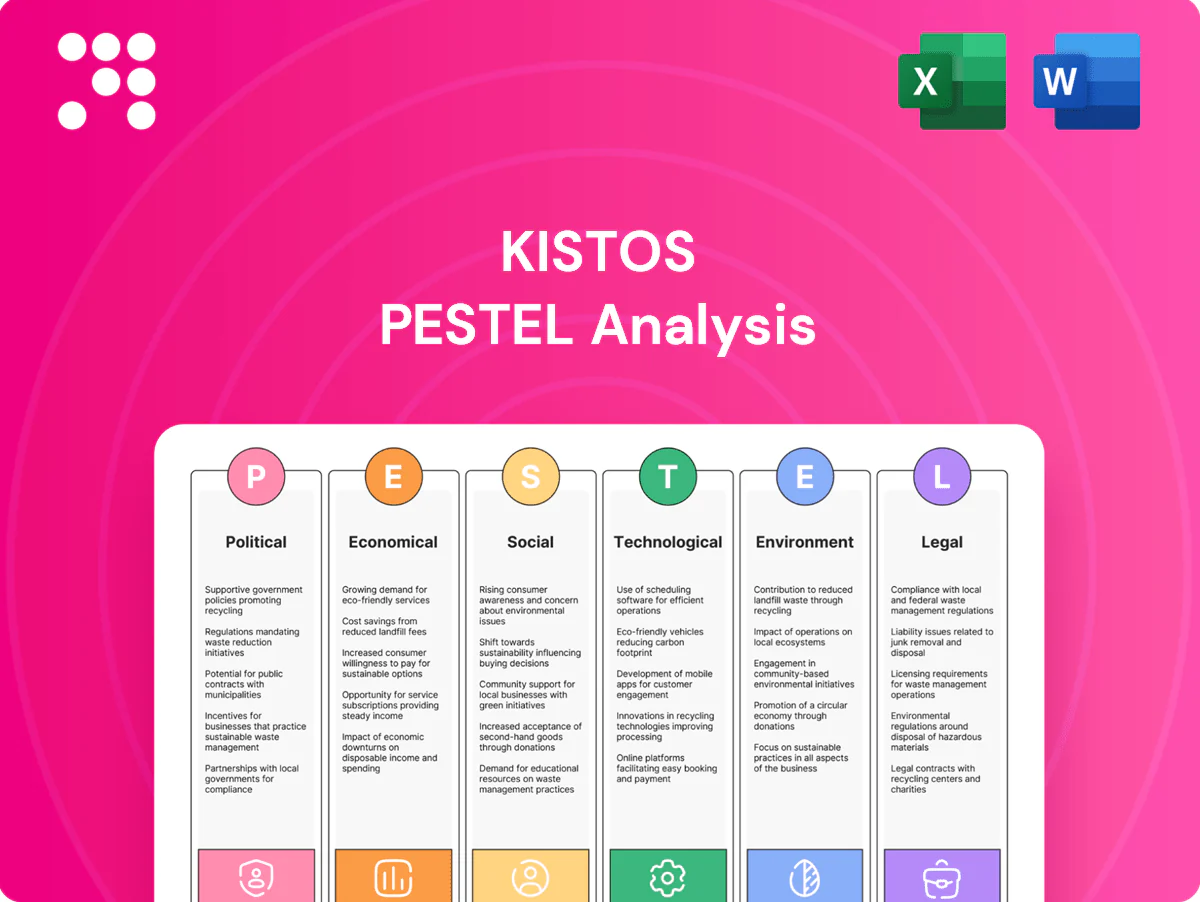
The Kistos PESTLE Analysis delivers a clean, visually segmented summary that’s easily dropped into presentations or shared across teams, with editable notes for regional or business-line context to streamline planning and risk discussions.
Economic factors

Gas price volatility
TTF and NBP remain highly sensitive to weather, storage and LNG arrivals: TTF spiked to about €345/MWh in Aug 2022 and EU storage reached near 97% by Oct 2023, illustrating supply-driven swings. Such volatility directly pressures Kistos revenues and increases hedging needs. Kistos should balance hedge coverage with upside optionality and use scenario planning to strengthen cash-flow resilience.
Cost inflation and supply chains
Offshore services and steel cost swings drive Kistos capex/opex: steel prices eased by circa 20% from 2022 peaks to 2024 while offshore vessel and contractor dayrates rose sharply in 2021–23, tightening schedules. Tight contractor markets can stretch timelines and add roughly 10–20% to project costs. Kistos gains from efficient procurement and standardized tie‑backs; a 5–10% deflation in inputs can materially lift project IRRs.

Interest rates and financing
Higher policy rates around 5% in 2024–25 push WACC and internal hurdle rates materially higher, often lifting financing costs by several hundred basis points for energy E&P peers. Debt availability increasingly depends on ESG-aligned narratives and hedged cash flows, with sustainability-linked loans surpassing $1tn by 2023. Kistos can leverage reserve-based lending and structured offtakes to secure finance, while any rate easing would support refinancing and M&A by lowering service costs and enabling tighter valuations.

LNG competition and imports
Abundant LNG additions (roughly 40 mtpa of new capacity 2023–25) can cap regional prices and compress margins, while supply tightness — as seen when JKM spiked above 30 USD/MMBtu in 2022 — can flip realizations higher; Kistos should prioritise low‑breakeven assets and use portfolio optionality to hedge import competition and shipping volatility.
- 40 mtpa capacity additions 2023–25
- JKM spike >30 USD/MMBtu (2022)
- Focus: low‑breakeven assets
- Mitigate via portfolio optionality
Currency exposure
Revenues are typically euro/sterling linked while a portion of operating and capital costs are USD-denominated, so FX swings materially affect reported earnings and capex timing. Natural hedges from EUR/GBP income profiles and use of derivatives have historically reduced volatility in reported results. Treasury policy must match asset cash‑flow profiles to avoid mismatches during currency moves.
- Revenue currency: EUR/GBP linked
- Cost exposure: USD denominated
- Risk management: natural hedges + derivatives
- Policy: treasury aligned to asset cash flows
Policy pivot: Russian gas ~9%; 90% storage; 25% levy; favor low‑capex tie‑ins
TTF/NBP and LNG-driven swings (EU storage ~97% Oct 2023; JKM >30 USD/MMBtu in 2022) heighten revenue volatility and hedging needs. Steel eased ~20% from 2022 to 2024 while offshore dayrates rose 2021–23, lifting capex risk. Policy rates ~5% in 2024–25 raise WACC; revenues EUR/GBP vs USD costs require active FX/treasury alignment.
| Metric | Value |
|---|---|
| LNG adds 2023–25 | ~40 mtpa |
| EU storage | ~97% Oct 2023 |
| Policy rates | ~5% (2024–25) |
| Steel move | -20% (2022–24) |
| JKM spike | >30 USD/MMBtu (2022) |
Same Document Delivered
Kistos PESTLE Analysis
The preview shown here is the exact Kistos PESTLE Analysis document you’ll receive after purchase—fully formatted and ready to use. The layout, content and structure visible are identical to the downloadable file, with no placeholders or teasers. After checkout you’ll instantly get this exact, professionally structured report.

Original: $10.00
-65%$10.00
$3.50Product Information
Product Information
Shipping & Returns
Shipping & Returns
Description
Your Shortcut to Market Insight Starts Here
Our PESTLE Analysis of Kistos reveals how political, economic, social, technological, legal and environmental forces are reshaping the company’s prospects, highlighting regulatory risks, commodity cycles and ESG drivers. Packed with actionable insights for investors and strategists, it’s ready for immediate use in decision-making. Purchase the full report to access the complete, editable breakdown and forecast implications.
Political factors
Energy security priorities
European and UK policy now prioritise domestic gas to cut import reliance — Russia's share of EU gas imports fell to about 9% in 2023 (Eurostat), prompting measures to shore up supply. Governments are fast-tracking approvals and procurement, sustaining demand for flexible gas supply. Kistos can market its assets as reliability contributors to grid stability. Geopolitical shocks since 2022 have amplified this regulatory tailwind.
Windfall taxes and fiscal shifts
Temporary levies on upstream profits (e.g., UK Energy Profits Levy introduced in 2022 at 25%) can materially alter project economics. Budget cycles may change investment allowances and incentives, shifting IRR thresholds and payback timing. Kistos must model multiple fiscal regimes and sensitivities. Stable, transparent tax policy improves capital planning.
Licensing and permitting policy
Hydrocarbon licensing rounds and moratoria remain politically sensitive, so faster permitting for near-term tie-backs materially shortens payback and reduces market exposure; stricter permitting regimes increase project lead times and capex risk. Kistos’ strategy should prioritise brownfield optimisation and low-capex tie-backs to preserve value. Proactive stakeholder alignment (regulators, operators, local communities) reduces approval friction and lowers sanction risk.
EU/UK transition frameworks
Gas as a transitional fuel is recognized in EU/UK frameworks and can support financing while eligible; EU Fit for 55 targets a 55% GHG reduction by 2030 and the UK is legally committed to net zero by 2050, but tightening targets and taxonomy reviews may narrow eligibility over time. Kistos should align disclosures with transition pathways to unlock green-leaning capital and meet lender/ESG criteria.
- Policy: Fit for 55 (55% by 2030), UK net zero 2050
- Risk: taxonomy tightening may reduce gas eligibility
- Action: align disclosures to transition pathways to access green capital
Geopolitical gas market dynamics
War and sanctions since 2022 pushed Russian pipeline deliveries to the EU down by over 70%, forcing a surge in LNG imports and driving high TTF volatility; the EU mandated 90% gas storage by 1 Nov 2024 and continues subsidizing storage and domestic supply. Kistos benefits from supportive measures and higher contract premiums but faces sharp price swings; supply shocks create both tactical buying/selling opportunities and downside risk.
- Tag: storage-target-90%-Nov2024
- Tag: Russian-flow-drop->70%
- Tag: LNG-replacement-pressure
- Tag: high-TTF-volatility
Policy pivot: Russian gas ~9%; 90% storage; 25% levy; favor low‑capex tie‑ins
Policy shifts favour domestic gas: Russian gas share fell to ~9% of EU imports in 2023 (Eurostat), EU required 90% storage by 1 Nov 2024, and UK Energy Profits Levy at 25% affects project economics; Fit for 55 (55% by 2030) and UK net zero 2050 tighten future eligibility, so Kistos should prioritise low‑capex tie‑backs and ESG-aligned disclosures.
| Metric | Value |
|---|---|
| Russian share (2023) | ~9% |
What is included in the product
Detailed Word Document
Provides a concise PESTLE evaluation of Kistos across Political, Economic, Social, Technological, Environmental and Legal dimensions, backed by current data and trends to reveal risks, opportunities and competitive impacts for executives and investors; formatted for direct inclusion in plans, decks and scenario planning.
Customizable Excel Spreadsheet
The Kistos PESTLE Analysis delivers a clean, visually segmented summary that’s easily dropped into presentations or shared across teams, with editable notes for regional or business-line context to streamline planning and risk discussions.
Economic factors
Gas price volatility
TTF and NBP remain highly sensitive to weather, storage and LNG arrivals: TTF spiked to about €345/MWh in Aug 2022 and EU storage reached near 97% by Oct 2023, illustrating supply-driven swings. Such volatility directly pressures Kistos revenues and increases hedging needs. Kistos should balance hedge coverage with upside optionality and use scenario planning to strengthen cash-flow resilience.
Cost inflation and supply chains
Offshore services and steel cost swings drive Kistos capex/opex: steel prices eased by circa 20% from 2022 peaks to 2024 while offshore vessel and contractor dayrates rose sharply in 2021–23, tightening schedules. Tight contractor markets can stretch timelines and add roughly 10–20% to project costs. Kistos gains from efficient procurement and standardized tie‑backs; a 5–10% deflation in inputs can materially lift project IRRs.
Interest rates and financing
Higher policy rates around 5% in 2024–25 push WACC and internal hurdle rates materially higher, often lifting financing costs by several hundred basis points for energy E&P peers. Debt availability increasingly depends on ESG-aligned narratives and hedged cash flows, with sustainability-linked loans surpassing $1tn by 2023. Kistos can leverage reserve-based lending and structured offtakes to secure finance, while any rate easing would support refinancing and M&A by lowering service costs and enabling tighter valuations.
LNG competition and imports
Abundant LNG additions (roughly 40 mtpa of new capacity 2023–25) can cap regional prices and compress margins, while supply tightness — as seen when JKM spiked above 30 USD/MMBtu in 2022 — can flip realizations higher; Kistos should prioritise low‑breakeven assets and use portfolio optionality to hedge import competition and shipping volatility.
- 40 mtpa capacity additions 2023–25
- JKM spike >30 USD/MMBtu (2022)
- Focus: low‑breakeven assets
- Mitigate via portfolio optionality
Currency exposure
Revenues are typically euro/sterling linked while a portion of operating and capital costs are USD-denominated, so FX swings materially affect reported earnings and capex timing. Natural hedges from EUR/GBP income profiles and use of derivatives have historically reduced volatility in reported results. Treasury policy must match asset cash‑flow profiles to avoid mismatches during currency moves.
- Revenue currency: EUR/GBP linked
- Cost exposure: USD denominated
- Risk management: natural hedges + derivatives
- Policy: treasury aligned to asset cash flows
Policy pivot: Russian gas ~9%; 90% storage; 25% levy; favor low‑capex tie‑ins
TTF/NBP and LNG-driven swings (EU storage ~97% Oct 2023; JKM >30 USD/MMBtu in 2022) heighten revenue volatility and hedging needs. Steel eased ~20% from 2022 to 2024 while offshore dayrates rose 2021–23, lifting capex risk. Policy rates ~5% in 2024–25 raise WACC; revenues EUR/GBP vs USD costs require active FX/treasury alignment.
| Metric | Value |
|---|---|
| LNG adds 2023–25 | ~40 mtpa |
| EU storage | ~97% Oct 2023 |
| Policy rates | ~5% (2024–25) |
| Steel move | -20% (2022–24) |
| JKM spike | >30 USD/MMBtu (2022) |
Same Document Delivered
Kistos PESTLE Analysis
The preview shown here is the exact Kistos PESTLE Analysis document you’ll receive after purchase—fully formatted and ready to use. The layout, content and structure visible are identical to the downloadable file, with no placeholders or teasers. After checkout you’ll instantly get this exact, professionally structured report.