Kirin PESTLE Analysis

Plan Smarter. Present Sharper. Compete Stronger.
Gain strategic clarity on Kirin with our concise PESTLE overview—spot regulatory, economic and environmental forces shaping its future. Ideal for investors, consultants and planners, it highlights risks and opportunities you can't ignore. Buy the full PESTLE for the complete, actionable report.
Political factors

Alcohol taxation and excise
Excise duties materially shape pricing and margins across Kirin's beer and spirits, often accounting for up to 50% of retail price in high-tax markets and pressuring margin recovery. Increases in sin taxes are nudging consumers toward lower-ABV and no-alcohol options, altering mix and volume. Kirin must optimize pack sizes and price ladders and proactively engage authorities with scenario planning to mitigate shocks.
Regulation of health claims
As a beverage and pharmaceutical group operating in over 30 countries, Kirin faces pivotal rules on functional claims and labeling that shape product strategy. Divergent national standards complicate cross-border launches of health-oriented drinks and raise relabeling costs. Coordinated regulatory affairs accelerate approvals and limit market delays. Clear clinical substantiation is essential to avoid enforcement actions and product withdrawals.

Trade policy and supply access
Tariffs and non-tariff barriers affect inputs such as barley, hops, sugar and packaging, increasing input costs and regulatory compliance for Kirin. Trade tensions can disrupt supply chains and raise logistics costs across export and import routes. Kirin leverages diversified sourcing and FTAs, including the Japan-EU EPA, to maintain input reliability. Contingency inventory and dual-sourcing strategies reduce supply volatility.

Public health and alcohol policy
Governments worldwide are tightening availability, advertising and responsible-drinking rules, with WHO estimating about 3 million alcohol-attributable deaths annually; tighter on-premise restrictions tend to compress bars/restaurants while accelerating demand for low/no-alcohol variants.
Kirin’s responsible marketing, moderation programs and collaborations with public-health bodies help preserve license to operate and position its growing no/low-alcohol portfolio to capture regulatory-driven shifts.
- Regulatory pressure: tighter availability and advertising rules
- Market impact: on-premise compression → growth in low/no lines
- Kirin actions: responsible marketing, moderation programs, public-health partnerships
Political stability in key markets
Macroeconomic and political shifts across Asia-Pacific and emerging markets—IMF 2024 GDP growth ~4.4% for Asia—directly affect Kirin’s demand and operations; policy continuity in Japan supports multi-year planning while select markets show elevated governance risk. Localized governance and compliance frameworks in ASEAN and Oceania reduce exposure, and ongoing country-risk monitoring guides capital allocation.
- Asia-Pacific growth ~4.4% (IMF 2024)
- Japan: policy continuity aids long-term planning
- Higher governance risk in select emerging markets
- Country-risk monitoring directs capex and M&A
Excise, sin-tax and regulations propel low/no-ABV growth and higher compliance costs
Excise duties (up to 50% of retail in high-tax markets) compress margins and force pack/price optimization; sin-tax rises shift volume to low/no-ABV. Divergent functional-claim and labeling rules across 30+ countries raise relabeling costs and delay launches; clinical substantiation is essential. Trade barriers, input volatility and policy risk—amid Asia GDP ~4.4% (IMF 2024) and ~3M alcohol deaths (WHO)—accelerate low/no demand and responsible-marketing needs.
| Factor | Metric | Impact |
|---|---|---|
| Excise | Up to 50% retail | Margin pressure |
| Market growth | Asia GDP 4.4% (IMF 2024) | Demand upside |
| Public health | ~3M alcohol deaths (WHO) | Tighter regs |
| Scope | 30+ countries | Compliance costs |
What is included in the product
 Detailed Word Document
Explores how external macro-environmental factors uniquely affect Kirin across Political, Economic, Social, Technological, Environmental and Legal dimensions, combining data-backed trends with regional market and regulatory context. Designed for executives and investors, it offers detailed sub-points, forward-looking insights and ready-to-insert formatting to guide strategy and funding decisions.

 Customizable Excel Spreadsheet
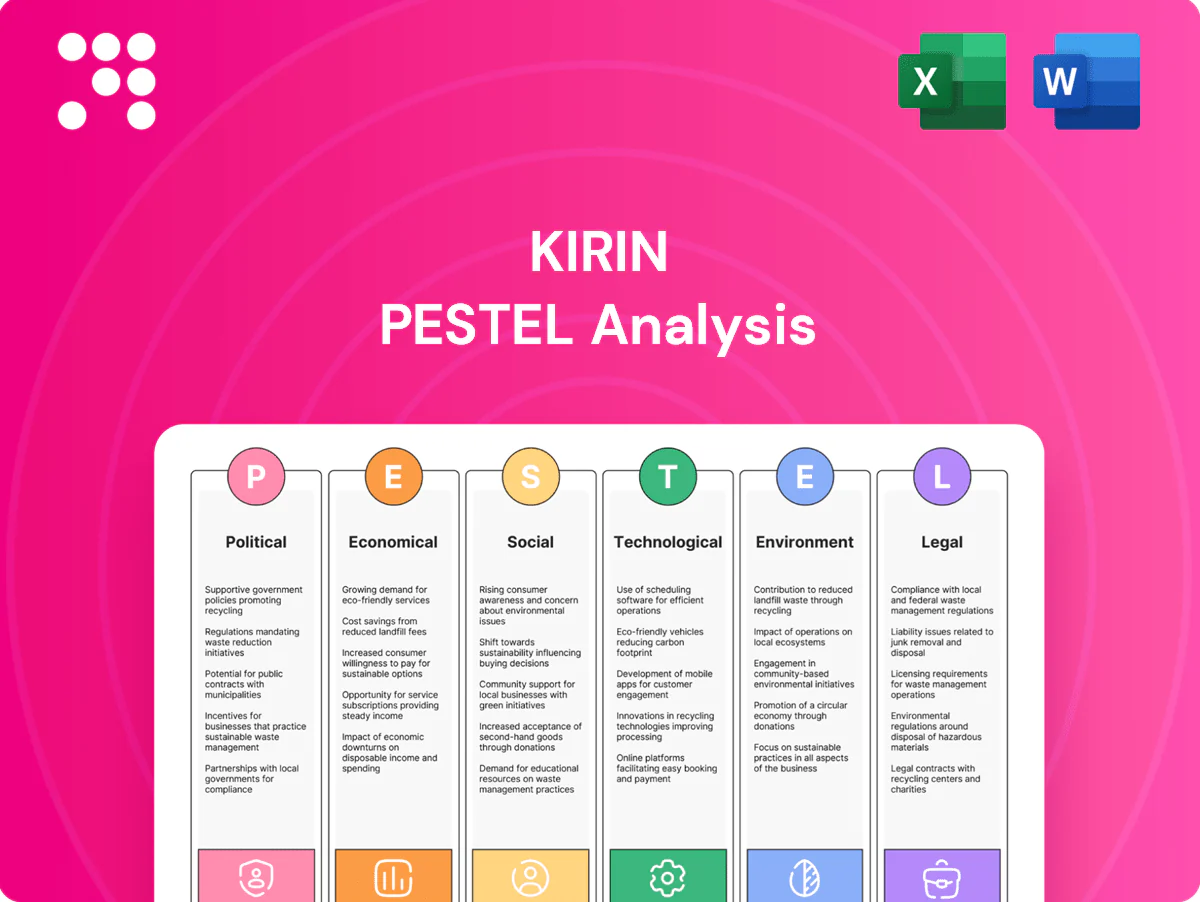
A concise, visually segmented Kirin PESTLE summary that eases meeting prep and strategy sessions, easily dropped into presentations or shared across teams and editable with notes for regional or business-line context.
Economic factors

Currency and interest rate volatility
Yen volatility (USD/JPY ~155 in July 2025) raises import costs for Kirin and affects translation of overseas earnings, while Japan's 10-year JGB yield near 0.8% increases market financing costs. Higher rates can damp discretionary beverage spending; Kirin uses FX hedging, natural offsets across sourcing/sales and flexible pricing to protect margins and stabilize cash flow.
Input cost inflation
Barley, aluminum, PET resin, energy and logistics cost swings directly inflate Kirin’s COGS—barley and PET saw double-digit increases in 2023–24, aluminum LME rose materially and Japanese industrial energy remained above pre‑pandemic levels, while container rates stayed volatile. Inflation spikes force trade-offs between price, pack architecture and promotions; long‑term supplier contracts and efficiency programs have cushioned shocks. Kirin’s packaging value engineering preserved affordability by reducing pack weight and material use.

Consumer spending cycles
Beer and soft drinks track real incomes and confidence; Japan's core CPI rose 3.2% in 2023, squeezing real incomes and shifting demand to value tiers and at-home consumption (off-trade share rose to roughly 60% in 2020–21). Kirin's pharma assets add defensiveness, premiumization typically returns in expansions improving mix, and a balanced beverage–pharma portfolio smooths earnings through cycles.

Demographic shifts in Japan
Japan's population is about 124 million (UN 2023) with 65+ residents at 29.1% (OECD 2023), pressuring domestic beer volumes as cohorts shrink and older consumers favor lower-alcohol/health products; demand shifts open opportunities in health, functional beverages and pharmaceuticals aligned with well-being. Strategic portfolio pivot and innovation can offset volume decline while overseas expansion must play a larger earnings role.
Emerging market growth
Rising middle classes in ASEAN (population ~670 million, 2024 UN estimate) and other EMs are boosting beer and RTD demand, with RTD segments outpacing beer in volume growth in several markets. Improved infrastructure and retail formalization expand cold-chain reach and shelf availability, enabling chilled launches and multipack formats. Localized flavors and smaller formats accelerate trial, while careful pricing is used to counter illicit trade and duty gaps.
- ASEAN population ~670M (2024 UN)
- RTD growth outpacing beer in multiple EMs
- Cold-chain expansion improves chilled distribution
- Localized SKUs + price discipline limit illicit trade
Excise, sin-tax and regulations propel low/no-ABV growth and higher compliance costs
Yen at ~155 (Jul 2025) and 10y JGB ~0.8% raise import and financing costs, hedging and pricing mitigate impact. Input inflation (barley, PET, aluminum) and logistics drove COGS up in 2023–24, prompting pack engineering and supplier contracts. Domestic demand hit by 124M population and 29.1% 65+ (UN/OECD), while ASEAN ~670M (2024) and RTD growth support overseas expansion.
| Metric | Value |
|---|---|
| USD/JPY (Jul 2025) | ~155 |
| 10y JGB | ~0.8% |
| Japan core CPI (2023) | 3.2% |
| Japan pop / 65+ | 124M / 29.1% |
| ASEAN pop (2024) | ~670M |
Preview Before You Purchase
Kirin PESTLE Analysis
The preview shown here is the exact Kirin PESTLE Analysis you’ll receive after purchase—fully formatted and ready to use. This is a real screenshot of the product you’re buying, delivered exactly as shown with no placeholders or teasers. After checkout you’ll instantly download the same final, professionally structured file displayed here.

Original: $10.00
-65%$10.00
$3.50Product Information
Product Information
Shipping & Returns
Shipping & Returns
Description
Plan Smarter. Present Sharper. Compete Stronger.
Gain strategic clarity on Kirin with our concise PESTLE overview—spot regulatory, economic and environmental forces shaping its future. Ideal for investors, consultants and planners, it highlights risks and opportunities you can't ignore. Buy the full PESTLE for the complete, actionable report.
Political factors
Alcohol taxation and excise
Excise duties materially shape pricing and margins across Kirin's beer and spirits, often accounting for up to 50% of retail price in high-tax markets and pressuring margin recovery. Increases in sin taxes are nudging consumers toward lower-ABV and no-alcohol options, altering mix and volume. Kirin must optimize pack sizes and price ladders and proactively engage authorities with scenario planning to mitigate shocks.
Regulation of health claims
As a beverage and pharmaceutical group operating in over 30 countries, Kirin faces pivotal rules on functional claims and labeling that shape product strategy. Divergent national standards complicate cross-border launches of health-oriented drinks and raise relabeling costs. Coordinated regulatory affairs accelerate approvals and limit market delays. Clear clinical substantiation is essential to avoid enforcement actions and product withdrawals.
Trade policy and supply access
Tariffs and non-tariff barriers affect inputs such as barley, hops, sugar and packaging, increasing input costs and regulatory compliance for Kirin. Trade tensions can disrupt supply chains and raise logistics costs across export and import routes. Kirin leverages diversified sourcing and FTAs, including the Japan-EU EPA, to maintain input reliability. Contingency inventory and dual-sourcing strategies reduce supply volatility.
Public health and alcohol policy
Governments worldwide are tightening availability, advertising and responsible-drinking rules, with WHO estimating about 3 million alcohol-attributable deaths annually; tighter on-premise restrictions tend to compress bars/restaurants while accelerating demand for low/no-alcohol variants.
Kirin’s responsible marketing, moderation programs and collaborations with public-health bodies help preserve license to operate and position its growing no/low-alcohol portfolio to capture regulatory-driven shifts.
- Regulatory pressure: tighter availability and advertising rules
- Market impact: on-premise compression → growth in low/no lines
- Kirin actions: responsible marketing, moderation programs, public-health partnerships
Political stability in key markets
Macroeconomic and political shifts across Asia-Pacific and emerging markets—IMF 2024 GDP growth ~4.4% for Asia—directly affect Kirin’s demand and operations; policy continuity in Japan supports multi-year planning while select markets show elevated governance risk. Localized governance and compliance frameworks in ASEAN and Oceania reduce exposure, and ongoing country-risk monitoring guides capital allocation.
- Asia-Pacific growth ~4.4% (IMF 2024)
- Japan: policy continuity aids long-term planning
- Higher governance risk in select emerging markets
- Country-risk monitoring directs capex and M&A
Excise, sin-tax and regulations propel low/no-ABV growth and higher compliance costs
Excise duties (up to 50% of retail in high-tax markets) compress margins and force pack/price optimization; sin-tax rises shift volume to low/no-ABV. Divergent functional-claim and labeling rules across 30+ countries raise relabeling costs and delay launches; clinical substantiation is essential. Trade barriers, input volatility and policy risk—amid Asia GDP ~4.4% (IMF 2024) and ~3M alcohol deaths (WHO)—accelerate low/no demand and responsible-marketing needs.
| Factor | Metric | Impact |
|---|---|---|
| Excise | Up to 50% retail | Margin pressure |
| Market growth | Asia GDP 4.4% (IMF 2024) | Demand upside |
| Public health | ~3M alcohol deaths (WHO) | Tighter regs |
| Scope | 30+ countries | Compliance costs |
What is included in the product
Detailed Word Document
Explores how external macro-environmental factors uniquely affect Kirin across Political, Economic, Social, Technological, Environmental and Legal dimensions, combining data-backed trends with regional market and regulatory context. Designed for executives and investors, it offers detailed sub-points, forward-looking insights and ready-to-insert formatting to guide strategy and funding decisions.
Customizable Excel Spreadsheet
A concise, visually segmented Kirin PESTLE summary that eases meeting prep and strategy sessions, easily dropped into presentations or shared across teams and editable with notes for regional or business-line context.
Economic factors
Currency and interest rate volatility
Yen volatility (USD/JPY ~155 in July 2025) raises import costs for Kirin and affects translation of overseas earnings, while Japan's 10-year JGB yield near 0.8% increases market financing costs. Higher rates can damp discretionary beverage spending; Kirin uses FX hedging, natural offsets across sourcing/sales and flexible pricing to protect margins and stabilize cash flow.
Input cost inflation
Barley, aluminum, PET resin, energy and logistics cost swings directly inflate Kirin’s COGS—barley and PET saw double-digit increases in 2023–24, aluminum LME rose materially and Japanese industrial energy remained above pre‑pandemic levels, while container rates stayed volatile. Inflation spikes force trade-offs between price, pack architecture and promotions; long‑term supplier contracts and efficiency programs have cushioned shocks. Kirin’s packaging value engineering preserved affordability by reducing pack weight and material use.
Consumer spending cycles
Beer and soft drinks track real incomes and confidence; Japan's core CPI rose 3.2% in 2023, squeezing real incomes and shifting demand to value tiers and at-home consumption (off-trade share rose to roughly 60% in 2020–21). Kirin's pharma assets add defensiveness, premiumization typically returns in expansions improving mix, and a balanced beverage–pharma portfolio smooths earnings through cycles.
Demographic shifts in Japan
Japan's population is about 124 million (UN 2023) with 65+ residents at 29.1% (OECD 2023), pressuring domestic beer volumes as cohorts shrink and older consumers favor lower-alcohol/health products; demand shifts open opportunities in health, functional beverages and pharmaceuticals aligned with well-being. Strategic portfolio pivot and innovation can offset volume decline while overseas expansion must play a larger earnings role.
Emerging market growth
Rising middle classes in ASEAN (population ~670 million, 2024 UN estimate) and other EMs are boosting beer and RTD demand, with RTD segments outpacing beer in volume growth in several markets. Improved infrastructure and retail formalization expand cold-chain reach and shelf availability, enabling chilled launches and multipack formats. Localized flavors and smaller formats accelerate trial, while careful pricing is used to counter illicit trade and duty gaps.
- ASEAN population ~670M (2024 UN)
- RTD growth outpacing beer in multiple EMs
- Cold-chain expansion improves chilled distribution
- Localized SKUs + price discipline limit illicit trade
Excise, sin-tax and regulations propel low/no-ABV growth and higher compliance costs
Yen at ~155 (Jul 2025) and 10y JGB ~0.8% raise import and financing costs, hedging and pricing mitigate impact. Input inflation (barley, PET, aluminum) and logistics drove COGS up in 2023–24, prompting pack engineering and supplier contracts. Domestic demand hit by 124M population and 29.1% 65+ (UN/OECD), while ASEAN ~670M (2024) and RTD growth support overseas expansion.
| Metric | Value |
|---|---|
| USD/JPY (Jul 2025) | ~155 |
| 10y JGB | ~0.8% |
| Japan core CPI (2023) | 3.2% |
| Japan pop / 65+ | 124M / 29.1% |
| ASEAN pop (2024) | ~670M |
Preview Before You Purchase
Kirin PESTLE Analysis
The preview shown here is the exact Kirin PESTLE Analysis you’ll receive after purchase—fully formatted and ready to use. This is a real screenshot of the product you’re buying, delivered exactly as shown with no placeholders or teasers. After checkout you’ll instantly download the same final, professionally structured file displayed here.