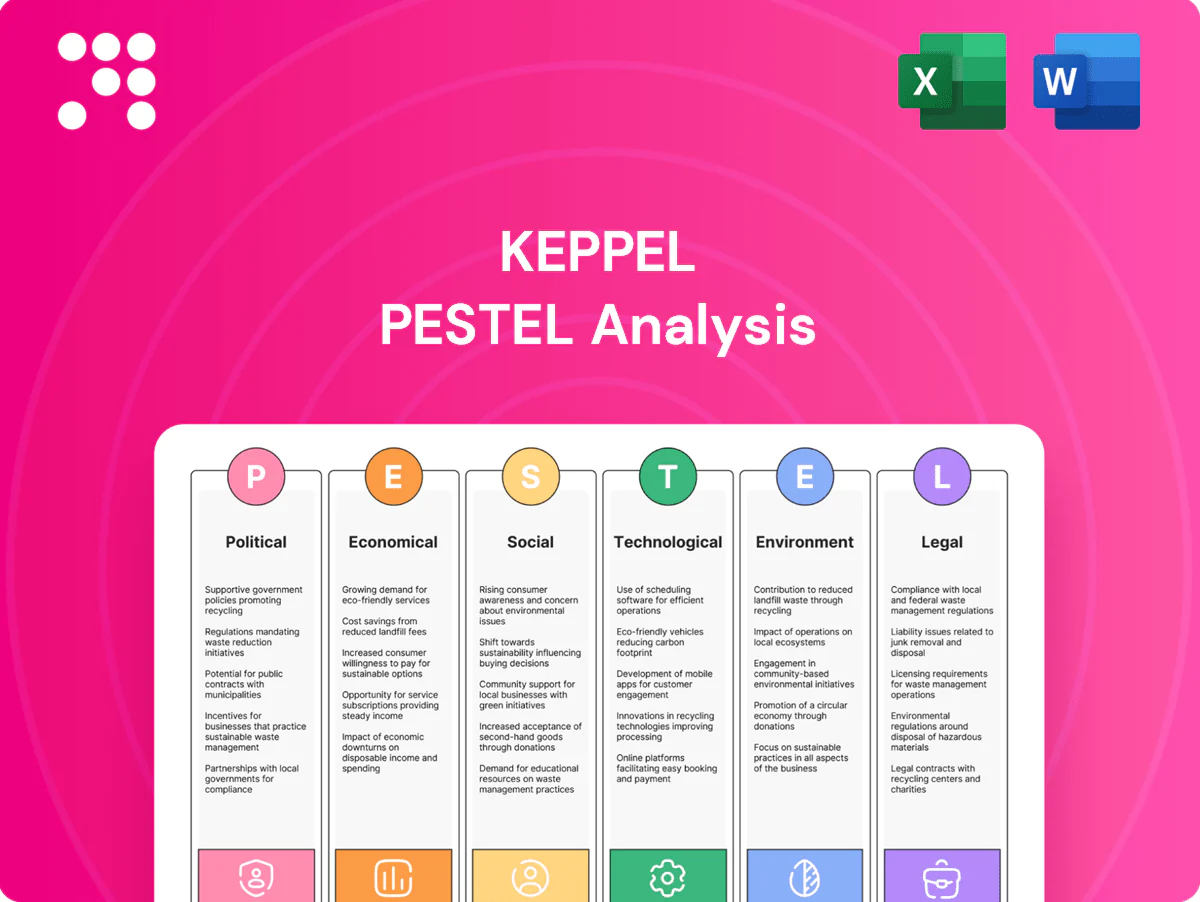
Keppel PESTLE Analysis

Make Smarter Strategic Decisions with a Complete PESTEL View
Unlock strategic clarity with our PESTLE analysis of Keppel—concise, actionable insight into political, economic, social, technological, legal and environmental forces shaping its future. Ideal for investors, consultants and planners, it’s fully researched and ready to use. Purchase the full report for the complete, editable breakdown and immediate download.
Political factors

Geopolitical stability in core markets
Keppel operates across Singapore, ASEAN, China and global hubs where political stability underpins multi-decade infrastructure contracts (typical concession lives 20–30 years). ASEAN hosts ~680 million people (2024), making regional stability critical for long-term demand. Heightened US–China tensions continue to disrupt supply chains, capital flows and data-infrastructure siting. Jurisdictional diversification reduces concentration risk and supports political risk management.
Energy transition policies
Government decarbonization targets — Singapore’s goal to scale solar to about 2 GWp by 2030 and the planned carbon tax rise to S$25/t in 2024 (rising toward S$50–80/t by 2030) — directly boost demand for renewables, waste‑to‑energy and district cooling projects that Keppel builds. Policy instruments such as feed‑in tariffs, PPAs and auction outcomes determine project cashflows and bankability. Material shifts in subsidy regimes or carbon pricing can swing IRRs materially, so early regulator engagement to secure bankable frameworks is essential.

Public–private partnership (PPP) agendas
Urban infrastructure delivery often hinges on robust PPP pipelines and shifting fiscal priorities, with transparent tendering and clear risk allocation directly shaping Keppel’s capital deployment and project pacing. Changes in administration can reprioritize projects or trigger renegotiations, affecting timelines and returns. Keppel’s strong government relationships and proven track record improve bid competitiveness in contested PPPs.

Urban planning and land use
Urban planning and land use—zoning, land reclamation and smart-city initiatives—directly shape Keppel’s development pipeline; policy support for transit-oriented development and green building incentives improves project economics but approval delays can erode IRR and extend timelines. Early alignment with planning authorities reduces execution risk and contingency costs.
- Zoning guides allowable density and mix
- Reclamation expands landbank options
- Smart-city policy unlocks tech-driven value
- Approvals timing affects IRR
- Early authority alignment lowers execution risk
Trade and investment regimes
FDI rules, local‑content requirements and tax incentives shape Keppel’s investment structuring; Singapore’s headline corporate tax rate is 17% and targeted incentives affect project returns and financing.
US‑led export controls since 2022 and sanctions constrain sourcing of advanced semiconductors and some energy technologies, raising supply‑chain risk and capex costs for digital and energy assets.
RCEP covers about 30% of global GDP and eases market entry across 15 Asia‑Pacific economies; proactive compliance preserves market access and investor confidence.
- FDI rules: affect ownership and JV structuring
- Local content: can raise CAPEX but support local market access
- Tax incentives: improve IRR vs 17% headline rate
- Sanctions/controls: constrain tech sourcing since 2022
- RCEP (~30% global GDP): lowers trade frictions
ASEAN-China stability backs long-term infra; US-China tensions raise capex and supply risks
Keppel’s long‑dated infrastructure exposure relies on political stability across ASEAN (~680M people, 2024) and China; US–China tensions and export controls since 2022 increase supply‑chain and capex risk. Singapore policy (17% corporate tax; carbon tax S$25/t in 2024; ~2 GWp solar by 2030) strengthens renewables demand while PPP pipelines and land‑use approvals shape timelines.
| Factor | Data | Impact |
|---|---|---|
| ASEAN | 680M (2024) | Market scale |
| Carbon tax | S$25/t (2024) | Renewables demand |
| Tax | 17% | Project IRR |
| RCEP | ~30% global GDP | Market access |
What is included in the product
 Detailed Word Document
Explores how external macro-environmental factors uniquely affect Keppel across Political, Economic, Social, Technological, Environmental and Legal dimensions, with each section backed by current data and trends. Designed for executives and investors, it highlights threats, opportunities and forward-looking scenarios ready for reports and decks.

 Customizable Excel Spreadsheet
A compact, visually segmented Keppel PESTLE that summarizes external risks and opportunities for quick reference in meetings or presentations. Easily editable and shareable, it supports rapid alignment across teams and seamless inclusion in strategy decks.
Economic factors

Interest rates and cost of capital
As an asset manager/operator, Keppel’s valuations are highly sensitive to discount rates; with the US federal funds rate at 5.25–5.50% and 10‑yr UST around 4–4.5% in 2024–25, rising rates compress infrastructure multiples and weaken PPA competitiveness. Keppel has emphasized active refinancing and interest-hedging to protect yields, while access to diverse funding pools across debt and equity sustains growth.
Macroeconomic growth and urbanization
Urban population growth—UN projects 68.4% urbanization by 2050 and Singapore is ~100% urban—boosts demand for utilities, housing and data infrastructure, underpinning Keppel’s infra and real estate pipelines. Economic slowdowns can delay offtake and compress tariff headroom, yet counter‑cyclical essentials (water, energy, waste) cushion revenue volatility; diversified portfolios enhance resilience across cycles.

Commodity and energy prices
Power, waste feedstock and construction inputs face price swings—Brent crude hovered near $80/bbl in 2024–25 and Asian LNG spot remained elevated, raising energy and feedstock costs for Keppel. Indexed contracts and pass-through clauses in project agreements help safeguard margins. Volatility in carbon markets—EU ETS ~€80–90/tCO2 in 2024—alters decarbonization economics, so strategic procurement and storage buffer shocks.

Currency fluctuations
Keppel's multi-country cash flows expose the group to FX risk on revenues, costs and USD- or local-currency debt; regional currencies showed >5% volatility versus SGD in parts of 2024. Natural hedges and derivatives (forwards, swaps) are critical to stabilise returns. A 10% devaluation in a project market can materially erode equity IRR; currency-matched financing reduces mismatch.
- Exposure: multi-currency revenues, costs, debt
- Mitigants: natural hedges, forwards/swaps
- Impact: ~10% devaluation can cut equity IRR
- Best practice: currency-matched financing
Capital market depth
Institutional appetite for sustainable infrastructure strengthens Keppel’s fundraising, with sustainability-linked loans typically delivering 5–75 basis points of margin relief versus conventional debt.
Market stress can freeze IPO or REIT exits and delay asset recycling, tightening liquidity and pricing for developers and asset owners.
Green bonds and transparent ESG reporting expand Keppel’s investor base — GSIA reported global sustainable investing at $35.3 trillion (2020), signaling structural demand.
- Institutional demand: supports funding
- Market stress: halts exits
- Green bonds/SLLs: 5–75 bps lower cost
- Transparent ESG: broader investor pool
ASEAN-China stability backs long-term infra; US-China tensions raise capex and supply risks
Rising rates (US fed funds 5.25–5.50%, 10‑yr 4–4.5% in 2024–25) compress infrastructure multiples and PPA competitiveness; Keppel leans on refinancing and hedging. Urbanisation (UN 68.4% by 2050; Singapore ~100%) supports infra/real estate demand while energy/feedstock cost pressure (Brent ~$80/bbl; EU ETS €80–90/tCO2) squeezes margins, offset by indexed contracts. FX volatility >5% vs SGD and SLLs (5–75bps cheaper) shape financing choices.
| Metric | Value |
|---|---|
| Fed funds | 5.25–5.50% |
| 10‑yr UST | 4–4.5% |
| Brent | $~80/bbl |
| EU ETS | €80–90/tCO2 |
| FX vol | >5% vs SGD |
| SLL benefit | 5–75bps |
Preview the Actual Deliverable
Keppel PESTLE Analysis
The preview shown here is the exact Keppel PESTLE Analysis document you’ll receive after purchase—fully formatted, professionally structured, and ready to use. No placeholders or teasers: the content, layout, and structure visible here are exactly what you’ll download instantly after payment. What you see is the finished file you’ll own after checkout.

Original: $10.00
-65%$10.00
$3.50Product Information
Product Information
Shipping & Returns
Shipping & Returns
Description
Make Smarter Strategic Decisions with a Complete PESTEL View
Unlock strategic clarity with our PESTLE analysis of Keppel—concise, actionable insight into political, economic, social, technological, legal and environmental forces shaping its future. Ideal for investors, consultants and planners, it’s fully researched and ready to use. Purchase the full report for the complete, editable breakdown and immediate download.
Political factors
Geopolitical stability in core markets
Keppel operates across Singapore, ASEAN, China and global hubs where political stability underpins multi-decade infrastructure contracts (typical concession lives 20–30 years). ASEAN hosts ~680 million people (2024), making regional stability critical for long-term demand. Heightened US–China tensions continue to disrupt supply chains, capital flows and data-infrastructure siting. Jurisdictional diversification reduces concentration risk and supports political risk management.
Energy transition policies
Government decarbonization targets — Singapore’s goal to scale solar to about 2 GWp by 2030 and the planned carbon tax rise to S$25/t in 2024 (rising toward S$50–80/t by 2030) — directly boost demand for renewables, waste‑to‑energy and district cooling projects that Keppel builds. Policy instruments such as feed‑in tariffs, PPAs and auction outcomes determine project cashflows and bankability. Material shifts in subsidy regimes or carbon pricing can swing IRRs materially, so early regulator engagement to secure bankable frameworks is essential.
Public–private partnership (PPP) agendas
Urban infrastructure delivery often hinges on robust PPP pipelines and shifting fiscal priorities, with transparent tendering and clear risk allocation directly shaping Keppel’s capital deployment and project pacing. Changes in administration can reprioritize projects or trigger renegotiations, affecting timelines and returns. Keppel’s strong government relationships and proven track record improve bid competitiveness in contested PPPs.
Urban planning and land use
Urban planning and land use—zoning, land reclamation and smart-city initiatives—directly shape Keppel’s development pipeline; policy support for transit-oriented development and green building incentives improves project economics but approval delays can erode IRR and extend timelines. Early alignment with planning authorities reduces execution risk and contingency costs.
- Zoning guides allowable density and mix
- Reclamation expands landbank options
- Smart-city policy unlocks tech-driven value
- Approvals timing affects IRR
- Early authority alignment lowers execution risk
Trade and investment regimes
FDI rules, local‑content requirements and tax incentives shape Keppel’s investment structuring; Singapore’s headline corporate tax rate is 17% and targeted incentives affect project returns and financing.
US‑led export controls since 2022 and sanctions constrain sourcing of advanced semiconductors and some energy technologies, raising supply‑chain risk and capex costs for digital and energy assets.
RCEP covers about 30% of global GDP and eases market entry across 15 Asia‑Pacific economies; proactive compliance preserves market access and investor confidence.
- FDI rules: affect ownership and JV structuring
- Local content: can raise CAPEX but support local market access
- Tax incentives: improve IRR vs 17% headline rate
- Sanctions/controls: constrain tech sourcing since 2022
- RCEP (~30% global GDP): lowers trade frictions
ASEAN-China stability backs long-term infra; US-China tensions raise capex and supply risks
Keppel’s long‑dated infrastructure exposure relies on political stability across ASEAN (~680M people, 2024) and China; US–China tensions and export controls since 2022 increase supply‑chain and capex risk. Singapore policy (17% corporate tax; carbon tax S$25/t in 2024; ~2 GWp solar by 2030) strengthens renewables demand while PPP pipelines and land‑use approvals shape timelines.
| Factor | Data | Impact |
|---|---|---|
| ASEAN | 680M (2024) | Market scale |
| Carbon tax | S$25/t (2024) | Renewables demand |
| Tax | 17% | Project IRR |
| RCEP | ~30% global GDP | Market access |
What is included in the product
Detailed Word Document
Explores how external macro-environmental factors uniquely affect Keppel across Political, Economic, Social, Technological, Environmental and Legal dimensions, with each section backed by current data and trends. Designed for executives and investors, it highlights threats, opportunities and forward-looking scenarios ready for reports and decks.
Customizable Excel Spreadsheet
A compact, visually segmented Keppel PESTLE that summarizes external risks and opportunities for quick reference in meetings or presentations. Easily editable and shareable, it supports rapid alignment across teams and seamless inclusion in strategy decks.
Economic factors
Interest rates and cost of capital
As an asset manager/operator, Keppel’s valuations are highly sensitive to discount rates; with the US federal funds rate at 5.25–5.50% and 10‑yr UST around 4–4.5% in 2024–25, rising rates compress infrastructure multiples and weaken PPA competitiveness. Keppel has emphasized active refinancing and interest-hedging to protect yields, while access to diverse funding pools across debt and equity sustains growth.
Macroeconomic growth and urbanization
Urban population growth—UN projects 68.4% urbanization by 2050 and Singapore is ~100% urban—boosts demand for utilities, housing and data infrastructure, underpinning Keppel’s infra and real estate pipelines. Economic slowdowns can delay offtake and compress tariff headroom, yet counter‑cyclical essentials (water, energy, waste) cushion revenue volatility; diversified portfolios enhance resilience across cycles.
Commodity and energy prices
Power, waste feedstock and construction inputs face price swings—Brent crude hovered near $80/bbl in 2024–25 and Asian LNG spot remained elevated, raising energy and feedstock costs for Keppel. Indexed contracts and pass-through clauses in project agreements help safeguard margins. Volatility in carbon markets—EU ETS ~€80–90/tCO2 in 2024—alters decarbonization economics, so strategic procurement and storage buffer shocks.
Currency fluctuations
Keppel's multi-country cash flows expose the group to FX risk on revenues, costs and USD- or local-currency debt; regional currencies showed >5% volatility versus SGD in parts of 2024. Natural hedges and derivatives (forwards, swaps) are critical to stabilise returns. A 10% devaluation in a project market can materially erode equity IRR; currency-matched financing reduces mismatch.
- Exposure: multi-currency revenues, costs, debt
- Mitigants: natural hedges, forwards/swaps
- Impact: ~10% devaluation can cut equity IRR
- Best practice: currency-matched financing
Capital market depth
Institutional appetite for sustainable infrastructure strengthens Keppel’s fundraising, with sustainability-linked loans typically delivering 5–75 basis points of margin relief versus conventional debt.
Market stress can freeze IPO or REIT exits and delay asset recycling, tightening liquidity and pricing for developers and asset owners.
Green bonds and transparent ESG reporting expand Keppel’s investor base — GSIA reported global sustainable investing at $35.3 trillion (2020), signaling structural demand.
- Institutional demand: supports funding
- Market stress: halts exits
- Green bonds/SLLs: 5–75 bps lower cost
- Transparent ESG: broader investor pool
ASEAN-China stability backs long-term infra; US-China tensions raise capex and supply risks
Rising rates (US fed funds 5.25–5.50%, 10‑yr 4–4.5% in 2024–25) compress infrastructure multiples and PPA competitiveness; Keppel leans on refinancing and hedging. Urbanisation (UN 68.4% by 2050; Singapore ~100%) supports infra/real estate demand while energy/feedstock cost pressure (Brent ~$80/bbl; EU ETS €80–90/tCO2) squeezes margins, offset by indexed contracts. FX volatility >5% vs SGD and SLLs (5–75bps cheaper) shape financing choices.
| Metric | Value |
|---|---|
| Fed funds | 5.25–5.50% |
| 10‑yr UST | 4–4.5% |
| Brent | $~80/bbl |
| EU ETS | €80–90/tCO2 |
| FX vol | >5% vs SGD |
| SLL benefit | 5–75bps |
Preview the Actual Deliverable
Keppel PESTLE Analysis
The preview shown here is the exact Keppel PESTLE Analysis document you’ll receive after purchase—fully formatted, professionally structured, and ready to use. No placeholders or teasers: the content, layout, and structure visible here are exactly what you’ll download instantly after payment. What you see is the finished file you’ll own after checkout.