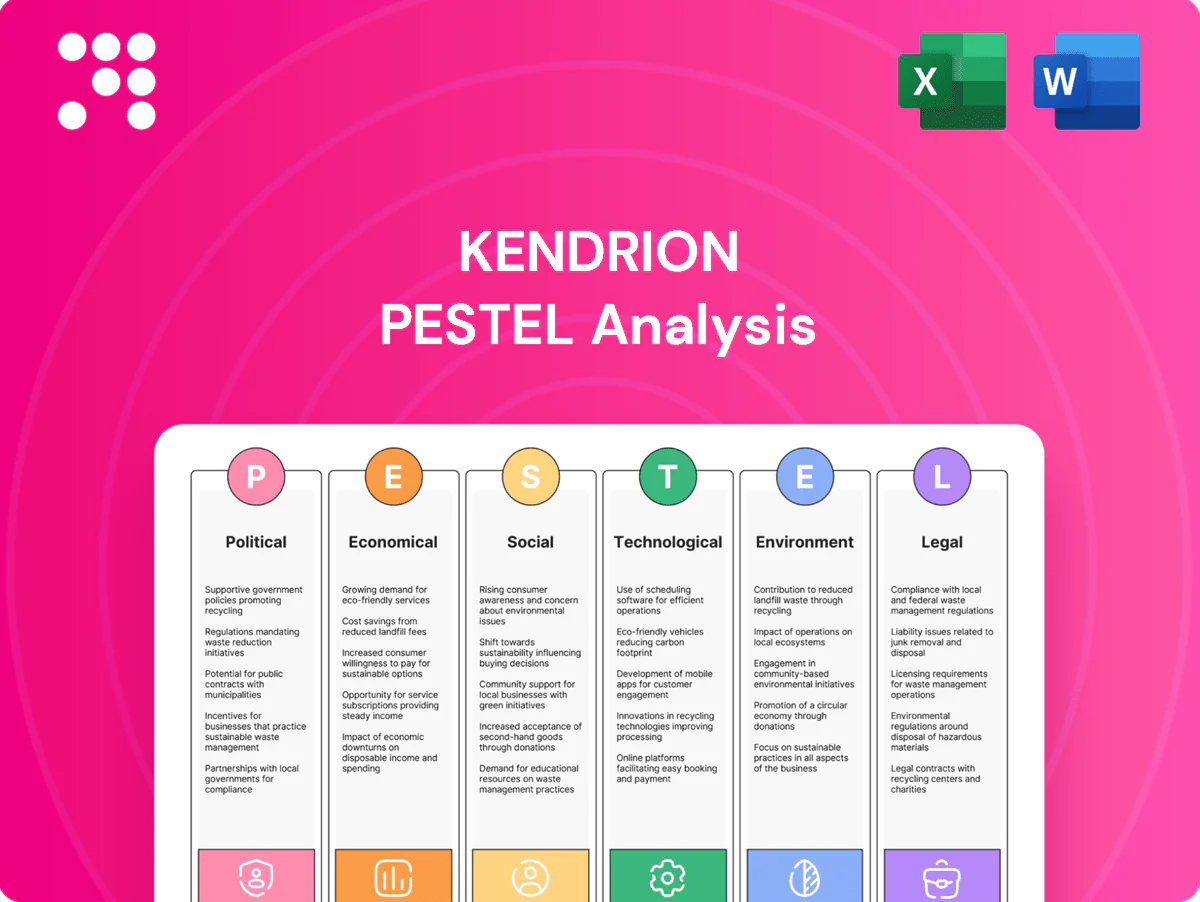
Kendrion PESTLE Analysis

Make Smarter Strategic Decisions with a Complete PESTEL View
Unlock how political shifts, economic cycles, and technological trends are reshaping Kendrion’s prospects with our concise PESTLE overview—perfect for investors and strategists. This snapshot highlights key external risks and opportunities to inform smarter decisions. Purchase the full, fully editable PESTLE analysis to access deep-dive insights and actionable recommendations instantly.
Political factors

EU industrial policy and subsidies
EU industrial policy and subsidies, including the Chips Act which mobilizes about €43 billion for strategic industrial capacity, create funding pathways for Kendrion’s electrification and advanced manufacturing investments. Access to IPCEI and national grant schemes can lower capex and R&D barriers and boost cost competitiveness in brakes and controls. Post-election policy shifts may reallocate funds or add local-content conditions, so active engagement with agencies is vital to align product roadmaps with funding priorities.
Trade policy, tariffs, and localization
Transatlantic and EU‑China trade frictions can change duties on components such as steel, electronics and magnets, noting US steel tariffs of 25% remain in force. Localization requirements in the US or Asia may push Kendrion toward expanded regional manufacturing to preserve competitiveness and access. Rules of origin materially affect pricing and lead times for global customers, so flexible supply footprints mitigate tariff volatility.

Geopolitical supply risk
Sanctions and export restrictions on motion control and dual‑use items since 2022—imposed by over 40 countries—can limit Kendrion’s sales and sourcing across automotive and industrial markets. Conflicts that close or threaten shipping lanes increase logistics lead times and costs, while governments increasingly prioritize critical industries, reshaping procurement pipelines. Scenario planning for raw materials and critical subcomponents is therefore essential.

Public procurement and standards influence
Government spending on health and infrastructure — driven by instruments like the US Bipartisan Infrastructure Law ($1.2tn) and the EU Recovery and Resilience Facility (€723.8bn) — boosts demand for Kendrion brakes and controls; public procurement represents about 12% of global GDP (World Bank). Public buyers require strict certifications and sustainability disclosures (EU green procurement standards), and active participation in standards bodies lets Kendrion influence technical specs for mechatronic solutions. Early compliance with certifications and sustainability reporting shortens sales cycles and increases tender win rates.
- Procurement scale: ~12% global GDP
- US infrastructure: $1.2tn
- EU RRF: €723.8bn
- Standards participation => favorable specs
Energy policy and grid stability
European Fit for 55 commits to a 55% greenhouse gas reduction by 2030 and REPowerEU pushes renewables toward roughly 45% of energy by 2030, raising pressure on manufacturers to cut energy intensity and exposure to volatile wholesale power prices.
Subsidies and tax credits for efficiency accelerate demand for energy‑saving actuators and controls, while increased grid volatility heightens value of high‑reliability industrial brakes for safety and uptime.
Long‑term PPAs and on‑site renewables can lock energy costs and reduce exposure; corporate PPA markets and on‑site solar adoption have been rising across Europe as hedges against price spikes.
- EU target: 55% GHG cut by 2030
- REPowerEU renewables goal: ~45% by 2030
- Incentives raising actuator/control adoption
- PPA/on‑site renewables stabilize OPEX
EU Chips Act €43bn and IPCEI cut electrification capex; tariffs and localisation drive reshoring
EU Chips Act (€43bn) and IPCEI grants lower capex for Kendrion’s electrification; engagement secures funding. US 25% steel tariffs, EU‑China frictions and localisation rules push regional production and flexible sourcing. Public infrastructure ($1.2tn US, €723.8bn EU RRF), Fit for 55 (−55% GHG by 2030) and REPowerEU (~45% renewables by 2030) raise demand and compliance burdens.
| Tag | Metric | Value |
|---|---|---|
| Chips Act | Funding | €43bn |
| US steel tariff | Rate | 25% |
| US infra | Spending | $1.2tn |
| EU RRF | Funds | €723.8bn |
What is included in the product
 Detailed Word Document
Explores how external macro-environmental factors uniquely affect Kendrion across Political, Economic, Social, Technological, Environmental and Legal dimensions, with data-backed trends, industry-specific subpoints, forward-looking insights and clean formatting to help executives, investors and strategists identify risks and opportunities.

 Customizable Excel Spreadsheet
Concise, visually segmented Kendrion PESTLE summary for quick stakeholder alignment—easily dropped into presentations or shared across teams to support external risk discussions and strategic planning.
Economic factors

Industrial capex and PMI cycles
Automation and machinery capex trends closely track Kendrion’s order intake, with Industrial Controls volumes dipping during the PMI downturn in 2023 and improving as major PMIs crossed back above the 50 expansion threshold in 2024 (S&P Global). PMI-driven delays can defer projects and pressure low-margin volume business, while recovery phases favor higher‑margin custom systems. Kendrion’s diversified end‑market mix cushions cyclical swings.
Automotive and commercial vehicle demand
OEM production swings directly affect Kendrion’s mechatronic volumes, with plant shutdowns or ramp-ups translating into immediate order variability.
Electrification and rising ADAS penetration—electric vehicles represented about 14% of global new car sales in 2024—support secular content growth despite unit cyclicality.
Commercial vehicle demand tracks freight and construction cycles, influencing brake and actuator demand, while platform wins provide multi‑year revenue visibility.

FX and cost inflation
EUR/USD ~1.10 and EUR/CNY ~7.7 (mid‑2025) shift export pricing and imported input costs for Kendrion, compressing euro‑denominated margins when USD/CNY strength raises local costs.
Inflation in steel, copper and electronics and a near‑term >30% spike in rare‑earth magnet (NdPr) costs since 2020 continue to pressure gross margins.
Contractual pricing clauses and FX/commodity hedging have materially protected gross margin volatility.
Greater regional sourcing and nearshoring reduce currency translation and long‑haul freight exposure, trimming cost shock risk.

Interest rates and financing conditions
Higher rates (ECB policy rate ~4.0% and 12m Euribor ~3.6% mid‑2025) raise WACC and can delay customer automation spend, while increasing Kendrion’s debt service and potentially deferring capex. Rate cuts could unlock deferred orders and improve order visibility. Maintaining liquidity and covenant headroom preserves strategic flexibility.
- ECB rate ~4.0%
- 12m Euribor ~3.6%
- Protect cash and covenants
- Delay capex if needed
Supply chain resilience and lead times
Component bottlenecks in semiconductors, motors and magnets have historically extended delivery schedules—industry data show semiconductor lead times eased from about 26 weeks in 2021 to roughly 18 weeks by 2024, but episodic shortages persist. Kendrion mitigates risk via dual‑sourcing and safety stock, preserving service levels while nearshoring initiatives shorten lead times and lower risk premia. Strong S&OP alignment improves throughput and can reduce working capital by tightening inventory turnover and forecast bias.
- semiconductor lead times ~26w (2021) → ~18w (2024)
- dual‑sourcing + safety stock = stabilized service
- nearshoring = shorter lead times, lower risk premium
- S&OP alignment = improved throughput, reduced working capital
EU Chips Act €43bn and IPCEI cut electrification capex; tariffs and localisation drive reshoring
Demand cyclicality and PMI recovery drive order flows; EVs ~14% of global new car sales (2024) support content growth while OEM swings cause short‑term volatility. ECB rate ~4.0% and EUR/USD ~1.10 (mid‑2025) pressure margins via FX and borrowing cost. NdPr up >30% since 2020; semiconductor lead times ~18w (2024) remain a constraint mitigated by nearshoring and hedges.
| Metric | Value |
|---|---|
| ECB rate | ~4.0% |
| EUR/USD | ~1.10 |
| EV share (2024) | 14% |
| NdPr change since 2020 | +>30% |
| Semiconductor lead time (2024) | ~18w |
Full Version Awaits
Kendrion PESTLE Analysis
The preview shown here is the exact Kendrion PESTLE Analysis document you’ll receive after purchase—fully formatted and ready to use. The content, layout and structure visible in this preview match the downloadable file exactly, with no placeholders or edits. After payment you’ll instantly get this same professional, finished report for immediate use.

Product Information
Product Information
Shipping & Returns
Shipping & Returns
Description
Make Smarter Strategic Decisions with a Complete PESTEL View
Unlock how political shifts, economic cycles, and technological trends are reshaping Kendrion’s prospects with our concise PESTLE overview—perfect for investors and strategists. This snapshot highlights key external risks and opportunities to inform smarter decisions. Purchase the full, fully editable PESTLE analysis to access deep-dive insights and actionable recommendations instantly.
Political factors
EU industrial policy and subsidies
EU industrial policy and subsidies, including the Chips Act which mobilizes about €43 billion for strategic industrial capacity, create funding pathways for Kendrion’s electrification and advanced manufacturing investments. Access to IPCEI and national grant schemes can lower capex and R&D barriers and boost cost competitiveness in brakes and controls. Post-election policy shifts may reallocate funds or add local-content conditions, so active engagement with agencies is vital to align product roadmaps with funding priorities.
Trade policy, tariffs, and localization
Transatlantic and EU‑China trade frictions can change duties on components such as steel, electronics and magnets, noting US steel tariffs of 25% remain in force. Localization requirements in the US or Asia may push Kendrion toward expanded regional manufacturing to preserve competitiveness and access. Rules of origin materially affect pricing and lead times for global customers, so flexible supply footprints mitigate tariff volatility.
Geopolitical supply risk
Sanctions and export restrictions on motion control and dual‑use items since 2022—imposed by over 40 countries—can limit Kendrion’s sales and sourcing across automotive and industrial markets. Conflicts that close or threaten shipping lanes increase logistics lead times and costs, while governments increasingly prioritize critical industries, reshaping procurement pipelines. Scenario planning for raw materials and critical subcomponents is therefore essential.
Public procurement and standards influence
Government spending on health and infrastructure — driven by instruments like the US Bipartisan Infrastructure Law ($1.2tn) and the EU Recovery and Resilience Facility (€723.8bn) — boosts demand for Kendrion brakes and controls; public procurement represents about 12% of global GDP (World Bank). Public buyers require strict certifications and sustainability disclosures (EU green procurement standards), and active participation in standards bodies lets Kendrion influence technical specs for mechatronic solutions. Early compliance with certifications and sustainability reporting shortens sales cycles and increases tender win rates.
- Procurement scale: ~12% global GDP
- US infrastructure: $1.2tn
- EU RRF: €723.8bn
- Standards participation => favorable specs
Energy policy and grid stability
European Fit for 55 commits to a 55% greenhouse gas reduction by 2030 and REPowerEU pushes renewables toward roughly 45% of energy by 2030, raising pressure on manufacturers to cut energy intensity and exposure to volatile wholesale power prices.
Subsidies and tax credits for efficiency accelerate demand for energy‑saving actuators and controls, while increased grid volatility heightens value of high‑reliability industrial brakes for safety and uptime.
Long‑term PPAs and on‑site renewables can lock energy costs and reduce exposure; corporate PPA markets and on‑site solar adoption have been rising across Europe as hedges against price spikes.
- EU target: 55% GHG cut by 2030
- REPowerEU renewables goal: ~45% by 2030
- Incentives raising actuator/control adoption
- PPA/on‑site renewables stabilize OPEX
EU Chips Act €43bn and IPCEI cut electrification capex; tariffs and localisation drive reshoring
EU Chips Act (€43bn) and IPCEI grants lower capex for Kendrion’s electrification; engagement secures funding. US 25% steel tariffs, EU‑China frictions and localisation rules push regional production and flexible sourcing. Public infrastructure ($1.2tn US, €723.8bn EU RRF), Fit for 55 (−55% GHG by 2030) and REPowerEU (~45% renewables by 2030) raise demand and compliance burdens.
| Tag | Metric | Value |
|---|---|---|
| Chips Act | Funding | €43bn |
| US steel tariff | Rate | 25% |
| US infra | Spending | $1.2tn |
| EU RRF | Funds | €723.8bn |
What is included in the product
Detailed Word Document
Explores how external macro-environmental factors uniquely affect Kendrion across Political, Economic, Social, Technological, Environmental and Legal dimensions, with data-backed trends, industry-specific subpoints, forward-looking insights and clean formatting to help executives, investors and strategists identify risks and opportunities.
Customizable Excel Spreadsheet
Concise, visually segmented Kendrion PESTLE summary for quick stakeholder alignment—easily dropped into presentations or shared across teams to support external risk discussions and strategic planning.
Economic factors
Industrial capex and PMI cycles
Automation and machinery capex trends closely track Kendrion’s order intake, with Industrial Controls volumes dipping during the PMI downturn in 2023 and improving as major PMIs crossed back above the 50 expansion threshold in 2024 (S&P Global). PMI-driven delays can defer projects and pressure low-margin volume business, while recovery phases favor higher‑margin custom systems. Kendrion’s diversified end‑market mix cushions cyclical swings.
Automotive and commercial vehicle demand
OEM production swings directly affect Kendrion’s mechatronic volumes, with plant shutdowns or ramp-ups translating into immediate order variability.
Electrification and rising ADAS penetration—electric vehicles represented about 14% of global new car sales in 2024—support secular content growth despite unit cyclicality.
Commercial vehicle demand tracks freight and construction cycles, influencing brake and actuator demand, while platform wins provide multi‑year revenue visibility.
FX and cost inflation
EUR/USD ~1.10 and EUR/CNY ~7.7 (mid‑2025) shift export pricing and imported input costs for Kendrion, compressing euro‑denominated margins when USD/CNY strength raises local costs.
Inflation in steel, copper and electronics and a near‑term >30% spike in rare‑earth magnet (NdPr) costs since 2020 continue to pressure gross margins.
Contractual pricing clauses and FX/commodity hedging have materially protected gross margin volatility.
Greater regional sourcing and nearshoring reduce currency translation and long‑haul freight exposure, trimming cost shock risk.
Interest rates and financing conditions
Higher rates (ECB policy rate ~4.0% and 12m Euribor ~3.6% mid‑2025) raise WACC and can delay customer automation spend, while increasing Kendrion’s debt service and potentially deferring capex. Rate cuts could unlock deferred orders and improve order visibility. Maintaining liquidity and covenant headroom preserves strategic flexibility.
- ECB rate ~4.0%
- 12m Euribor ~3.6%
- Protect cash and covenants
- Delay capex if needed
Supply chain resilience and lead times
Component bottlenecks in semiconductors, motors and magnets have historically extended delivery schedules—industry data show semiconductor lead times eased from about 26 weeks in 2021 to roughly 18 weeks by 2024, but episodic shortages persist. Kendrion mitigates risk via dual‑sourcing and safety stock, preserving service levels while nearshoring initiatives shorten lead times and lower risk premia. Strong S&OP alignment improves throughput and can reduce working capital by tightening inventory turnover and forecast bias.
- semiconductor lead times ~26w (2021) → ~18w (2024)
- dual‑sourcing + safety stock = stabilized service
- nearshoring = shorter lead times, lower risk premium
- S&OP alignment = improved throughput, reduced working capital
EU Chips Act €43bn and IPCEI cut electrification capex; tariffs and localisation drive reshoring
Demand cyclicality and PMI recovery drive order flows; EVs ~14% of global new car sales (2024) support content growth while OEM swings cause short‑term volatility. ECB rate ~4.0% and EUR/USD ~1.10 (mid‑2025) pressure margins via FX and borrowing cost. NdPr up >30% since 2020; semiconductor lead times ~18w (2024) remain a constraint mitigated by nearshoring and hedges.
| Metric | Value |
|---|---|
| ECB rate | ~4.0% |
| EUR/USD | ~1.10 |
| EV share (2024) | 14% |
| NdPr change since 2020 | +>30% |
| Semiconductor lead time (2024) | ~18w |
Full Version Awaits
Kendrion PESTLE Analysis
The preview shown here is the exact Kendrion PESTLE Analysis document you’ll receive after purchase—fully formatted and ready to use. The content, layout and structure visible in this preview match the downloadable file exactly, with no placeholders or edits. After payment you’ll instantly get this same professional, finished report for immediate use.











