KB Financial Group PESTLE Analysis

Make Smarter Strategic Decisions with a Complete PESTEL View
Explore how political shifts, economic cycles, and technological disruption are shaping KB Financial Group’s outlook in our concise PESTLE Analysis. This actionable briefing highlights regulatory risks, market opportunities, and sustainability trends to inform strategic decisions. Purchase the full report to access the complete, editable analysis and immediate insights for investors and planners.
Political factors

Prudential policy stance
South Korea’s macroprudential focus forces KB Financial to maintain higher capital and liquidity buffers amid system household debt of about 1,900 trillion won (end-2023), with tighter DSR/LTV limits curbing mortgage growth and pricing. KB must align lending strategy with shifting tools while protecting margins, and coordination with the Bank of Korea and FSC can tighten or loosen credit cycles rapidly.
Geopolitical tensions
Inter-Korean risk and U.S.–China frictions can quickly sway markets and investor sentiment, with China accounting for roughly 27% of South Korea’s exports in 2023, amplifying trade-linked exposure. Elevated risk premiums can lift funding costs and compress asset valuations, making contingency planning for sanctions and volatility essential. KB’s international operations require agile risk management to respond to rapid shocks amid a 2024 South Korean defense budget of KRW 61.4 trillion.

State policy on innovation
Seoul's Digital New Deal (part of Korea's 2020 New Deal, ~160 trillion won) and city fintech sandboxes promote digital finance and a data-driven economy, accelerating KB Financial's fintech partnerships and product pilots. Incentives and sandbox approvals shorten time-to-market and support collaboration with startups. Public initiatives also intensify competition from Big Tech and non-banks such as KakaoBank (over 17 million customers by 2023). Strategic participation helps KB capture platform growth while managing cannibalization.

Public-credit programs
Govt-backed SME, housing and inclusive-finance schemes shape KB Financial Group’s loan mix and margins; South Korea household debt was about 1,900 trillion won in 2023, increasing policy focus on subsidized housing credit that can compress yields while boosting customer acquisition.
- Supports social mandates and client growth
- Compresses yields vs market loans
- Execution tied to subsidy timelines/eligibility
- Must balance policy goals with risk-adjusted returns
International policy alignment
Adherence to global standards and sanctions regimes directly affects KB Financial Group's trade finance and correspondent banking, increasing screening costs as cross-border volumes rise; South Korea's 2024 nominal GDP was about 1.8 trillion USD, underscoring international exposure. Political shifts in China, Vietnam and the US can alter opportunities and compliance burdens, requiring strengthened KYC/AML to avoid multi‑million-dollar penalties. Diplomatic developments can rapidly unlock or constrain regional expansion.
- Sanctions compliance: higher screening costs
- KYC/AML: prevention of regulatory fines
- Markets: China/ Vietnam/ US shift cross-border flows
- Diplomacy: can enable or block expansion
Macroprudential tightening, China risks and fintech competition squeeze Korean banks
South Korea’s macroprudential tightening (household debt ~1,900 trillion won, end‑2023) forces KB to hold higher capital/liquidity and curbs mortgage growth via DSR/LTV, pressuring margins. Geopolitical risks (China ~27% of exports, 2023) and US–China frictions lift funding costs and require agile contingency planning. Digital New Deal and fintech sandboxes accelerate competition (KakaoBank >17M customers, 2023) and platform opportunities.
| Indicator | Value | Year |
|---|---|---|
| Household debt | ~1,900T won | 2023 |
| China share of exports | ~27% | 2023 |
| KakaoBank users | >17M | 2023 |
What is included in the product
 Detailed Word Document
Explores how external macro-environmental factors uniquely affect KB Financial Group across Political, Economic, Social, Technological, Environmental and Legal dimensions, with region-specific regulatory and market context. Provides data-backed trends, forward-looking insights and actionable implications to help executives, investors and advisors identify risks, opportunities and strategic responses.

 Customizable Excel Spreadsheet
Clean, summarized PESTLE insights for KB Financial Group that fit directly into presentations or meeting packs, enabling quick reference and alignment. Supports risk discussion and market-positioning decisions with clear, stakeholder-friendly language for fast consensus across teams.
Economic factors

Rate cycle sensitivity
Bank of Korea policy (base rate at 3.50% as of July 2025) directly drives KB Financial Group NIM through asset–liability repricing; higher rates historically lift margins but also raise credit costs, particularly across mortgage and SME portfolios. Rapid policy cuts can compress NIM while reducing delinquencies and loan-loss provisioning. Robust ALM discipline and a stable, low-cost deposit mix are therefore critical to preserve margin resilience.
High household leverage
Korea’s household debt reached about 1,900 trillion KRW by end-2024, heightening credit risk during downturns. Rapid property price swings transmit quickly to consumer confidence and loan quality, raising NPL vulnerability. Tighter DSR/LTV rules since 2023 temper credit growth but improve resilience. KB must refine risk models and collateral management.

Export-led cyclicality
South Korea's exports account for roughly 40% of GDP, so export-led cyclicality materially swings corporate cash flows and capex, pressuring KB Financial's lending and working capital lines during downturns. FX volatility in KRW raises hedging costs and alters cross-border funding and capital flows, increasing risk in treasury operations. Sector diversification reduces concentration in cyclical industries, while advisory and transaction-banking demand closely tracks trade cycles.

Inflation and wages
Inflation in 2024 eased to about 2.6% in South Korea, but price pressures still raise operating costs and reduce borrower affordability, while persistent inflation can lift KB Financial Group funding costs and compress net interest margins. Wage growth—around mid-single digits in 2024—supports fee-income in wealth and insurance but raises staff expenses, making pricing agility and fee diversification critical to preserve margins.
- Inflation: 2024 CPI ~2.6%
- Funding risk: higher rates compress spreads
- Wages: mid-single-digit growth boosts fees yet raises costs
- Mitigation: pricing agility, fee diversification
Capital markets depth
Korea’s deep equity and debt markets — KRX market capitalization around KRW 3,500 trillion (≈USD 2.6 trillion) at end-2024 with average daily cash turnover near KRW 10 trillion in 2024 — enables KB to earn underwriting, brokerage and asset-management fees; episodic volatility lifts trading income but raises VaR and capital needs. Stable market inflows support bancassurance and wealth-management flows, and KB can cross-sell across its universal platform.
- Market cap: KRW 3,500 trillion (end-2024)
- Daily turnover: ~KRW 10 trillion (2024)
- Impact: higher trading income vs. higher VaR and capital
- Strategy: cross-sell via universal platform
Macroprudential tightening, China risks and fintech competition squeeze Korean banks
Bank of Korea policy rate 3.50% (July 2025) directly drives NIM and credit costs; higher rates boost margins but lift provisioning. Household debt ~1,900tn KRW (end-2024) and property volatility raise NPL risk despite tighter DSR/LTV. Exports ~40% of GDP and KRX market cap ~3,500tn KRW (end-2024) increase cyclical funding and trading income; FX swings raise hedging costs.
| Metric | Value |
|---|---|
| Base rate | 3.50% (Jul 2025) |
| Household debt | ~1,900tn KRW (end-2024) |
| CPI | ~2.6% (2024) |
| KRX market cap | ~3,500tn KRW (end-2024) |
Preview Before You Purchase
KB Financial Group PESTLE Analysis
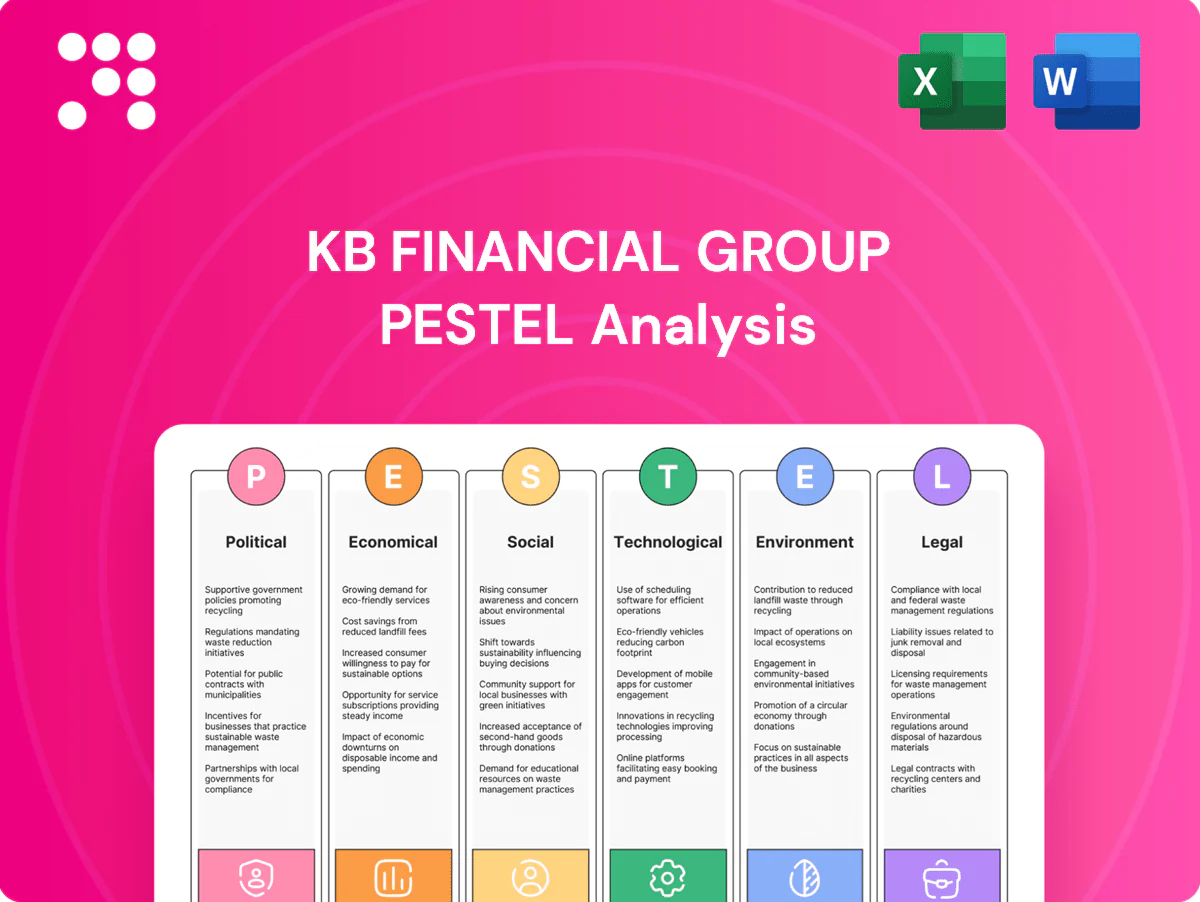
The preview shown here is the exact KB Financial Group PESTLE Analysis document you’ll receive after purchase—fully formatted and ready to use. This is a real screenshot of the product you’re buying and contains the complete political, economic, social, technological, legal, and environmental assessment. No placeholders or teasers—what you see is the finished file available for immediate download.

Original: $10.00
-65%$10.00
$3.50Product Information
Product Information
Shipping & Returns
Shipping & Returns
Description
Make Smarter Strategic Decisions with a Complete PESTEL View
Explore how political shifts, economic cycles, and technological disruption are shaping KB Financial Group’s outlook in our concise PESTLE Analysis. This actionable briefing highlights regulatory risks, market opportunities, and sustainability trends to inform strategic decisions. Purchase the full report to access the complete, editable analysis and immediate insights for investors and planners.
Political factors
Prudential policy stance
South Korea’s macroprudential focus forces KB Financial to maintain higher capital and liquidity buffers amid system household debt of about 1,900 trillion won (end-2023), with tighter DSR/LTV limits curbing mortgage growth and pricing. KB must align lending strategy with shifting tools while protecting margins, and coordination with the Bank of Korea and FSC can tighten or loosen credit cycles rapidly.
Geopolitical tensions
Inter-Korean risk and U.S.–China frictions can quickly sway markets and investor sentiment, with China accounting for roughly 27% of South Korea’s exports in 2023, amplifying trade-linked exposure. Elevated risk premiums can lift funding costs and compress asset valuations, making contingency planning for sanctions and volatility essential. KB’s international operations require agile risk management to respond to rapid shocks amid a 2024 South Korean defense budget of KRW 61.4 trillion.
State policy on innovation
Seoul's Digital New Deal (part of Korea's 2020 New Deal, ~160 trillion won) and city fintech sandboxes promote digital finance and a data-driven economy, accelerating KB Financial's fintech partnerships and product pilots. Incentives and sandbox approvals shorten time-to-market and support collaboration with startups. Public initiatives also intensify competition from Big Tech and non-banks such as KakaoBank (over 17 million customers by 2023). Strategic participation helps KB capture platform growth while managing cannibalization.
Public-credit programs
Govt-backed SME, housing and inclusive-finance schemes shape KB Financial Group’s loan mix and margins; South Korea household debt was about 1,900 trillion won in 2023, increasing policy focus on subsidized housing credit that can compress yields while boosting customer acquisition.
- Supports social mandates and client growth
- Compresses yields vs market loans
- Execution tied to subsidy timelines/eligibility
- Must balance policy goals with risk-adjusted returns
International policy alignment
Adherence to global standards and sanctions regimes directly affects KB Financial Group's trade finance and correspondent banking, increasing screening costs as cross-border volumes rise; South Korea's 2024 nominal GDP was about 1.8 trillion USD, underscoring international exposure. Political shifts in China, Vietnam and the US can alter opportunities and compliance burdens, requiring strengthened KYC/AML to avoid multi‑million-dollar penalties. Diplomatic developments can rapidly unlock or constrain regional expansion.
- Sanctions compliance: higher screening costs
- KYC/AML: prevention of regulatory fines
- Markets: China/ Vietnam/ US shift cross-border flows
- Diplomacy: can enable or block expansion
Macroprudential tightening, China risks and fintech competition squeeze Korean banks
South Korea’s macroprudential tightening (household debt ~1,900 trillion won, end‑2023) forces KB to hold higher capital/liquidity and curbs mortgage growth via DSR/LTV, pressuring margins. Geopolitical risks (China ~27% of exports, 2023) and US–China frictions lift funding costs and require agile contingency planning. Digital New Deal and fintech sandboxes accelerate competition (KakaoBank >17M customers, 2023) and platform opportunities.
| Indicator | Value | Year |
|---|---|---|
| Household debt | ~1,900T won | 2023 |
| China share of exports | ~27% | 2023 |
| KakaoBank users | >17M | 2023 |
What is included in the product
Detailed Word Document
Explores how external macro-environmental factors uniquely affect KB Financial Group across Political, Economic, Social, Technological, Environmental and Legal dimensions, with region-specific regulatory and market context. Provides data-backed trends, forward-looking insights and actionable implications to help executives, investors and advisors identify risks, opportunities and strategic responses.
Customizable Excel Spreadsheet
Clean, summarized PESTLE insights for KB Financial Group that fit directly into presentations or meeting packs, enabling quick reference and alignment. Supports risk discussion and market-positioning decisions with clear, stakeholder-friendly language for fast consensus across teams.
Economic factors
Rate cycle sensitivity
Bank of Korea policy (base rate at 3.50% as of July 2025) directly drives KB Financial Group NIM through asset–liability repricing; higher rates historically lift margins but also raise credit costs, particularly across mortgage and SME portfolios. Rapid policy cuts can compress NIM while reducing delinquencies and loan-loss provisioning. Robust ALM discipline and a stable, low-cost deposit mix are therefore critical to preserve margin resilience.
High household leverage
Korea’s household debt reached about 1,900 trillion KRW by end-2024, heightening credit risk during downturns. Rapid property price swings transmit quickly to consumer confidence and loan quality, raising NPL vulnerability. Tighter DSR/LTV rules since 2023 temper credit growth but improve resilience. KB must refine risk models and collateral management.
Export-led cyclicality
South Korea's exports account for roughly 40% of GDP, so export-led cyclicality materially swings corporate cash flows and capex, pressuring KB Financial's lending and working capital lines during downturns. FX volatility in KRW raises hedging costs and alters cross-border funding and capital flows, increasing risk in treasury operations. Sector diversification reduces concentration in cyclical industries, while advisory and transaction-banking demand closely tracks trade cycles.
Inflation and wages
Inflation in 2024 eased to about 2.6% in South Korea, but price pressures still raise operating costs and reduce borrower affordability, while persistent inflation can lift KB Financial Group funding costs and compress net interest margins. Wage growth—around mid-single digits in 2024—supports fee-income in wealth and insurance but raises staff expenses, making pricing agility and fee diversification critical to preserve margins.
- Inflation: 2024 CPI ~2.6%
- Funding risk: higher rates compress spreads
- Wages: mid-single-digit growth boosts fees yet raises costs
- Mitigation: pricing agility, fee diversification
Capital markets depth
Korea’s deep equity and debt markets — KRX market capitalization around KRW 3,500 trillion (≈USD 2.6 trillion) at end-2024 with average daily cash turnover near KRW 10 trillion in 2024 — enables KB to earn underwriting, brokerage and asset-management fees; episodic volatility lifts trading income but raises VaR and capital needs. Stable market inflows support bancassurance and wealth-management flows, and KB can cross-sell across its universal platform.
- Market cap: KRW 3,500 trillion (end-2024)
- Daily turnover: ~KRW 10 trillion (2024)
- Impact: higher trading income vs. higher VaR and capital
- Strategy: cross-sell via universal platform
Macroprudential tightening, China risks and fintech competition squeeze Korean banks
Bank of Korea policy rate 3.50% (July 2025) directly drives NIM and credit costs; higher rates boost margins but lift provisioning. Household debt ~1,900tn KRW (end-2024) and property volatility raise NPL risk despite tighter DSR/LTV. Exports ~40% of GDP and KRX market cap ~3,500tn KRW (end-2024) increase cyclical funding and trading income; FX swings raise hedging costs.
| Metric | Value |
|---|---|
| Base rate | 3.50% (Jul 2025) |
| Household debt | ~1,900tn KRW (end-2024) |
| CPI | ~2.6% (2024) |
| KRX market cap | ~3,500tn KRW (end-2024) |
Preview Before You Purchase
KB Financial Group PESTLE Analysis
The preview shown here is the exact KB Financial Group PESTLE Analysis document you’ll receive after purchase—fully formatted and ready to use. This is a real screenshot of the product you’re buying and contains the complete political, economic, social, technological, legal, and environmental assessment. No placeholders or teasers—what you see is the finished file available for immediate download.