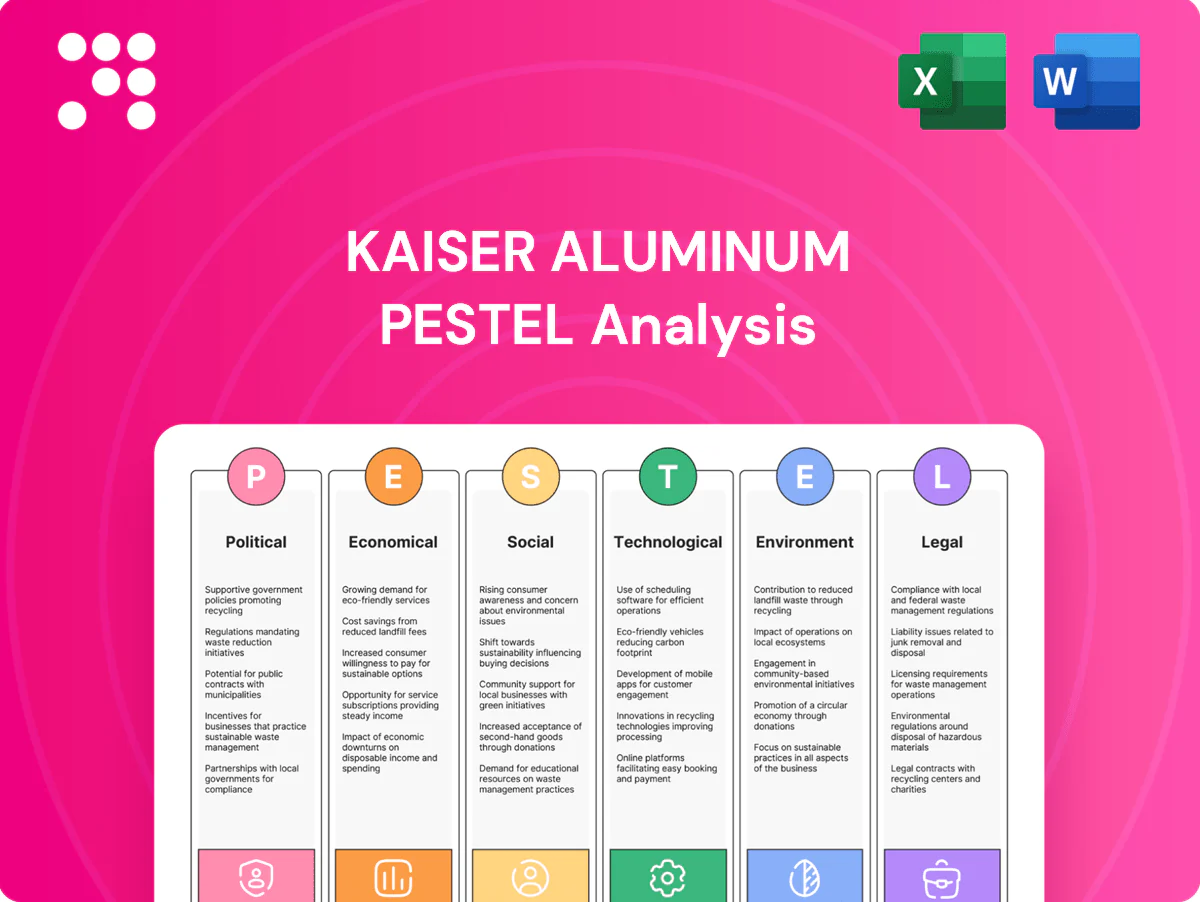
Kaiser Aluminum PESTLE Analysis

Skip the Research. Get the Strategy.
Unlock strategic advantage with our PESTLE analysis of Kaiser Aluminum—three perspectives on political, environmental and market forces that will shape its near-term outlook. Ideal for investors and strategists, it’s fully researched and actionable. Purchase the full report for the complete, editable analysis and immediate insights.
Political factors

Tariffs and trade policy
U.S. Section 232 tariffs on aluminum (10% since 2018) and antidumping/countervailing duties—sometimes reaching triple‑digit percentages on some Chinese products—raise Kaiser’s input costs and squeeze price competitiveness. Shifts in U.S.‑China/EU trade ties risk disrupting supplies of billet, slab and alloying elements, so Kaiser must hedge exposure, diversify sourcing and use industry lobbying (Aluminum Association, AIA) to influence policy.
Defense and aerospace spending
U.S. FY2024 defense spending of about 858 billion dollars and NATO allies' combined defense outlays exceeding 1.3 trillion dollars in 2024 drive demand for high-strength aerospace plate, rod, and tube. Procurement cycles and program approvals materially affect volume visibility for suppliers. ITAR and export approvals to allied programs also constrain order timing. Budget stability supports multi-year capacity planning and targeted capex.

Industrial and infrastructure policy
The $1.2 trillion Infrastructure Investment and Jobs Act and related programs boost aluminum demand in transportation and engineering, with federal surface transportation funding up ~20% through 2026 supporting vehicle and bridge projects. Expanded Buy America provisions increasingly favor U.S.-made aluminum for federal contracts. The Inflation Reduction Act (~369 billion) and energy subsidies can lower smelting and downstream energy costs, while clearer long-term policy reduces investment risk for capacity and decarbonization projects.

Sanctions and geopolitical risk
Sanctions on major bauxite/alumina/aluminum producers can tighten supply and lift premiums; global primary aluminum output was about 68.2 million tonnes in 2023 and Russia represented roughly 6% (~4.1 Mt), so disruptions materially affect markets. Geopolitical tensions raise shipping costs and lead times, forcing Kaiser to secure alternative suppliers and inventory buffers while compliance oversight grows more complex.
- Supply risk: sanctions can remove ~4.1 Mt capacity
- Logistics: higher freight/longer lead times
- Mitigation: diversify suppliers, increase inventory, enhance compliance
Environmental policy direction
Rising carbon pricing (EU ETS ~€90–100/t in 2024–25) and CBAM-style import levies (phase-in to 2026) shift cost curves sharply; with ~12 tCO2/t for primary aluminum, carbon adds ~€1,080–1,200/t (~$1,160–$1,290/t). Lower-CO2 facilities gain export advantage; reporting mandates raise compliance costs but enable green-premium pricing; policy volatility demands flexible offtake and hedging contracts.
- EU ETS price: ~€90–100/t (2024–25)
- Primary Al emissions: ~12 tCO2/t → ~€1,080–1,200/t carbon cost
- CBAM import adjustments from 2026
- Reporting ↑ overhead; enables green premiums
Tariffs, ETS and sanctions squeeze aluminum; 10% Section 232 risk
U.S. tariffs (Section 232 10%), AD/CVD and trade tensions raise input costs and sourcing risk; lobbying and supplier diversification are critical. Strong 2024 defense spending (~$858B) and $1.2T infrastructure law support demand and Buy America. Carbon regs (EU ETS €90–100/t; primary Al ~12 tCO2/t) and sanctions (global output 68.2 Mt; Russia ~4.1 Mt) shift cost and supply dynamics.
| Item | Value | Impact |
|---|---|---|
| Section 232 | 10% | Higher input costs |
| US defense 2024 | $858B | Stable aerospace demand |
| Infra law | $1.2T | Stronger construction demand |
| EU ETS | €90–100/t | Carbon cost ~€1,080–1,200/t |
| Global Al 2023 | 68.2 Mt (Russia ~4.1 Mt) | Supply risk if sanctioned |
What is included in the product
 Detailed Word Document
Explores how Political, Economic, Social, Technological, Environmental, and Legal forces specifically shape Kaiser Aluminum’s operations, supply chain, and market positioning, with data-backed trends and forward-looking implications for risk mitigation and opportunity capture for executives and investors.

 Customizable Excel Spreadsheet
A clean, summarized PESTLE of Kaiser Aluminum that’s visually segmented for quick interpretation, easily dropped into presentations or shared across teams to streamline external risk discussions and support planning sessions.
Economic factors

Aluminum price volatility
LME aluminum averaged about $2,500/ton in 2024 with intra-year swings near ±20%, and the Midwest premium moved roughly between $150–$420/ton, pressures that compress Kaiser Aluminum’s margins and tie up working capital when prices spike. Pass-through mechanisms to customers often lag market moves, creating timing risk for margin recovery. Hedging programs blunt headline volatility but introduce basis risk versus regional premiums. Maintaining strategic inventory levels is therefore critical to manage cash flow and service performance.
End-market cycles
Aerospace build rates (global OEM backlog >13,000 aircraft in 2024) plus US light-vehicle output (~11M units in 2024) and industrial capex drive Kaiser Aluminum order books; widebody and defense spending (>USD 2.2T global military expenditure in 2023) recovery can offset auto softness and vice versa. Diversification across aerospace, automotive and industrial smooths mill utilization, while forecast accuracy underpins tight mill scheduling and working-capital planning.

Energy and transportation costs
Fabrication is energy- and logistics-intensive for Kaiser, raising conversion costs as industrial power prices averaged about 11.02 cents/kWh in 2023 (EIA), while trucking capacity and driver shortages tightened freight markets. Power-price spikes and rail/truck constraints compress margins and increase working-capital needs. Kaiser mitigates exposure through long-term energy contracts and modal optimization. Proximity of plants to customers reduces freight risk and variability.

Labor availability and wage inflation
Tight markets for skilled operators and metallurgists—69% of manufacturers report recruitment difficulty per Deloitte 2024—push Kaiser Aluminum labor costs higher amid a US manufacturing workforce of ~12.6 million (BLS 2024). Wage inflation (~3.6% avg. manufacturing hourly growth 2024) plus overtime and training elevate scrap and reduce throughput. Apprenticeships and targeted automation can cut hours and errors, while union dynamics shape long-term cost structure.
- Skilled shortage: 69% (Deloitte 2024)
- Manufacturing jobs: ~12.6M (BLS 2024)
- Wage growth: ~3.6% (2024)
- Mitigants: apprenticeships, automation
- Risk: union-driven labor costs
FX and global premiums
Exchange-rate moves in 2024 affected Kaiser Aluminum’s imported alloy and energy costs and shifted competitiveness versus foreign mills, while regional premiums continued to drive realized contract pricing; multiyear supply agreements increasingly include FX adjustment clauses and diversified currency exposure in sales/COGS reduces concentration risk.
- FX impacts inputs and export competitiveness
- Regional premiums shape contract pricing
- Multiyear deals often include FX clauses
- Diversified currency exposure lowers risk
Tariffs, ETS and sanctions squeeze aluminum; 10% Section 232 risk
LME avg ~$2,500/ton (2024) with ±20% swings and Midwest premium $150–$420/ton squeeze margins; pass-through lags create timing risk. Aerospace backlog >13,000 (2024) and US auto ~11M units support demand but mix risk remains. Energy ~11.02¢/kWh (2023) and 69% skilled-shortage (Deloitte 2024) raise conversion and labor costs; hedges, inventory, automation mitigate.
| Metric | Value |
|---|---|
| LME (2024) | $2,500/ton |
| Midwest premium | $150–$420/ton |
| Aerospace backlog | >13,000 aircraft |
| US auto (2024) | ~11M units |
| Energy price (2023) | 11.02¢/kWh |
| Skilled shortage | 69% |
Preview Before You Purchase
Kaiser Aluminum PESTLE Analysis
This Kaiser Aluminum PESTLE Analysis preview is the exact document you’ll receive after purchase—fully formatted and ready to use. The content, layout, and structure shown here are identical to the downloadable file. No placeholders, no surprises—what you see is the final product.

Product Information
Product Information
Shipping & Returns
Shipping & Returns
Description
Skip the Research. Get the Strategy.
Unlock strategic advantage with our PESTLE analysis of Kaiser Aluminum—three perspectives on political, environmental and market forces that will shape its near-term outlook. Ideal for investors and strategists, it’s fully researched and actionable. Purchase the full report for the complete, editable analysis and immediate insights.
Political factors
Tariffs and trade policy
U.S. Section 232 tariffs on aluminum (10% since 2018) and antidumping/countervailing duties—sometimes reaching triple‑digit percentages on some Chinese products—raise Kaiser’s input costs and squeeze price competitiveness. Shifts in U.S.‑China/EU trade ties risk disrupting supplies of billet, slab and alloying elements, so Kaiser must hedge exposure, diversify sourcing and use industry lobbying (Aluminum Association, AIA) to influence policy.
Defense and aerospace spending
U.S. FY2024 defense spending of about 858 billion dollars and NATO allies' combined defense outlays exceeding 1.3 trillion dollars in 2024 drive demand for high-strength aerospace plate, rod, and tube. Procurement cycles and program approvals materially affect volume visibility for suppliers. ITAR and export approvals to allied programs also constrain order timing. Budget stability supports multi-year capacity planning and targeted capex.
Industrial and infrastructure policy
The $1.2 trillion Infrastructure Investment and Jobs Act and related programs boost aluminum demand in transportation and engineering, with federal surface transportation funding up ~20% through 2026 supporting vehicle and bridge projects. Expanded Buy America provisions increasingly favor U.S.-made aluminum for federal contracts. The Inflation Reduction Act (~369 billion) and energy subsidies can lower smelting and downstream energy costs, while clearer long-term policy reduces investment risk for capacity and decarbonization projects.
Sanctions and geopolitical risk
Sanctions on major bauxite/alumina/aluminum producers can tighten supply and lift premiums; global primary aluminum output was about 68.2 million tonnes in 2023 and Russia represented roughly 6% (~4.1 Mt), so disruptions materially affect markets. Geopolitical tensions raise shipping costs and lead times, forcing Kaiser to secure alternative suppliers and inventory buffers while compliance oversight grows more complex.
- Supply risk: sanctions can remove ~4.1 Mt capacity
- Logistics: higher freight/longer lead times
- Mitigation: diversify suppliers, increase inventory, enhance compliance
Environmental policy direction
Rising carbon pricing (EU ETS ~€90–100/t in 2024–25) and CBAM-style import levies (phase-in to 2026) shift cost curves sharply; with ~12 tCO2/t for primary aluminum, carbon adds ~€1,080–1,200/t (~$1,160–$1,290/t). Lower-CO2 facilities gain export advantage; reporting mandates raise compliance costs but enable green-premium pricing; policy volatility demands flexible offtake and hedging contracts.
- EU ETS price: ~€90–100/t (2024–25)
- Primary Al emissions: ~12 tCO2/t → ~€1,080–1,200/t carbon cost
- CBAM import adjustments from 2026
- Reporting ↑ overhead; enables green premiums
Tariffs, ETS and sanctions squeeze aluminum; 10% Section 232 risk
U.S. tariffs (Section 232 10%), AD/CVD and trade tensions raise input costs and sourcing risk; lobbying and supplier diversification are critical. Strong 2024 defense spending (~$858B) and $1.2T infrastructure law support demand and Buy America. Carbon regs (EU ETS €90–100/t; primary Al ~12 tCO2/t) and sanctions (global output 68.2 Mt; Russia ~4.1 Mt) shift cost and supply dynamics.
| Item | Value | Impact |
|---|---|---|
| Section 232 | 10% | Higher input costs |
| US defense 2024 | $858B | Stable aerospace demand |
| Infra law | $1.2T | Stronger construction demand |
| EU ETS | €90–100/t | Carbon cost ~€1,080–1,200/t |
| Global Al 2023 | 68.2 Mt (Russia ~4.1 Mt) | Supply risk if sanctioned |
What is included in the product
Detailed Word Document
Explores how Political, Economic, Social, Technological, Environmental, and Legal forces specifically shape Kaiser Aluminum’s operations, supply chain, and market positioning, with data-backed trends and forward-looking implications for risk mitigation and opportunity capture for executives and investors.
Customizable Excel Spreadsheet
A clean, summarized PESTLE of Kaiser Aluminum that’s visually segmented for quick interpretation, easily dropped into presentations or shared across teams to streamline external risk discussions and support planning sessions.
Economic factors
Aluminum price volatility
LME aluminum averaged about $2,500/ton in 2024 with intra-year swings near ±20%, and the Midwest premium moved roughly between $150–$420/ton, pressures that compress Kaiser Aluminum’s margins and tie up working capital when prices spike. Pass-through mechanisms to customers often lag market moves, creating timing risk for margin recovery. Hedging programs blunt headline volatility but introduce basis risk versus regional premiums. Maintaining strategic inventory levels is therefore critical to manage cash flow and service performance.
End-market cycles
Aerospace build rates (global OEM backlog >13,000 aircraft in 2024) plus US light-vehicle output (~11M units in 2024) and industrial capex drive Kaiser Aluminum order books; widebody and defense spending (>USD 2.2T global military expenditure in 2023) recovery can offset auto softness and vice versa. Diversification across aerospace, automotive and industrial smooths mill utilization, while forecast accuracy underpins tight mill scheduling and working-capital planning.
Energy and transportation costs
Fabrication is energy- and logistics-intensive for Kaiser, raising conversion costs as industrial power prices averaged about 11.02 cents/kWh in 2023 (EIA), while trucking capacity and driver shortages tightened freight markets. Power-price spikes and rail/truck constraints compress margins and increase working-capital needs. Kaiser mitigates exposure through long-term energy contracts and modal optimization. Proximity of plants to customers reduces freight risk and variability.
Labor availability and wage inflation
Tight markets for skilled operators and metallurgists—69% of manufacturers report recruitment difficulty per Deloitte 2024—push Kaiser Aluminum labor costs higher amid a US manufacturing workforce of ~12.6 million (BLS 2024). Wage inflation (~3.6% avg. manufacturing hourly growth 2024) plus overtime and training elevate scrap and reduce throughput. Apprenticeships and targeted automation can cut hours and errors, while union dynamics shape long-term cost structure.
- Skilled shortage: 69% (Deloitte 2024)
- Manufacturing jobs: ~12.6M (BLS 2024)
- Wage growth: ~3.6% (2024)
- Mitigants: apprenticeships, automation
- Risk: union-driven labor costs
FX and global premiums
Exchange-rate moves in 2024 affected Kaiser Aluminum’s imported alloy and energy costs and shifted competitiveness versus foreign mills, while regional premiums continued to drive realized contract pricing; multiyear supply agreements increasingly include FX adjustment clauses and diversified currency exposure in sales/COGS reduces concentration risk.
- FX impacts inputs and export competitiveness
- Regional premiums shape contract pricing
- Multiyear deals often include FX clauses
- Diversified currency exposure lowers risk
Tariffs, ETS and sanctions squeeze aluminum; 10% Section 232 risk
LME avg ~$2,500/ton (2024) with ±20% swings and Midwest premium $150–$420/ton squeeze margins; pass-through lags create timing risk. Aerospace backlog >13,000 (2024) and US auto ~11M units support demand but mix risk remains. Energy ~11.02¢/kWh (2023) and 69% skilled-shortage (Deloitte 2024) raise conversion and labor costs; hedges, inventory, automation mitigate.
| Metric | Value |
|---|---|
| LME (2024) | $2,500/ton |
| Midwest premium | $150–$420/ton |
| Aerospace backlog | >13,000 aircraft |
| US auto (2024) | ~11M units |
| Energy price (2023) | 11.02¢/kWh |
| Skilled shortage | 69% |
Preview Before You Purchase
Kaiser Aluminum PESTLE Analysis
This Kaiser Aluminum PESTLE Analysis preview is the exact document you’ll receive after purchase—fully formatted and ready to use. The content, layout, and structure shown here are identical to the downloadable file. No placeholders, no surprises—what you see is the final product.