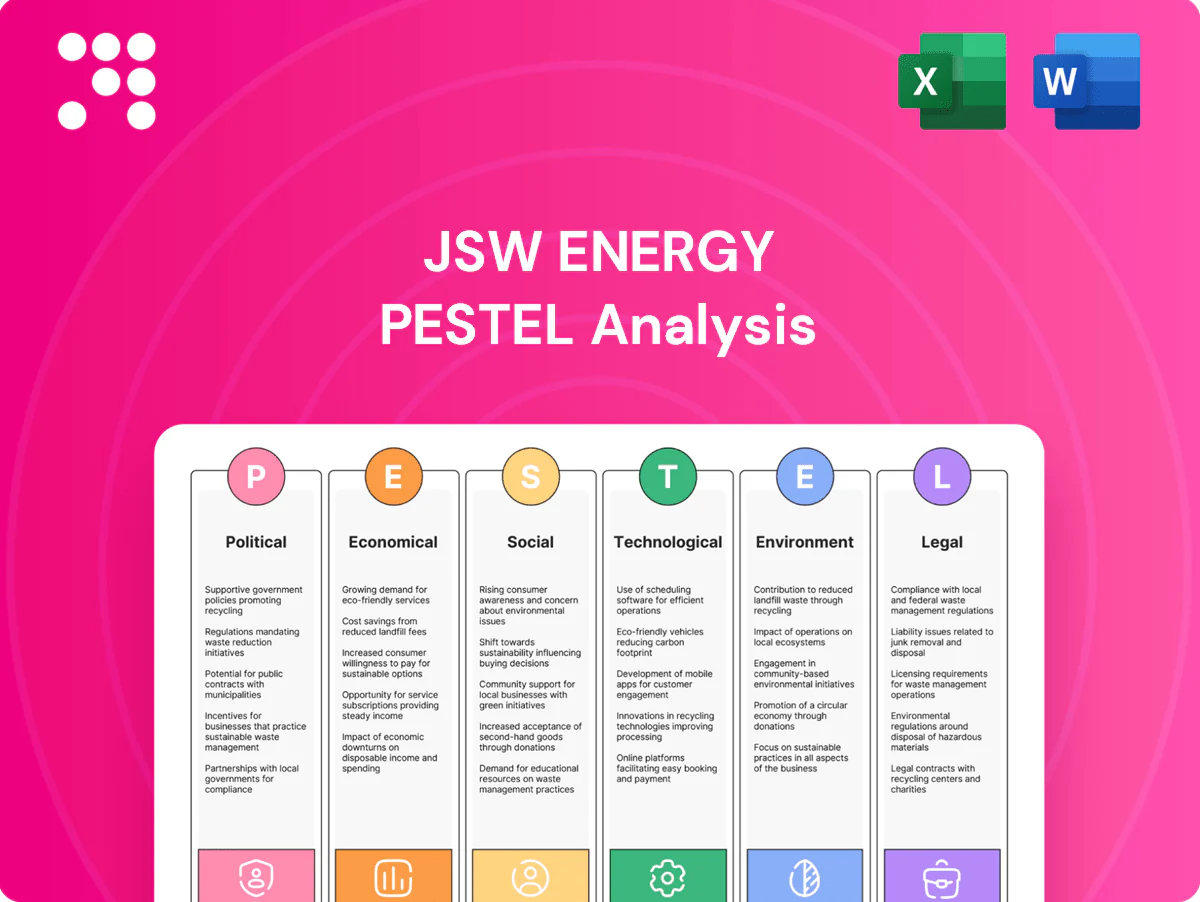
JSW Energy PESTLE Analysis

Plan Smarter. Present Sharper. Compete Stronger.
JSW Energy's PESTLE Analysis reveals how policy shifts, fuel economics, technological innovation, social expectations and environmental regulation converge to reshape its growth trajectory. Gain concise strategic insights and risk signals tailored for investors and planners. Purchase the full PESTLE to access the detailed, actionable breakdown instantly.
Political factors

National energy policy direction
Central energy policies—including the 24x7 power-for-all agenda and India’s 500 GW non-fossil capacity target by 2030—directly steer generation mix, grid expansion and private participation, shaping JSW Energy’s project selection and capex allocation. Priorities on renewables, domestic manufacturing and grid upgrades influence which assets JSW scales versus retires. Close policy alignment unlocks incentives and accelerates clearances, while changes to schemes or budget lines can materially alter project viability.
State-level regulatory dynamics
Power is concurrent under the Electricity Act 2003, so state policies, tariffs and open-access rules differ widely; payment delays by state utilities often exceed 60 days, pressuring generator cash flows and working capital. Political momentum for discom reform or privatization in states such as Gujarat and Rajasthan affects PPA execution and credit risk. JSW Energy must actively manage multi-state stakeholder relations and regulatory compliance to mitigate revenue volatility.

Subsidies and incentives
Capital subsidies and viability gap funding have materially improved JSW Energy project economics, while changes to accelerated depreciation can reduce project IRRs by about 1.5–3.0 percentage points. India's push to reach roughly 500 GW non-fossil capacity by 2030 and firm Renewable Purchase Obligations sustain demand for green power. Withdrawal or redesign of incentives risks slowing pipeline conversions; proactive policy monitoring mitigates volatility.

Fuel security geopolitics
Imported coal and equipment face heightened geopolitical and trade-policy risks that can disrupt supplies and raise FOB prices, while domestic coal allocation and linkage policies directly affect plant load factors and availability; Indian Railways still transports around 70% of coal volumes, so rail/port policy shifts materially change logistics costs and delivered coal economics. JSW Energy mitigates exposure through fuel diversification and hedging strategies.
- Imported coal & equipment: geopolitical/trade risk
- Domestic linkage: impacts PLF and dispatch
- Rail/port policy: drives logistics cost (rail ~70% coal movement)
- Diversification/hedging: lowers supply-price exposure
Elections and governance stability
India's 2024 general election (Apr–May 2024) illustrated how election cycles can delay approvals and procurement; long-gestation power projects (3–5 years) face heightened risk from policy reversal or continuity. Stable governance historically shortens contracting and payment timelines, while rigorous scenario planning (contingency buffers, staged procurement) reduces execution risk for JSW Energy.
- Election delays: approval slippage
- Project horizon: 3–5 years
- Stable gov: faster payments
- Mitigation: scenario planning
24x7 push and 500 GW target reshape capex; tariffs, >60-day discom delays and coal risks
Central 24x7 and 500 GW by 2030 targets steer JSW Energy capex and asset mix; state-level tariffs and >60-day average discom delays pressure cashflow. Election cycles (Apr–May 2024) and trade/geopolitical risks affect coal/equipment supply; rail moves ~70% coal. Policy shifts (e.g., accel. depreciation) can cut IRRs ~1.5–3 ppt; active hedging and stakeholder engagement mitigate risks.
| Metric | Value |
|---|---|
| Non-fossil target | 500 GW by 2030 |
| Discom delays | >60 days |
| Coal rail share | ~70% |
What is included in the product
 Detailed Word Document
Explores how Political, Economic, Social, Technological, Environmental and Legal forces uniquely affect JSW Energy, with data-backed trends and region-specific regulatory context to identify risks and opportunities for executives, investors and strategists.

 Customizable Excel Spreadsheet
A concise, visually segmented PESTLE summary of JSW Energy that highlights regulatory, market and environmental risks for quick inclusion in presentations and team planning, with editable notes for local context.
Economic factors

Power demand growth
Industrialization, data-center buildout and EV adoption have accelerated India's electricity consumption—all-India peak demand crossed 226 GW in 2023–24 per CEA, with system demand growing ~6% y/y, lifting merchant and dispatch opportunities for JSW Energy's ~4.8 GW portfolio. Demand elasticity now materially affects dispatch and merchant realizations. Rising peaks drive storage and peaking capacity investments; accurate forecasting optimizes the thermal/hydro/renewable mix.
Tariffs and merchant prices
Regulated PPAs give JSW Energy predictable cash flows while merchant prices offer upside and higher volatility; balanced contract mix stabilizes earnings. Market coupling and evolving real-time markets affect capture prices and short-term dispatch signals. Tariff pressure from stressed discoms increases renegotiation risk and can compress margins.

Fuel and input cost volatility
Coal, freight and FX swings materially move JSW Energy margins: Newcastle thermal coal averaged about $110/t in 2024 while INR/USD near 83 in H1‑2025 increased imported fuel cost exposure. Domestic linkage quality and lower calorific value can raise station heat rates by ~5–8%, inflating variable costs. Active hedging, coal blending and short/long-term supply contracts (covering majority of needs) help stabilise costs and reduce volatility.

Interest rates and financing
Capex-heavy assets are highly sensitive to cost of capital; India’s policy rate was 6.5% in 2024, raising refinancing costs and reducing project NPVs for JSW Energy as it pursues ~20 GW by 2030; green and ESG-linked loans can cut spreads ~25–75 bps, while strong credit metrics broaden funding access and lower financing premia.
- Policy rate: 6.5% (2024)
- JSW Energy target: ~20 GW by 2030
- ESG loan spread reduction: 25–75 bps
Infrastructure and transmission readiness
Transmission congestion in India constrains offtake and can curtail renewables in pockets, limiting JSW Energy’s ability to dispatch its ~7.8 GW portfolio (FY24) and merchant sales; constrained areas have reported curtailment spikes exceeding 5% during peak flows. Timely grid augmentation and targeted line upgrades unlock capacity additions and reduce system losses, while locational marginal signals increasingly guide site selection. Closer coordination with POSOCO and state DISCOMs reduces curtailment risk and improves utilization.
- Transmission congestion: curtailment spikes >5% in constrained pockets
- JSW Energy capacity: ~7.8 GW (FY24)
- Grid augmentation: unlocks new MWs and merchant revenue
- Coordination with grid operators cuts curtailment risk
24x7 push and 500 GW target reshape capex; tariffs, >60-day discom delays and coal risks
Rising demand (all‑India peak 226 GW in 2023–24; system demand ~6% y/y) boosts merchant/dispatch opportunities for JSW Energy (~7.8 GW FY24) while peaks spur storage and peaking investment. Fuel, freight and FX (Newcastle coal ~$110/t in 2024; INR/USD ~83 H1‑2025) and transmission curtailment (>5% pockets) materially affect margins. Capex sensitivity: policy rate 6.5% (2024) and 20 GW target by 2030 shape financing.
| Metric | Value |
|---|---|
| All‑India peak (2023–24) | 226 GW |
| System demand growth | ~6% y/y |
| JSW Energy capacity (FY24) | ~7.8 GW |
| Target by 2030 | ~20 GW |
| Newcastle coal (2024) | ~$110/t |
| INR/USD (H1‑2025) | ~83 |
| Policy rate (2024) | 6.5% |
| Curtailment spikes | >5% in pockets |
Full Version Awaits
JSW Energy PESTLE Analysis
The preview shown here is the exact JSW Energy PESTLE Analysis document you’ll receive after purchase—fully formatted and ready to use. It includes the complete political, economic, social, technological, legal and environmental assessment with charts and actionable insights. No placeholders or teasers—this is the final file you'll download instantly after payment.

Original: $10.00
-65%$10.00
$3.50Product Information
Product Information
Shipping & Returns
Shipping & Returns
Description
Plan Smarter. Present Sharper. Compete Stronger.
JSW Energy's PESTLE Analysis reveals how policy shifts, fuel economics, technological innovation, social expectations and environmental regulation converge to reshape its growth trajectory. Gain concise strategic insights and risk signals tailored for investors and planners. Purchase the full PESTLE to access the detailed, actionable breakdown instantly.
Political factors
National energy policy direction
Central energy policies—including the 24x7 power-for-all agenda and India’s 500 GW non-fossil capacity target by 2030—directly steer generation mix, grid expansion and private participation, shaping JSW Energy’s project selection and capex allocation. Priorities on renewables, domestic manufacturing and grid upgrades influence which assets JSW scales versus retires. Close policy alignment unlocks incentives and accelerates clearances, while changes to schemes or budget lines can materially alter project viability.
State-level regulatory dynamics
Power is concurrent under the Electricity Act 2003, so state policies, tariffs and open-access rules differ widely; payment delays by state utilities often exceed 60 days, pressuring generator cash flows and working capital. Political momentum for discom reform or privatization in states such as Gujarat and Rajasthan affects PPA execution and credit risk. JSW Energy must actively manage multi-state stakeholder relations and regulatory compliance to mitigate revenue volatility.
Subsidies and incentives
Capital subsidies and viability gap funding have materially improved JSW Energy project economics, while changes to accelerated depreciation can reduce project IRRs by about 1.5–3.0 percentage points. India's push to reach roughly 500 GW non-fossil capacity by 2030 and firm Renewable Purchase Obligations sustain demand for green power. Withdrawal or redesign of incentives risks slowing pipeline conversions; proactive policy monitoring mitigates volatility.
Fuel security geopolitics
Imported coal and equipment face heightened geopolitical and trade-policy risks that can disrupt supplies and raise FOB prices, while domestic coal allocation and linkage policies directly affect plant load factors and availability; Indian Railways still transports around 70% of coal volumes, so rail/port policy shifts materially change logistics costs and delivered coal economics. JSW Energy mitigates exposure through fuel diversification and hedging strategies.
- Imported coal & equipment: geopolitical/trade risk
- Domestic linkage: impacts PLF and dispatch
- Rail/port policy: drives logistics cost (rail ~70% coal movement)
- Diversification/hedging: lowers supply-price exposure
Elections and governance stability
India's 2024 general election (Apr–May 2024) illustrated how election cycles can delay approvals and procurement; long-gestation power projects (3–5 years) face heightened risk from policy reversal or continuity. Stable governance historically shortens contracting and payment timelines, while rigorous scenario planning (contingency buffers, staged procurement) reduces execution risk for JSW Energy.
- Election delays: approval slippage
- Project horizon: 3–5 years
- Stable gov: faster payments
- Mitigation: scenario planning
24x7 push and 500 GW target reshape capex; tariffs, >60-day discom delays and coal risks
Central 24x7 and 500 GW by 2030 targets steer JSW Energy capex and asset mix; state-level tariffs and >60-day average discom delays pressure cashflow. Election cycles (Apr–May 2024) and trade/geopolitical risks affect coal/equipment supply; rail moves ~70% coal. Policy shifts (e.g., accel. depreciation) can cut IRRs ~1.5–3 ppt; active hedging and stakeholder engagement mitigate risks.
| Metric | Value |
|---|---|
| Non-fossil target | 500 GW by 2030 |
| Discom delays | >60 days |
| Coal rail share | ~70% |
What is included in the product
Detailed Word Document
Explores how Political, Economic, Social, Technological, Environmental and Legal forces uniquely affect JSW Energy, with data-backed trends and region-specific regulatory context to identify risks and opportunities for executives, investors and strategists.
Customizable Excel Spreadsheet
A concise, visually segmented PESTLE summary of JSW Energy that highlights regulatory, market and environmental risks for quick inclusion in presentations and team planning, with editable notes for local context.
Economic factors
Power demand growth
Industrialization, data-center buildout and EV adoption have accelerated India's electricity consumption—all-India peak demand crossed 226 GW in 2023–24 per CEA, with system demand growing ~6% y/y, lifting merchant and dispatch opportunities for JSW Energy's ~4.8 GW portfolio. Demand elasticity now materially affects dispatch and merchant realizations. Rising peaks drive storage and peaking capacity investments; accurate forecasting optimizes the thermal/hydro/renewable mix.
Tariffs and merchant prices
Regulated PPAs give JSW Energy predictable cash flows while merchant prices offer upside and higher volatility; balanced contract mix stabilizes earnings. Market coupling and evolving real-time markets affect capture prices and short-term dispatch signals. Tariff pressure from stressed discoms increases renegotiation risk and can compress margins.
Fuel and input cost volatility
Coal, freight and FX swings materially move JSW Energy margins: Newcastle thermal coal averaged about $110/t in 2024 while INR/USD near 83 in H1‑2025 increased imported fuel cost exposure. Domestic linkage quality and lower calorific value can raise station heat rates by ~5–8%, inflating variable costs. Active hedging, coal blending and short/long-term supply contracts (covering majority of needs) help stabilise costs and reduce volatility.
Interest rates and financing
Capex-heavy assets are highly sensitive to cost of capital; India’s policy rate was 6.5% in 2024, raising refinancing costs and reducing project NPVs for JSW Energy as it pursues ~20 GW by 2030; green and ESG-linked loans can cut spreads ~25–75 bps, while strong credit metrics broaden funding access and lower financing premia.
- Policy rate: 6.5% (2024)
- JSW Energy target: ~20 GW by 2030
- ESG loan spread reduction: 25–75 bps
Infrastructure and transmission readiness
Transmission congestion in India constrains offtake and can curtail renewables in pockets, limiting JSW Energy’s ability to dispatch its ~7.8 GW portfolio (FY24) and merchant sales; constrained areas have reported curtailment spikes exceeding 5% during peak flows. Timely grid augmentation and targeted line upgrades unlock capacity additions and reduce system losses, while locational marginal signals increasingly guide site selection. Closer coordination with POSOCO and state DISCOMs reduces curtailment risk and improves utilization.
- Transmission congestion: curtailment spikes >5% in constrained pockets
- JSW Energy capacity: ~7.8 GW (FY24)
- Grid augmentation: unlocks new MWs and merchant revenue
- Coordination with grid operators cuts curtailment risk
24x7 push and 500 GW target reshape capex; tariffs, >60-day discom delays and coal risks
Rising demand (all‑India peak 226 GW in 2023–24; system demand ~6% y/y) boosts merchant/dispatch opportunities for JSW Energy (~7.8 GW FY24) while peaks spur storage and peaking investment. Fuel, freight and FX (Newcastle coal ~$110/t in 2024; INR/USD ~83 H1‑2025) and transmission curtailment (>5% pockets) materially affect margins. Capex sensitivity: policy rate 6.5% (2024) and 20 GW target by 2030 shape financing.
| Metric | Value |
|---|---|
| All‑India peak (2023–24) | 226 GW |
| System demand growth | ~6% y/y |
| JSW Energy capacity (FY24) | ~7.8 GW |
| Target by 2030 | ~20 GW |
| Newcastle coal (2024) | ~$110/t |
| INR/USD (H1‑2025) | ~83 |
| Policy rate (2024) | 6.5% |
| Curtailment spikes | >5% in pockets |
Full Version Awaits
JSW Energy PESTLE Analysis
The preview shown here is the exact JSW Energy PESTLE Analysis document you’ll receive after purchase—fully formatted and ready to use. It includes the complete political, economic, social, technological, legal and environmental assessment with charts and actionable insights. No placeholders or teasers—this is the final file you'll download instantly after payment.