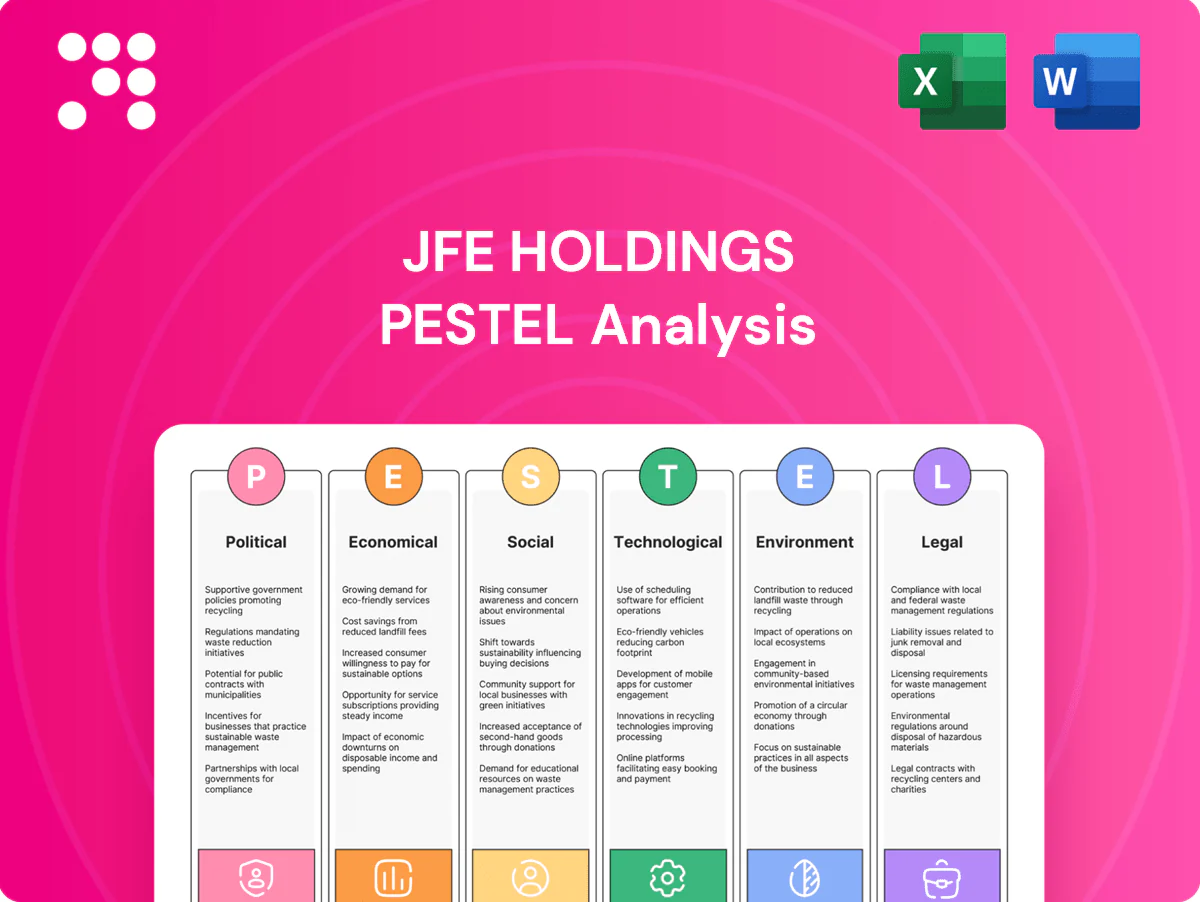
JFE Holdings PESTLE Analysis

Your Shortcut to Market Insight Starts Here
Unpack the external forces shaping JFE Holdings—political shifts, economic cycles, regulatory pressure, social trends, and technological change—and see how they affect strategy and valuation. This concise PESTLE highlights risks and opportunities; buy the full analysis to access the complete, actionable intelligence for investment or strategic use.
Political factors

Trade policy and tariffs
Steel faces cyclical tariff and anti-dumping regimes—notably the US Section 232 steel tariff of 25% since 2018—that can rapidly shift import parity and margins across the US, EU and Asia. JFE must hedge exposure through export mix adjustments, JV localization and flexible pricing to protect margins. Japan’s trade diplomacy via CPTPP (11 members) and RCEP (15 members) supports market access, but bilateral geopolitical frictions can override. Persistent monitoring of quota windows and safeguard reviews is essential.
Geopolitical supply security
Australia and Brazil dominate seaborne iron ore and coking coal supplies (Australia ~37% of global iron ore production in 2023), concentrating geopolitical supply risk for JFE; sanctions or diplomatic strains can disrupt flows and lift working capital and freight costs. JFE’s trading arm and long-term offtakes partially hedge procurement risk. Increased scrap use and HBI investments lower JFE’s dependence on seaborne coking coal.

Industrial policy in Japan
Japan’s industrial policy channels subsidies, tax credits and green financing to strategic materials, decarbonization and energy security—supporting hydrogen trials, CCUS pilots and electric-furnace upgrades for groups like JFE as part of the 2050 net-zero drive and 46% emissions-reduction target by 2030 (vs 2013). Conditional compliance and domestic-content rules influence capital allocation, while alignment with METI roadmaps can speed or delay project timelines.

Infrastructure and defense demand
Government stimulus for resilient infrastructure and national security can lift plate and section demand; Japan raised its defense budget to about ¥6.9 trillion in FY2024, supporting steel-intensive programs. Procurement standards are shifting toward low-carbon steel, altering product mix and CAPEX. Timing of fiscal packages affects mill utilization and JFE Engineering can capture EPC spillovers.
- Defense budget FY2024: ¥6.9 trillion
- Procurement favors low-carbon steel → product mix change
- Fiscal timing drives mill utilization; EPC upside for JFE Engineering
China policy spillovers
China produces roughly 50–52% of global steel (circa 1.0–1.1 billion tonnes annually), so Beijing’s output caps, stimulus measures and export rebate changes materially swing global spreads, rapidly shifting Asian HRC pricing and arbitrage windows; JFE must dynamically balance fixed domestic contract volumes against opportunistic export sales, keeping inventory and freight flexibility to manage policy-driven volatility.
- China share ~50–52% global output
- Policy moves trigger rapid HRC Asian price/arbitrage shifts
- JFE: balance domestic contracts vs exports
- Requires agile inventory & freight to hedge volatility
Tariff shocks, ore concentration and Japan defense spend reshape steel margins and green CAPEX
Tariffs and anti-dumping (eg US Section 232) can swing margins and trade flows; JFE hedges via localization, JV and flexible pricing. Seaborne raw-material concentration (Australia ~37% iron ore 2023) and China steel ~50–52% output drive supply and price risk. Japan policy and FY2024 defense spend (¥6.9 trillion) plus green subsidies shape CAPEX toward low-carbon steel.
| Metric | Value |
|---|---|
| China steel output (2024 est.) | 50–52% |
| Australia iron ore share (2023) | ~37% |
| Japan defense budget FY2024 | ¥6.9 trillion |
What is included in the product
 Detailed Word Document
Explores how Political, Economic, Social, Technological, Environmental and Legal forces uniquely impact JFE Holdings, providing data-backed trends, forward-looking risks and opportunities to inform strategic planning, investor communications and scenario-based decision-making.

 Customizable Excel Spreadsheet
A concise, visually segmented PESTLE summary for JFE Holdings that simplifies external risk assessment and market positioning, easily dropped into presentations or shared across teams for rapid alignment and tailored notes by region or business line.
Economic factors

Global steel cycle
Global steel demand closely follows construction, automotive, machinery and energy capex cycles; global crude steel output was 1,878 Mt in 2023 (World Steel Association). Overcapacity and price competition compress spreads in commodity flats during downturns, so margin resilience at JFE depends on value-added grades and strict cost discipline. Timing of maintenance outages and raw-material restocking often determines cashflow volatility.
Raw material price volatility
Iron ore 62% Fe CFR China averaged about $110/t in 2024–25 and hard coking coal FOB Australia near $220/t, driving large blast furnace cost swings for JFE; index-linked contracts and hedging smooth P&L but basis risk persists. Domestic shredded scrap traded near ¥60,000/t (~$420/t) in 2024, tightening EAF competitiveness. Blending ore/scrap mixes and productivity gains remain primary levers to cut per-ton costs.

FX and interest rates
Yen depreciation (USD/JPY ~155 in mid‑2025) improves JFE export competitiveness but raises imported iron ore and coking coal costs (iron ore ~$110/t July 2025), squeezing margins. Rising JGB yields (~0.8% 10y) and higher corporate borrowing costs make decarbonization retrofits more capital‑intensive and extend payback periods. FX volatility also distorts consolidated earnings via translation of overseas subsidiaries, requiring a balanced currency exposure and funding mix.

Automotive transition
Rising EV adoption (global EV sales exceeded 10 million annually by 2022 and continued growth into 2024) shifts demand toward higher AHSS and electrical steel for motor cores while tightening supply-chain expectations; aluminum and composites drive lightweighting pressure in auto bodies, forcing JFE to commercialize giga-strength steels and motor-core electrical steel; OEM platform cycles (typically 5–7 years) concentrate volume and contract timing risks.
- EV sales >10M (2022) shifting mix to AHSS/electrical steel
- Lightweighting: aluminum/composites press segments
- JFE focus: giga-strength steels, motor core materials
- OEM cycles 5–7 yrs affect contract terms/volume stability
Energy and infrastructure cycles
Offshore wind additions (~16 GW globally in 2024) and rising LNG trade (roughly +3% y/y in 2024) boost demand for plates, pipes and specialty steels for foundations and terminals; grid upgrade programs increase fixed‑asset spending that supports electrical steels. Oil and gas capex recovery lifted tubular demand in 2024 but remains commodity‑price sensitive. Japan’s public works budget (~¥5.8 trillion in 2024) provides steady baseline volumes; shifting project timing dictates mill scheduling and engineering backlog.
- offshore_wind: ~16 GW global additions 2024 supporting foundations/monopiles
- lng: +3% demand 2024, aiding terminals and cryogenic steels
- oil_gas_capex: recovery boosts tubulars but sensitive to oil price swings
- japan_infra: ~¥5.8T public works 2024 gives baseline volumes
- timing: project phasing drives mill schedules & backlog
Tariff shocks, ore concentration and Japan defense spend reshape steel margins and green CAPEX
Global steel demand drives JFE volumes (crude steel 1,878 Mt in 2023) while overcapacity and price competition pressure margins; value‑added grades and cost control are key. Raw materials matter: iron ore ~ $110/t (2024–25) and coking coal ~ $220/t raise BF costs; EAF scrap ~ ¥60,000/t (2024) shifts competitiveness. FX (USD/JPY ~155 mid‑2025) and JGB yields (~0.8% 10y) raise capex/translation risk.
| Metric | Value |
|---|---|
| Crude steel (2023) | 1,878 Mt |
| Iron ore (2024–25) | $110/t |
| USD/JPY (mid‑2025) | ~155 |
Preview Before You Purchase
JFE Holdings PESTLE Analysis
The JFE Holdings PESTLE Analysis preview shown here is the exact document you’ll receive after purchase—fully formatted and ready to use. It covers political, economic, social, technological, legal and environmental factors for JFE in a concise, professional layout. No placeholders or teasers—this is the final file you’ll download.

Product Information
Product Information
Shipping & Returns
Shipping & Returns
Description
Your Shortcut to Market Insight Starts Here
Unpack the external forces shaping JFE Holdings—political shifts, economic cycles, regulatory pressure, social trends, and technological change—and see how they affect strategy and valuation. This concise PESTLE highlights risks and opportunities; buy the full analysis to access the complete, actionable intelligence for investment or strategic use.
Political factors
Trade policy and tariffs
Steel faces cyclical tariff and anti-dumping regimes—notably the US Section 232 steel tariff of 25% since 2018—that can rapidly shift import parity and margins across the US, EU and Asia. JFE must hedge exposure through export mix adjustments, JV localization and flexible pricing to protect margins. Japan’s trade diplomacy via CPTPP (11 members) and RCEP (15 members) supports market access, but bilateral geopolitical frictions can override. Persistent monitoring of quota windows and safeguard reviews is essential.
Geopolitical supply security
Australia and Brazil dominate seaborne iron ore and coking coal supplies (Australia ~37% of global iron ore production in 2023), concentrating geopolitical supply risk for JFE; sanctions or diplomatic strains can disrupt flows and lift working capital and freight costs. JFE’s trading arm and long-term offtakes partially hedge procurement risk. Increased scrap use and HBI investments lower JFE’s dependence on seaborne coking coal.
Industrial policy in Japan
Japan’s industrial policy channels subsidies, tax credits and green financing to strategic materials, decarbonization and energy security—supporting hydrogen trials, CCUS pilots and electric-furnace upgrades for groups like JFE as part of the 2050 net-zero drive and 46% emissions-reduction target by 2030 (vs 2013). Conditional compliance and domestic-content rules influence capital allocation, while alignment with METI roadmaps can speed or delay project timelines.
Infrastructure and defense demand
Government stimulus for resilient infrastructure and national security can lift plate and section demand; Japan raised its defense budget to about ¥6.9 trillion in FY2024, supporting steel-intensive programs. Procurement standards are shifting toward low-carbon steel, altering product mix and CAPEX. Timing of fiscal packages affects mill utilization and JFE Engineering can capture EPC spillovers.
- Defense budget FY2024: ¥6.9 trillion
- Procurement favors low-carbon steel → product mix change
- Fiscal timing drives mill utilization; EPC upside for JFE Engineering
China policy spillovers
China produces roughly 50–52% of global steel (circa 1.0–1.1 billion tonnes annually), so Beijing’s output caps, stimulus measures and export rebate changes materially swing global spreads, rapidly shifting Asian HRC pricing and arbitrage windows; JFE must dynamically balance fixed domestic contract volumes against opportunistic export sales, keeping inventory and freight flexibility to manage policy-driven volatility.
- China share ~50–52% global output
- Policy moves trigger rapid HRC Asian price/arbitrage shifts
- JFE: balance domestic contracts vs exports
- Requires agile inventory & freight to hedge volatility
Tariff shocks, ore concentration and Japan defense spend reshape steel margins and green CAPEX
Tariffs and anti-dumping (eg US Section 232) can swing margins and trade flows; JFE hedges via localization, JV and flexible pricing. Seaborne raw-material concentration (Australia ~37% iron ore 2023) and China steel ~50–52% output drive supply and price risk. Japan policy and FY2024 defense spend (¥6.9 trillion) plus green subsidies shape CAPEX toward low-carbon steel.
| Metric | Value |
|---|---|
| China steel output (2024 est.) | 50–52% |
| Australia iron ore share (2023) | ~37% |
| Japan defense budget FY2024 | ¥6.9 trillion |
What is included in the product
Detailed Word Document
Explores how Political, Economic, Social, Technological, Environmental and Legal forces uniquely impact JFE Holdings, providing data-backed trends, forward-looking risks and opportunities to inform strategic planning, investor communications and scenario-based decision-making.
Customizable Excel Spreadsheet
A concise, visually segmented PESTLE summary for JFE Holdings that simplifies external risk assessment and market positioning, easily dropped into presentations or shared across teams for rapid alignment and tailored notes by region or business line.
Economic factors
Global steel cycle
Global steel demand closely follows construction, automotive, machinery and energy capex cycles; global crude steel output was 1,878 Mt in 2023 (World Steel Association). Overcapacity and price competition compress spreads in commodity flats during downturns, so margin resilience at JFE depends on value-added grades and strict cost discipline. Timing of maintenance outages and raw-material restocking often determines cashflow volatility.
Raw material price volatility
Iron ore 62% Fe CFR China averaged about $110/t in 2024–25 and hard coking coal FOB Australia near $220/t, driving large blast furnace cost swings for JFE; index-linked contracts and hedging smooth P&L but basis risk persists. Domestic shredded scrap traded near ¥60,000/t (~$420/t) in 2024, tightening EAF competitiveness. Blending ore/scrap mixes and productivity gains remain primary levers to cut per-ton costs.
FX and interest rates
Yen depreciation (USD/JPY ~155 in mid‑2025) improves JFE export competitiveness but raises imported iron ore and coking coal costs (iron ore ~$110/t July 2025), squeezing margins. Rising JGB yields (~0.8% 10y) and higher corporate borrowing costs make decarbonization retrofits more capital‑intensive and extend payback periods. FX volatility also distorts consolidated earnings via translation of overseas subsidiaries, requiring a balanced currency exposure and funding mix.
Automotive transition
Rising EV adoption (global EV sales exceeded 10 million annually by 2022 and continued growth into 2024) shifts demand toward higher AHSS and electrical steel for motor cores while tightening supply-chain expectations; aluminum and composites drive lightweighting pressure in auto bodies, forcing JFE to commercialize giga-strength steels and motor-core electrical steel; OEM platform cycles (typically 5–7 years) concentrate volume and contract timing risks.
- EV sales >10M (2022) shifting mix to AHSS/electrical steel
- Lightweighting: aluminum/composites press segments
- JFE focus: giga-strength steels, motor core materials
- OEM cycles 5–7 yrs affect contract terms/volume stability
Energy and infrastructure cycles
Offshore wind additions (~16 GW globally in 2024) and rising LNG trade (roughly +3% y/y in 2024) boost demand for plates, pipes and specialty steels for foundations and terminals; grid upgrade programs increase fixed‑asset spending that supports electrical steels. Oil and gas capex recovery lifted tubular demand in 2024 but remains commodity‑price sensitive. Japan’s public works budget (~¥5.8 trillion in 2024) provides steady baseline volumes; shifting project timing dictates mill scheduling and engineering backlog.
- offshore_wind: ~16 GW global additions 2024 supporting foundations/monopiles
- lng: +3% demand 2024, aiding terminals and cryogenic steels
- oil_gas_capex: recovery boosts tubulars but sensitive to oil price swings
- japan_infra: ~¥5.8T public works 2024 gives baseline volumes
- timing: project phasing drives mill schedules & backlog
Tariff shocks, ore concentration and Japan defense spend reshape steel margins and green CAPEX
Global steel demand drives JFE volumes (crude steel 1,878 Mt in 2023) while overcapacity and price competition pressure margins; value‑added grades and cost control are key. Raw materials matter: iron ore ~ $110/t (2024–25) and coking coal ~ $220/t raise BF costs; EAF scrap ~ ¥60,000/t (2024) shifts competitiveness. FX (USD/JPY ~155 mid‑2025) and JGB yields (~0.8% 10y) raise capex/translation risk.
| Metric | Value |
|---|---|
| Crude steel (2023) | 1,878 Mt |
| Iron ore (2024–25) | $110/t |
| USD/JPY (mid‑2025) | ~155 |
Preview Before You Purchase
JFE Holdings PESTLE Analysis
The JFE Holdings PESTLE Analysis preview shown here is the exact document you’ll receive after purchase—fully formatted and ready to use. It covers political, economic, social, technological, legal and environmental factors for JFE in a concise, professional layout. No placeholders or teasers—this is the final file you’ll download.











