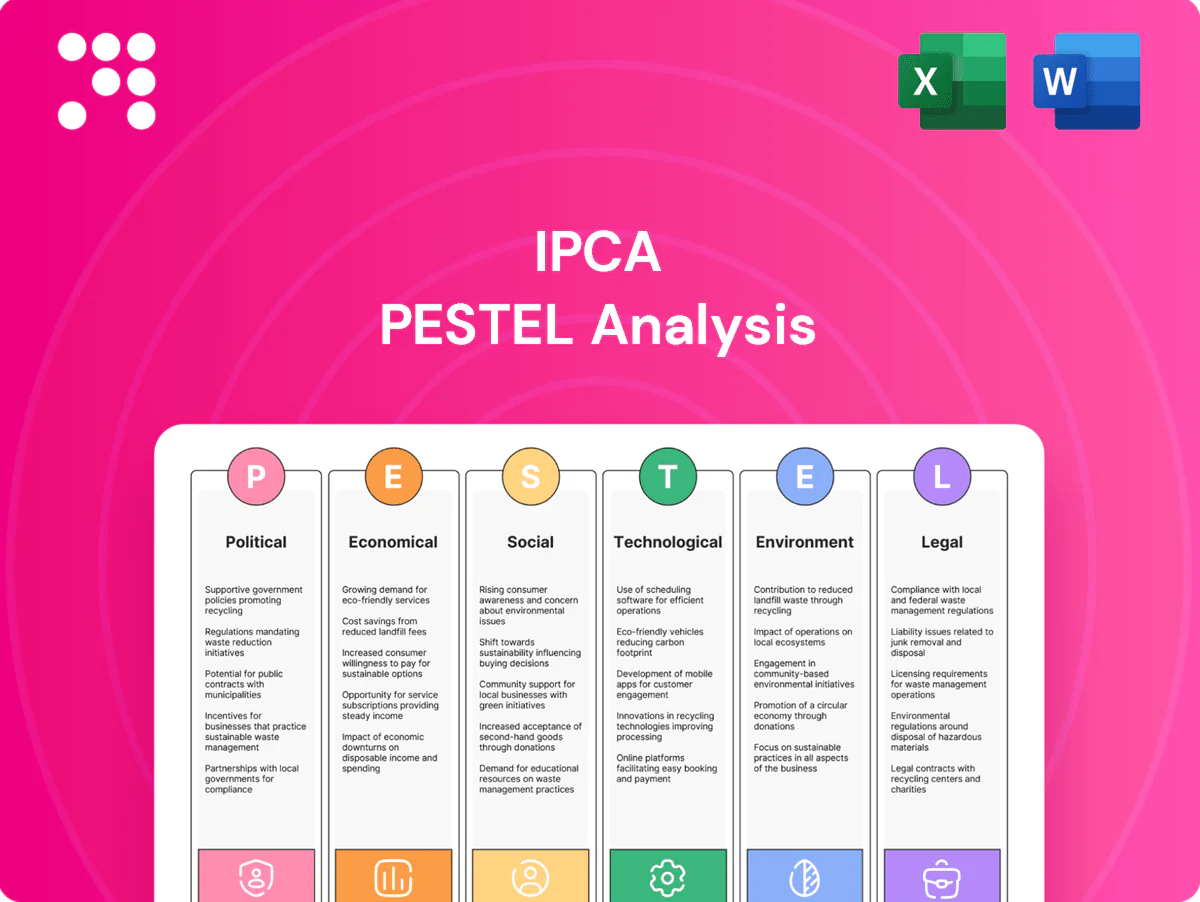
Ipca PESTLE Analysis

Plan Smarter. Present Sharper. Compete Stronger.
Gain a strategic edge with our focused PESTLE Analysis of Ipca—three to five key external forces distilled into actionable insights to inform your investment or strategy. Understand regulatory, economic, and technological risks shaping Ipca’s future. Purchase the full report for the complete, editable deep-dive and make smarter decisions faster.
Political factors

Drug price controls
DPCO caps prices for scheduled formulations (the 2013 order fixed ceiling prices for 348 formulations) and India’s National List of Essential Medicines (NLEM, 2015 list of 376 drugs) can compress margins on key molecules, squeezing generic players including Ipca. Similar price pressure from payers abroad risks spreading to export markets. Ipca must shift product mix, improve plant efficiencies and lower COGS to protect profitability. Proactive engagement with regulators helps anticipate DPCO/NLEM revisions and tender dynamics.
Export and trade policies
Changes in export incentives, customs duties and bilateral trade pacts alter landed costs and market access for Indian pharma; India’s pharma exports were about $24.8bn in FY2023-24, raising stakes for Ipca. Geopolitical tensions that disrupted Red Sea routes in 2023 raised logistics and insurance costs, increasing delivery risk. Ipca’s presence in over 100 countries and stable government ties aid tender wins and regulatory access.

Public health priorities
Government malaria eradication and infectious-disease programs (India aims malaria elimination by 2030) sustain steady demand for antimalarials; WHO reported ~247 million malaria cases and ~619,000 deaths in 2021–22, underscoring volume needs. Multilateral funding (Global Fund replenishment ~$14.25bn in 2022) heavily influences volumes and pricing. Policy shifts toward NCDs can rebalance IPCA’s portfolio, while alignment with public-health goals boosts procurement and brand reputation.

Make-in-India and incentives
Make-in-India production-linked incentives and local sourcing mandates can lower effective capex and push Ipca toward backward integration of APIs/intermediates; India still sources around 70% of APIs from China, so incentives and subsidies for capacity and technology upgrades materially affect Ipca’s expansion and site selection, with policy stability shaping investment timelines.
- PLI reduces capex burden
- Local sourcing → API backward integration
- Subsidies enable capacity & tech upgrades
- Policy stability drives site & timeline decisions
Political stability and governance
Stable governance in India, reinforced by the May 2024 general election that returned a majority government, underpins more predictable regulation and faster approvals for Ipca, though policy shifts remain possible. Elections or coalition changes at state level can still alter healthcare budgets and procurement cycles, affecting timing of tenders. Emerging-market political risk can lengthen receivable cycles from public tenders; strong compliance and stakeholder management lower disruption risk.
- post-2024-election stability
- state-level budget/procurement volatility
- public-tender receivable risk
- importance of compliance & stakeholder engagement
Political shifts reshape India pharma margins: DPCO/NLEM, PLI, $24.8bn exports, 70% APIs from China
Political factors: DPCO/NLEM pricing, PLI and trade policy reshape margins and capex; India pharma exports $24.8bn FY2023-24 and ~70% APIs from China; post-May 2024 electoral stability aids regulatory predictability but state-level budget swings and tender delays persist.
| Metric | Value | Impact |
|---|---|---|
| Pharma exports | $24.8bn FY2023-24 | Export exposure |
What is included in the product
 Detailed Word Document
Explores how Political, Economic, Social, Technological, Environmental and Legal forces uniquely affect Ipca, with data-backed insights and current trends to identify risks and opportunities; designed for executives, consultants and investors, formatted for direct use in plans, decks and scenario planning.

 Customizable Excel Spreadsheet
A concise, visually segmented Ipca PESTLE summary that highlights regulatory, market and operational risks for quick alignment in meetings or slide decks, and allows note-taking for region- or product-specific action planning.
Economic factors

Currency volatility
Ipca's revenue is diversified globally while many costs remain INR- and USD-linked. INR depreciation (USD/INR ~83 in July 2025) can lift export rupee realizations but raises imported input costs. Active hedging, natural offsets and contract pricing clauses sharing FX risk with buyers are critical to protect margins.
API and solvent input costs
Global commodity cycles drive prices of key intermediates and solvents and India sources about 60% of certain chemical intermediates from China, so supply tightness there or logistics shocks (freight spikes exceeded 300% in 2021–22) can compress Ipca’s gross margins. Backward integration and multiple sourcing mitigate exposure by securing captive inputs and alternative suppliers. Inventory strategies must balance holding cost risk against obsolescence and working capital constraints.

Global demand cycles
Macroeconomic slowdowns can curb private market sales while public tenders remain resilient, supported by steady government procurement; global pharma sales hit about 1.6 trillion USD in 2024 (IQVIA), sustaining baseline demand. Healthcare spending is defensive—India spends ~3.3% of GDP on health—buffering volumes. Epidemics or seasonal surges drive short-term spikes; forecast agility and capacity flexibility capture upside and limit stockouts.

Interest rates and capital access
Higher rates elevate borrowing costs for capex and working capital. Pharma capex in quality, ETPs, and automation requires long paybacks. RBI repo rate stood at 6.50% in mid‑2025, increasing financing burdens. Strong cash flows and credit ratings lower IPCA's financing costs; timing investments with rate cycles improves returns.
- Higher rates → higher capex/WC costs
- Pharma capex: long paybacks (quality, ETPs, automation)
- RBI repo 6.50% (mid‑2025)
- Strong cash/ratings reduce funding costs; time with rate cycles
Affordability and payer pressure
- Generics ~70% of volume (India, 2024)
- Tenders prioritize lowest compliant bid → margin compression
- Price cuts reported up to 40% in certain public tenders
- Quality, reliability, compliance drive volume retention
- Value engineering/lean ops deliver single-digit % cost savings
Political shifts reshape India pharma margins: DPCO/NLEM, PLI, $24.8bn exports, 70% APIs from China
Ipca faces INR depreciation (USD/INR ~83 mid‑2025) boosting rupee export realizations but raising imported input costs; hedging and pricing clauses are key. Commodity/China exposure (~60% of some intermediates) and freight volatility threaten margins; backward integration and multi‑sourcing mitigate. Demand resilient (global pharma $1.6T 2024); tender-driven price cuts (up to 40%) compress margins while RBI repo 6.50% raises capex/WC costs.
| Metric | Value |
|---|---|
| USD/INR | ~83 |
| RBI repo | 6.50% |
| Global pharma | $1.6T (2024) |
| Generics (India) | ~70% |
| China sourcing | ~60% |
| Tender cuts | Up to 40% |
Preview Before You Purchase
Ipca PESTLE Analysis
The preview shown here is the exact Ipca PESTLE Analysis document you’ll receive after purchase—fully formatted and ready to use. This is a real screenshot of the product you’re buying with no placeholders or surprises. The layout, content, and structure visible here are exactly what you’ll be able to download immediately after buying.

Original: $10.00
-65%$10.00
$3.50Product Information
Product Information
Shipping & Returns
Shipping & Returns
Description
Plan Smarter. Present Sharper. Compete Stronger.
Gain a strategic edge with our focused PESTLE Analysis of Ipca—three to five key external forces distilled into actionable insights to inform your investment or strategy. Understand regulatory, economic, and technological risks shaping Ipca’s future. Purchase the full report for the complete, editable deep-dive and make smarter decisions faster.
Political factors
Drug price controls
DPCO caps prices for scheduled formulations (the 2013 order fixed ceiling prices for 348 formulations) and India’s National List of Essential Medicines (NLEM, 2015 list of 376 drugs) can compress margins on key molecules, squeezing generic players including Ipca. Similar price pressure from payers abroad risks spreading to export markets. Ipca must shift product mix, improve plant efficiencies and lower COGS to protect profitability. Proactive engagement with regulators helps anticipate DPCO/NLEM revisions and tender dynamics.
Export and trade policies
Changes in export incentives, customs duties and bilateral trade pacts alter landed costs and market access for Indian pharma; India’s pharma exports were about $24.8bn in FY2023-24, raising stakes for Ipca. Geopolitical tensions that disrupted Red Sea routes in 2023 raised logistics and insurance costs, increasing delivery risk. Ipca’s presence in over 100 countries and stable government ties aid tender wins and regulatory access.
Public health priorities
Government malaria eradication and infectious-disease programs (India aims malaria elimination by 2030) sustain steady demand for antimalarials; WHO reported ~247 million malaria cases and ~619,000 deaths in 2021–22, underscoring volume needs. Multilateral funding (Global Fund replenishment ~$14.25bn in 2022) heavily influences volumes and pricing. Policy shifts toward NCDs can rebalance IPCA’s portfolio, while alignment with public-health goals boosts procurement and brand reputation.
Make-in-India and incentives
Make-in-India production-linked incentives and local sourcing mandates can lower effective capex and push Ipca toward backward integration of APIs/intermediates; India still sources around 70% of APIs from China, so incentives and subsidies for capacity and technology upgrades materially affect Ipca’s expansion and site selection, with policy stability shaping investment timelines.
- PLI reduces capex burden
- Local sourcing → API backward integration
- Subsidies enable capacity & tech upgrades
- Policy stability drives site & timeline decisions
Political stability and governance
Stable governance in India, reinforced by the May 2024 general election that returned a majority government, underpins more predictable regulation and faster approvals for Ipca, though policy shifts remain possible. Elections or coalition changes at state level can still alter healthcare budgets and procurement cycles, affecting timing of tenders. Emerging-market political risk can lengthen receivable cycles from public tenders; strong compliance and stakeholder management lower disruption risk.
- post-2024-election stability
- state-level budget/procurement volatility
- public-tender receivable risk
- importance of compliance & stakeholder engagement
Political shifts reshape India pharma margins: DPCO/NLEM, PLI, $24.8bn exports, 70% APIs from China
Political factors: DPCO/NLEM pricing, PLI and trade policy reshape margins and capex; India pharma exports $24.8bn FY2023-24 and ~70% APIs from China; post-May 2024 electoral stability aids regulatory predictability but state-level budget swings and tender delays persist.
| Metric | Value | Impact |
|---|---|---|
| Pharma exports | $24.8bn FY2023-24 | Export exposure |
What is included in the product
Detailed Word Document
Explores how Political, Economic, Social, Technological, Environmental and Legal forces uniquely affect Ipca, with data-backed insights and current trends to identify risks and opportunities; designed for executives, consultants and investors, formatted for direct use in plans, decks and scenario planning.
Customizable Excel Spreadsheet
A concise, visually segmented Ipca PESTLE summary that highlights regulatory, market and operational risks for quick alignment in meetings or slide decks, and allows note-taking for region- or product-specific action planning.
Economic factors
Currency volatility
Ipca's revenue is diversified globally while many costs remain INR- and USD-linked. INR depreciation (USD/INR ~83 in July 2025) can lift export rupee realizations but raises imported input costs. Active hedging, natural offsets and contract pricing clauses sharing FX risk with buyers are critical to protect margins.
API and solvent input costs
Global commodity cycles drive prices of key intermediates and solvents and India sources about 60% of certain chemical intermediates from China, so supply tightness there or logistics shocks (freight spikes exceeded 300% in 2021–22) can compress Ipca’s gross margins. Backward integration and multiple sourcing mitigate exposure by securing captive inputs and alternative suppliers. Inventory strategies must balance holding cost risk against obsolescence and working capital constraints.
Global demand cycles
Macroeconomic slowdowns can curb private market sales while public tenders remain resilient, supported by steady government procurement; global pharma sales hit about 1.6 trillion USD in 2024 (IQVIA), sustaining baseline demand. Healthcare spending is defensive—India spends ~3.3% of GDP on health—buffering volumes. Epidemics or seasonal surges drive short-term spikes; forecast agility and capacity flexibility capture upside and limit stockouts.
Interest rates and capital access
Higher rates elevate borrowing costs for capex and working capital. Pharma capex in quality, ETPs, and automation requires long paybacks. RBI repo rate stood at 6.50% in mid‑2025, increasing financing burdens. Strong cash flows and credit ratings lower IPCA's financing costs; timing investments with rate cycles improves returns.
- Higher rates → higher capex/WC costs
- Pharma capex: long paybacks (quality, ETPs, automation)
- RBI repo 6.50% (mid‑2025)
- Strong cash/ratings reduce funding costs; time with rate cycles
Affordability and payer pressure
- Generics ~70% of volume (India, 2024)
- Tenders prioritize lowest compliant bid → margin compression
- Price cuts reported up to 40% in certain public tenders
- Quality, reliability, compliance drive volume retention
- Value engineering/lean ops deliver single-digit % cost savings
Political shifts reshape India pharma margins: DPCO/NLEM, PLI, $24.8bn exports, 70% APIs from China
Ipca faces INR depreciation (USD/INR ~83 mid‑2025) boosting rupee export realizations but raising imported input costs; hedging and pricing clauses are key. Commodity/China exposure (~60% of some intermediates) and freight volatility threaten margins; backward integration and multi‑sourcing mitigate. Demand resilient (global pharma $1.6T 2024); tender-driven price cuts (up to 40%) compress margins while RBI repo 6.50% raises capex/WC costs.
| Metric | Value |
|---|---|
| USD/INR | ~83 |
| RBI repo | 6.50% |
| Global pharma | $1.6T (2024) |
| Generics (India) | ~70% |
| China sourcing | ~60% |
| Tender cuts | Up to 40% |
Preview Before You Purchase
Ipca PESTLE Analysis
The preview shown here is the exact Ipca PESTLE Analysis document you’ll receive after purchase—fully formatted and ready to use. This is a real screenshot of the product you’re buying with no placeholders or surprises. The layout, content, and structure visible here are exactly what you’ll be able to download immediately after buying.











