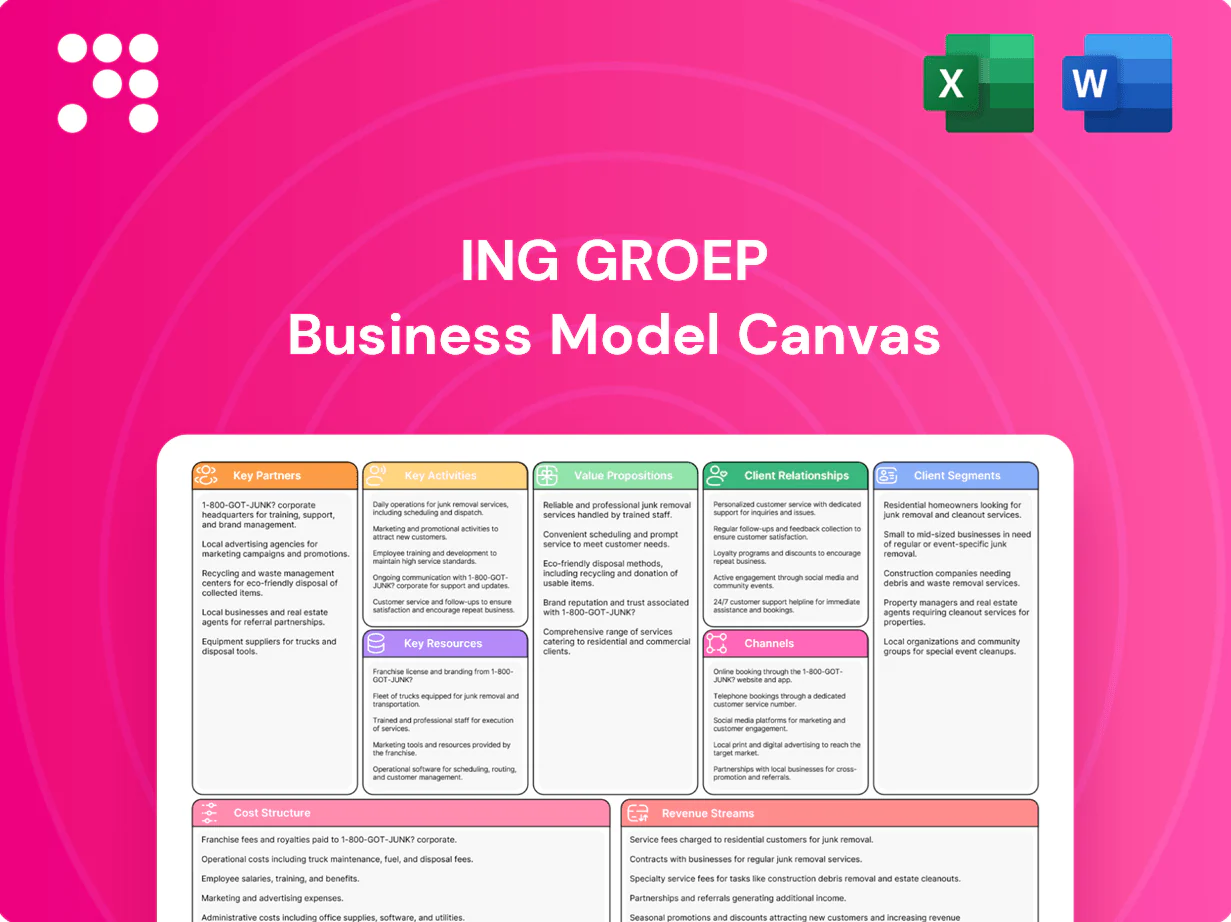
ING Groep Business Model Canvas

Unlock a leading bank's Business Model Canvas: strategic blueprint for digital scale and loyalty
Unlock the full strategic blueprint behind ING Groep’s Business Model Canvas and see how the bank creates value, scales digitally, and secures customer loyalty. This concise, professionally mapped canvas highlights key partners, revenue streams, and cost drivers. Purchase the complete, downloadable version to use in benchmarking, investor decks, or strategy sessions.
Partnerships

Fintech and technology vendors
ING partners with fintechs for payments, onboarding and analytics to accelerate digital features, shortening development cycles and enhancing customer experience across its global footprint in over 40 countries. APIs and co-development enable scalable integration and reuse of services across markets, while risk-sharing agreements and controlled pilots allow efficient testing and scaling of innovations with lower capital exposure. These partnerships help deliver faster rollouts to millions of customers and improve time-to-market for new services.
Payment networks and card schemes
Alliances with Visa and Mastercard, each accepted in over 200 countries and territories, give ING global acceptance and secure rails for card payments. Co-branding, EMVCo tokenization and digital wallets improve trust and convenience for retail customers and SMEs. Interchange and settlement connectivity—subject to EU interchange caps of 0.2% for debit and 0.3% for credit—supports seamless flows. Network rules govern compliance and dispute resolution across ING’s card portfolio.

Cloud and cybersecurity providers
Partnerships with major cloud platforms deliver resilience, elasticity and cost efficiency for ING, which serves 38.7 million customers at end-2023. Security vendors supply threat intelligence, identity and fraud controls integrated into ING operations. Joint architectures and shared roadmaps help meet GDPR and EBA guidelines while driving continuous improvement and high uptime.

Regulators and industry bodies
Constructive engagement with central banks, supervisors and banking associations shapes compliant operations; ING maintained these dialogues across its 40+ markets to support governance and risk frameworks for ~38 million customers in 2024. Participation in PSD2/Open Banking ecosystems broadened service reach and partner integration. Regulatory sandboxes piloted new services safely, reducing time-to-market and compliance risk while enhancing transparency.
- Regulatory dialogue: central banks, supervisors
- PSD2/Open Banking: wider distribution
- Sandboxes: safe pilots, lower compliance risk
- Transparency: strengthened reporting and controls
Corporate and institutional alliances
Corporate and institutional alliances — via treasury, trade and capital markets partnerships — expand ING’s wholesale product suite and distribution, supporting syndications and structured financing for corporates; ING serves about 39 million customers across ~40 markets (2024). Syndicate banks, clearinghouses and custodians enable execution of complex transactions, while co-lending and risk participation improve balance-sheet efficiency and cross-selling widens client access geographically.
- Wholesale expansion: treasury, trade, capital markets
- Execution enablers: syndicates, clearinghouses, custodians
- Balance-sheet: co-lending, risk participation
- Distribution: cross-selling across ~40 markets (39M clients, 2024)
Fintech, cards & cloud speed digital rollout to ~39M in ~40 markets
ING leverages fintechs, card networks and cloud vendors to speed digital rollouts, serving ~39 million customers across ~40 markets (2024). Regulatory engagement, PSD2/Open Banking and sandboxes ensure compliant scaling and lower time-to-market. Wholesale partnerships support syndications, co-lending and treasury services to optimize balance-sheet use.
| Partner | Role | 2024 metric |
|---|---|---|
| Fintechs | API & co-dev | ~39M customers |
| Visa/Mastercard | Payments rails | accepted 200+ countries |
| Cloud/security | Resilience & fraud | global ops (~40 markets) |
What is included in the product
 Detailed Word Document
A comprehensive Business Model Canvas for ING Groep detailing customer segments, value propositions, channels, revenue streams and cost structure across the 9 BMC blocks, with competitive analysis, SWOT-linked insights and practical use for investors and strategists.

 Customizable Excel Spreadsheet
High-level view of ING Groep’s business model with editable cells—quickly identify core banking components, revenue streams and risk drivers to streamline strategic decisions and team collaboration.
Activities

Lending and credit management
Origination, underwriting, pricing and portfolio monitoring drive ING’s retail and corporate lending across a customer lending book of about €540 billion and roughly €1 trillion in total assets (end-2023). Data-driven credit and capital models—fed by digital telemetry—optimize risk-weighted assets and capital allocation. Active collections and restructuring preserve asset quality through cycles while continuous product tuning aligns pricing with rate and regulatory shifts.
Deposit gathering and cash management
Acquiring and retaining deposits provides ING with stable, low‑cost funding—over €600 billion in customer deposits reported in 2024—supporting lending and balance sheet resilience. Cash and liquidity services target consumers, SMEs and corporates through payments, treasury and working‑capital products. Active interest‑rate management optimises net interest margin while preserving customer value. Digital features (mobile/web) increase stickiness and cut servicing costs.

Payments and transaction services
Processing card, instant and cross-border payments at scale is core to daily engagement—ING serves about 38 million customers and processes millions of transactions daily. API-based payment services integrate with client ERPs and platforms to enable straight-through processing. Robust fraud detection and dispute handling protect trust. Continuous uptime and transaction speed are monitored as critical KPIs.

Digital platform development
Digital platform development at ING drives mobile and web banking design, engineering and DevOps to realise the digital-bank ambition across ~40 countries and about 58 million customers (2024); personalization engines and data analytics boost UX and conversion while Open Banking APIs enable ecosystem plays; Agile delivery shortens feature rollout cycles and improves resiliency.
- Mobile/web design & DevOps
- Personalization & analytics
- Open Banking APIs
- Agile delivery & resiliency
Risk, compliance, and capital management
ING maintains comprehensive credit, market, liquidity and operational risk frameworks to protect the franchise, supported by a reported CET1 ratio of 15.0% at year-end 2024 and active ALM to optimize ROE within Basel and local rules. AML/KYC and sanctions controls meet global standards and are continuously updated; capital planning, stress testing and recovery planning — including regular bank-wide scenario tests in 2024 — ensure durability.
- Credit risk coverage and limits
- Market & liquidity contingency plans
- AML/KYC and sanctions controls
- Capital planning, ALM, CET1 15.0% (YE2024)
- Stress testing & recovery planning
Digital bank: €600bn deposits, 58m customers
Origination, underwriting, pricing and portfolio monitoring run ING’s lending (≈€540bn book, ~€1.0tn total assets). Deposits (~€600bn in 2024) fund lending and liquidity; digital channels and payments drive engagement (≈58m customers). Risk, ALM and capital planning preserve franchise (CET1 15.0% YE2024).
| Metric | Value |
|---|---|
| Customers | 58m (2024) |
| Customer deposits | €600bn (2024) |
| Total assets | ≈€1.0tn |
| Lending book | €540bn (end-2023) |
| CET1 | 15.0% (YE2024) |
Full Version Awaits
Business Model Canvas
The document you're previewing is the exact ING Groep Business Model Canvas you’ll receive after purchase. It’s not a sample or mockup—this live preview reflects the full deliverable with the same structure, content, and formatting. After ordering you’ll download the identical file, ready to edit, present, or integrate into your strategic work.

Product Information
Product Information
Shipping & Returns
Shipping & Returns
Description
Unlock a leading bank's Business Model Canvas: strategic blueprint for digital scale and loyalty
Unlock the full strategic blueprint behind ING Groep’s Business Model Canvas and see how the bank creates value, scales digitally, and secures customer loyalty. This concise, professionally mapped canvas highlights key partners, revenue streams, and cost drivers. Purchase the complete, downloadable version to use in benchmarking, investor decks, or strategy sessions.
Partnerships
Fintech and technology vendors
ING partners with fintechs for payments, onboarding and analytics to accelerate digital features, shortening development cycles and enhancing customer experience across its global footprint in over 40 countries. APIs and co-development enable scalable integration and reuse of services across markets, while risk-sharing agreements and controlled pilots allow efficient testing and scaling of innovations with lower capital exposure. These partnerships help deliver faster rollouts to millions of customers and improve time-to-market for new services.
Payment networks and card schemes
Alliances with Visa and Mastercard, each accepted in over 200 countries and territories, give ING global acceptance and secure rails for card payments. Co-branding, EMVCo tokenization and digital wallets improve trust and convenience for retail customers and SMEs. Interchange and settlement connectivity—subject to EU interchange caps of 0.2% for debit and 0.3% for credit—supports seamless flows. Network rules govern compliance and dispute resolution across ING’s card portfolio.
Cloud and cybersecurity providers
Partnerships with major cloud platforms deliver resilience, elasticity and cost efficiency for ING, which serves 38.7 million customers at end-2023. Security vendors supply threat intelligence, identity and fraud controls integrated into ING operations. Joint architectures and shared roadmaps help meet GDPR and EBA guidelines while driving continuous improvement and high uptime.
Regulators and industry bodies
Constructive engagement with central banks, supervisors and banking associations shapes compliant operations; ING maintained these dialogues across its 40+ markets to support governance and risk frameworks for ~38 million customers in 2024. Participation in PSD2/Open Banking ecosystems broadened service reach and partner integration. Regulatory sandboxes piloted new services safely, reducing time-to-market and compliance risk while enhancing transparency.
- Regulatory dialogue: central banks, supervisors
- PSD2/Open Banking: wider distribution
- Sandboxes: safe pilots, lower compliance risk
- Transparency: strengthened reporting and controls
Corporate and institutional alliances
Corporate and institutional alliances — via treasury, trade and capital markets partnerships — expand ING’s wholesale product suite and distribution, supporting syndications and structured financing for corporates; ING serves about 39 million customers across ~40 markets (2024). Syndicate banks, clearinghouses and custodians enable execution of complex transactions, while co-lending and risk participation improve balance-sheet efficiency and cross-selling widens client access geographically.
- Wholesale expansion: treasury, trade, capital markets
- Execution enablers: syndicates, clearinghouses, custodians
- Balance-sheet: co-lending, risk participation
- Distribution: cross-selling across ~40 markets (39M clients, 2024)
Fintech, cards & cloud speed digital rollout to ~39M in ~40 markets
ING leverages fintechs, card networks and cloud vendors to speed digital rollouts, serving ~39 million customers across ~40 markets (2024). Regulatory engagement, PSD2/Open Banking and sandboxes ensure compliant scaling and lower time-to-market. Wholesale partnerships support syndications, co-lending and treasury services to optimize balance-sheet use.
| Partner | Role | 2024 metric |
|---|---|---|
| Fintechs | API & co-dev | ~39M customers |
| Visa/Mastercard | Payments rails | accepted 200+ countries |
| Cloud/security | Resilience & fraud | global ops (~40 markets) |
What is included in the product
Detailed Word Document
A comprehensive Business Model Canvas for ING Groep detailing customer segments, value propositions, channels, revenue streams and cost structure across the 9 BMC blocks, with competitive analysis, SWOT-linked insights and practical use for investors and strategists.
Customizable Excel Spreadsheet
High-level view of ING Groep’s business model with editable cells—quickly identify core banking components, revenue streams and risk drivers to streamline strategic decisions and team collaboration.
Activities
Lending and credit management
Origination, underwriting, pricing and portfolio monitoring drive ING’s retail and corporate lending across a customer lending book of about €540 billion and roughly €1 trillion in total assets (end-2023). Data-driven credit and capital models—fed by digital telemetry—optimize risk-weighted assets and capital allocation. Active collections and restructuring preserve asset quality through cycles while continuous product tuning aligns pricing with rate and regulatory shifts.
Deposit gathering and cash management
Acquiring and retaining deposits provides ING with stable, low‑cost funding—over €600 billion in customer deposits reported in 2024—supporting lending and balance sheet resilience. Cash and liquidity services target consumers, SMEs and corporates through payments, treasury and working‑capital products. Active interest‑rate management optimises net interest margin while preserving customer value. Digital features (mobile/web) increase stickiness and cut servicing costs.
Payments and transaction services
Processing card, instant and cross-border payments at scale is core to daily engagement—ING serves about 38 million customers and processes millions of transactions daily. API-based payment services integrate with client ERPs and platforms to enable straight-through processing. Robust fraud detection and dispute handling protect trust. Continuous uptime and transaction speed are monitored as critical KPIs.
Digital platform development
Digital platform development at ING drives mobile and web banking design, engineering and DevOps to realise the digital-bank ambition across ~40 countries and about 58 million customers (2024); personalization engines and data analytics boost UX and conversion while Open Banking APIs enable ecosystem plays; Agile delivery shortens feature rollout cycles and improves resiliency.
- Mobile/web design & DevOps
- Personalization & analytics
- Open Banking APIs
- Agile delivery & resiliency
Risk, compliance, and capital management
ING maintains comprehensive credit, market, liquidity and operational risk frameworks to protect the franchise, supported by a reported CET1 ratio of 15.0% at year-end 2024 and active ALM to optimize ROE within Basel and local rules. AML/KYC and sanctions controls meet global standards and are continuously updated; capital planning, stress testing and recovery planning — including regular bank-wide scenario tests in 2024 — ensure durability.
- Credit risk coverage and limits
- Market & liquidity contingency plans
- AML/KYC and sanctions controls
- Capital planning, ALM, CET1 15.0% (YE2024)
- Stress testing & recovery planning
Digital bank: €600bn deposits, 58m customers
Origination, underwriting, pricing and portfolio monitoring run ING’s lending (≈€540bn book, ~€1.0tn total assets). Deposits (~€600bn in 2024) fund lending and liquidity; digital channels and payments drive engagement (≈58m customers). Risk, ALM and capital planning preserve franchise (CET1 15.0% YE2024).
| Metric | Value |
|---|---|
| Customers | 58m (2024) |
| Customer deposits | €600bn (2024) |
| Total assets | ≈€1.0tn |
| Lending book | €540bn (end-2023) |
| CET1 | 15.0% (YE2024) |
Full Version Awaits
Business Model Canvas
The document you're previewing is the exact ING Groep Business Model Canvas you’ll receive after purchase. It’s not a sample or mockup—this live preview reflects the full deliverable with the same structure, content, and formatting. After ordering you’ll download the identical file, ready to edit, present, or integrate into your strategic work.