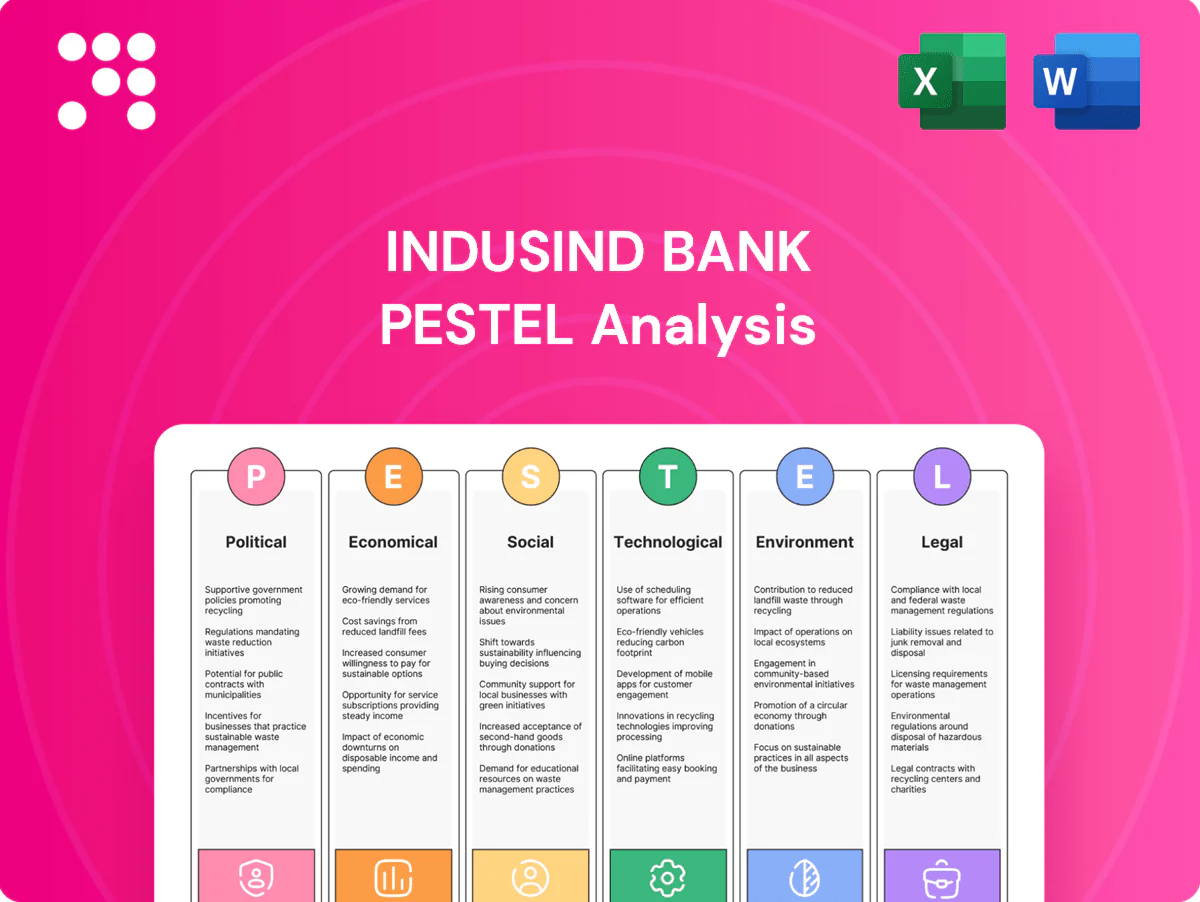
IndusInd Bank PESTLE Analysis

Plan Smarter. Present Sharper. Compete Stronger.
Unlock how political shifts, economic cycles, and tech disruption are shaping IndusInd Bank’s strategic options in our concise PESTLE overview; we map regulatory risks, market opportunities and societal trends to actionable insights. Purchase the full PESTLE to get the complete, editable analysis and stay ahead.
Political factors

RBI policy direction and governance
RBI monetary and regulatory stance—repo rate at 6.5% and CRR 4.5%—directly shapes IndusInd Bank’s capital, liquidity and lending norms, affecting funding costs and loan pricing. Adjustments to priority sector lending targets shift portfolio mix toward agriculture and microcredit, influencing credit allocation and provisioning. Rising governance expectations from RBI push stronger board composition and enhanced risk frameworks, while policy stability supports predictable growth.
Government financial inclusion push
National schemes—PMJDY with over 50 crore accounts and deposits >INR 1.5 lakh crore, DBT rollouts and PM SVANidhi (over 80 lakh loans disbursed)—have expanded low-cost accounts and small-ticket credit demand. Partnerships with government agencies can boost IndusInd Bank’s CASA and fee income (CASA ~44% in FY24). Compliance with scheme processes raises operational complexity, while intense competition for subsidized segments pressures margins.

Public sector dominance and policy lending
Public sector banks traditionally channel government-directed lending, driven by the RBI-mandated priority sector lending target of 40% of adjusted net bank credit, which shapes pricing and market share dynamics. Private banks like IndusInd must balance profitability with alignment to such policy goals, often absorbing lower-yield loans to meet national priorities. Political shifts that redirect credit to specific sectors raise risk-weighted assets and provisioning, pressuring capital ratios and margins.

Election cycles and spending priorities
Election cycles (Apr–May 2024) shift fiscal choices that influenced 2024–25 bank credit growth and asset quality; pre-election spending lifted demand while post-election consolidation eased stress on NPAs. Elevated infrastructure capex (budgeted ~Rs 11 lakh crore for 2024–25) expanded corporate lending pipelines. Populist measures delayed some reforms, raising concentration risks; policy continuity lowers planning volatility for IndusInd Bank.
- Election: Apr–May 2024
- Capex: ~Rs 11 lakh crore (2024–25)
- Risk: reform delays increase borrower stress
- Benefit: continuity reduces volatility
Geopolitical and trade dynamics
Geopolitical tensions and trade frictions tightened capital flows in 2024, with WTO reporting only about 1% global goods trade growth and India holding roughly $600 billion in forex reserves mid-2024, amplifying currency and inflation transmission risks for IndusInd Bank’s balance sheet. Exporters/importers demand greater liquidity and currency hedges, while sanctions regimes increase transaction screening and compliance costs, raising treasury and ALM significance.
- Liquidity stress for trade clients
- Hedging demand up—FX exposure management
- Heightened sanctions screening/compliance
- Stronger treasury/ALM oversight required
RBI 6.5% repo, CRR 4.5% and 40% priority rule shape funding; PMJDY, capex lift credit demand
RBI stance (repo 6.5%, CRR 4.5%) and priority sector rules (40%) shape funding, pricing and provisioning for IndusInd (CASA ~44% FY24). PMJDY (50 crore accounts, deposits ~INR 1.5 lakh crore) and DBT expand low-cost funding but raise operations load. Apr–May 2024 elections and Rs 11 lakh crore capex (2024–25) drive credit demand; FX/geo risks persist with forex ~USD 600bn mid-2024.
| Factor | 2024/25 data | Impact |
|---|---|---|
| Macro policy | Repo 6.5%, CRR 4.5% | Higher funding cost |
| Government schemes | PMJDY: 50 crore; INR1.5L cr | CASA, fee income |
| Fiscal | Capex Rs11L cr | Corp lending up |
What is included in the product
 Detailed Word Document
Explores how macro-environmental factors uniquely affect IndusInd Bank across Political, Economic, Social, Technological, Environmental and Legal dimensions, with data-backed insights and forward-looking implications to help executives, consultants and investors identify risks, opportunities and strategic actions.

 Customizable Excel Spreadsheet
Visually segmented PESTLE for IndusInd Bank, offering a concise, editable summary that relieves analysis overload and can be dropped into presentations or strategic folders. Ideal for quick alignment across teams, supporting external risk discussions and client-ready consultant reports.
Economic factors

GDP growth and credit demand
India GDP expanded 7.2% in FY2023-24 while scheduled commercial bank credit grew about 17% YoY in 2024, amplifying retail, MSME and corporate loan demand for IndusInd Bank. Economic slowdowns tend to raise delinquencies and compress fee income, stressing provisioning and NIMs. Sectoral cycles in real estate, auto and infra require dynamic, tranche-wise underwriting. Broad portfolio diversification mitigates concentration and idiosyncratic risk.
Interest rate and liquidity cycle
RBI policy rate at 6.50% (July 2025) directly alters IndusInd Bank’s NIM via asset-liability repricing as loans reprice faster than low-cost deposits. Tight liquidity and deposit competition have pushed term deposit rates toward the 7%+ band, pressuring funding costs. Rate volatility and rising 10Y G-sec yields (~7.3% mid‑2025) increase treasury MTM and VaR risk, making robust ALM essential for stability.

Inflation and consumer affordability
High inflation (CPI broadly hovering around 5–6% in 2024–25 versus the RBI 4% target) compresses disposable income and shifts savings to essentials, damping discretionary loans and card spends—card transaction growth eased to low single digits in FY24. Rising wage and tech costs push operating expense ratios higher for IndusInd Bank, making pricing discipline and tight cost control pivotal to protect margins.

NBFC and fintech competition
NBFCs and fintechs increasingly compress yields in retail and SME niches; NBFC assets were around Rs 31 trillion by FY24, intensifying competition for IndusInd Bank in unsecured segments. Co-lending and partnerships expand reach but introduce coordination and credit‑allocation risk. Fast onboarding and UX (sub-10 minute digital journeys common) raise customer expectations; differentiation hinges on superior risk analytics and service quality.
- NBFCs share: ~17–18% of credit (RBI, 2024)
- NBFC assets: ~Rs 31 trillion (FY24)
- Onboarding benchmark: sub-10 minute digital journeys
- Key edge: advanced risk analytics + differentiated service
Employment and income formalization
Rising formal wages and expanding EPFO coverage (around 25 crore subscribers in 2024) improve underwriting via richer payroll and tax records, while the gig economy—estimated at 77 million workers—requires tailored products and alternative risk models; regional income disparities force localized pricing and branch-digital mixes, and cross-sell opportunities grow as household incomes rise, boosting wallet share for IndusInd.
- Formal payroll data: stronger underwriting
- Gig workers: 77 million — need bespoke products
- Regional gaps: localized strategies
- Cross-sell: higher ARPU as incomes grow
RBI 6.5% repo, CRR 4.5% and 40% priority rule shape funding; PMJDY, capex lift credit demand
India GDP 7.2% FY24 and bank credit +17% YoY (2024) boost loan demand for IndusInd; RBI policy rate 6.50% (Jul 2025) and 10Y G-sec ~7.3% raise funding and MTM risk. Inflation ~5–6% (2024–25) compresses discretionary spending; NBFC assets ~Rs31tn (FY24) heighten retail competition. EPFO ~25 crore, gig ~77m expand addressable market but require tailored underwriting.
| Indicator | Value |
|---|---|
| GDP | 7.2% FY24 |
| Bank credit | +17% YoY (2024) |
| RBI rate | 6.50% (Jul 2025) |
| 10Y G-sec | ~7.3% mid‑2025 |
| Inflation | 5–6% (2024–25) |
| NBFC assets | ~Rs31tn FY24 |
| EPFO | ~25 crore |
| Gig workers | ~77 million |
Preview the Actual Deliverable
IndusInd Bank PESTLE Analysis
The IndusInd Bank PESTLE Analysis preview shown here is the exact document you’ll receive after purchase—fully formatted and ready to use. This is the final, professionally structured file with no placeholders. The layout, content, and structure visible here are exactly what you’ll download immediately after payment.

Product Information
Product Information
Shipping & Returns
Shipping & Returns
Description
Plan Smarter. Present Sharper. Compete Stronger.
Unlock how political shifts, economic cycles, and tech disruption are shaping IndusInd Bank’s strategic options in our concise PESTLE overview; we map regulatory risks, market opportunities and societal trends to actionable insights. Purchase the full PESTLE to get the complete, editable analysis and stay ahead.
Political factors
RBI policy direction and governance
RBI monetary and regulatory stance—repo rate at 6.5% and CRR 4.5%—directly shapes IndusInd Bank’s capital, liquidity and lending norms, affecting funding costs and loan pricing. Adjustments to priority sector lending targets shift portfolio mix toward agriculture and microcredit, influencing credit allocation and provisioning. Rising governance expectations from RBI push stronger board composition and enhanced risk frameworks, while policy stability supports predictable growth.
Government financial inclusion push
National schemes—PMJDY with over 50 crore accounts and deposits >INR 1.5 lakh crore, DBT rollouts and PM SVANidhi (over 80 lakh loans disbursed)—have expanded low-cost accounts and small-ticket credit demand. Partnerships with government agencies can boost IndusInd Bank’s CASA and fee income (CASA ~44% in FY24). Compliance with scheme processes raises operational complexity, while intense competition for subsidized segments pressures margins.
Public sector dominance and policy lending
Public sector banks traditionally channel government-directed lending, driven by the RBI-mandated priority sector lending target of 40% of adjusted net bank credit, which shapes pricing and market share dynamics. Private banks like IndusInd must balance profitability with alignment to such policy goals, often absorbing lower-yield loans to meet national priorities. Political shifts that redirect credit to specific sectors raise risk-weighted assets and provisioning, pressuring capital ratios and margins.
Election cycles and spending priorities
Election cycles (Apr–May 2024) shift fiscal choices that influenced 2024–25 bank credit growth and asset quality; pre-election spending lifted demand while post-election consolidation eased stress on NPAs. Elevated infrastructure capex (budgeted ~Rs 11 lakh crore for 2024–25) expanded corporate lending pipelines. Populist measures delayed some reforms, raising concentration risks; policy continuity lowers planning volatility for IndusInd Bank.
- Election: Apr–May 2024
- Capex: ~Rs 11 lakh crore (2024–25)
- Risk: reform delays increase borrower stress
- Benefit: continuity reduces volatility
Geopolitical and trade dynamics
Geopolitical tensions and trade frictions tightened capital flows in 2024, with WTO reporting only about 1% global goods trade growth and India holding roughly $600 billion in forex reserves mid-2024, amplifying currency and inflation transmission risks for IndusInd Bank’s balance sheet. Exporters/importers demand greater liquidity and currency hedges, while sanctions regimes increase transaction screening and compliance costs, raising treasury and ALM significance.
- Liquidity stress for trade clients
- Hedging demand up—FX exposure management
- Heightened sanctions screening/compliance
- Stronger treasury/ALM oversight required
RBI 6.5% repo, CRR 4.5% and 40% priority rule shape funding; PMJDY, capex lift credit demand
RBI stance (repo 6.5%, CRR 4.5%) and priority sector rules (40%) shape funding, pricing and provisioning for IndusInd (CASA ~44% FY24). PMJDY (50 crore accounts, deposits ~INR 1.5 lakh crore) and DBT expand low-cost funding but raise operations load. Apr–May 2024 elections and Rs 11 lakh crore capex (2024–25) drive credit demand; FX/geo risks persist with forex ~USD 600bn mid-2024.
| Factor | 2024/25 data | Impact |
|---|---|---|
| Macro policy | Repo 6.5%, CRR 4.5% | Higher funding cost |
| Government schemes | PMJDY: 50 crore; INR1.5L cr | CASA, fee income |
| Fiscal | Capex Rs11L cr | Corp lending up |
What is included in the product
Detailed Word Document
Explores how macro-environmental factors uniquely affect IndusInd Bank across Political, Economic, Social, Technological, Environmental and Legal dimensions, with data-backed insights and forward-looking implications to help executives, consultants and investors identify risks, opportunities and strategic actions.
Customizable Excel Spreadsheet
Visually segmented PESTLE for IndusInd Bank, offering a concise, editable summary that relieves analysis overload and can be dropped into presentations or strategic folders. Ideal for quick alignment across teams, supporting external risk discussions and client-ready consultant reports.
Economic factors
GDP growth and credit demand
India GDP expanded 7.2% in FY2023-24 while scheduled commercial bank credit grew about 17% YoY in 2024, amplifying retail, MSME and corporate loan demand for IndusInd Bank. Economic slowdowns tend to raise delinquencies and compress fee income, stressing provisioning and NIMs. Sectoral cycles in real estate, auto and infra require dynamic, tranche-wise underwriting. Broad portfolio diversification mitigates concentration and idiosyncratic risk.
Interest rate and liquidity cycle
RBI policy rate at 6.50% (July 2025) directly alters IndusInd Bank’s NIM via asset-liability repricing as loans reprice faster than low-cost deposits. Tight liquidity and deposit competition have pushed term deposit rates toward the 7%+ band, pressuring funding costs. Rate volatility and rising 10Y G-sec yields (~7.3% mid‑2025) increase treasury MTM and VaR risk, making robust ALM essential for stability.
Inflation and consumer affordability
High inflation (CPI broadly hovering around 5–6% in 2024–25 versus the RBI 4% target) compresses disposable income and shifts savings to essentials, damping discretionary loans and card spends—card transaction growth eased to low single digits in FY24. Rising wage and tech costs push operating expense ratios higher for IndusInd Bank, making pricing discipline and tight cost control pivotal to protect margins.
NBFC and fintech competition
NBFCs and fintechs increasingly compress yields in retail and SME niches; NBFC assets were around Rs 31 trillion by FY24, intensifying competition for IndusInd Bank in unsecured segments. Co-lending and partnerships expand reach but introduce coordination and credit‑allocation risk. Fast onboarding and UX (sub-10 minute digital journeys common) raise customer expectations; differentiation hinges on superior risk analytics and service quality.
- NBFCs share: ~17–18% of credit (RBI, 2024)
- NBFC assets: ~Rs 31 trillion (FY24)
- Onboarding benchmark: sub-10 minute digital journeys
- Key edge: advanced risk analytics + differentiated service
Employment and income formalization
Rising formal wages and expanding EPFO coverage (around 25 crore subscribers in 2024) improve underwriting via richer payroll and tax records, while the gig economy—estimated at 77 million workers—requires tailored products and alternative risk models; regional income disparities force localized pricing and branch-digital mixes, and cross-sell opportunities grow as household incomes rise, boosting wallet share for IndusInd.
- Formal payroll data: stronger underwriting
- Gig workers: 77 million — need bespoke products
- Regional gaps: localized strategies
- Cross-sell: higher ARPU as incomes grow
RBI 6.5% repo, CRR 4.5% and 40% priority rule shape funding; PMJDY, capex lift credit demand
India GDP 7.2% FY24 and bank credit +17% YoY (2024) boost loan demand for IndusInd; RBI policy rate 6.50% (Jul 2025) and 10Y G-sec ~7.3% raise funding and MTM risk. Inflation ~5–6% (2024–25) compresses discretionary spending; NBFC assets ~Rs31tn (FY24) heighten retail competition. EPFO ~25 crore, gig ~77m expand addressable market but require tailored underwriting.
| Indicator | Value |
|---|---|
| GDP | 7.2% FY24 |
| Bank credit | +17% YoY (2024) |
| RBI rate | 6.50% (Jul 2025) |
| 10Y G-sec | ~7.3% mid‑2025 |
| Inflation | 5–6% (2024–25) |
| NBFC assets | ~Rs31tn FY24 |
| EPFO | ~25 crore |
| Gig workers | ~77 million |
Preview the Actual Deliverable
IndusInd Bank PESTLE Analysis
The IndusInd Bank PESTLE Analysis preview shown here is the exact document you’ll receive after purchase—fully formatted and ready to use. This is the final, professionally structured file with no placeholders. The layout, content, and structure visible here are exactly what you’ll download immediately after payment.