Dada Nexus PESTLE Analysis

Your Shortcut to Market Insight Starts Here
Our PESTLE Analysis of Dada Nexus reveals how political shifts, economic trends, social dynamics, and tech disruption shape its strategic outlook. Ideal for investors and strategists, it translates external forces into actionable risks and opportunities. Purchase the full report for the complete, downloadable breakdown and ready-to-use insights.
Political factors

Platform-economy oversight
Chinese authorities closely supervise large internet platforms to enforce fair competition and labor protections; e.g., Alibaba was fined 18.2 billion RMB in 2021 for antitrust breaches. Dada Now and JDDJ must align operations with shifting directives on pricing, dispatching, and merchant practices, which raises compliance costs and operational complexity. Heightened scrutiny can curb predatory rivals, while proactive engagement with regulators can mitigate sudden shocks.
Digital economy promotion
Beijing and local governments push internet plus and retail digitalization, boosting on‑demand models as China’s digital economy reached about 45% of GDP in 2023; this creates stronger market demand for Dada’s last‑mile services.
Subsidies, pilot zones and over 600 smart‑city projects across provinces can accelerate merchant onboarding and lower CAC through co‑funded pilots.
Participation in government programs can open prioritized data‑sharing and logistics corridors, but policy support typically brings reporting obligations and periodic municipal compliance metrics that raise operational costs.

Local government coordination
City-level rules shape delivery vehicle access, curb space allocation, and operating hours, directly affecting last-mile cost and speed. Strong local ties can secure permits and preferential routes for riders and micro-fulfillment sites, reducing delays and fines. Fragmented municipal policies force tailored city playbooks, making rapid execution across jurisdictions a measurable political advantage.

Public health and safety priorities
Health policies drive demand spikes for groceries and pharmaceuticals—China online grocery GMV reached about RMB 1.3 trillion in 2023, amplifying Dada’s volumes; contactless delivery and cold-chain compliance (vaccine cold chain standards at 2–8°C or −20°C) sustain trust in sensitive categories. Government campaigns can shift behavior quickly; Dada must update protocols in days to weeks to remain compliant and retain market share.
- Demand spike: RMB 1.3 trillion (2023)
- Cold-chain temps: 2–8°C or −20°C
- Compliance drives trust
- Policy turnaround: days–weeks
Geopolitical and capital-market exposure
US-China tensions and tightening listing rules, notably the Holding Foreign Companies Accountable Act (HFCAA, 2020), continue to pressure ADR valuations and access to US capital markets; through 2024 PCAOB inspections of China-based auditors remained restricted, raising delisting risk and higher cost of capital for cross-listed issuers. Regulatory divergence increases disclosure and audit burdens, while currency controls and cross-border data rules limit partnerships and cash repatriation; stable policy expectations are therefore critical to preserve financing flexibility.
- HFCAA in force since 2020
- PCAOB inspections of China-located audits restricted through 2024
- Cross-border data and currency rules constrain partnerships
- Policy stability directly tied to financing access and valuation
Antitrust 18.2bn RMB, digital economy 45%, cross-listing risk
Chinese platforms face strict antitrust and labor oversight (Alibaba fine 18.2bn RMB, 2021), raising compliance costs for Dada. China's digital economy ~45% of GDP (2023) and online grocery GMV ~1.3tn RMB (2023) boost demand; 600+ smart‑city pilots lower CAC. HFCAA (2020) and PCAOB inspection limits through 2024 raise cross‑listing risk and cost of capital.
| Factor | Metric | Impact |
|---|---|---|
| Antitrust | 18.2bn RMB fine | Higher compliance |
| Digital demand | 45% GDP; 1.3tn RMB GMV | Volume growth |
| Cross‑border | HFCAA; PCAOB limits | Financing risk |
What is included in the product
 Detailed Word Document
Explores how Political, Economic, Social, Technological, Environmental and Legal forces specifically affect the Dada Nexus, with data-backed trends, detailed sub-points and forward-looking scenarios to inform executives, investors and consultants; formatted for direct inclusion in plans, pitch decks and strategic reports.

 Customizable Excel Spreadsheet
A concise, visually segmented PESTLE summary for Dada Nexus that streamlines external risk assessment and market positioning, easily dropped into presentations or shared across teams for faster strategic alignment.
Economic factors

Consumer spending cycles
China’s consumption recovery is uneven across regions and categories: urban coastal areas outpaced inland cities while online penetration reached roughly 30% of retail in 2024. Essential goods show resilience, keeping grocery and pharma volumes on JDDJ in double-digit year-on-year growth. Discretionary orders remain highly elastic to income and sentiment swings. Marketing ROI should be tracked at city and category level to optimize spend.
Cost inflation and unit economics
Rising courier pay, packaging and energy costs have squeezed margins—last-mile often represents 40–60% of fulfillment cost and packaging inflation exceeded 15% in recent years—raising per-order breakevens. Dynamic pricing and batching can protect per-order profitability, often improving margins by mid-single digits. Scale-driven density lowers last-mile cost curves, cutting cost per order 20–40% as density rises. Continuous cost analytics is critical to recover 1–3% margin in low-margin categories.

Tier-2/3 city penetration
Lower-tier cities offer growth via rising smartphone adoption (China >70% in 2024) and accelerating retail digitization; logistics density is thinner, raising initial cost per drop by an estimated 20–40%. Partnering with regional chains can accelerate scale, while route design and service-level targets must be adjusted to local demand, wage and delivery-time economics.

Retailer digital transformation
Offline retailers increasingly seek omni-channel solutions, boosting JDDJ’s integrations across last-mile, POS, and inventory; company disclosures in 2024 highlight growing take rates from fulfillment orchestration and promotions. Tie-ins with POS, inventory, and CRM create economic stickiness, while merchant churn declines as the digital sales mix rises.
Capital access and investment cycle
Capital access for Dada Nexus is constrained by higher borrowing costs (US Fed funds ~5.25–5.50% mid‑2025), tighter credit and wider spreads, and equity markets valuing growth more conservatively (S&P 500 forward P/E ~16–18), forcing nearer‑term payback and CAC efficiency; global VC funding fell roughly 30% in 2024, heightening discipline.
- Interest rates: Fed 5.25–5.50% (mid‑2025)
- Valuations: S&P fwd P/E ~16–18
- Funding: global VC down ~30% in 2024
- Strategy: focus on CAC efficiency, payback, balanced tech vs coverage
Antitrust 18.2bn RMB, digital economy 45%, cross-listing risk
Online retail ~30% (2024); essentials +10–20% YoY on JDDJ, discretionaries volatile. Last‑mile 40–60% of fulfillment cost; packaging inflation >15%; density cuts cost/order 20–40%. Fed funds 5.25–5.50% (mid‑2025); global VC −30% (2024).
| Metric | Value |
|---|---|
| Online share | ~30% (2024) |
| Last‑mile | 40–60% of cost |
| Packaging inflation | >15% |
| Density benefit | ↓ cost/order 20–40% |
| Fed funds | 5.25–5.50% (mid‑2025) |
Full Version Awaits
Dada Nexus PESTLE Analysis
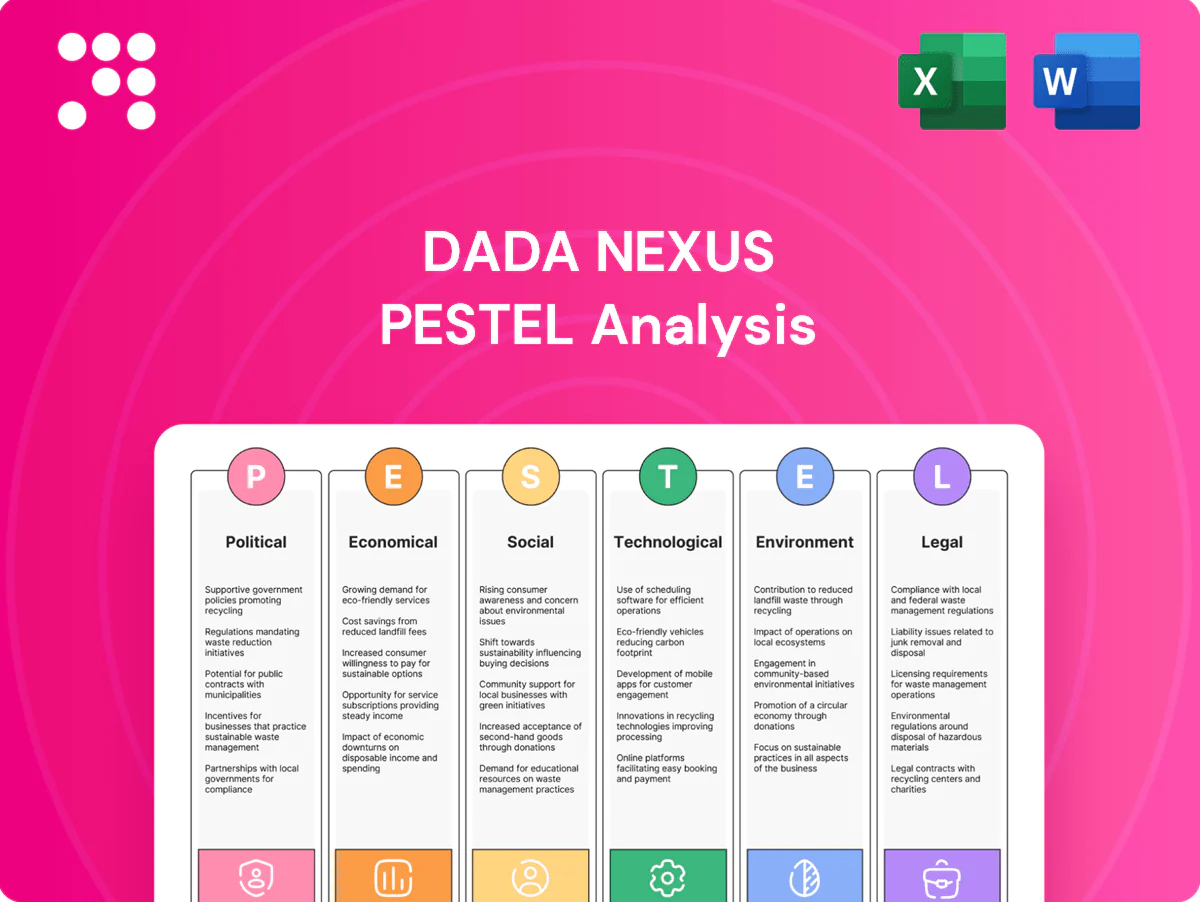
This Dada Nexus PESTLE Analysis provides a concise, professional assessment of political, economic, social, technological, legal, and environmental factors affecting Dada Nexus. It highlights key risks, opportunities, and strategic implications for stakeholders and investors. The preview shown here is the exact document you’ll receive after purchase—fully formatted and ready to use.

Original: $10.00
-65%$10.00
$3.50Product Information
Product Information
Shipping & Returns
Shipping & Returns
Description
Your Shortcut to Market Insight Starts Here
Our PESTLE Analysis of Dada Nexus reveals how political shifts, economic trends, social dynamics, and tech disruption shape its strategic outlook. Ideal for investors and strategists, it translates external forces into actionable risks and opportunities. Purchase the full report for the complete, downloadable breakdown and ready-to-use insights.
Political factors
Platform-economy oversight
Chinese authorities closely supervise large internet platforms to enforce fair competition and labor protections; e.g., Alibaba was fined 18.2 billion RMB in 2021 for antitrust breaches. Dada Now and JDDJ must align operations with shifting directives on pricing, dispatching, and merchant practices, which raises compliance costs and operational complexity. Heightened scrutiny can curb predatory rivals, while proactive engagement with regulators can mitigate sudden shocks.
Digital economy promotion
Beijing and local governments push internet plus and retail digitalization, boosting on‑demand models as China’s digital economy reached about 45% of GDP in 2023; this creates stronger market demand for Dada’s last‑mile services.
Subsidies, pilot zones and over 600 smart‑city projects across provinces can accelerate merchant onboarding and lower CAC through co‑funded pilots.
Participation in government programs can open prioritized data‑sharing and logistics corridors, but policy support typically brings reporting obligations and periodic municipal compliance metrics that raise operational costs.
Local government coordination
City-level rules shape delivery vehicle access, curb space allocation, and operating hours, directly affecting last-mile cost and speed. Strong local ties can secure permits and preferential routes for riders and micro-fulfillment sites, reducing delays and fines. Fragmented municipal policies force tailored city playbooks, making rapid execution across jurisdictions a measurable political advantage.
Public health and safety priorities
Health policies drive demand spikes for groceries and pharmaceuticals—China online grocery GMV reached about RMB 1.3 trillion in 2023, amplifying Dada’s volumes; contactless delivery and cold-chain compliance (vaccine cold chain standards at 2–8°C or −20°C) sustain trust in sensitive categories. Government campaigns can shift behavior quickly; Dada must update protocols in days to weeks to remain compliant and retain market share.
- Demand spike: RMB 1.3 trillion (2023)
- Cold-chain temps: 2–8°C or −20°C
- Compliance drives trust
- Policy turnaround: days–weeks
Geopolitical and capital-market exposure
US-China tensions and tightening listing rules, notably the Holding Foreign Companies Accountable Act (HFCAA, 2020), continue to pressure ADR valuations and access to US capital markets; through 2024 PCAOB inspections of China-based auditors remained restricted, raising delisting risk and higher cost of capital for cross-listed issuers. Regulatory divergence increases disclosure and audit burdens, while currency controls and cross-border data rules limit partnerships and cash repatriation; stable policy expectations are therefore critical to preserve financing flexibility.
- HFCAA in force since 2020
- PCAOB inspections of China-located audits restricted through 2024
- Cross-border data and currency rules constrain partnerships
- Policy stability directly tied to financing access and valuation
Antitrust 18.2bn RMB, digital economy 45%, cross-listing risk
Chinese platforms face strict antitrust and labor oversight (Alibaba fine 18.2bn RMB, 2021), raising compliance costs for Dada. China's digital economy ~45% of GDP (2023) and online grocery GMV ~1.3tn RMB (2023) boost demand; 600+ smart‑city pilots lower CAC. HFCAA (2020) and PCAOB inspection limits through 2024 raise cross‑listing risk and cost of capital.
| Factor | Metric | Impact |
|---|---|---|
| Antitrust | 18.2bn RMB fine | Higher compliance |
| Digital demand | 45% GDP; 1.3tn RMB GMV | Volume growth |
| Cross‑border | HFCAA; PCAOB limits | Financing risk |
What is included in the product
Detailed Word Document
Explores how Political, Economic, Social, Technological, Environmental and Legal forces specifically affect the Dada Nexus, with data-backed trends, detailed sub-points and forward-looking scenarios to inform executives, investors and consultants; formatted for direct inclusion in plans, pitch decks and strategic reports.
Customizable Excel Spreadsheet
A concise, visually segmented PESTLE summary for Dada Nexus that streamlines external risk assessment and market positioning, easily dropped into presentations or shared across teams for faster strategic alignment.
Economic factors
Consumer spending cycles
China’s consumption recovery is uneven across regions and categories: urban coastal areas outpaced inland cities while online penetration reached roughly 30% of retail in 2024. Essential goods show resilience, keeping grocery and pharma volumes on JDDJ in double-digit year-on-year growth. Discretionary orders remain highly elastic to income and sentiment swings. Marketing ROI should be tracked at city and category level to optimize spend.
Cost inflation and unit economics
Rising courier pay, packaging and energy costs have squeezed margins—last-mile often represents 40–60% of fulfillment cost and packaging inflation exceeded 15% in recent years—raising per-order breakevens. Dynamic pricing and batching can protect per-order profitability, often improving margins by mid-single digits. Scale-driven density lowers last-mile cost curves, cutting cost per order 20–40% as density rises. Continuous cost analytics is critical to recover 1–3% margin in low-margin categories.
Tier-2/3 city penetration
Lower-tier cities offer growth via rising smartphone adoption (China >70% in 2024) and accelerating retail digitization; logistics density is thinner, raising initial cost per drop by an estimated 20–40%. Partnering with regional chains can accelerate scale, while route design and service-level targets must be adjusted to local demand, wage and delivery-time economics.
Retailer digital transformation
Offline retailers increasingly seek omni-channel solutions, boosting JDDJ’s integrations across last-mile, POS, and inventory; company disclosures in 2024 highlight growing take rates from fulfillment orchestration and promotions. Tie-ins with POS, inventory, and CRM create economic stickiness, while merchant churn declines as the digital sales mix rises.
Capital access and investment cycle
Capital access for Dada Nexus is constrained by higher borrowing costs (US Fed funds ~5.25–5.50% mid‑2025), tighter credit and wider spreads, and equity markets valuing growth more conservatively (S&P 500 forward P/E ~16–18), forcing nearer‑term payback and CAC efficiency; global VC funding fell roughly 30% in 2024, heightening discipline.
- Interest rates: Fed 5.25–5.50% (mid‑2025)
- Valuations: S&P fwd P/E ~16–18
- Funding: global VC down ~30% in 2024
- Strategy: focus on CAC efficiency, payback, balanced tech vs coverage
Antitrust 18.2bn RMB, digital economy 45%, cross-listing risk
Online retail ~30% (2024); essentials +10–20% YoY on JDDJ, discretionaries volatile. Last‑mile 40–60% of fulfillment cost; packaging inflation >15%; density cuts cost/order 20–40%. Fed funds 5.25–5.50% (mid‑2025); global VC −30% (2024).
| Metric | Value |
|---|---|
| Online share | ~30% (2024) |
| Last‑mile | 40–60% of cost |
| Packaging inflation | >15% |
| Density benefit | ↓ cost/order 20–40% |
| Fed funds | 5.25–5.50% (mid‑2025) |
Full Version Awaits
Dada Nexus PESTLE Analysis
This Dada Nexus PESTLE Analysis provides a concise, professional assessment of political, economic, social, technological, legal, and environmental factors affecting Dada Nexus. It highlights key risks, opportunities, and strategic implications for stakeholders and investors. The preview shown here is the exact document you’ll receive after purchase—fully formatted and ready to use.