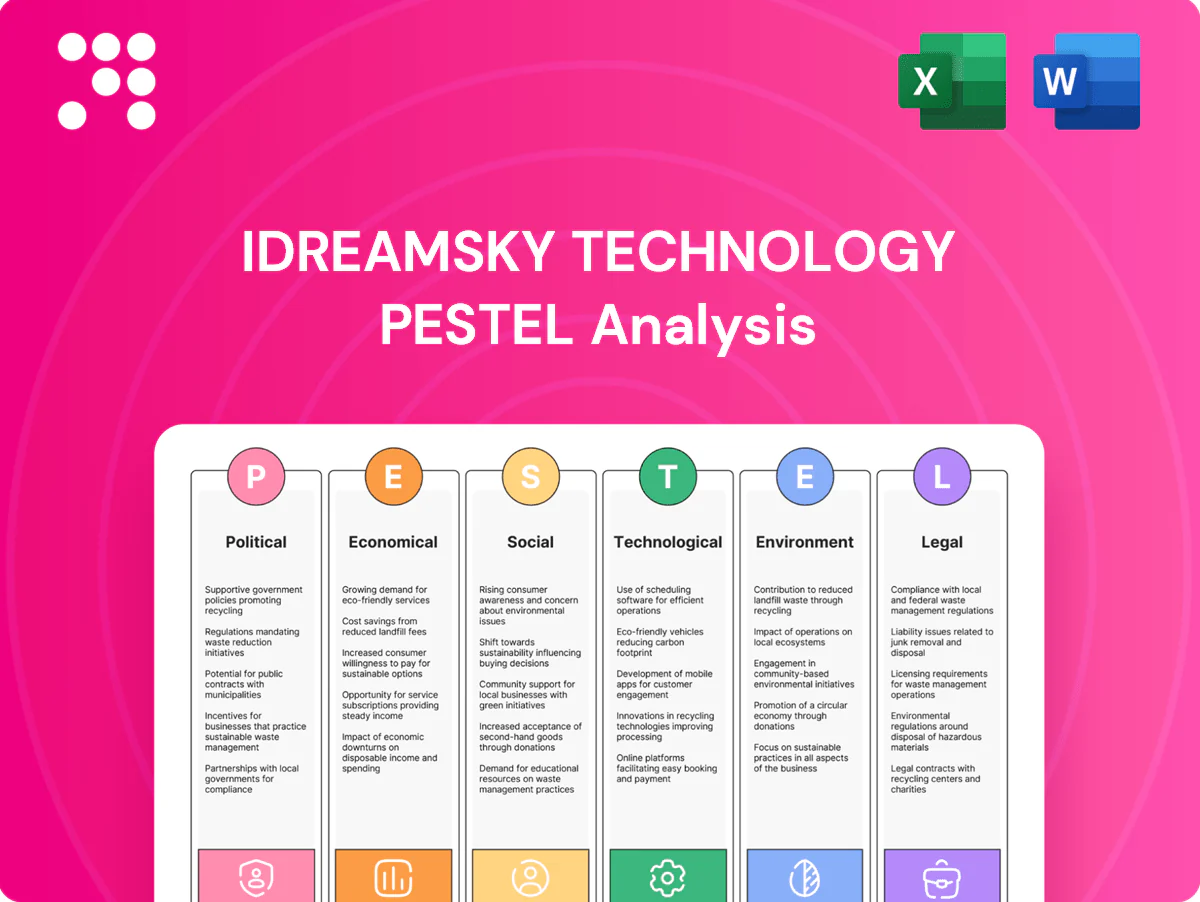
iDreamSky Technology PESTLE Analysis

Your Shortcut to Market Insight Starts Here
Unlock strategic advantage with our PESTLE analysis of iDreamSky Technology—three concise sections revealing how political shifts, economic cycles, and rapid tech change shape its growth and risk profile. Ideal for investors and strategists, this actionable report pinpoints regulatory, social, and environmental pressures affecting performance. Purchase the full analysis to get the complete, editable insights you can use immediately.
Political factors

NPPA game approvals
China’s National Press and Publication Administration tightly controls game licenses, pacing launches and revenue ramps for publishers like iDreamSky. Approval windows, quota allocations and mandated content edits have delayed or derailed titles, increasing go-to-market risk. Maintaining a strong compliance process and diversifying the pipeline reduces single-title concentration for revenue stability. Forward visibility remains tied to NPPA policy cadence and shifting political priorities.
Content censorship & ideology
Themes around history, religion, gore and so-called unhealthy values face strict review in China, highlighted by the 2018 nine-month freeze on game approvals that disrupted timelines and revenues across the industry.
Localization and narrative design must align with cultural and ideological guidelines; iterative edits from regulators increase costs and can delay launches in a market that accounted for over half of global mobile game revenue in recent years.
Partnering early with regulators and leveraging proven IP materially lowers rejection risk and time-to-market for publishers like iDreamSky, which focus on compliant localization and licensed titles.

Geopolitics & IP sourcing
Sino-foreign tensions have complicated licensing from overseas studios and platforms, especially after tighter US export controls on advanced chips and software in 2022–23 that raised compliance costs for cross‑border deals. Sanctions and controls can restrict access to essential tech, tools, or monetization partners, forcing publishers to rebuild stacks and revenue channels. Diversifying IP sourcing toward domestic and friendly markets and designing cross‑border structures that can withstand policy shocks reduces single‑point geopolitical risk.

Industrial policy & digital economy
State-led industrial policy and digital-economy initiatives (China's digital economy reached about 51.6 trillion yuan in 2023, ~41% of GDP) favor high-quality, culturally aligned content that iDreamSky produces, while subsidies, talent programs and regional digital hubs can materially reduce production and distribution costs. Rapid shifts in policy priorities may reallocate support quickly, raising regulatory and funding volatility, but close alignment with local governments unlocks venues, subsidies and offline retail channels.
- State support: boosts cultural IP development
- Cost relief: subsidies, talent schemes, regional hubs
- Risk: fast policy reallocation increases volatility
- Local alignment: access to venues, funding, offline retail
Platform relationships
iDreamSky relies on major Chinese app stores—Tencent MyApp, Huawei AppGallery, Oppo, Vivo and Xiaomi—for the bulk of Android distribution, so platform policies and traffic allocation materially affect revenue and user acquisition. Political scrutiny of Big Tech (eg Alibaba fined 18.2 billion yuan, Apr 2021) shows regulators can change fee structures or traffic rules rapidly. Maintaining multi-platform presence reduces single-platform dependency and exposure to platform-led delisting or reprioritization.
- Major stores: Tencent, Huawei, Oppo, Vivo, Xiaomi
- Regulatory precedent: Alibaba 18.2 billion yuan fine (Apr 2021)
- Mitigation: multi-store distribution
- Risk: government-led rectifications can reshape channels quickly
NPPA controls, export curbs and five-store dependence heighten China go-to-market risk
NPPA license control and content rules drive go-to-market risk for iDreamSky, with the 2018 nine‑month approval freeze still shaping timelines and revenue concentration. Sino‑US export controls (2022–23) raised compliance costs for cross‑border IP and tech, while China’s digital economy was 51.6 trillion yuan in 2023, favoring aligned domestic content. Dependence on five major Android stores magnifies platform policy risk.
| Metric | Value |
|---|---|
| 2018 NPPA freeze | 9 months |
| China digital economy (2023) | 51.6 trillion yuan |
| Alibaba fine (Apr 2021) | 18.2 billion yuan |
| Major Android stores | 5 (Tencent, Huawei, Oppo, Vivo, Xiaomi) |
What is included in the product
 Detailed Word Document
Explores how Political, Economic, Social, Technological, Environmental and Legal forces uniquely affect iDreamSky Technology, combining data-driven trends and regional industry context to identify risks and opportunities. Designed for executives and investors, it offers actionable, forward-looking insights for strategy and scenario planning.

 Customizable Excel Spreadsheet
Concise PESTLE summary for iDreamSky Technology that isolates regulatory, economic, and tech risks into easy-to-scan sections for faster meeting decisions. Shareable, editable format lets teams annotate region-specific impacts and drop slides into presentations.
Economic factors

Consumer spending cycles
Mobile gaming is discretionary and sensitive to income and confidence; China’s GDP growth was about 5.2% in 2024 and youth unemployment peaked at 21.3% in 2023, which can depress ARPU for iDreamSky. Property-sector stress and weak sentiment further constrain in-app spending. Counter-cyclical live-ops and value pricing boost retention. Merch and offline retail diversify revenue across segments.
Revenue model mix
IAP typically drives the bulk of mobile-game revenue, commonly around 70% of industry receipts, with top whales (often the top 1–3% of players) contributing roughly 50–75% of IAP intake; advertising and merchandise yield lower margins and greater cyclicality. Expanding IP derivatives and console/PC ports can diversify revenue and smooth cash flows, while physical merchandise and store operations create added working-capital and inventory demands.

Platform fees & taxes
App-store commissions (commonly 15–30%) and channel revenue splits materially compress iDreamSky unit economics; Google/Apple moves to 15% on initial $1M or small developers lower headline cuts but still squeeze margins. VAT and tax-incentive shifts alter net take-rate and cashflow timing. Securing better platform terms at scale can lift gross margin by several percentage points, while tighter attribution and ad-spend optimization (AppsFlyer reported ~25% YoY CPI rise in 2024) preserves ROAS.

FX and cross-border
- RMB movement ~6% (2023–24)
- Hedging commonly covers 30–60% exposure
- Overseas publishing increases USD/EUR revenue
- Repatriation compliance critical to cash flow
Capital access & cost
Market sentiment toward gaming affects valuation and fundraising for iDreamSky, with global mobile games revenue near $116B in 2024 signaling investor appetite. Elevated policy rates (US fed funds 5.25–5.50% in 2024–25) and tighter credit constrain retail rollout and expansion. Revenue‑sharing partnerships can cut upfront capex; prudent cash management extends content runway.
- Market: mobile gaming ~$116B (2024)
- Rates: Fed funds 5.25–5.50% (2024–25)
- Strategy: revenue‑share reduces capex
- Finance: cash management lengthens runway
NPPA controls, export curbs and five-store dependence heighten China go-to-market risk
Mobile gaming is discretionary; China GDP ~5.2% (2024) and youth unemployment 21.3% (2023) pressure ARPU and spending. IAP ≈70% of revenue, top whales 50–75%, and app-store fees 15–30% compress margins. RMB ≈6% depreciation (2023–24) raises costs; hedging typically covers 30–60%; global mobile gaming ~$116B (2024).
| Metric | Value |
|---|---|
| China GDP (2024) | 5.2% |
| Youth unemployment (2023) | 21.3% |
| Global mobile gaming (2024) | $116B |
| IAP share | ~70% |
| App-store fees | 15–30% |
| RMB movement (2023–24) | ~6%↓ |
| Hedging coverage | 30–60% |
Same Document Delivered
iDreamSky Technology PESTLE Analysis
The iDreamSky Technology PESTLE Analysis preview shown here is the exact document you’ll receive after purchase — fully formatted, professionally structured, and ready to use. This is the real file, not a teaser or placeholder, so the content, layout, and analysis visible now match the downloadable product. After checkout you’ll instantly get this identical, final document.

Original: $10.00
-65%$10.00
$3.50Product Information
Product Information
Shipping & Returns
Shipping & Returns
Description
Your Shortcut to Market Insight Starts Here
Unlock strategic advantage with our PESTLE analysis of iDreamSky Technology—three concise sections revealing how political shifts, economic cycles, and rapid tech change shape its growth and risk profile. Ideal for investors and strategists, this actionable report pinpoints regulatory, social, and environmental pressures affecting performance. Purchase the full analysis to get the complete, editable insights you can use immediately.
Political factors
NPPA game approvals
China’s National Press and Publication Administration tightly controls game licenses, pacing launches and revenue ramps for publishers like iDreamSky. Approval windows, quota allocations and mandated content edits have delayed or derailed titles, increasing go-to-market risk. Maintaining a strong compliance process and diversifying the pipeline reduces single-title concentration for revenue stability. Forward visibility remains tied to NPPA policy cadence and shifting political priorities.
Content censorship & ideology
Themes around history, religion, gore and so-called unhealthy values face strict review in China, highlighted by the 2018 nine-month freeze on game approvals that disrupted timelines and revenues across the industry.
Localization and narrative design must align with cultural and ideological guidelines; iterative edits from regulators increase costs and can delay launches in a market that accounted for over half of global mobile game revenue in recent years.
Partnering early with regulators and leveraging proven IP materially lowers rejection risk and time-to-market for publishers like iDreamSky, which focus on compliant localization and licensed titles.
Geopolitics & IP sourcing
Sino-foreign tensions have complicated licensing from overseas studios and platforms, especially after tighter US export controls on advanced chips and software in 2022–23 that raised compliance costs for cross‑border deals. Sanctions and controls can restrict access to essential tech, tools, or monetization partners, forcing publishers to rebuild stacks and revenue channels. Diversifying IP sourcing toward domestic and friendly markets and designing cross‑border structures that can withstand policy shocks reduces single‑point geopolitical risk.
Industrial policy & digital economy
State-led industrial policy and digital-economy initiatives (China's digital economy reached about 51.6 trillion yuan in 2023, ~41% of GDP) favor high-quality, culturally aligned content that iDreamSky produces, while subsidies, talent programs and regional digital hubs can materially reduce production and distribution costs. Rapid shifts in policy priorities may reallocate support quickly, raising regulatory and funding volatility, but close alignment with local governments unlocks venues, subsidies and offline retail channels.
- State support: boosts cultural IP development
- Cost relief: subsidies, talent schemes, regional hubs
- Risk: fast policy reallocation increases volatility
- Local alignment: access to venues, funding, offline retail
Platform relationships
iDreamSky relies on major Chinese app stores—Tencent MyApp, Huawei AppGallery, Oppo, Vivo and Xiaomi—for the bulk of Android distribution, so platform policies and traffic allocation materially affect revenue and user acquisition. Political scrutiny of Big Tech (eg Alibaba fined 18.2 billion yuan, Apr 2021) shows regulators can change fee structures or traffic rules rapidly. Maintaining multi-platform presence reduces single-platform dependency and exposure to platform-led delisting or reprioritization.
- Major stores: Tencent, Huawei, Oppo, Vivo, Xiaomi
- Regulatory precedent: Alibaba 18.2 billion yuan fine (Apr 2021)
- Mitigation: multi-store distribution
- Risk: government-led rectifications can reshape channels quickly
NPPA controls, export curbs and five-store dependence heighten China go-to-market risk
NPPA license control and content rules drive go-to-market risk for iDreamSky, with the 2018 nine‑month approval freeze still shaping timelines and revenue concentration. Sino‑US export controls (2022–23) raised compliance costs for cross‑border IP and tech, while China’s digital economy was 51.6 trillion yuan in 2023, favoring aligned domestic content. Dependence on five major Android stores magnifies platform policy risk.
| Metric | Value |
|---|---|
| 2018 NPPA freeze | 9 months |
| China digital economy (2023) | 51.6 trillion yuan |
| Alibaba fine (Apr 2021) | 18.2 billion yuan |
| Major Android stores | 5 (Tencent, Huawei, Oppo, Vivo, Xiaomi) |
What is included in the product
Detailed Word Document
Explores how Political, Economic, Social, Technological, Environmental and Legal forces uniquely affect iDreamSky Technology, combining data-driven trends and regional industry context to identify risks and opportunities. Designed for executives and investors, it offers actionable, forward-looking insights for strategy and scenario planning.
Customizable Excel Spreadsheet
Concise PESTLE summary for iDreamSky Technology that isolates regulatory, economic, and tech risks into easy-to-scan sections for faster meeting decisions. Shareable, editable format lets teams annotate region-specific impacts and drop slides into presentations.
Economic factors
Consumer spending cycles
Mobile gaming is discretionary and sensitive to income and confidence; China’s GDP growth was about 5.2% in 2024 and youth unemployment peaked at 21.3% in 2023, which can depress ARPU for iDreamSky. Property-sector stress and weak sentiment further constrain in-app spending. Counter-cyclical live-ops and value pricing boost retention. Merch and offline retail diversify revenue across segments.
Revenue model mix
IAP typically drives the bulk of mobile-game revenue, commonly around 70% of industry receipts, with top whales (often the top 1–3% of players) contributing roughly 50–75% of IAP intake; advertising and merchandise yield lower margins and greater cyclicality. Expanding IP derivatives and console/PC ports can diversify revenue and smooth cash flows, while physical merchandise and store operations create added working-capital and inventory demands.
Platform fees & taxes
App-store commissions (commonly 15–30%) and channel revenue splits materially compress iDreamSky unit economics; Google/Apple moves to 15% on initial $1M or small developers lower headline cuts but still squeeze margins. VAT and tax-incentive shifts alter net take-rate and cashflow timing. Securing better platform terms at scale can lift gross margin by several percentage points, while tighter attribution and ad-spend optimization (AppsFlyer reported ~25% YoY CPI rise in 2024) preserves ROAS.
FX and cross-border
- RMB movement ~6% (2023–24)
- Hedging commonly covers 30–60% exposure
- Overseas publishing increases USD/EUR revenue
- Repatriation compliance critical to cash flow
Capital access & cost
Market sentiment toward gaming affects valuation and fundraising for iDreamSky, with global mobile games revenue near $116B in 2024 signaling investor appetite. Elevated policy rates (US fed funds 5.25–5.50% in 2024–25) and tighter credit constrain retail rollout and expansion. Revenue‑sharing partnerships can cut upfront capex; prudent cash management extends content runway.
- Market: mobile gaming ~$116B (2024)
- Rates: Fed funds 5.25–5.50% (2024–25)
- Strategy: revenue‑share reduces capex
- Finance: cash management lengthens runway
NPPA controls, export curbs and five-store dependence heighten China go-to-market risk
Mobile gaming is discretionary; China GDP ~5.2% (2024) and youth unemployment 21.3% (2023) pressure ARPU and spending. IAP ≈70% of revenue, top whales 50–75%, and app-store fees 15–30% compress margins. RMB ≈6% depreciation (2023–24) raises costs; hedging typically covers 30–60%; global mobile gaming ~$116B (2024).
| Metric | Value |
|---|---|
| China GDP (2024) | 5.2% |
| Youth unemployment (2023) | 21.3% |
| Global mobile gaming (2024) | $116B |
| IAP share | ~70% |
| App-store fees | 15–30% |
| RMB movement (2023–24) | ~6%↓ |
| Hedging coverage | 30–60% |
Same Document Delivered
iDreamSky Technology PESTLE Analysis
The iDreamSky Technology PESTLE Analysis preview shown here is the exact document you’ll receive after purchase — fully formatted, professionally structured, and ready to use. This is the real file, not a teaser or placeholder, so the content, layout, and analysis visible now match the downloadable product. After checkout you’ll instantly get this identical, final document.