Industrial Bank of Korea SWOT Analysis

Make Insightful Decisions Backed by Expert Research
Industrial Bank of Korea's SWOT reveals strong government backing, SME-focused lending expertise, and advancing digital capabilities, balanced against asset concentration, regulatory sensitivity, and rising competitive pressures. Our concise analysis highlights operational strengths, market threats, and strategic gaps that matter to investors and managers. Want the full story behind the company’s strengths, risks, and growth drivers? Purchase the complete SWOT analysis to gain access to a professionally written, fully editable report designed to support planning, pitches, and research.
Strengths

Government backing and mandate
As a majority state-owned bank, IBK benefits from strong policy support and implicit sovereign backing, underpinning funding stability and market confidence during downturns. Its public mandate aligns IBK with national SME development priorities and reinforces strategic relevance. With over KRW 300 trillion in assets (2024) and preferential access to policy funding, IBK is differentiated from purely commercial peers.
Deep SME specialization
IBK’s core competency is serving SMEs across credit, advisory and ecosystem support, built over 64 years since its 1961 founding. Longstanding client ties and deep SME data improve underwriting and cross-sell, enabling tailored products and risk models that match SME cash-flow cycles better than generic banks. This specialization drives stronger loyalty and higher share of wallet among SME clients.

Diverse financial services suite
IBK offers loans, deposits, FX, trade finance and investment banking, delivering end-to-end client coverage that supports corporate and SME needs. Its universal banking capability boosts fee income and buffers reliance on interest margins. One-stop solutions lower client friction, enhance retention and support scalable growth, with total assets exceeding KRW 300 trillion.

Strong domestic franchise
Industrial Bank of Korea leverages a strong domestic franchise as Korea’s largest dedicated SME lender, with over 600 domestic branches and a nationwide brand that sustains consistent SME deal flow. Dense local branch networks and experienced relationship managers provide deep regional industry knowledge, enabling efficient credit monitoring and collections. Network density helps contain customer acquisition and servicing costs.
- Nationwide reach: over 600 branches
- SME focus: Korea’s largest dedicated SME lender
- Operational advantage: local RM expertise for credit monitoring
- Cost control: dense network reduces acquisition costs
Countercyclical role
IBK steps in to support SMEs during stress, stabilizing portfolios via targeted lending and recovery programs and leveraging government policy alignment to reduce systemic risk. Access to public policy tools and guarantee schemes mitigates credit losses and preserves capital flexibility. Countercyclical lending captures market share when competitors retrench and builds stakeholder goodwill.
- Supports SMEs during downturns
- Uses guarantees to mitigate losses
- Gains market share vs retrenching peers
- Strengthens policy and stakeholder ties
State-backed SME lender, > KRW 300T, 64 yrs, 600+ branches
Majority state-owned IBK benefits from strong policy support and implicit sovereign backing, providing funding stability and market confidence. Its 64-year SME specialization delivers deep client ties, tailored underwriting and high SME wallet share. With total assets above KRW 300 trillion (2024) and 600+ branches, IBK offers universal banking for SMEs, enabling fee diversification and countercyclical lending.
| Metric | Value (latest) |
|---|---|
| Total assets | > KRW 300 trillion (2024) |
| Branches | > 600 |
| Founded | 1961 (64 years) |
| Core focus | Dedicated SME lender |
What is included in the product
 Detailed Word Document
Provides a concise SWOT analysis of Industrial Bank of Korea, outlining its core strengths, operational weaknesses, market opportunities, and external threats to assess strategic position and growth prospects.

 Customizable Excel Spreadsheet
Provides a concise SWOT matrix tailored to Industrial Bank of Korea for rapid strategic alignment and risk mitigation; editable format enables quick updates as market, regulatory, or credit conditions change for clear stakeholder communication.
Weaknesses

Concentration in SME credit
Heavy concentration in SME credit leaves IBK with higher credit risk than retail-focused peers; SME lending accounts for over half of its loan book, reflecting its statutory mandate to serve SMEs. SMEs are more sensitive to macro shocks and rate volatility, so sectoral downturns can rapidly generate NPL spikes as seen in prior cycles. Structural mandate constrains diversification, limiting mitigation options.
Margin pressure from policy roles
Policy-driven pricing at Industrial Bank of Korea caps loan yields and compresses net interest margin, while concessional lending and guarantee-linked programs constrain profitability. Balancing state-directed SME support with shareholder return targets creates tension for capital allocation. To sustain returns IBK must boost operating efficiency and fee income to offset the pricing gap.

Legacy systems and agility
Larger public institutions like Industrial Bank of Korea typically face slower IT modernization, with legacy core systems delaying product rollout and preventing analytics at scale. This gap erodes digital UX versus fintechs and top-tier private banks, making customer-facing innovation harder to execute rapidly. Integration costs and change management remain material, increasing project timelines and operational risk.

Capital efficiency constraints
Capital efficiency is constrained as IBK’s SME-heavy portfolio raises risk-weighted assets, lowering risk-adjusted returns; CET1 was 12.9% at end‑2024, limiting capital deployment for higher-yield segments. Regulatory and countercyclical buffers—maintained to support SME lending—tie capital, while evolving Basel/FSB requirements reduce balance-sheet flexibility and can slow growth into higher-return corporate or retail activities.
- Risk-weight intensity: SME loan concentration raises RWA burden
- Capital buffers: countercyclical and prudential requirements tie capital
- Regulation: evolving rules constrain balance-sheet flexibility
- Growth impact: may slow expansion into higher-return segments
International footprint limits
IBK remains predominantly domestic, with core business focused on Korea’s SME sector; its limited overseas scale reduces diversification and exposes earnings to domestic cyclical risk. Cross-border capabilities and networks lag larger Korean peers, constraining fee income and international lending growth. This limits exposure to faster-growing external markets.
- Domestic SME concentration
- Smaller overseas network vs peers
- Lower diversification into high-growth markets
SME-heavy loan book (>50%) ups NPL/RWA risk; policy pricing squeezes NIM; legacy tech lags
Heavy SME concentration (SME loans >50% of book) raises credit and RWA risk, amplifying NPL sensitivity in downturns. Policy-driven pricing and concessional programs compress NIM and profitability, forcing reliance on cost cuts and fee income. Legacy systems slow digital rollout, weakening competitiveness vs fintechs and global peers.
| Metric | Value |
|---|---|
| SME loan share | >50% |
| CET1 (end-2024) | 12.9% |
What You See Is What You Get
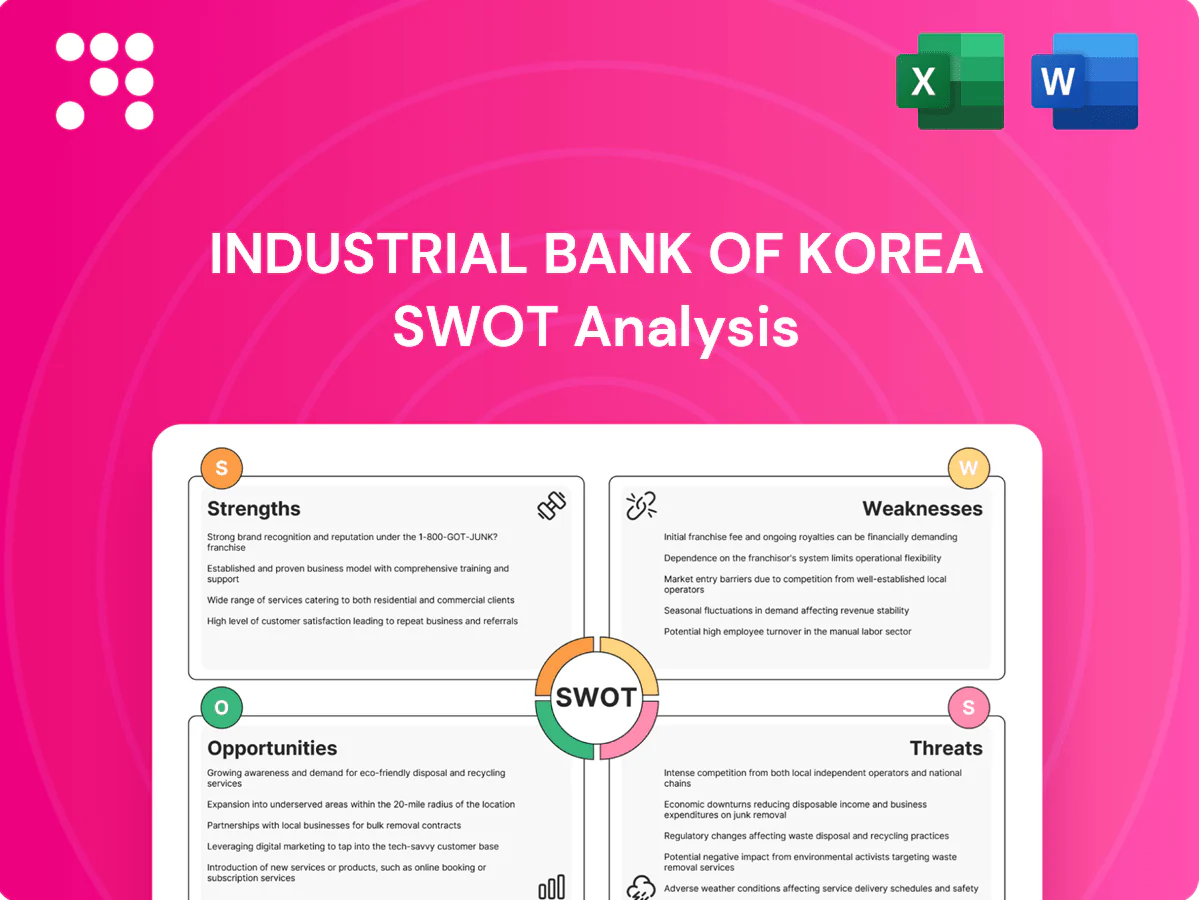
Industrial Bank of Korea SWOT Analysis
This is the actual SWOT analysis document you’ll receive upon purchase—no surprises, just professional quality. The preview below is taken directly from the full SWOT report you'll get. Once purchased, you’ll receive the complete, editable version ready for use. Buy now to unlock the full, detailed file.

Original: $10.00
-65%$10.00
$3.50Product Information
Product Information
Shipping & Returns
Shipping & Returns
Description
Make Insightful Decisions Backed by Expert Research
Industrial Bank of Korea's SWOT reveals strong government backing, SME-focused lending expertise, and advancing digital capabilities, balanced against asset concentration, regulatory sensitivity, and rising competitive pressures. Our concise analysis highlights operational strengths, market threats, and strategic gaps that matter to investors and managers. Want the full story behind the company’s strengths, risks, and growth drivers? Purchase the complete SWOT analysis to gain access to a professionally written, fully editable report designed to support planning, pitches, and research.
Strengths
Government backing and mandate
As a majority state-owned bank, IBK benefits from strong policy support and implicit sovereign backing, underpinning funding stability and market confidence during downturns. Its public mandate aligns IBK with national SME development priorities and reinforces strategic relevance. With over KRW 300 trillion in assets (2024) and preferential access to policy funding, IBK is differentiated from purely commercial peers.
Deep SME specialization
IBK’s core competency is serving SMEs across credit, advisory and ecosystem support, built over 64 years since its 1961 founding. Longstanding client ties and deep SME data improve underwriting and cross-sell, enabling tailored products and risk models that match SME cash-flow cycles better than generic banks. This specialization drives stronger loyalty and higher share of wallet among SME clients.
Diverse financial services suite
IBK offers loans, deposits, FX, trade finance and investment banking, delivering end-to-end client coverage that supports corporate and SME needs. Its universal banking capability boosts fee income and buffers reliance on interest margins. One-stop solutions lower client friction, enhance retention and support scalable growth, with total assets exceeding KRW 300 trillion.
Strong domestic franchise
Industrial Bank of Korea leverages a strong domestic franchise as Korea’s largest dedicated SME lender, with over 600 domestic branches and a nationwide brand that sustains consistent SME deal flow. Dense local branch networks and experienced relationship managers provide deep regional industry knowledge, enabling efficient credit monitoring and collections. Network density helps contain customer acquisition and servicing costs.
- Nationwide reach: over 600 branches
- SME focus: Korea’s largest dedicated SME lender
- Operational advantage: local RM expertise for credit monitoring
- Cost control: dense network reduces acquisition costs
Countercyclical role
IBK steps in to support SMEs during stress, stabilizing portfolios via targeted lending and recovery programs and leveraging government policy alignment to reduce systemic risk. Access to public policy tools and guarantee schemes mitigates credit losses and preserves capital flexibility. Countercyclical lending captures market share when competitors retrench and builds stakeholder goodwill.
- Supports SMEs during downturns
- Uses guarantees to mitigate losses
- Gains market share vs retrenching peers
- Strengthens policy and stakeholder ties
State-backed SME lender, > KRW 300T, 64 yrs, 600+ branches
Majority state-owned IBK benefits from strong policy support and implicit sovereign backing, providing funding stability and market confidence. Its 64-year SME specialization delivers deep client ties, tailored underwriting and high SME wallet share. With total assets above KRW 300 trillion (2024) and 600+ branches, IBK offers universal banking for SMEs, enabling fee diversification and countercyclical lending.
| Metric | Value (latest) |
|---|---|
| Total assets | > KRW 300 trillion (2024) |
| Branches | > 600 |
| Founded | 1961 (64 years) |
| Core focus | Dedicated SME lender |
What is included in the product
Detailed Word Document
Provides a concise SWOT analysis of Industrial Bank of Korea, outlining its core strengths, operational weaknesses, market opportunities, and external threats to assess strategic position and growth prospects.
Customizable Excel Spreadsheet
Provides a concise SWOT matrix tailored to Industrial Bank of Korea for rapid strategic alignment and risk mitigation; editable format enables quick updates as market, regulatory, or credit conditions change for clear stakeholder communication.
Weaknesses
Concentration in SME credit
Heavy concentration in SME credit leaves IBK with higher credit risk than retail-focused peers; SME lending accounts for over half of its loan book, reflecting its statutory mandate to serve SMEs. SMEs are more sensitive to macro shocks and rate volatility, so sectoral downturns can rapidly generate NPL spikes as seen in prior cycles. Structural mandate constrains diversification, limiting mitigation options.
Margin pressure from policy roles
Policy-driven pricing at Industrial Bank of Korea caps loan yields and compresses net interest margin, while concessional lending and guarantee-linked programs constrain profitability. Balancing state-directed SME support with shareholder return targets creates tension for capital allocation. To sustain returns IBK must boost operating efficiency and fee income to offset the pricing gap.
Legacy systems and agility
Larger public institutions like Industrial Bank of Korea typically face slower IT modernization, with legacy core systems delaying product rollout and preventing analytics at scale. This gap erodes digital UX versus fintechs and top-tier private banks, making customer-facing innovation harder to execute rapidly. Integration costs and change management remain material, increasing project timelines and operational risk.
Capital efficiency constraints
Capital efficiency is constrained as IBK’s SME-heavy portfolio raises risk-weighted assets, lowering risk-adjusted returns; CET1 was 12.9% at end‑2024, limiting capital deployment for higher-yield segments. Regulatory and countercyclical buffers—maintained to support SME lending—tie capital, while evolving Basel/FSB requirements reduce balance-sheet flexibility and can slow growth into higher-return corporate or retail activities.
- Risk-weight intensity: SME loan concentration raises RWA burden
- Capital buffers: countercyclical and prudential requirements tie capital
- Regulation: evolving rules constrain balance-sheet flexibility
- Growth impact: may slow expansion into higher-return segments
International footprint limits
IBK remains predominantly domestic, with core business focused on Korea’s SME sector; its limited overseas scale reduces diversification and exposes earnings to domestic cyclical risk. Cross-border capabilities and networks lag larger Korean peers, constraining fee income and international lending growth. This limits exposure to faster-growing external markets.
- Domestic SME concentration
- Smaller overseas network vs peers
- Lower diversification into high-growth markets
SME-heavy loan book (>50%) ups NPL/RWA risk; policy pricing squeezes NIM; legacy tech lags
Heavy SME concentration (SME loans >50% of book) raises credit and RWA risk, amplifying NPL sensitivity in downturns. Policy-driven pricing and concessional programs compress NIM and profitability, forcing reliance on cost cuts and fee income. Legacy systems slow digital rollout, weakening competitiveness vs fintechs and global peers.
| Metric | Value |
|---|---|
| SME loan share | >50% |
| CET1 (end-2024) | 12.9% |
What You See Is What You Get
Industrial Bank of Korea SWOT Analysis
This is the actual SWOT analysis document you’ll receive upon purchase—no surprises, just professional quality. The preview below is taken directly from the full SWOT report you'll get. Once purchased, you’ll receive the complete, editable version ready for use. Buy now to unlock the full, detailed file.