Industrial Bank of Korea PESTLE Analysis

Your Competitive Advantage Starts with This Report
Our PESTLE Analysis of Industrial Bank of Korea reveals how political regulation, economic cycles, technological disruption, social shifts, and environmental and legal trends will shape its trajectory; uncover strategic risks and growth levers with evidence-based insights. Purchase the full report to get the complete, actionable breakdown instantly.
Political factors

State ownership and policy alignment
Industrial Bank of Korea is majority state-owned (government stake >50%), tying its strategy to SME mandates and national industrial policy. Government-directed budget priorities and policy loan programs can expand or constrain IBK’s lending headroom. Political shifts may reallocate focus to sectors like strategic tech and regional revitalization, forcing governance to balance commercial performance with mandated policy outcomes.
Regulatory oversight by Korean authorities
Close supervision by the Financial Services Commission and Financial Supervisory Service tightly shapes IBK’s capital, liquidity and conduct standards. Policy-driven lending programs and subsidy schemes can quickly alter pricing and risk appetite for SME exposures. With household debt near 1,900 trillion KRW (2024), LTV/DTI macroprudential caps materially constrain retail and SME credit growth. Coordinated regulator action in stress expedites targeted support measures.

Geopolitical tensions on the peninsula
Geopolitical tensions on the peninsula can erode investor confidence, raise funding spreads and slow SME investment—critical given Korean SMEs represent about 99% of firms and ~87% of employment. Contingency planning for sanctions or supply shocks is necessary, while crisis-era government backstops could expand IBK’s balance-sheet role. Client demand for insurance and FX hedging has risen amid KRW volatility (roughly 15% swing vs USD in 2021–23).

Trade and industrial policy shifts
Export controls, friend-shoring and supply‑chain diversification are shifting SME financing toward working‑capital and reshoring capex needs; global incentives such as the US CHIPS Act (about $52bn) and clean‑energy credits under the IRA (roughly $369bn) through 2025 create targeted lending opportunities for semiconductors, batteries and green firms; trade disputes can squeeze export‑oriented SMEs’ cash flows while policy‑linked guarantees reduce sector risk.
- Export controls → higher WC demand
- Friend‑shoring → reshoring capex loans
- CHIPS $52bn, IRA $369bn → targeted lending
- Guarantees → risk mitigation for IBK
Public accountability and stakeholder scrutiny
As a state-backed policy bank founded in 1961, IBK faces elevated expectations for inclusive finance and measurable ESG outcomes, with South Korea's net-zero by 2050 pledge increasing pressure on green lending. Parliamentary oversight through the National Assembly can shape executive decisions and disclosure requirements, while public-sector wage frameworks and labor relations materially affect IBK's cost base. Heightened transparency demands expand reporting burdens and compliance costs.
- State-backed mandate: inclusive finance + ESG focus
- Parliamentary oversight: influences disclosures and strategy
- Labor/wage frameworks: upward pressure on operating costs
- Transparency: increased reporting and compliance workload
State majority (>50%) ties lender to SME policy; caps curb credit
State majority ownership (>50%) ties IBK to SME policy, directing concessional lending and capital use while regulators (FSC/FSS) enforce tight capital, liquidity and conduct rules. Household debt ~1,900tn KRW (2024) and macroprudential LTV/DTI caps limit retail/SME credit growth. Geopolitical/supply‑chain shifts raise funding costs but create targeted lending via CHIPS $52bn and IRA $369bn.
| Metric | Value |
|---|---|
| State stake | >50% |
| Household debt (2024) | ~1,900tn KRW |
| KRW volatility (2021–23) | ~15% vs USD |
| US incentives | CHIPS $52bn, IRA $369bn |
What is included in the product
 Detailed Word Document
Explores how Political, Economic, Social, Technological, Environmental, and Legal forces uniquely impact the Industrial Bank of Korea, with data-driven insights and region-specific trends; designed for executives, consultants, and investors to identify risks and opportunities and support scenario planning. Delivered in clean, report-ready format with forward-looking recommendations for strategy and funding decisions.

 Customizable Excel Spreadsheet
A clean, summarized PESTLE of Industrial Bank of Korea for easy reference in meetings, highlighting regulatory, economic, technological and geopolitical risks and opportunities to streamline strategic decisions.
Economic factors

Interest rate cycles and NIM sensitivity
Policy rate moves—Bank of Korea peak 3.50% in Aug 2023 and 3.25% mid-2024—directly raise deposit costs and squeeze SME loan pricing, lifting margin-compression risk during rapid tightening. Easing cycles (cuts since mid-2024) can boost SME credit demand but repricing lags cause earnings volatility quarter-to-quarter. For IBK, active asset-liability management is critical to stabilize NIM and buffer short-term repricing gaps.
SME health across the business cycle
SME defaults in Korea move with GDP, consumption and export momentum: GDP growth slowed to 1.3% in 2023 before recovering to about 2.6% in 2024, and SME delinquencies rose in downturns. Weak demand strains working-capital lines and increases restructurings, driving higher short-term credit utilisation. Countercyclical policy programs (2020–24 relief and guarantee schemes) cushioned losses. Diversifying sector exposure lowers concentration risk.

KRW exchange rate and external demand
Won volatility—USD/KRW averaged about 1,320 in 2024 and traded near 1,350 in June 2025—raises import costs and compresses exporters’ won revenues, shifting margins for IBK clients. Demand swings from US/China/EU cycles transmit quickly to Korean SMEs, driving variable needs for FX hedging, trade finance and supply-chain finance. Tighter FX market liquidity reduces FX transaction volumes and fee income for the bank.

Inflation and cost pressures
Inflation remained elevated in 2024 with South Korea CPI around 2.6%, squeezing SME margins and reducing debt-service capacity as input costs rose; Industrial Bank of Korea faces higher operating expenses from IT, compliance and staffing, pressuring cost-to-income ratios. Pricing discipline and risk-based pricing have become more important, while inflation-linked deposit and loan features can help customers manage real-cost shocks.
- 2024 CPI ~2.6% — higher input costs for SMEs
- Bank operating costs up due to IT/compliance/staffing
- Greater emphasis on risk-based pricing
- Inflation-linked products support customer resilience
Capital markets and funding conditions
Wholesale funding spreads and access to covered-bond markets directly affect IBK’s cost of funds; 10-year KTB yields near 3.7% (July 2025) lift benchmark funding costs, while covered-bond issuance can trim spreads by 10–30 bps. Investor appetite for policy-bank paper is cyclical, tightening demand in risk-off phases. Stable retail deposits (over 60% of funding) provide resilience but are highly rate-sensitive. Securitization and guarantee schemes can lower RWA and improve return on equity.
- Wholesale spreads: +10–30 bps impact
- 10y KTB ~3.7% (Jul 2025)
- Retail deposits >60% funding, rate-sensitive
- Securitization/guarantees optimize RWA
State majority (>50%) ties lender to SME policy; caps curb credit
Policy rate moves (BoK peak 3.50% Aug 2023, cut to 3.25% mid‑2024) squeeze NIM; cuts from mid‑2024 boost loan demand but create repricing volatility. GDP 2024 ~2.6% with SME stress rising in downturns; CPI ~2.6% (2024) and 10y KTB ~3.7% (Jul 2025) push funding costs; USD/KRW ~1,350 (Jun 2025) raises FX hedging needs.
| Metric | Value |
|---|---|
| Policy rate | 3.25% (mid‑2024) |
| GDP 2024 | 2.6% |
| CPI 2024 | 2.6% |
| 10y KTB | 3.7% (Jul 2025) |
| USD/KRW | ~1,350 (Jun 2025) |
What You See Is What You Get
Industrial Bank of Korea PESTLE Analysis
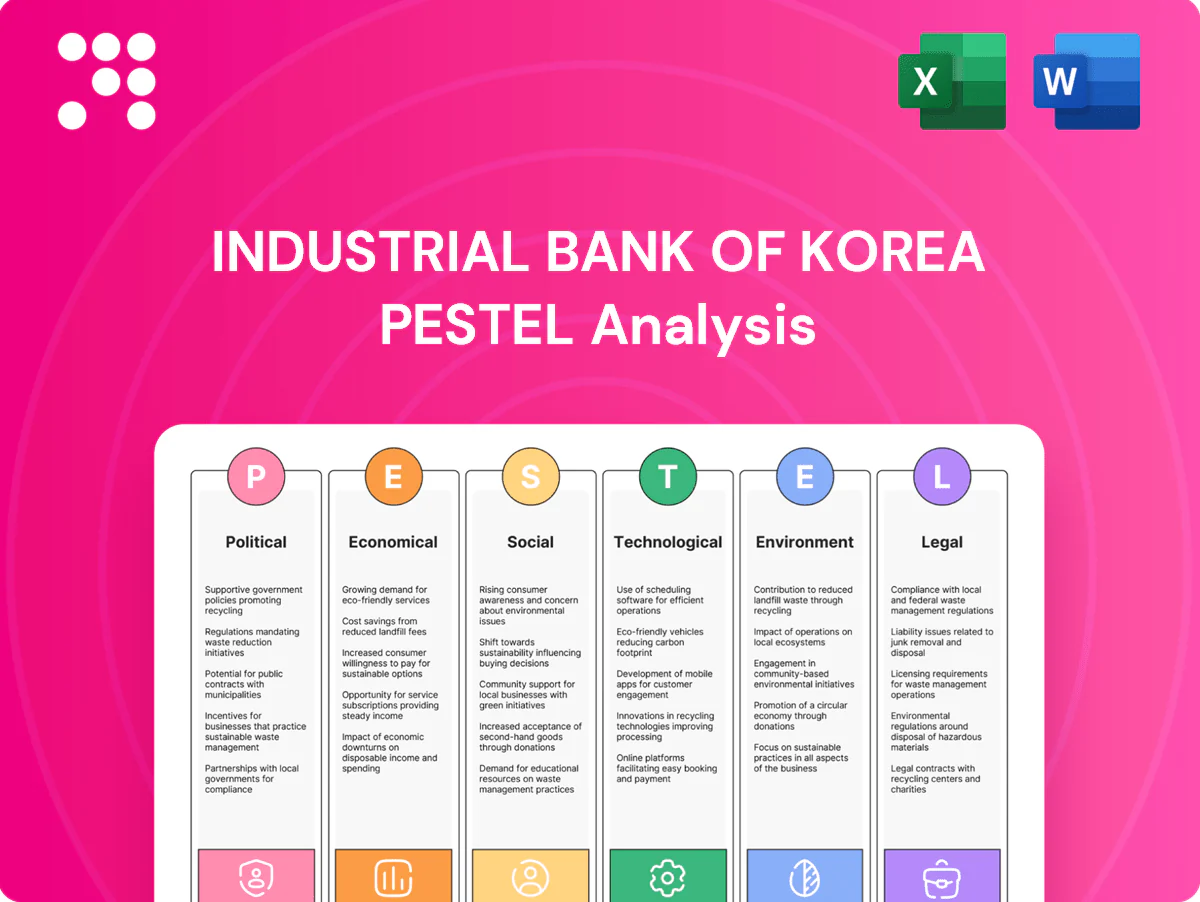
The Industrial Bank of Korea PESTLE Analysis shown here is the exact document you’ll receive after purchase, fully formatted and ready to use. This preview reflects the final content, structure, and professional layout—no placeholders or teasers. After checkout you’ll instantly download the same file displayed here, prepared for immediate application.

Original: $10.00
-65%$10.00
$3.50Product Information
Product Information
Shipping & Returns
Shipping & Returns
Description
Your Competitive Advantage Starts with This Report
Our PESTLE Analysis of Industrial Bank of Korea reveals how political regulation, economic cycles, technological disruption, social shifts, and environmental and legal trends will shape its trajectory; uncover strategic risks and growth levers with evidence-based insights. Purchase the full report to get the complete, actionable breakdown instantly.
Political factors
State ownership and policy alignment
Industrial Bank of Korea is majority state-owned (government stake >50%), tying its strategy to SME mandates and national industrial policy. Government-directed budget priorities and policy loan programs can expand or constrain IBK’s lending headroom. Political shifts may reallocate focus to sectors like strategic tech and regional revitalization, forcing governance to balance commercial performance with mandated policy outcomes.
Regulatory oversight by Korean authorities
Close supervision by the Financial Services Commission and Financial Supervisory Service tightly shapes IBK’s capital, liquidity and conduct standards. Policy-driven lending programs and subsidy schemes can quickly alter pricing and risk appetite for SME exposures. With household debt near 1,900 trillion KRW (2024), LTV/DTI macroprudential caps materially constrain retail and SME credit growth. Coordinated regulator action in stress expedites targeted support measures.
Geopolitical tensions on the peninsula
Geopolitical tensions on the peninsula can erode investor confidence, raise funding spreads and slow SME investment—critical given Korean SMEs represent about 99% of firms and ~87% of employment. Contingency planning for sanctions or supply shocks is necessary, while crisis-era government backstops could expand IBK’s balance-sheet role. Client demand for insurance and FX hedging has risen amid KRW volatility (roughly 15% swing vs USD in 2021–23).
Trade and industrial policy shifts
Export controls, friend-shoring and supply‑chain diversification are shifting SME financing toward working‑capital and reshoring capex needs; global incentives such as the US CHIPS Act (about $52bn) and clean‑energy credits under the IRA (roughly $369bn) through 2025 create targeted lending opportunities for semiconductors, batteries and green firms; trade disputes can squeeze export‑oriented SMEs’ cash flows while policy‑linked guarantees reduce sector risk.
- Export controls → higher WC demand
- Friend‑shoring → reshoring capex loans
- CHIPS $52bn, IRA $369bn → targeted lending
- Guarantees → risk mitigation for IBK
Public accountability and stakeholder scrutiny
As a state-backed policy bank founded in 1961, IBK faces elevated expectations for inclusive finance and measurable ESG outcomes, with South Korea's net-zero by 2050 pledge increasing pressure on green lending. Parliamentary oversight through the National Assembly can shape executive decisions and disclosure requirements, while public-sector wage frameworks and labor relations materially affect IBK's cost base. Heightened transparency demands expand reporting burdens and compliance costs.
- State-backed mandate: inclusive finance + ESG focus
- Parliamentary oversight: influences disclosures and strategy
- Labor/wage frameworks: upward pressure on operating costs
- Transparency: increased reporting and compliance workload
State majority (>50%) ties lender to SME policy; caps curb credit
State majority ownership (>50%) ties IBK to SME policy, directing concessional lending and capital use while regulators (FSC/FSS) enforce tight capital, liquidity and conduct rules. Household debt ~1,900tn KRW (2024) and macroprudential LTV/DTI caps limit retail/SME credit growth. Geopolitical/supply‑chain shifts raise funding costs but create targeted lending via CHIPS $52bn and IRA $369bn.
| Metric | Value |
|---|---|
| State stake | >50% |
| Household debt (2024) | ~1,900tn KRW |
| KRW volatility (2021–23) | ~15% vs USD |
| US incentives | CHIPS $52bn, IRA $369bn |
What is included in the product
Detailed Word Document
Explores how Political, Economic, Social, Technological, Environmental, and Legal forces uniquely impact the Industrial Bank of Korea, with data-driven insights and region-specific trends; designed for executives, consultants, and investors to identify risks and opportunities and support scenario planning. Delivered in clean, report-ready format with forward-looking recommendations for strategy and funding decisions.
Customizable Excel Spreadsheet
A clean, summarized PESTLE of Industrial Bank of Korea for easy reference in meetings, highlighting regulatory, economic, technological and geopolitical risks and opportunities to streamline strategic decisions.
Economic factors
Interest rate cycles and NIM sensitivity
Policy rate moves—Bank of Korea peak 3.50% in Aug 2023 and 3.25% mid-2024—directly raise deposit costs and squeeze SME loan pricing, lifting margin-compression risk during rapid tightening. Easing cycles (cuts since mid-2024) can boost SME credit demand but repricing lags cause earnings volatility quarter-to-quarter. For IBK, active asset-liability management is critical to stabilize NIM and buffer short-term repricing gaps.
SME health across the business cycle
SME defaults in Korea move with GDP, consumption and export momentum: GDP growth slowed to 1.3% in 2023 before recovering to about 2.6% in 2024, and SME delinquencies rose in downturns. Weak demand strains working-capital lines and increases restructurings, driving higher short-term credit utilisation. Countercyclical policy programs (2020–24 relief and guarantee schemes) cushioned losses. Diversifying sector exposure lowers concentration risk.
KRW exchange rate and external demand
Won volatility—USD/KRW averaged about 1,320 in 2024 and traded near 1,350 in June 2025—raises import costs and compresses exporters’ won revenues, shifting margins for IBK clients. Demand swings from US/China/EU cycles transmit quickly to Korean SMEs, driving variable needs for FX hedging, trade finance and supply-chain finance. Tighter FX market liquidity reduces FX transaction volumes and fee income for the bank.
Inflation and cost pressures
Inflation remained elevated in 2024 with South Korea CPI around 2.6%, squeezing SME margins and reducing debt-service capacity as input costs rose; Industrial Bank of Korea faces higher operating expenses from IT, compliance and staffing, pressuring cost-to-income ratios. Pricing discipline and risk-based pricing have become more important, while inflation-linked deposit and loan features can help customers manage real-cost shocks.
- 2024 CPI ~2.6% — higher input costs for SMEs
- Bank operating costs up due to IT/compliance/staffing
- Greater emphasis on risk-based pricing
- Inflation-linked products support customer resilience
Capital markets and funding conditions
Wholesale funding spreads and access to covered-bond markets directly affect IBK’s cost of funds; 10-year KTB yields near 3.7% (July 2025) lift benchmark funding costs, while covered-bond issuance can trim spreads by 10–30 bps. Investor appetite for policy-bank paper is cyclical, tightening demand in risk-off phases. Stable retail deposits (over 60% of funding) provide resilience but are highly rate-sensitive. Securitization and guarantee schemes can lower RWA and improve return on equity.
- Wholesale spreads: +10–30 bps impact
- 10y KTB ~3.7% (Jul 2025)
- Retail deposits >60% funding, rate-sensitive
- Securitization/guarantees optimize RWA
State majority (>50%) ties lender to SME policy; caps curb credit
Policy rate moves (BoK peak 3.50% Aug 2023, cut to 3.25% mid‑2024) squeeze NIM; cuts from mid‑2024 boost loan demand but create repricing volatility. GDP 2024 ~2.6% with SME stress rising in downturns; CPI ~2.6% (2024) and 10y KTB ~3.7% (Jul 2025) push funding costs; USD/KRW ~1,350 (Jun 2025) raises FX hedging needs.
| Metric | Value |
|---|---|
| Policy rate | 3.25% (mid‑2024) |
| GDP 2024 | 2.6% |
| CPI 2024 | 2.6% |
| 10y KTB | 3.7% (Jul 2025) |
| USD/KRW | ~1,350 (Jun 2025) |
What You See Is What You Get
Industrial Bank of Korea PESTLE Analysis
The Industrial Bank of Korea PESTLE Analysis shown here is the exact document you’ll receive after purchase, fully formatted and ready to use. This preview reflects the final content, structure, and professional layout—no placeholders or teasers. After checkout you’ll instantly download the same file displayed here, prepared for immediate application.