Hunt Consolidated/Hunt Oil SWOT Analysis

Your Strategic Toolkit Starts Here
Hunt Consolidated/Hunt Oil's strategic footprint, asset diversification, and geopolitical exposure create a complex mix of strengths and risks that demand careful evaluation. Our preview highlights key competitive advantages, operational vulnerabilities, and growth drivers across upstream and service operations. Purchase the complete SWOT analysis to gain access to a professionally written, fully editable report designed to support planning, pitches, and research.
Strengths

Diversified portfolio
As of 2024 Hunt Consolidated operates across E&P, real estate, power and diversified investments, which reduces earnings volatility and cyclicality by spreading exposure across sectors. Cash flows from real estate and investment arms provide a buffer during oil and gas downturns. This diversification creates cross-segment optionality for capital allocation and enhances resilience through differing macro cycles.
Deep E&P expertise
Over 80 years of global exploration and production experience underpins Hunt’s technical capability and basin knowledge, enabling repeatable subsurface models and play development. Scale and accumulated know-how support lower finding and development costs through shared drilling, completion and logistics practices. Established regional relationships improve access to acreage and partners, and operational learnings compound across assets.

Private ownership agility
As a privately held company, Hunt Consolidated can take a multi‑decade view and avoid SEC quarterly reporting and public earnings guidance, enabling decisive strategic pivots and portfolio reshaping with fewer disclosure constraints; clear family governance facilitates rapid capital deployment and confidential dealmaking, preserving competitive advantage in upstream and midstream projects while most US firms remain privately held (SBA: ~99.9% are small businesses).

Integrated energy footprint
Integrated exposure across upstream and power gives Hunt optionality across the energy value chain; power assets provide more stable, contracted cashflows via power purchase agreements (PPAs typically 10–25 years), while E&P preserves commodity upside. Knowledge transfer across segments strengthens risk management and enables participation in transition-era projects.
- Optionality: upstream + power
- Stability: PPAs typically 10–25 years
- Risk management: cross-segment knowledge transfer
- Transition: supports low‑carbon project participation
Strong reputation and legacy
Hunt Consolidated’s oil business traces to 1934, and that long industry presence builds credibility with regulators, partners and capital providers, while a decades-long track record supports preferential access to quality deal flow. Institutional memory promotes disciplined risk-taking across cycles, and the Hunt brand helps attract top technical talent.
- RegulatoryCredibility
- DealFlowAccess
- InstitutionalMemory
- TalentAttraction
4-segment energy & real estate platform; PPAs 10–25 yrs; family-owned
Hunt Consolidated operates four principal segments (E&P, real estate, power, investments), reducing cyclicality and providing cross‑segment capital optionality. Family‑owned since 1934 (91 years in 2025), the private structure enables long‑term deployment and confidential dealmaking. Power PPAs typically span 10–25 years, providing contracted cashflow stability.
| Metric | Value |
|---|---|
| Segments | 4 |
| Founded | 1934 (91 yrs) |
| PPA tenor | 10–25 yrs |
| Ownership | Privately held |
What is included in the product
 Detailed Word Document
Provides a concise SWOT analysis of Hunt Consolidated/Hunt Oil, highlighting strengths in diversified energy assets and private capital, weaknesses from commodity exposure and legacy infrastructure, opportunities in energy transition and unconventional plays, and threats from regulatory shifts, market volatility, and intensifying competition.

 Customizable Excel Spreadsheet
Provides a concise SWOT matrix tailored to Hunt Consolidated/Hunt Oil for fast strategic alignment and risk mitigation; editable format enables quick updates as market, regulatory, or commodity conditions change.
Weaknesses

Commodity price exposure
Core earnings at Hunt remain closely tied to volatile oil and gas prices, exemplified by extremes such as WTI briefly trading negative on April 20, 2020 and Brent spiking toward $139/bbl in March 2022; such swings can disrupt cash flows and capex plans. Hedging programs blunt short-term moves but do not eliminate basis, timing or counterparty risk. Prolonged downturns compress returns and make reserves replacement more costly and uncertain.
Capital intensity
E&P and power projects demand large upfront capex and often multi‑year paybacks (commonly 5–10+ years), so cost overruns or delays can materially cut IRR; competing capital needs across Hunt’s segments can dilute strategic focus. Higher financing costs—US federal funds target 5.25–5.50% in mid‑2025—increase hurdle rates and raise borrowing costs for large projects.

Private-market opacity
Limited public disclosures for Hunt’s private-market oil assets constrain external benchmarking and valuation transparency because private entities are not SEC-reporting issuers, limiting peer comparables. This opacity can restrict access to institutional capital and secondary-market liquidity, often prompting counterparties to demand higher risk premia. ESG data gaps complicate stakeholder assessments amid ISSB standards adoption in 2023–25.

Geopolitical and operational risk
Global E&P exposure brings country risk, licensing uncertainty and security challenges that can disrupt Hunt Consolidated’s upstream projects; operational incidents cause downtime and reputational damage, increasing project delays and remediation costs. Supply chain and services availability strain schedules and inflate operating costs, while higher insurance premiums and complex compliance regimes add recurring overhead.
- Country risk and licensing uncertainty
- Security and operational incident exposure
- Supply chain/service availability pressures
- Rising insurance and compliance costs
Environmental liabilities
Environmental liabilities—high carbon intensity, methane releases and growing decommissioning obligations—expose Hunt Consolidated/Hunt Oil to material financial and legal risk; methane is ~84 times more potent than CO2 over 20 years (IPCC AR5), amplifying regulatory pressure. EPA and state methane/oil‑and‑gas rules tightened in 2023–24, raising compliance costs and remediation needs for legacy assets, while public scrutiny can slow permitting and partnerships.
- Carbon & methane intensity — higher GHG risk
- Stricter EPA/state rules (2023–24) — higher compliance costs
- Legacy assets — potential remediation/decommissioning liabilities
- Public scrutiny — permitting and JV risk
Upstream earnings squeezed by oil price swings, higher rates and stricter methane rules
Hunt’s earnings remain tied to volatile oil prices (WTI went negative 4/20/2020; Brent hit ~$139/bbl Mar 2022), compressing cash flow and reserve economics. High upfront capex and 5.25–5.50% US policy rates (mid‑2025) raise financing hurdles. Tightened EPA/state methane/oil rules in 2023–24 and methane potency (~84x CO2 over 20y) increase compliance and remediation costs.
| Risk | Metric | Estimated impact |
|---|---|---|
| Price Volatility | WTI/Brent extremes | Cashflow volatility |
Preview Before You Purchase
Hunt Consolidated/Hunt Oil SWOT Analysis
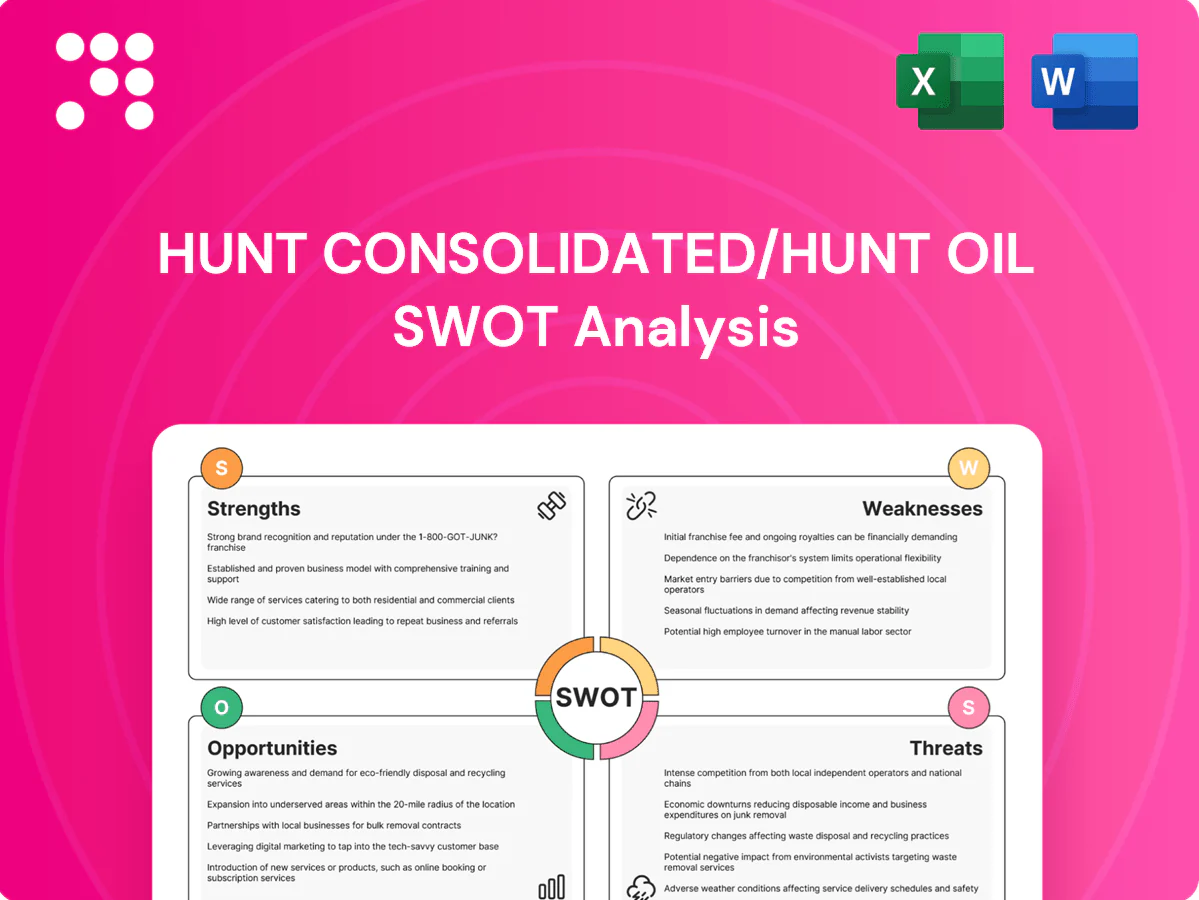
This preview is an actual excerpt from the Hunt Consolidated / Hunt Oil SWOT analysis you’ll receive upon purchase—no placeholders, no surprises. The full document is professional, structured, and editable, and it becomes available immediately after checkout. Buy now to unlock the complete, in-depth report.

Product Information
Product Information
Shipping & Returns
Shipping & Returns
Description
Your Strategic Toolkit Starts Here
Hunt Consolidated/Hunt Oil's strategic footprint, asset diversification, and geopolitical exposure create a complex mix of strengths and risks that demand careful evaluation. Our preview highlights key competitive advantages, operational vulnerabilities, and growth drivers across upstream and service operations. Purchase the complete SWOT analysis to gain access to a professionally written, fully editable report designed to support planning, pitches, and research.
Strengths
Diversified portfolio
As of 2024 Hunt Consolidated operates across E&P, real estate, power and diversified investments, which reduces earnings volatility and cyclicality by spreading exposure across sectors. Cash flows from real estate and investment arms provide a buffer during oil and gas downturns. This diversification creates cross-segment optionality for capital allocation and enhances resilience through differing macro cycles.
Deep E&P expertise
Over 80 years of global exploration and production experience underpins Hunt’s technical capability and basin knowledge, enabling repeatable subsurface models and play development. Scale and accumulated know-how support lower finding and development costs through shared drilling, completion and logistics practices. Established regional relationships improve access to acreage and partners, and operational learnings compound across assets.
Private ownership agility
As a privately held company, Hunt Consolidated can take a multi‑decade view and avoid SEC quarterly reporting and public earnings guidance, enabling decisive strategic pivots and portfolio reshaping with fewer disclosure constraints; clear family governance facilitates rapid capital deployment and confidential dealmaking, preserving competitive advantage in upstream and midstream projects while most US firms remain privately held (SBA: ~99.9% are small businesses).
Integrated energy footprint
Integrated exposure across upstream and power gives Hunt optionality across the energy value chain; power assets provide more stable, contracted cashflows via power purchase agreements (PPAs typically 10–25 years), while E&P preserves commodity upside. Knowledge transfer across segments strengthens risk management and enables participation in transition-era projects.
- Optionality: upstream + power
- Stability: PPAs typically 10–25 years
- Risk management: cross-segment knowledge transfer
- Transition: supports low‑carbon project participation
Strong reputation and legacy
Hunt Consolidated’s oil business traces to 1934, and that long industry presence builds credibility with regulators, partners and capital providers, while a decades-long track record supports preferential access to quality deal flow. Institutional memory promotes disciplined risk-taking across cycles, and the Hunt brand helps attract top technical talent.
- RegulatoryCredibility
- DealFlowAccess
- InstitutionalMemory
- TalentAttraction
4-segment energy & real estate platform; PPAs 10–25 yrs; family-owned
Hunt Consolidated operates four principal segments (E&P, real estate, power, investments), reducing cyclicality and providing cross‑segment capital optionality. Family‑owned since 1934 (91 years in 2025), the private structure enables long‑term deployment and confidential dealmaking. Power PPAs typically span 10–25 years, providing contracted cashflow stability.
| Metric | Value |
|---|---|
| Segments | 4 |
| Founded | 1934 (91 yrs) |
| PPA tenor | 10–25 yrs |
| Ownership | Privately held |
What is included in the product
Detailed Word Document
Provides a concise SWOT analysis of Hunt Consolidated/Hunt Oil, highlighting strengths in diversified energy assets and private capital, weaknesses from commodity exposure and legacy infrastructure, opportunities in energy transition and unconventional plays, and threats from regulatory shifts, market volatility, and intensifying competition.
Customizable Excel Spreadsheet
Provides a concise SWOT matrix tailored to Hunt Consolidated/Hunt Oil for fast strategic alignment and risk mitigation; editable format enables quick updates as market, regulatory, or commodity conditions change.
Weaknesses
Commodity price exposure
Core earnings at Hunt remain closely tied to volatile oil and gas prices, exemplified by extremes such as WTI briefly trading negative on April 20, 2020 and Brent spiking toward $139/bbl in March 2022; such swings can disrupt cash flows and capex plans. Hedging programs blunt short-term moves but do not eliminate basis, timing or counterparty risk. Prolonged downturns compress returns and make reserves replacement more costly and uncertain.
Capital intensity
E&P and power projects demand large upfront capex and often multi‑year paybacks (commonly 5–10+ years), so cost overruns or delays can materially cut IRR; competing capital needs across Hunt’s segments can dilute strategic focus. Higher financing costs—US federal funds target 5.25–5.50% in mid‑2025—increase hurdle rates and raise borrowing costs for large projects.
Private-market opacity
Limited public disclosures for Hunt’s private-market oil assets constrain external benchmarking and valuation transparency because private entities are not SEC-reporting issuers, limiting peer comparables. This opacity can restrict access to institutional capital and secondary-market liquidity, often prompting counterparties to demand higher risk premia. ESG data gaps complicate stakeholder assessments amid ISSB standards adoption in 2023–25.
Geopolitical and operational risk
Global E&P exposure brings country risk, licensing uncertainty and security challenges that can disrupt Hunt Consolidated’s upstream projects; operational incidents cause downtime and reputational damage, increasing project delays and remediation costs. Supply chain and services availability strain schedules and inflate operating costs, while higher insurance premiums and complex compliance regimes add recurring overhead.
- Country risk and licensing uncertainty
- Security and operational incident exposure
- Supply chain/service availability pressures
- Rising insurance and compliance costs
Environmental liabilities
Environmental liabilities—high carbon intensity, methane releases and growing decommissioning obligations—expose Hunt Consolidated/Hunt Oil to material financial and legal risk; methane is ~84 times more potent than CO2 over 20 years (IPCC AR5), amplifying regulatory pressure. EPA and state methane/oil‑and‑gas rules tightened in 2023–24, raising compliance costs and remediation needs for legacy assets, while public scrutiny can slow permitting and partnerships.
- Carbon & methane intensity — higher GHG risk
- Stricter EPA/state rules (2023–24) — higher compliance costs
- Legacy assets — potential remediation/decommissioning liabilities
- Public scrutiny — permitting and JV risk
Upstream earnings squeezed by oil price swings, higher rates and stricter methane rules
Hunt’s earnings remain tied to volatile oil prices (WTI went negative 4/20/2020; Brent hit ~$139/bbl Mar 2022), compressing cash flow and reserve economics. High upfront capex and 5.25–5.50% US policy rates (mid‑2025) raise financing hurdles. Tightened EPA/state methane/oil rules in 2023–24 and methane potency (~84x CO2 over 20y) increase compliance and remediation costs.
| Risk | Metric | Estimated impact |
|---|---|---|
| Price Volatility | WTI/Brent extremes | Cashflow volatility |
Preview Before You Purchase
Hunt Consolidated/Hunt Oil SWOT Analysis
This preview is an actual excerpt from the Hunt Consolidated / Hunt Oil SWOT analysis you’ll receive upon purchase—no placeholders, no surprises. The full document is professional, structured, and editable, and it becomes available immediately after checkout. Buy now to unlock the complete, in-depth report.