Huhtamaki PESTLE Analysis

Skip the Research. Get the Strategy.
Discover how political shifts, economic cycles, and sustainability trends are reshaping Huhtamaki’s strategic landscape in this concise PESTLE snapshot. Ideal for investors and strategists, it highlights risks and growth levers you can act on today. Purchase the full PESTLE for detailed, ready-to-use insights and data-driven recommendations.
Political factors

Trade policies and tariffs
Escalating trade tensions and shifting tariff regimes, often imposing levies in the 10–25% range on polymers, paper and machinery, raise input costs and squeeze margins for packagers like Huhtamaki. Preferential trade agreements such as CPTPP and EU deals can open growth lanes for packaged-food exports, lifting demand for packaging. Sanctions and export controls have recently disrupted regional supply chains, so strategic sourcing and regionalization are used to mitigate exposure.
Government sustainability incentives
Government incentives such as the EU Circular Economy Action Plan and the US Inflation Reduction Act (roughly $369bn for clean energy) cut payback periods for Huhtamaki circular and decarbonization projects, making investments in fiber-based recyclable solutions more viable. Policy support and procurement rules accelerate market adoption of fiber packaging, while green financing linked to policy frameworks can lower capital costs by roughly 10–25 basis points. Tracking policy pipelines enables Huhtamaki to prioritize R&D bets and capture grant/subsidy windows.

Geopolitical stability and energy policy
Conflicts and energy-policy shifts drive electricity and gas price volatility — European TTF gas peaked ~345 EUR/MWh in Aug 2022, while wholesale power spikes continued sporadically into 2023–24, affecting plant operating costs. Political choices on energy mix and measures like the EU ETS (trading >€90/ton CO2 in 2024) directly change carbon intensity of production sites. Operation in stable jurisdictions supports predictable planning and uptime, while a diversified footprint and active energy hedging lower cost and supply risks.

Public procurement and food security
Government-led school meal and healthcare procurement sets packaging standards and predictable volumes, supporting demand for safe, tamper-evident formats; OECD data shows public procurement averages about 12% of GDP, and WFP reported school feeding reached 388 million children in 2022, underscoring scale. Local content rules affect site placement and supplier selection, and compliance can secure long-term, low-risk contracts.
- Standards/volumes: stable public demand
- Food safety: tamper-evident formats prioritized
- Local content: influences plant/supplier location
- Contracts: compliance → multi-year public contracts
EPR and waste management policy
Extended Producer Responsibility schemes shift end-of-life costs to packaging producers, increasing Huhtamaki’s accountability for collection and treatment under expanding national and EU frameworks such as the Packaging and Packaging Waste Regulation. Design-for-recycling is being mandated more often, driving product redesign and material choices. Modulated fees and eco-taxes reward recyclable, low-impact formats, so early alignment reduces future regulatory cost burdens.
- EPR shifts disposal costs to producers
- Design-for-recycling mandated in national/EU rules
- Fees/eco-taxes favor recyclable formats
- Early compliance lowers regulatory costs
Tariffs, EU ETS >€90/t and IRA $369bn spur green circular export shift
Trade tariffs (often 10–25%) and sanctions raise input costs; CPTPP/EU deals open export lanes. EU ETS >€90/t CO2 (2024) and IRA ~$369bn (clean energy) spur circular/decab investments; green finance can cut funding costs ~10–25 bps. EPR/design-for-recycling and public procurement (~12% GDP) shift costs and secure volumes.
| Factor | Metric |
|---|---|
| EU ETS | >€90/t (2024) |
| US IRA | ~$369bn |
| Public procurement | ~12% GDP (OECD) |
| School feeding | 388M children (2022) |
What is included in the product
 Detailed Word Document
Explores how Political, Economic, Social, Technological, Environmental and Legal factors uniquely affect Huhtamaki, with data-backed, forward-looking insights and detailed sub-points to support executives, investors and strategists in scenario planning, risk mitigation and opportunity identification—ready for reports and decks.

 Customizable Excel Spreadsheet
A concise, PESTLE‑segmented summary of Huhtamaki’s external risks and opportunities that can be dropped into presentations or strategy sessions to streamline decision‑making and cross‑team alignment.
Economic factors

Input cost volatility
Pulp, recycled fiber, polymers and aluminium follow global commodity cycles—LME aluminium traded roughly $1,800–2,500/t in 2022–24 and Brent crude ranged ~$70–120/bbl, driving polymer feedstock swings; cost spikes compressed Huhtamaki margins in 2021–22 unless passed to customers. Long-term contracts and hedges helped stabilize gross margin, while material-substitution flexibility (fiber vs. polymer) improved resilience.
Consumer demand and foodservice cycles
Packaging volumes track on-the-go consumption and quick-service channels; recessions shift sales toward value formats and retail multipacks while recovery in travel and hospitality lifts high-volume disposables — passenger traffic recovered to about 95% of 2019 levels in 2024 (IATA). Huhtamaki’s broad portfolio smooths category cyclicality by balancing retail multipacks with foodservice disposables.

FX and emerging market exposure
Huhtamaki earns revenues in multiple local currencies while sourcing inputs and servicing debt largely in euros and dollars, so EUR/USD swings (range about 0.95–1.12 in 2024) and local currency moves affect both translation and transaction margins. Localized sourcing, pass-through pricing and FX clauses mitigate shocks, but emerging market exposure—IMF 2024 EM growth ~4.3%—offers volume upside with higher volatility and occasional currency losses.

Inflation and interest rates
High inflation pushed wages, utilities and logistics costs for Huhtamaki, though euro-area HICP eased to about 2.9% in 2024 (Eurostat), leaving residual input-price pressure. ECB policy rates near 4.0% in 2024 raised financing costs for capex and M&A, lifting hurdle rates. Productivity gains and automation plus prioritised ROI projects helped offset unit-cost inflation and preserve margins.
- Inflation: euro-area HICP ~2.9% (2024)
- Rates: ECB policy ~4.0% (2024)
- Mitigants: automation, productivity, ROI-focused capex
Logistics and supply chain efficiency
Freight bottlenecks and elevated container rates—which fell over 80% from 2021 peaks by 2024—have raised Huhtamaki’s cost-to-serve and pressured service levels, while nearshoring and multi-sourcing improved continuity across its packaging network.
Network optimization has shortened lead times and lowered inventory needs, and data-driven planning (forecast error reductions up to 30% in peers) enhances production matching and working capital efficiency.
- Freight pressure: higher cost-to-serve
- Nearshoring/multi-sourcing: continuity
- Network optimization: lower lead times/inventory
- Data-driven planning: better forecast accuracy
Tariffs, EU ETS >€90/t and IRA $369bn spur green circular export shift
Commodity swings (LME Al $1,800–2,500/t; Brent $70–120/bbl in 2022–24) and freight volatility raised input and transport costs, pressuring margins; pass-through pricing, long-term contracts and fiber/polymer flexibility eased impact. FX (EUR/USD ~0.95–1.12 in 2024) and ECB rates (~4.0% 2024) lifted financing costs while EM growth (~4.3% IMF 2024) supports volume upside.
| Metric | 2024 |
|---|---|
| HICP | 2.9% |
| ECB rate | ~4.0% |
| Passenger traffic | ~95% of 2019 |
Preview the Actual Deliverable
Huhtamaki PESTLE Analysis
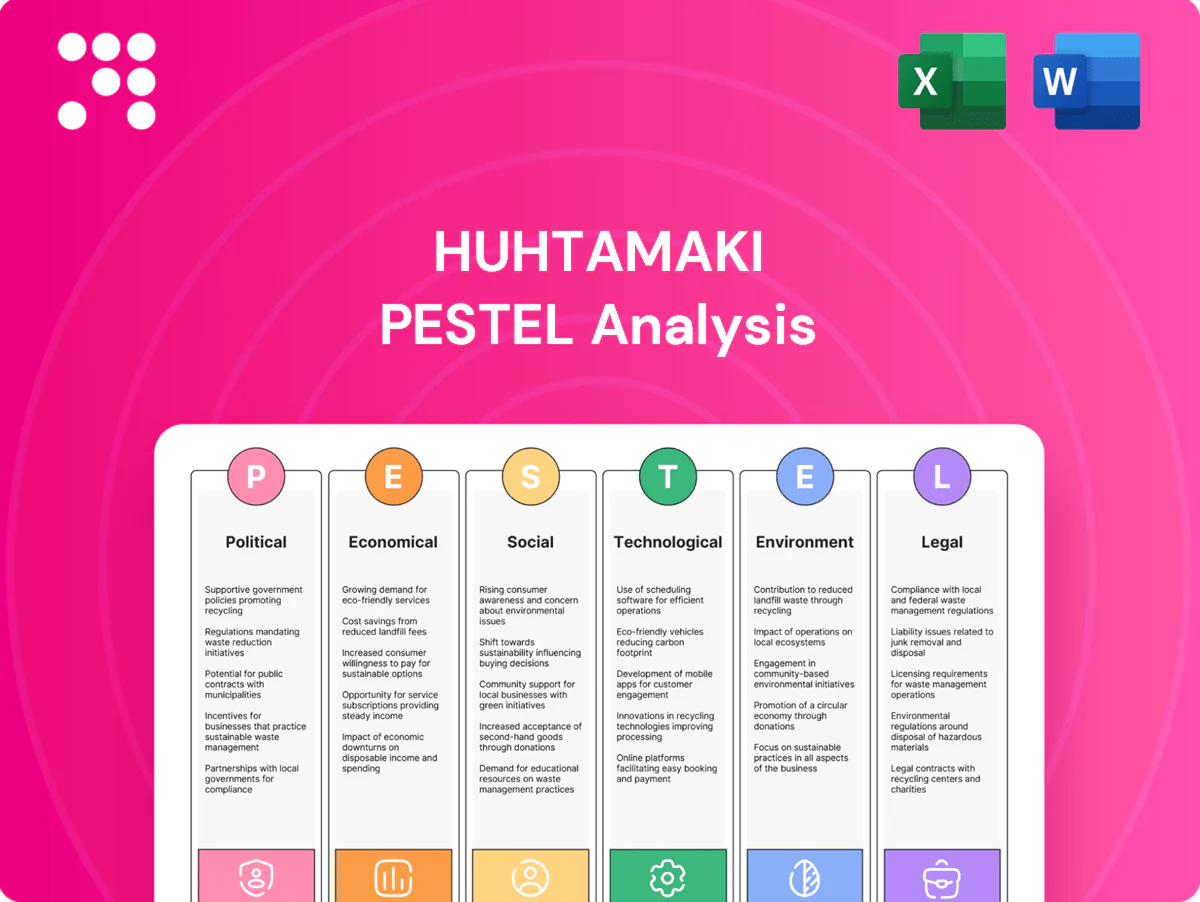
This Huhtamaki PESTLE Analysis preview is the exact document you’ll receive after purchase—fully formatted and ready to use. It covers political, economic, social, technological, legal, and environmental factors specific to Huhtamäki with professional structure and citations. No placeholders or teasers—what you see is the final, downloadable file. Purchase delivers this same complete report instantly.

Original: $10.00
-65%$10.00
$3.50Product Information
Product Information
Shipping & Returns
Shipping & Returns
Description
Skip the Research. Get the Strategy.
Discover how political shifts, economic cycles, and sustainability trends are reshaping Huhtamaki’s strategic landscape in this concise PESTLE snapshot. Ideal for investors and strategists, it highlights risks and growth levers you can act on today. Purchase the full PESTLE for detailed, ready-to-use insights and data-driven recommendations.
Political factors
Trade policies and tariffs
Escalating trade tensions and shifting tariff regimes, often imposing levies in the 10–25% range on polymers, paper and machinery, raise input costs and squeeze margins for packagers like Huhtamaki. Preferential trade agreements such as CPTPP and EU deals can open growth lanes for packaged-food exports, lifting demand for packaging. Sanctions and export controls have recently disrupted regional supply chains, so strategic sourcing and regionalization are used to mitigate exposure.
Government sustainability incentives
Government incentives such as the EU Circular Economy Action Plan and the US Inflation Reduction Act (roughly $369bn for clean energy) cut payback periods for Huhtamaki circular and decarbonization projects, making investments in fiber-based recyclable solutions more viable. Policy support and procurement rules accelerate market adoption of fiber packaging, while green financing linked to policy frameworks can lower capital costs by roughly 10–25 basis points. Tracking policy pipelines enables Huhtamaki to prioritize R&D bets and capture grant/subsidy windows.
Geopolitical stability and energy policy
Conflicts and energy-policy shifts drive electricity and gas price volatility — European TTF gas peaked ~345 EUR/MWh in Aug 2022, while wholesale power spikes continued sporadically into 2023–24, affecting plant operating costs. Political choices on energy mix and measures like the EU ETS (trading >€90/ton CO2 in 2024) directly change carbon intensity of production sites. Operation in stable jurisdictions supports predictable planning and uptime, while a diversified footprint and active energy hedging lower cost and supply risks.
Public procurement and food security
Government-led school meal and healthcare procurement sets packaging standards and predictable volumes, supporting demand for safe, tamper-evident formats; OECD data shows public procurement averages about 12% of GDP, and WFP reported school feeding reached 388 million children in 2022, underscoring scale. Local content rules affect site placement and supplier selection, and compliance can secure long-term, low-risk contracts.
- Standards/volumes: stable public demand
- Food safety: tamper-evident formats prioritized
- Local content: influences plant/supplier location
- Contracts: compliance → multi-year public contracts
EPR and waste management policy
Extended Producer Responsibility schemes shift end-of-life costs to packaging producers, increasing Huhtamaki’s accountability for collection and treatment under expanding national and EU frameworks such as the Packaging and Packaging Waste Regulation. Design-for-recycling is being mandated more often, driving product redesign and material choices. Modulated fees and eco-taxes reward recyclable, low-impact formats, so early alignment reduces future regulatory cost burdens.
- EPR shifts disposal costs to producers
- Design-for-recycling mandated in national/EU rules
- Fees/eco-taxes favor recyclable formats
- Early compliance lowers regulatory costs
Tariffs, EU ETS >€90/t and IRA $369bn spur green circular export shift
Trade tariffs (often 10–25%) and sanctions raise input costs; CPTPP/EU deals open export lanes. EU ETS >€90/t CO2 (2024) and IRA ~$369bn (clean energy) spur circular/decab investments; green finance can cut funding costs ~10–25 bps. EPR/design-for-recycling and public procurement (~12% GDP) shift costs and secure volumes.
| Factor | Metric |
|---|---|
| EU ETS | >€90/t (2024) |
| US IRA | ~$369bn |
| Public procurement | ~12% GDP (OECD) |
| School feeding | 388M children (2022) |
What is included in the product
Detailed Word Document
Explores how Political, Economic, Social, Technological, Environmental and Legal factors uniquely affect Huhtamaki, with data-backed, forward-looking insights and detailed sub-points to support executives, investors and strategists in scenario planning, risk mitigation and opportunity identification—ready for reports and decks.
Customizable Excel Spreadsheet
A concise, PESTLE‑segmented summary of Huhtamaki’s external risks and opportunities that can be dropped into presentations or strategy sessions to streamline decision‑making and cross‑team alignment.
Economic factors
Input cost volatility
Pulp, recycled fiber, polymers and aluminium follow global commodity cycles—LME aluminium traded roughly $1,800–2,500/t in 2022–24 and Brent crude ranged ~$70–120/bbl, driving polymer feedstock swings; cost spikes compressed Huhtamaki margins in 2021–22 unless passed to customers. Long-term contracts and hedges helped stabilize gross margin, while material-substitution flexibility (fiber vs. polymer) improved resilience.
Consumer demand and foodservice cycles
Packaging volumes track on-the-go consumption and quick-service channels; recessions shift sales toward value formats and retail multipacks while recovery in travel and hospitality lifts high-volume disposables — passenger traffic recovered to about 95% of 2019 levels in 2024 (IATA). Huhtamaki’s broad portfolio smooths category cyclicality by balancing retail multipacks with foodservice disposables.
FX and emerging market exposure
Huhtamaki earns revenues in multiple local currencies while sourcing inputs and servicing debt largely in euros and dollars, so EUR/USD swings (range about 0.95–1.12 in 2024) and local currency moves affect both translation and transaction margins. Localized sourcing, pass-through pricing and FX clauses mitigate shocks, but emerging market exposure—IMF 2024 EM growth ~4.3%—offers volume upside with higher volatility and occasional currency losses.
Inflation and interest rates
High inflation pushed wages, utilities and logistics costs for Huhtamaki, though euro-area HICP eased to about 2.9% in 2024 (Eurostat), leaving residual input-price pressure. ECB policy rates near 4.0% in 2024 raised financing costs for capex and M&A, lifting hurdle rates. Productivity gains and automation plus prioritised ROI projects helped offset unit-cost inflation and preserve margins.
- Inflation: euro-area HICP ~2.9% (2024)
- Rates: ECB policy ~4.0% (2024)
- Mitigants: automation, productivity, ROI-focused capex
Logistics and supply chain efficiency
Freight bottlenecks and elevated container rates—which fell over 80% from 2021 peaks by 2024—have raised Huhtamaki’s cost-to-serve and pressured service levels, while nearshoring and multi-sourcing improved continuity across its packaging network.
Network optimization has shortened lead times and lowered inventory needs, and data-driven planning (forecast error reductions up to 30% in peers) enhances production matching and working capital efficiency.
- Freight pressure: higher cost-to-serve
- Nearshoring/multi-sourcing: continuity
- Network optimization: lower lead times/inventory
- Data-driven planning: better forecast accuracy
Tariffs, EU ETS >€90/t and IRA $369bn spur green circular export shift
Commodity swings (LME Al $1,800–2,500/t; Brent $70–120/bbl in 2022–24) and freight volatility raised input and transport costs, pressuring margins; pass-through pricing, long-term contracts and fiber/polymer flexibility eased impact. FX (EUR/USD ~0.95–1.12 in 2024) and ECB rates (~4.0% 2024) lifted financing costs while EM growth (~4.3% IMF 2024) supports volume upside.
| Metric | 2024 |
|---|---|
| HICP | 2.9% |
| ECB rate | ~4.0% |
| Passenger traffic | ~95% of 2019 |
Preview the Actual Deliverable
Huhtamaki PESTLE Analysis
This Huhtamaki PESTLE Analysis preview is the exact document you’ll receive after purchase—fully formatted and ready to use. It covers political, economic, social, technological, legal, and environmental factors specific to Huhtamäki with professional structure and citations. No placeholders or teasers—what you see is the final, downloadable file. Purchase delivers this same complete report instantly.