House Foods Group PESTLE Analysis

Your Shortcut to Market Insight Starts Here
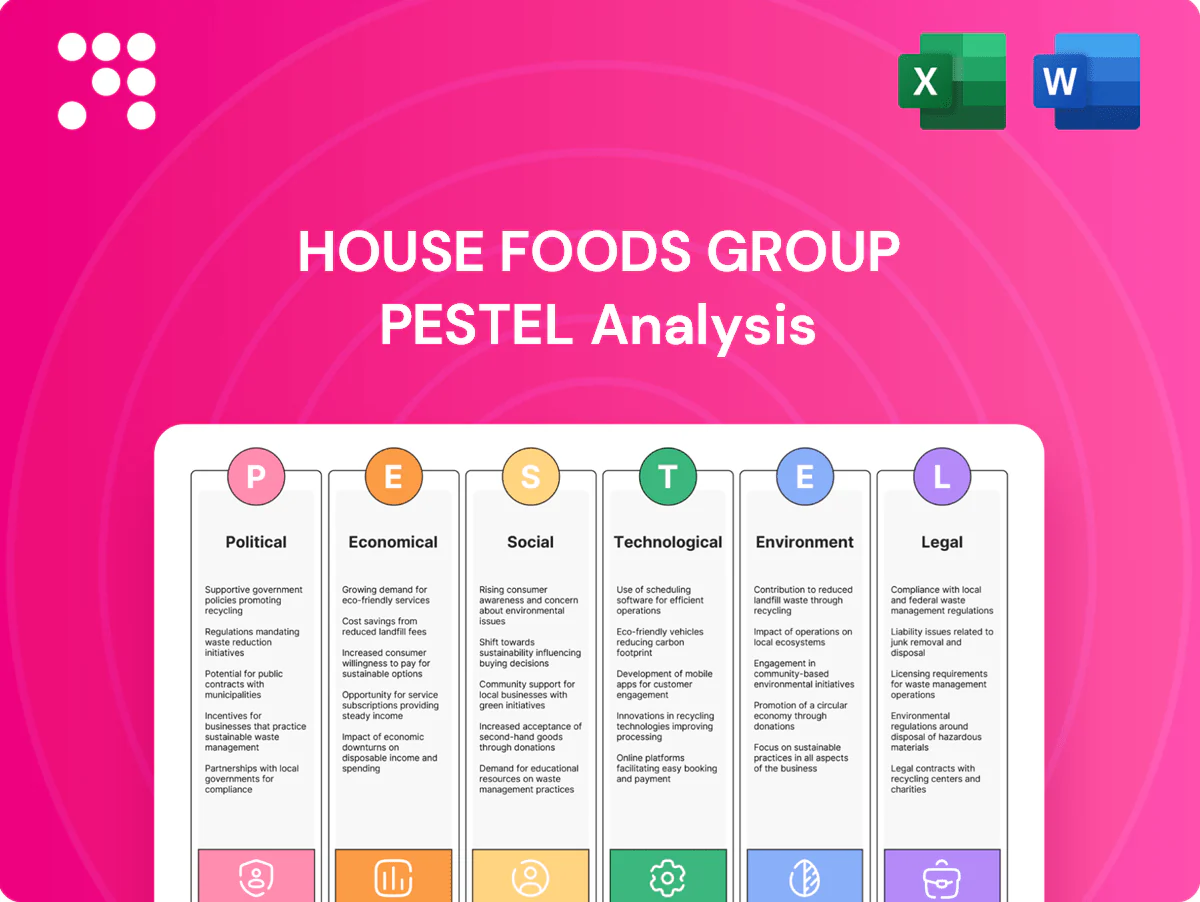
Our PESTLE Analysis for House Foods Group maps the political, economic, social, technological, legal, and environmental forces reshaping its market position. It highlights regulatory risks, consumer trends, and innovation drivers that matter to investors and strategists. Use these insights to anticipate threats and spot growth opportunities. Buy the full report now for the complete, actionable breakdown.
Political factors

Food security and import policies
Japan's food self-sufficiency is about 37% (calorie basis, MAFF 2023), while a WTO rice TRQ of 682,000 tonnes and tariff-rate schemes shape costs for grains and dairy; spice inputs largely sourced from India/Vietnam and cocoa from Côte d'Ivoire/Ghana (together ~60% of global cocoa), creating geopolitical exposure. Government stockpiling/strategic reserves constrain procurement flexibility; multi-origin sourcing and local contract farming are key mitigants.
Regulatory oversight and food safety governance
Japan made HACCP-based controls mandatory for food business operators under the revised Food Sanitation Act with a June 2021 deadline. Central and local authorities enforce inspections and recall protocols, and high-profile incidents prompt tighter post-incident standards across processors and restaurants. Compliance raises upfront costs but boosts brand trust and exportability through coordination with regulators such as the US FDA and EU authorities.

Subsidies and innovation incentives
Access to METI and local R&D grants plus Japan’s R&D tax credit (up to 14% for qualifying incremental spend) and productivity subsidies support automation, digitalization and health-food innovation, but require domestic-activity eligibility, detailed project reporting and frequent audits. Such incentives can speed plant-based, low-allergen and functional-food launches, while rival firms winning similar support raise industry capex competition and compress first-mover advantages.

Trade agreements and market access
- tariff cuts: CPTPP >95% lines; EU‑Japan ~97%
- benefits: streamlined rules of origin, label alignment
- NTBs: SPS, permits, packaging standards in ASEAN/NA
- risks: JPY volatility (~±15% 2022–24), customs delays impact margins
Public health and nutrition policy direction
Government campaigns on sodium, sugar and trans fats force House Foods to reformulate packaged lines and restaurant menus; WHO estimates sodium reduction could avert roughly 2.5 million deaths, and Mexico’s sugar tax saw a 5.5% sales decline in year one, prompting labeling and recipe changes.
- Policy tools: sugar taxes, front-of-pack warnings
- Procurement: school-lunch nutrition criteria affect supplier selection
- Timing/cost: reformulation lead times months–>12+ months; SKU compliance raises ingredient and CAPEX pressures
Japan food security and cocoa import risk drive reformulation, CAPEX and cost volatility
Japan's food self-sufficiency ~37% (calorie basis, MAFF 2023) and reliance on imports (cocoa origins Côte d'Ivoire/Ghana ~60%) raise geopolitical procurement risk; CPTPP (>95% tariff lines) and EU–Japan EPA (~97%) cut duties but NTBs and JPY volatility (~±15% 2022–24) affect landed costs. Mandatory HACCP (from 2021) and salt/sugar policies force reformulation and CAPEX; R&D credits (up to 14%) and METI grants support innovation.
| Factor | Metric |
|---|---|
| Food self-sufficiency | ~37% (MAFF 2023) |
| Cocoa origin risk | Côte d'Ivoire/Ghana ~60% global |
| Tariff liberalization | CPTPP >95% lines; EU–Japan ~97% |
| Currency volatility | JPY ~±15% (2022–24) |
| Regulation | HACCP mandatory since 2021 |
| Incentives | R&D tax credit up to 14% |
What is included in the product
 Detailed Word Document
Explores how Political, Economic, Social, Technological, Environmental and Legal forces uniquely shape House Foods Group’s strategy and operations, with data-driven insights and trend analysis tailored to its food, ingredient and retail businesses. Designed to help executives and investors identify opportunities, mitigate risks and support scenario planning.

 Customizable Excel Spreadsheet
A concise, visually segmented PESTLE summary for House Foods Group that highlights external risks and opportunities, easily dropped into presentations or shared across teams to speed decision-making and support strategy sessions.
Economic factors

Exchange rate volatility
Yen depreciation of roughly 15% since 2021 has raised imported spice and dairy costs by about 10–12% and packaging costs by ~5–8%, pressuring COGS for House Foods Group.
Full pass-through to retail is limited in Japan, so the group faces margin compression in consumer foods while B2B/restaurant and healthcare contracts show greater price rigidity.
House Foods mitigates via FX forwards and commodity hedges and benefits from overseas sales (around one-quarter of revenue) as a natural currency offset, but pricing in restaurants and healthcare food services remains sensitive.
Consumer spending cycles
House Foods categories show demand sensitivity: Japan CPI rose about 3% in 2024, pressuring real wages and reducing spend on discretionary desserts while stabilizing staples like curry, noodles, and snacks. Downturns drive trade-downs to private labels, which can gain several percentage points share in supermarkets (often reaching ~15–20%). At-home cooking items prove more resilient than desserts. Channel shifts favor supermarkets and convenience stores for staples, while e-commerce grocery sales grew strongly (~+25% 2019–2024).

Input cost inflation
Volatility in palm oil (peaked ~+20% in 2024), wheat (down ~12% YoY in 2024), sugar (+8%) and dairy (+6%) materially pressures House Foods Group COGS, forcing margin management. Supplier contracts now include indexation clauses and short-cycle purchase windows; reformulation (e.g., palm blends) is used to blunt spikes. Higher energy and freight costs—Brent ~86 USD/bbl avg 2024—affect plant footprint decisions. Price revisions are timed quarterly with major retailers and wholesalers to pass through costs.

Global expansion and portfolio diversification
Global expansion across Asia and North America smooths domestic cyclicality by diversifying revenue streams, enabling demand offsets between markets; localized flavors and tiered price points capture premium and value segments, boosting volume and margin mix. Packaged-food R&D and supply chains create synergies with restaurant operations through co-branded products and bulk procurement, while capital allocation must balance steady returns in mature markets against higher-growth opportunities and rollout costs in emerging markets.
- Geographic diversification: reduces volatility
- Localization: captures growth segments
- Synergies: supply chain and co-branding
- Capital trade-offs: mature stability vs emerging growth
Labor market and productivity
Japan's aging population (65+ about 29% in 2024) strains manufacturing and foodservice staffing, raising recruitment gaps and shift-coverage risk; wage inflation (Shunto 2024 base increases ~3.6%) plus statutory overtime caps (720 hours/year) squeeze margins. Automation and process redesign can lift output per worker 20–40% with typical payback of 3–5 years, while selective outsourcing and regional hubs (Vietnam, Philippines) reduce labor cost and flex risk.
- Demographics: 65+ ~29% (2024)
- Wage pressure: Shunto ~+3.6% (2024)
- Overtime cap: 720 hrs/yr
- Automation ROI: payback 3–5 yrs; productivity +20–40%
- Options: outsourcing; regional hubs (VN, PH)
Japan food security and cocoa import risk drive reformulation, CAPEX and cost volatility
Yen down ~15% since 2021 raised spice/dairy costs ~10–12% and packaging ~5–8%, squeezing retail margins despite FX hedges; overseas sales ~25% offset currency risk. Japan CPI ~+3% (2024) and Shunto wage +3.6% pressure demand and labor costs; palm oil +20% (2024) and Brent ~$86/bbl raise COGS and freight.
| Metric | Value |
|---|---|
| Overseas rev | ~25% |
| Yen change | -15% since 2021 |
| Japan CPI (2024) | +3% |
| Palm oil (2024) | +20% |
Preview the Actual Deliverable
House Foods Group PESTLE Analysis
The preview shown here is the exact House Foods Group PESTLE Analysis you’ll receive after purchase—fully formatted and ready to use. This screenshot reflects the final content, structure, and layout with no placeholders or edits pending. After checkout you’ll instantly download this same professional, ready-to-present document.

Original: $10.00
-65%$10.00
$3.50Product Information
Product Information
Shipping & Returns
Shipping & Returns
Description
Your Shortcut to Market Insight Starts Here
Our PESTLE Analysis for House Foods Group maps the political, economic, social, technological, legal, and environmental forces reshaping its market position. It highlights regulatory risks, consumer trends, and innovation drivers that matter to investors and strategists. Use these insights to anticipate threats and spot growth opportunities. Buy the full report now for the complete, actionable breakdown.
Political factors
Food security and import policies
Japan's food self-sufficiency is about 37% (calorie basis, MAFF 2023), while a WTO rice TRQ of 682,000 tonnes and tariff-rate schemes shape costs for grains and dairy; spice inputs largely sourced from India/Vietnam and cocoa from Côte d'Ivoire/Ghana (together ~60% of global cocoa), creating geopolitical exposure. Government stockpiling/strategic reserves constrain procurement flexibility; multi-origin sourcing and local contract farming are key mitigants.
Regulatory oversight and food safety governance
Japan made HACCP-based controls mandatory for food business operators under the revised Food Sanitation Act with a June 2021 deadline. Central and local authorities enforce inspections and recall protocols, and high-profile incidents prompt tighter post-incident standards across processors and restaurants. Compliance raises upfront costs but boosts brand trust and exportability through coordination with regulators such as the US FDA and EU authorities.
Subsidies and innovation incentives
Access to METI and local R&D grants plus Japan’s R&D tax credit (up to 14% for qualifying incremental spend) and productivity subsidies support automation, digitalization and health-food innovation, but require domestic-activity eligibility, detailed project reporting and frequent audits. Such incentives can speed plant-based, low-allergen and functional-food launches, while rival firms winning similar support raise industry capex competition and compress first-mover advantages.
Trade agreements and market access
- tariff cuts: CPTPP >95% lines; EU‑Japan ~97%
- benefits: streamlined rules of origin, label alignment
- NTBs: SPS, permits, packaging standards in ASEAN/NA
- risks: JPY volatility (~±15% 2022–24), customs delays impact margins
Public health and nutrition policy direction
Government campaigns on sodium, sugar and trans fats force House Foods to reformulate packaged lines and restaurant menus; WHO estimates sodium reduction could avert roughly 2.5 million deaths, and Mexico’s sugar tax saw a 5.5% sales decline in year one, prompting labeling and recipe changes.
- Policy tools: sugar taxes, front-of-pack warnings
- Procurement: school-lunch nutrition criteria affect supplier selection
- Timing/cost: reformulation lead times months–>12+ months; SKU compliance raises ingredient and CAPEX pressures
Japan food security and cocoa import risk drive reformulation, CAPEX and cost volatility
Japan's food self-sufficiency ~37% (calorie basis, MAFF 2023) and reliance on imports (cocoa origins Côte d'Ivoire/Ghana ~60%) raise geopolitical procurement risk; CPTPP (>95% tariff lines) and EU–Japan EPA (~97%) cut duties but NTBs and JPY volatility (~±15% 2022–24) affect landed costs. Mandatory HACCP (from 2021) and salt/sugar policies force reformulation and CAPEX; R&D credits (up to 14%) and METI grants support innovation.
| Factor | Metric |
|---|---|
| Food self-sufficiency | ~37% (MAFF 2023) |
| Cocoa origin risk | Côte d'Ivoire/Ghana ~60% global |
| Tariff liberalization | CPTPP >95% lines; EU–Japan ~97% |
| Currency volatility | JPY ~±15% (2022–24) |
| Regulation | HACCP mandatory since 2021 |
| Incentives | R&D tax credit up to 14% |
What is included in the product
Detailed Word Document
Explores how Political, Economic, Social, Technological, Environmental and Legal forces uniquely shape House Foods Group’s strategy and operations, with data-driven insights and trend analysis tailored to its food, ingredient and retail businesses. Designed to help executives and investors identify opportunities, mitigate risks and support scenario planning.
Customizable Excel Spreadsheet
A concise, visually segmented PESTLE summary for House Foods Group that highlights external risks and opportunities, easily dropped into presentations or shared across teams to speed decision-making and support strategy sessions.
Economic factors
Exchange rate volatility
Yen depreciation of roughly 15% since 2021 has raised imported spice and dairy costs by about 10–12% and packaging costs by ~5–8%, pressuring COGS for House Foods Group.
Full pass-through to retail is limited in Japan, so the group faces margin compression in consumer foods while B2B/restaurant and healthcare contracts show greater price rigidity.
House Foods mitigates via FX forwards and commodity hedges and benefits from overseas sales (around one-quarter of revenue) as a natural currency offset, but pricing in restaurants and healthcare food services remains sensitive.
Consumer spending cycles
House Foods categories show demand sensitivity: Japan CPI rose about 3% in 2024, pressuring real wages and reducing spend on discretionary desserts while stabilizing staples like curry, noodles, and snacks. Downturns drive trade-downs to private labels, which can gain several percentage points share in supermarkets (often reaching ~15–20%). At-home cooking items prove more resilient than desserts. Channel shifts favor supermarkets and convenience stores for staples, while e-commerce grocery sales grew strongly (~+25% 2019–2024).
Input cost inflation
Volatility in palm oil (peaked ~+20% in 2024), wheat (down ~12% YoY in 2024), sugar (+8%) and dairy (+6%) materially pressures House Foods Group COGS, forcing margin management. Supplier contracts now include indexation clauses and short-cycle purchase windows; reformulation (e.g., palm blends) is used to blunt spikes. Higher energy and freight costs—Brent ~86 USD/bbl avg 2024—affect plant footprint decisions. Price revisions are timed quarterly with major retailers and wholesalers to pass through costs.
Global expansion and portfolio diversification
Global expansion across Asia and North America smooths domestic cyclicality by diversifying revenue streams, enabling demand offsets between markets; localized flavors and tiered price points capture premium and value segments, boosting volume and margin mix. Packaged-food R&D and supply chains create synergies with restaurant operations through co-branded products and bulk procurement, while capital allocation must balance steady returns in mature markets against higher-growth opportunities and rollout costs in emerging markets.
- Geographic diversification: reduces volatility
- Localization: captures growth segments
- Synergies: supply chain and co-branding
- Capital trade-offs: mature stability vs emerging growth
Labor market and productivity
Japan's aging population (65+ about 29% in 2024) strains manufacturing and foodservice staffing, raising recruitment gaps and shift-coverage risk; wage inflation (Shunto 2024 base increases ~3.6%) plus statutory overtime caps (720 hours/year) squeeze margins. Automation and process redesign can lift output per worker 20–40% with typical payback of 3–5 years, while selective outsourcing and regional hubs (Vietnam, Philippines) reduce labor cost and flex risk.
- Demographics: 65+ ~29% (2024)
- Wage pressure: Shunto ~+3.6% (2024)
- Overtime cap: 720 hrs/yr
- Automation ROI: payback 3–5 yrs; productivity +20–40%
- Options: outsourcing; regional hubs (VN, PH)
Japan food security and cocoa import risk drive reformulation, CAPEX and cost volatility
Yen down ~15% since 2021 raised spice/dairy costs ~10–12% and packaging ~5–8%, squeezing retail margins despite FX hedges; overseas sales ~25% offset currency risk. Japan CPI ~+3% (2024) and Shunto wage +3.6% pressure demand and labor costs; palm oil +20% (2024) and Brent ~$86/bbl raise COGS and freight.
| Metric | Value |
|---|---|
| Overseas rev | ~25% |
| Yen change | -15% since 2021 |
| Japan CPI (2024) | +3% |
| Palm oil (2024) | +20% |
Preview the Actual Deliverable
House Foods Group PESTLE Analysis
The preview shown here is the exact House Foods Group PESTLE Analysis you’ll receive after purchase—fully formatted and ready to use. This screenshot reflects the final content, structure, and layout with no placeholders or edits pending. After checkout you’ll instantly download this same professional, ready-to-present document.











