Hokkan Holdings PESTLE Analysis

Your Shortcut to Market Insight Starts Here
Discover how political, economic, social, technological, legal, and environmental forces are shaping Hokkan Holdings’ trajectory in our concise PESTLE snapshot—perfect for investors and strategists. Get actionable risks and opportunity signals to refine your strategy. Purchase the full PESTLE for the complete, editable analysis and instant download.
Political factors

Trade and tariff shifts
Changes in metal tariffs and trade deals can swing aluminum and steel input costs for can production, with global primary aluminum output ~68 million tonnes in 2023 affecting supply dynamics. Import/export rules for beverages and packaging directly influence Hokkan’s cross-border contracts and margins. The firm must hedge policy risk via diversified sourcing and regional capacity and engage industry bodies to anticipate regulatory shifts.
Recycling policy momentum
National and municipal recycling mandates and extended producer responsibility schemes are tightening design, labeling, and take-back obligations, pushing producers toward recyclable formats. Aluminum’s recyclability is an advantage—recycling uses up to 95% less energy than primary production—so EPR-driven costs can be offset by closed-loop value. Hokkan can commercialize closed-loop can solutions for beverage brands, using early compliance as a sales differentiator.

Subsidies and industrial policy
Government incentives for decarbonization, automation and regional revitalization can materially lower Hokkan Holdings’ upfront capex for new production lines by subsidizing equipment and installation costs. Grants and vouchers available in 2024–25 support upgrades such as high‑speed filling systems and energy‑efficient ovens, reducing payback periods and operating costs. Plants that meet green funding criteria strengthen competitive positioning, so monitoring eligibility windows and application timelines is critical for optimal investment timing.

Geopolitical supply risks
Geopolitical tensions that hit energy, shipping lanes or metal supply can disrupt body stock availability—maritime transport moves about 80% of global trade by volume (UNCTAD) and DRC supplied ~70% of global cobalt in 2023 (USGS), creating concentrated risk; sanctions and export controls since 2022 have constrained coatings, inks and specialized machinery parts, threatening fill-rate for contract clients. Hokkan should multi-source, hold inventory buffers and run scenario planning to maintain service continuity.
- Risk: shipping chokepoints — 80% of trade by volume
- Concentration: DRC ~70% cobalt (2023)
- Controls: export/sanctions on dual-use goods since 2022
- Mitigation: multi-sourcing, buffers, scenario plans
Local permits and siting
Local zoning, water-use permits and waste approvals directly shape Hokkan Holdings plant expansions and filling operations, with permitting commonly taking 6–24 months in many jurisdictions in 2024, affecting capital deployment and cash-flow timing.
Community relations and operating-hour restrictions can extend timelines; proactive stakeholder engagement reduces NIMBY resistance and speeds approvals.
Site diversification lowers single-location political exposure and helps maintain production continuity during local permit disputes.
- Zoning, water, waste: permitting 6–24 months (2024)
- Community engagement: reduces NIMBY delays
- Site diversification: lowers single-site political risk
Tariff swings, recycled aluminum and permitting timelines reshape margins and capex timing
Tariff shifts and trade controls (primary aluminum ~68 Mt in 2023; 80% of trade by sea) can swing input costs and margins, forcing diversified sourcing and regional capacity. EPR and recycling (recycling saves up to 95% energy vs primary) raise compliance costs but create closed-loop sales opportunities. Permitting timelines (6–24 months in 2024) and green grants (2024–25) materially affect capex timing.
| Factor | Metric/2023–25 |
|---|---|
| Aluminum supply | 68 Mt (2023) |
| Maritime trade | 80% by volume |
| Recycling energy | Up to 95% savings |
| Permitting | 6–24 months (2024) |
What is included in the product
 Detailed Word Document
Explores how Political, Economic, Social, Technological, Environmental and Legal forces specifically affect Hokkan Holdings, using current data and trend analysis to identify risks and opportunities; designed for executives and investors, region- and industry-specific, forward-looking, and formatted for direct inclusion in plans and reports.

 Customizable Excel Spreadsheet
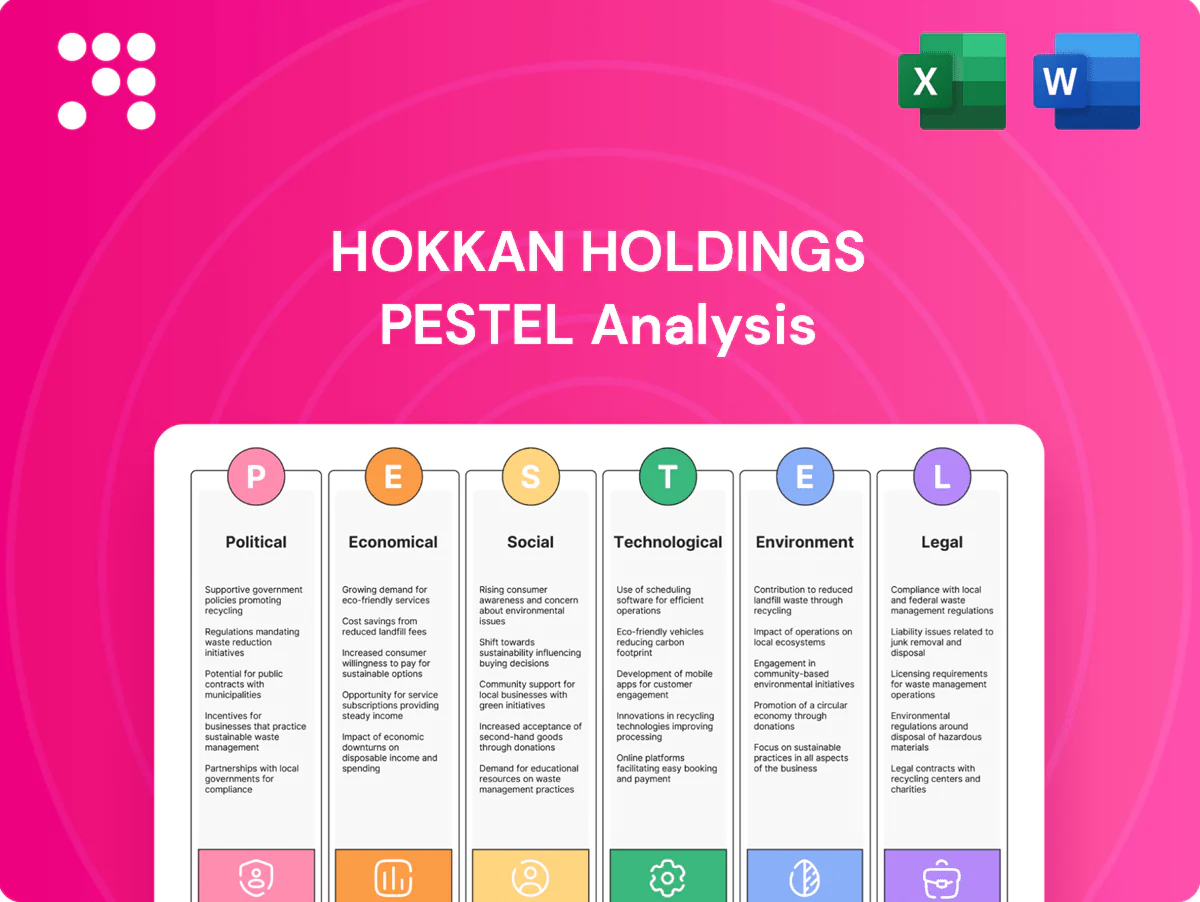
Concise, visually segmented PESTLE summary of Hokkan Holdings that streamlines meeting prep and decision-making, easily dropped into presentations or shared across teams to align on external risks and market positioning.
Economic factors

Aluminum price volatility
LME aluminum averaged about 2,400 USD/tonne in 2024 with regional conversion premiums near 350 USD/tonne, and these swings directly compress can margins. Pass-through clauses with beverage customers are essential to preserve margins. Active hedging and lightweighting programs reduce exposure to spot spikes, while procurement must balance spot purchases and long-term contracts to stabilize costs.
Currency and BOJ policy
Yen swings (USD/JPY broadly ranged 130–155 since 2022) materially alter input costs for imported PET and packaging and affect competitiveness of Hokkan Holdings’ exported services. BOJ policy has only gradually normalized, with short-term rates remaining near zero, keeping financing accessible but sensitive to any rate shift that would raise capex costs for new filling lines. Aligning invoices to customer currencies and using FX hedges reduces mismatch risk, while dynamic pricing tied to JPY moves can protect contribution margins.

Beverage demand cycles
RTD tea, coffee, energy drinks and alcohol remain primary drivers of can and filler volumes, with energy drinks sustaining ~6% YoY volume growth in 2023 and RTD coffee expanding rapidly in convenience channels. Seasonal peaks around summer and holidays force flexible capacity and contingent labor planning to absorb 20–40% monthly swings in some SKUs. Private-label growth, roughly 20% share in key markets in 2024, helps stabilize baseline utilization, while category diversification cushions demand shocks across cycles.

Energy and logistics costs
- Power: PPAs 20–60 USD/MWh (2024)
- Efficiency: -10–30% energy intensity
- Freight/nearshoring: -20–50% exposure
- On-site gen: reduces price volatility
Labor availability and wages
Aging demographics tighten skilled manufacturing labor: Japan's 65+ share reached 29.1% in 2023 (World Bank), reducing available experienced shop-floor staff and raising recruitment costs. Wage inflation and rising nominal wages in 2023–24 have pushed operating costs higher, shortening payback for automation investments and boosting collaborative-robot adoption to ease shift coverage. Training and retention programs remain critical to sustain uptime.
- Labor shrinkage: 65+ = 29.1% (2023, World Bank)
- Automation ROI shortened by rising wages and OPEX
- Collaborative robots reduce shift gaps and increase flexibility
- Targeted training/retention sustains uptime
Tariff swings, recycled aluminum and permitting timelines reshape margins and capex timing
LME aluminum ~2,400 USD/tonne (2024) with regional conversion premiums ~350 USD/tonne compress margins; hedging and pass-throughs essential. USD/JPY 130–155 since 2022 affects imported PET and export competitiveness; FX hedges and currency-aligned invoicing mitigate risk. Energy PPAs 20–60 USD/MWh (2024) and Japan 65+ = 29.1% (2023) raise capex and labor pressures; category growth (energy drinks ~6% YoY 2023) supports volumes.
| Metric | Value |
|---|---|
| Aluminum (LME) | ~2,400 USD/tonne (2024) |
| Conversion premium | ~350 USD/tonne |
| USD/JPY | 130–155 (since 2022) |
| PPAs | 20–60 USD/MWh (2024) |
| 65+ population | 29.1% (Japan, 2023) |
| Energy drinks growth | ~6% YoY (2023) |
| Private-label share | ~20% (key markets, 2024) |
Full Version Awaits
Hokkan Holdings PESTLE Analysis
The Hokkan Holdings PESTLE Analysis preview shown here is the exact document you’ll receive after purchase—fully formatted and ready to use. The layout, content, and structure visible are the same file you’ll download immediately after payment. No placeholders, no teasers—this is the real, final report ready for analysis and presentation.

Original: $10.00
-65%$10.00
$3.50Product Information
Product Information
Shipping & Returns
Shipping & Returns
Description
Your Shortcut to Market Insight Starts Here
Discover how political, economic, social, technological, legal, and environmental forces are shaping Hokkan Holdings’ trajectory in our concise PESTLE snapshot—perfect for investors and strategists. Get actionable risks and opportunity signals to refine your strategy. Purchase the full PESTLE for the complete, editable analysis and instant download.
Political factors
Trade and tariff shifts
Changes in metal tariffs and trade deals can swing aluminum and steel input costs for can production, with global primary aluminum output ~68 million tonnes in 2023 affecting supply dynamics. Import/export rules for beverages and packaging directly influence Hokkan’s cross-border contracts and margins. The firm must hedge policy risk via diversified sourcing and regional capacity and engage industry bodies to anticipate regulatory shifts.
Recycling policy momentum
National and municipal recycling mandates and extended producer responsibility schemes are tightening design, labeling, and take-back obligations, pushing producers toward recyclable formats. Aluminum’s recyclability is an advantage—recycling uses up to 95% less energy than primary production—so EPR-driven costs can be offset by closed-loop value. Hokkan can commercialize closed-loop can solutions for beverage brands, using early compliance as a sales differentiator.
Subsidies and industrial policy
Government incentives for decarbonization, automation and regional revitalization can materially lower Hokkan Holdings’ upfront capex for new production lines by subsidizing equipment and installation costs. Grants and vouchers available in 2024–25 support upgrades such as high‑speed filling systems and energy‑efficient ovens, reducing payback periods and operating costs. Plants that meet green funding criteria strengthen competitive positioning, so monitoring eligibility windows and application timelines is critical for optimal investment timing.
Geopolitical supply risks
Geopolitical tensions that hit energy, shipping lanes or metal supply can disrupt body stock availability—maritime transport moves about 80% of global trade by volume (UNCTAD) and DRC supplied ~70% of global cobalt in 2023 (USGS), creating concentrated risk; sanctions and export controls since 2022 have constrained coatings, inks and specialized machinery parts, threatening fill-rate for contract clients. Hokkan should multi-source, hold inventory buffers and run scenario planning to maintain service continuity.
- Risk: shipping chokepoints — 80% of trade by volume
- Concentration: DRC ~70% cobalt (2023)
- Controls: export/sanctions on dual-use goods since 2022
- Mitigation: multi-sourcing, buffers, scenario plans
Local permits and siting
Local zoning, water-use permits and waste approvals directly shape Hokkan Holdings plant expansions and filling operations, with permitting commonly taking 6–24 months in many jurisdictions in 2024, affecting capital deployment and cash-flow timing.
Community relations and operating-hour restrictions can extend timelines; proactive stakeholder engagement reduces NIMBY resistance and speeds approvals.
Site diversification lowers single-location political exposure and helps maintain production continuity during local permit disputes.
- Zoning, water, waste: permitting 6–24 months (2024)
- Community engagement: reduces NIMBY delays
- Site diversification: lowers single-site political risk
Tariff swings, recycled aluminum and permitting timelines reshape margins and capex timing
Tariff shifts and trade controls (primary aluminum ~68 Mt in 2023; 80% of trade by sea) can swing input costs and margins, forcing diversified sourcing and regional capacity. EPR and recycling (recycling saves up to 95% energy vs primary) raise compliance costs but create closed-loop sales opportunities. Permitting timelines (6–24 months in 2024) and green grants (2024–25) materially affect capex timing.
| Factor | Metric/2023–25 |
|---|---|
| Aluminum supply | 68 Mt (2023) |
| Maritime trade | 80% by volume |
| Recycling energy | Up to 95% savings |
| Permitting | 6–24 months (2024) |
What is included in the product
Detailed Word Document
Explores how Political, Economic, Social, Technological, Environmental and Legal forces specifically affect Hokkan Holdings, using current data and trend analysis to identify risks and opportunities; designed for executives and investors, region- and industry-specific, forward-looking, and formatted for direct inclusion in plans and reports.
Customizable Excel Spreadsheet
Concise, visually segmented PESTLE summary of Hokkan Holdings that streamlines meeting prep and decision-making, easily dropped into presentations or shared across teams to align on external risks and market positioning.
Economic factors
Aluminum price volatility
LME aluminum averaged about 2,400 USD/tonne in 2024 with regional conversion premiums near 350 USD/tonne, and these swings directly compress can margins. Pass-through clauses with beverage customers are essential to preserve margins. Active hedging and lightweighting programs reduce exposure to spot spikes, while procurement must balance spot purchases and long-term contracts to stabilize costs.
Currency and BOJ policy
Yen swings (USD/JPY broadly ranged 130–155 since 2022) materially alter input costs for imported PET and packaging and affect competitiveness of Hokkan Holdings’ exported services. BOJ policy has only gradually normalized, with short-term rates remaining near zero, keeping financing accessible but sensitive to any rate shift that would raise capex costs for new filling lines. Aligning invoices to customer currencies and using FX hedges reduces mismatch risk, while dynamic pricing tied to JPY moves can protect contribution margins.
Beverage demand cycles
RTD tea, coffee, energy drinks and alcohol remain primary drivers of can and filler volumes, with energy drinks sustaining ~6% YoY volume growth in 2023 and RTD coffee expanding rapidly in convenience channels. Seasonal peaks around summer and holidays force flexible capacity and contingent labor planning to absorb 20–40% monthly swings in some SKUs. Private-label growth, roughly 20% share in key markets in 2024, helps stabilize baseline utilization, while category diversification cushions demand shocks across cycles.
Energy and logistics costs
- Power: PPAs 20–60 USD/MWh (2024)
- Efficiency: -10–30% energy intensity
- Freight/nearshoring: -20–50% exposure
- On-site gen: reduces price volatility
Labor availability and wages
Aging demographics tighten skilled manufacturing labor: Japan's 65+ share reached 29.1% in 2023 (World Bank), reducing available experienced shop-floor staff and raising recruitment costs. Wage inflation and rising nominal wages in 2023–24 have pushed operating costs higher, shortening payback for automation investments and boosting collaborative-robot adoption to ease shift coverage. Training and retention programs remain critical to sustain uptime.
- Labor shrinkage: 65+ = 29.1% (2023, World Bank)
- Automation ROI shortened by rising wages and OPEX
- Collaborative robots reduce shift gaps and increase flexibility
- Targeted training/retention sustains uptime
Tariff swings, recycled aluminum and permitting timelines reshape margins and capex timing
LME aluminum ~2,400 USD/tonne (2024) with regional conversion premiums ~350 USD/tonne compress margins; hedging and pass-throughs essential. USD/JPY 130–155 since 2022 affects imported PET and export competitiveness; FX hedges and currency-aligned invoicing mitigate risk. Energy PPAs 20–60 USD/MWh (2024) and Japan 65+ = 29.1% (2023) raise capex and labor pressures; category growth (energy drinks ~6% YoY 2023) supports volumes.
| Metric | Value |
|---|---|
| Aluminum (LME) | ~2,400 USD/tonne (2024) |
| Conversion premium | ~350 USD/tonne |
| USD/JPY | 130–155 (since 2022) |
| PPAs | 20–60 USD/MWh (2024) |
| 65+ population | 29.1% (Japan, 2023) |
| Energy drinks growth | ~6% YoY (2023) |
| Private-label share | ~20% (key markets, 2024) |
Full Version Awaits
Hokkan Holdings PESTLE Analysis
The Hokkan Holdings PESTLE Analysis preview shown here is the exact document you’ll receive after purchase—fully formatted and ready to use. The layout, content, and structure visible are the same file you’ll download immediately after payment. No placeholders, no teasers—this is the real, final report ready for analysis and presentation.