Hong Kong Technology Venture PESTLE Analysis

Skip the Research. Get the Strategy.
Unlock how political shifts, regulatory reform, and rapid tech advances are reshaping Hong Kong Technology Venture’s growth trajectory and risk profile. Our PESTLE distills these external forces into clear implications for strategy, investment, and operations. Purchase the full analysis to get actionable, fully editable insights you can deploy immediately.
Political factors

Beijing–HK policy alignment
Central–local alignment under the One Country, Two Systems framework and measures such as the National Security Law (enacted 30 June 2020) increasingly shape media and digital commerce oversight. Stability supports long-term investment in logistics and platform tech in a services-driven economy (services ≈92% of GDP). Sudden policy recalibrations on content or data could materially affect HKTV’s multimedia and e-commerce operations; maintaining compliance and constructive government relations is strategic.
GBA integration push
GBA integration across 11 cities (≈86 million people, GDP ≈US$1.9 trillion) boosts cross-border logistics, payments and merchant sourcing, enabling mainland partners to expand SKU variety and shorten supply cycles. Pilot harmonization has cut clearance and settlement times by up to 30–40%, directly improving speed-to-market and fulfillment efficiency. Strategic GBA partnerships can lower cost-to-serve an estimated 10–20% while widening assortment breadth.

Geopolitical trade tensions
US–China frictions and tightened US export controls since 2022 have pushed component sourcing costs up, exacerbating price volatility in a bilateral goods trade of roughly US$690bn in 2023. Sanctions and shifting tariffs can reconfigure supplier portfolios and raise landed costs by an estimated 5–15% for electronics. Hong Kong’s role as a re-export hub faces greater scrutiny and compliance overhead. Diversifying origins and dual-sourcing mitigates disruption.

Public digitalization agenda
Hong Kong’s public digitalization agenda (FPS launched 2018) plus territory-wide 5G rollout since 2020 (coverage >90% by 2024) and targeted ITF/smart city logistics pilots are accelerating e-commerce and last-mile efficiency; public-sector open data platforms host thousands of datasets enabling better address, mapping and traffic insights that HKTV can use to upgrade customer experience and operations.
Social stability and sentiment
Consumer confidence in Hong Kong is highly sensitive to political sentiment and public events; periods of tension have historically cut discretionary spend and media engagement, with inbound tourism recovering to roughly 60% of 2019 levels by 2024. Reliable delivery during typhoons (signal No.8 issued about 2–3 times yearly) and other disruptions preserves trust, while neutral brand positioning and community programs improve resilience.
- Consumer sensitivity: high
- Tourism recovery: ~60% of 2019 (2024)
- Typhoon disruption: 2–3 No.8s/yr
- Mitigants: neutral branding, community programs, reliable delivery
GBA digitalization trims logistics 10–20% and speeds market entry 30–40% amid stricter oversight
One Country, Two Systems alignment and the National Security Law (2020) increase regulatory oversight, affecting media and e-commerce compliance. GBA (≈86M people, GDP ≈US$1.9T) and public digitalization (5G >90% by 2024; FPS real-time payments) lower logistics costs 10–20% and speed-to-market 30–40%. US–China export controls raise component landed costs 5–15% and increase compliance burden; tourism ~60% of 2019 (2024).
| Metric | Value | Relevance |
|---|---|---|
| GBA population | ≈86M | Market/fulfillment expansion |
| GBA GDP | ≈US$1.9T | Trade scale |
| 5G coverage | >90% (2024) | Low-latency services |
| Tourism | ~60% of 2019 (2024) | Demand sensitivity |
What is included in the product
 Detailed Word Document
Examines how Political, Economic, Social, Technological, Environmental and Legal forces uniquely shape the Hong Kong Technology Venture, using current data and trends to identify key risks and growth opportunities. Tailored for executives and investors to support strategy, funding and scenario planning.

 Customizable Excel Spreadsheet
A concise, visually segmented PESTLE brief tailored for Hong Kong tech ventures that streamlines external risk assessment, is easy to drop into presentations, editable for local context, and instantly shareable to align teams during planning or client meetings.
Economic factors

Rate-linked cost of capital
Hong Kong’s USD peg transmits US Fed cycles — the effective Fed funds rate stood near 5.25% in mid‑2025, with 3‑month HIBOR tracking around 5.0%, pushing local financing costs up. Higher rates typically lift warehouse, fleet and tech capex hurdle rates by roughly 200–300 basis points, slowing marginal projects. As rates ease, growth investments and promotions regain viability. Active treasury management and flexible lease structures help firms navigate these cycles.
Retail demand volatility
Tourism recovery—arrivals reaching roughly 60% of 2019 levels by 2024—plus government consumption-voucher rounds have buoyed GMV, though consumer sentiment remains uneven. Groceries show resilience with steady spend, while electronics and fashion remain cyclical and discount-sensitive. Basket size and purchase frequency track real income and employment (unemployment ~3.0% in 2024). Dynamic pricing and category mix are used to hedge these swings.

Rents and logistics expenses
Industrial rents and rising labor costs compress fulfillment unit economics in Hong Kong; Grade A industrial rents averaged about HK$22–28 per sq ft/month in 2024, lifting per-order fixed costs. Fuel and electricity spikes—diesel around HK$18–22/litre and commercial electricity tariffs up ~8% y/y in 2024—erode delivery and cold-chain margins. Network design using dark stores and micro-fulfillment cuts last-mile costs, while higher volume density and route optimization (reducing empty miles) are critical to reach profitable unit economics.

FX and import exposure
HKD stability under the linked rate (maintained within 7.75–7.85 per USD through 2024–2025) eases USD-linked procurement, but suppliers invoicing in CNY, JPY or EUR introduce FX risk; moves in those currencies shift landed costs and compress retail pricing power. Active hedging and localized sourcing lower volatility, while transparent price adjustments help preserve customer trust.
- HKD peg: 7.75–7.85/USD
- Currencies: CNY, JPY, EUR drive cost variance
- Mitigants: FX hedging, local sourcing, transparent pricing
SME merchant ecosystem
HKTVmall depends on a healthy base of local SMEs for assortment; Hong Kong SMEs account for 98% of businesses and 45% of employment (GovHK 2023). Macroeconomic stress compresses merchant inventory and marketing budgets, so enabling seller financing, analytics and fulfillment-as-a-service improves seller GMV and retention. Platform take-rate and incentives must balance growth and margins.
- SME footprint: 98% businesses, 45% employment (GovHK 2023)
- Risk: tighter inventory and marketing spend under macro stress
- Levers: seller financing, analytics, FaaS to lift seller success
- Trade-off: take-rate vs acquisition incentives for margin control
GBA digitalization trims logistics 10–20% and speeds market entry 30–40% amid stricter oversight
USD peg transmits Fed cycles (FF ~5.25% mid‑2025, 3m HIBOR ~5.0%), raising hurdle rates and slowing marginal tech capex; HKD held 7.75–7.85/USD. Tourism ~60% of 2019 arrivals (2024); unemployment ~3.0% (2024). Industrial rents HK$22–28/sq ft/mo (2024) and electricity +8% y/y squeeze fulfillment margins; SME base (98% firms) limits assortment resilience.
| Metric | Value |
|---|---|
| Fed funds | ~5.25% |
| 3m HIBOR | ~5.0% |
| Tourism (2024) | ~60% of 2019 |
| Industrial rent (2024) | HK$22–28/sq ft/mo |
| SME share | 98% firms |
Preview Before You Purchase
Hong Kong Technology Venture PESTLE Analysis
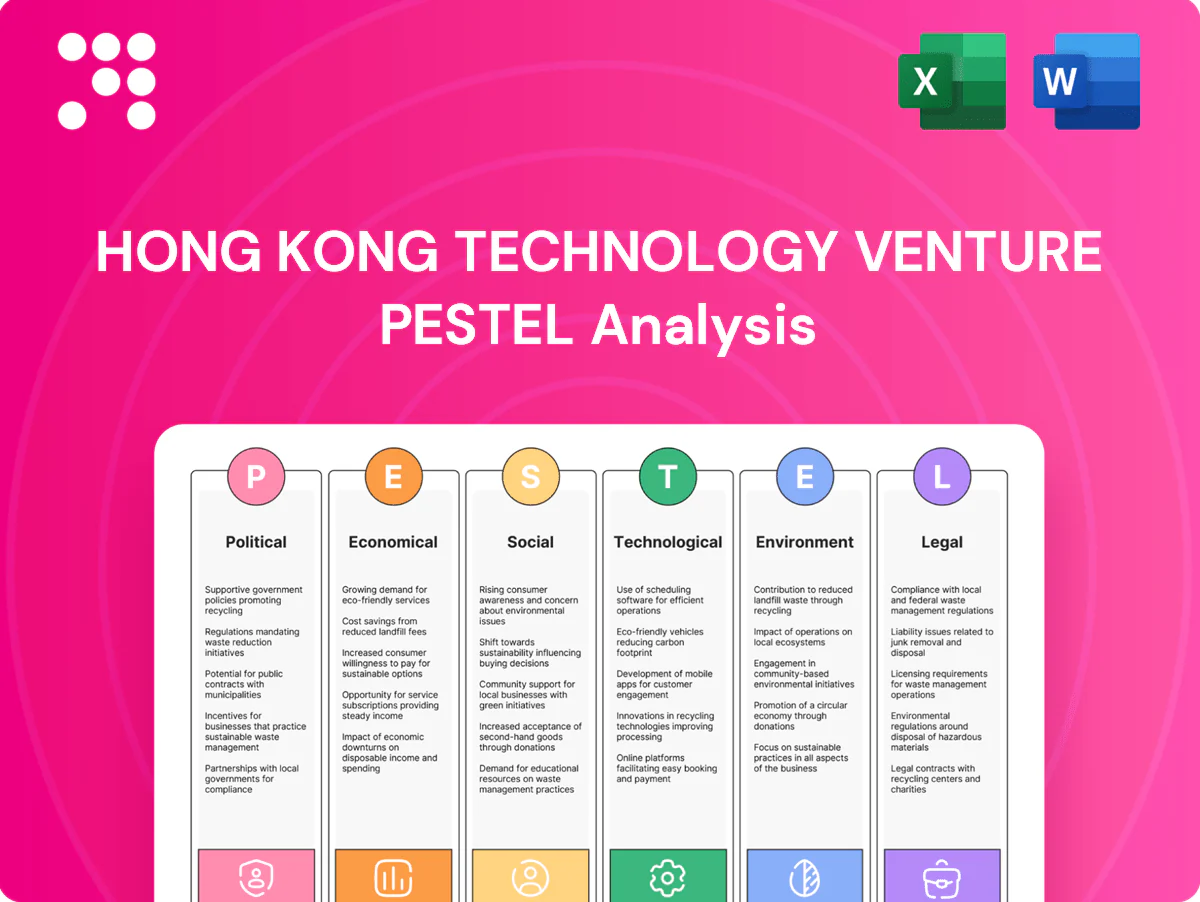
The preview shown here is the exact Hong Kong Technology Venture PESTLE Analysis you’ll receive after purchase—fully formatted and ready to use. It covers political, economic, social, technological, legal and environmental factors specific to Hong Kong tech ventures. No placeholders or teasers; this is the final, downloadable file.

Product Information
Product Information
Shipping & Returns
Shipping & Returns
Description
Skip the Research. Get the Strategy.
Unlock how political shifts, regulatory reform, and rapid tech advances are reshaping Hong Kong Technology Venture’s growth trajectory and risk profile. Our PESTLE distills these external forces into clear implications for strategy, investment, and operations. Purchase the full analysis to get actionable, fully editable insights you can deploy immediately.
Political factors
Beijing–HK policy alignment
Central–local alignment under the One Country, Two Systems framework and measures such as the National Security Law (enacted 30 June 2020) increasingly shape media and digital commerce oversight. Stability supports long-term investment in logistics and platform tech in a services-driven economy (services ≈92% of GDP). Sudden policy recalibrations on content or data could materially affect HKTV’s multimedia and e-commerce operations; maintaining compliance and constructive government relations is strategic.
GBA integration push
GBA integration across 11 cities (≈86 million people, GDP ≈US$1.9 trillion) boosts cross-border logistics, payments and merchant sourcing, enabling mainland partners to expand SKU variety and shorten supply cycles. Pilot harmonization has cut clearance and settlement times by up to 30–40%, directly improving speed-to-market and fulfillment efficiency. Strategic GBA partnerships can lower cost-to-serve an estimated 10–20% while widening assortment breadth.
Geopolitical trade tensions
US–China frictions and tightened US export controls since 2022 have pushed component sourcing costs up, exacerbating price volatility in a bilateral goods trade of roughly US$690bn in 2023. Sanctions and shifting tariffs can reconfigure supplier portfolios and raise landed costs by an estimated 5–15% for electronics. Hong Kong’s role as a re-export hub faces greater scrutiny and compliance overhead. Diversifying origins and dual-sourcing mitigates disruption.
Public digitalization agenda
Hong Kong’s public digitalization agenda (FPS launched 2018) plus territory-wide 5G rollout since 2020 (coverage >90% by 2024) and targeted ITF/smart city logistics pilots are accelerating e-commerce and last-mile efficiency; public-sector open data platforms host thousands of datasets enabling better address, mapping and traffic insights that HKTV can use to upgrade customer experience and operations.
Social stability and sentiment
Consumer confidence in Hong Kong is highly sensitive to political sentiment and public events; periods of tension have historically cut discretionary spend and media engagement, with inbound tourism recovering to roughly 60% of 2019 levels by 2024. Reliable delivery during typhoons (signal No.8 issued about 2–3 times yearly) and other disruptions preserves trust, while neutral brand positioning and community programs improve resilience.
- Consumer sensitivity: high
- Tourism recovery: ~60% of 2019 (2024)
- Typhoon disruption: 2–3 No.8s/yr
- Mitigants: neutral branding, community programs, reliable delivery
GBA digitalization trims logistics 10–20% and speeds market entry 30–40% amid stricter oversight
One Country, Two Systems alignment and the National Security Law (2020) increase regulatory oversight, affecting media and e-commerce compliance. GBA (≈86M people, GDP ≈US$1.9T) and public digitalization (5G >90% by 2024; FPS real-time payments) lower logistics costs 10–20% and speed-to-market 30–40%. US–China export controls raise component landed costs 5–15% and increase compliance burden; tourism ~60% of 2019 (2024).
| Metric | Value | Relevance |
|---|---|---|
| GBA population | ≈86M | Market/fulfillment expansion |
| GBA GDP | ≈US$1.9T | Trade scale |
| 5G coverage | >90% (2024) | Low-latency services |
| Tourism | ~60% of 2019 (2024) | Demand sensitivity |
What is included in the product
Detailed Word Document
Examines how Political, Economic, Social, Technological, Environmental and Legal forces uniquely shape the Hong Kong Technology Venture, using current data and trends to identify key risks and growth opportunities. Tailored for executives and investors to support strategy, funding and scenario planning.
Customizable Excel Spreadsheet
A concise, visually segmented PESTLE brief tailored for Hong Kong tech ventures that streamlines external risk assessment, is easy to drop into presentations, editable for local context, and instantly shareable to align teams during planning or client meetings.
Economic factors
Rate-linked cost of capital
Hong Kong’s USD peg transmits US Fed cycles — the effective Fed funds rate stood near 5.25% in mid‑2025, with 3‑month HIBOR tracking around 5.0%, pushing local financing costs up. Higher rates typically lift warehouse, fleet and tech capex hurdle rates by roughly 200–300 basis points, slowing marginal projects. As rates ease, growth investments and promotions regain viability. Active treasury management and flexible lease structures help firms navigate these cycles.
Retail demand volatility
Tourism recovery—arrivals reaching roughly 60% of 2019 levels by 2024—plus government consumption-voucher rounds have buoyed GMV, though consumer sentiment remains uneven. Groceries show resilience with steady spend, while electronics and fashion remain cyclical and discount-sensitive. Basket size and purchase frequency track real income and employment (unemployment ~3.0% in 2024). Dynamic pricing and category mix are used to hedge these swings.
Rents and logistics expenses
Industrial rents and rising labor costs compress fulfillment unit economics in Hong Kong; Grade A industrial rents averaged about HK$22–28 per sq ft/month in 2024, lifting per-order fixed costs. Fuel and electricity spikes—diesel around HK$18–22/litre and commercial electricity tariffs up ~8% y/y in 2024—erode delivery and cold-chain margins. Network design using dark stores and micro-fulfillment cuts last-mile costs, while higher volume density and route optimization (reducing empty miles) are critical to reach profitable unit economics.
FX and import exposure
HKD stability under the linked rate (maintained within 7.75–7.85 per USD through 2024–2025) eases USD-linked procurement, but suppliers invoicing in CNY, JPY or EUR introduce FX risk; moves in those currencies shift landed costs and compress retail pricing power. Active hedging and localized sourcing lower volatility, while transparent price adjustments help preserve customer trust.
- HKD peg: 7.75–7.85/USD
- Currencies: CNY, JPY, EUR drive cost variance
- Mitigants: FX hedging, local sourcing, transparent pricing
SME merchant ecosystem
HKTVmall depends on a healthy base of local SMEs for assortment; Hong Kong SMEs account for 98% of businesses and 45% of employment (GovHK 2023). Macroeconomic stress compresses merchant inventory and marketing budgets, so enabling seller financing, analytics and fulfillment-as-a-service improves seller GMV and retention. Platform take-rate and incentives must balance growth and margins.
- SME footprint: 98% businesses, 45% employment (GovHK 2023)
- Risk: tighter inventory and marketing spend under macro stress
- Levers: seller financing, analytics, FaaS to lift seller success
- Trade-off: take-rate vs acquisition incentives for margin control
GBA digitalization trims logistics 10–20% and speeds market entry 30–40% amid stricter oversight
USD peg transmits Fed cycles (FF ~5.25% mid‑2025, 3m HIBOR ~5.0%), raising hurdle rates and slowing marginal tech capex; HKD held 7.75–7.85/USD. Tourism ~60% of 2019 arrivals (2024); unemployment ~3.0% (2024). Industrial rents HK$22–28/sq ft/mo (2024) and electricity +8% y/y squeeze fulfillment margins; SME base (98% firms) limits assortment resilience.
| Metric | Value |
|---|---|
| Fed funds | ~5.25% |
| 3m HIBOR | ~5.0% |
| Tourism (2024) | ~60% of 2019 |
| Industrial rent (2024) | HK$22–28/sq ft/mo |
| SME share | 98% firms |
Preview Before You Purchase
Hong Kong Technology Venture PESTLE Analysis
The preview shown here is the exact Hong Kong Technology Venture PESTLE Analysis you’ll receive after purchase—fully formatted and ready to use. It covers political, economic, social, technological, legal and environmental factors specific to Hong Kong tech ventures. No placeholders or teasers; this is the final, downloadable file.