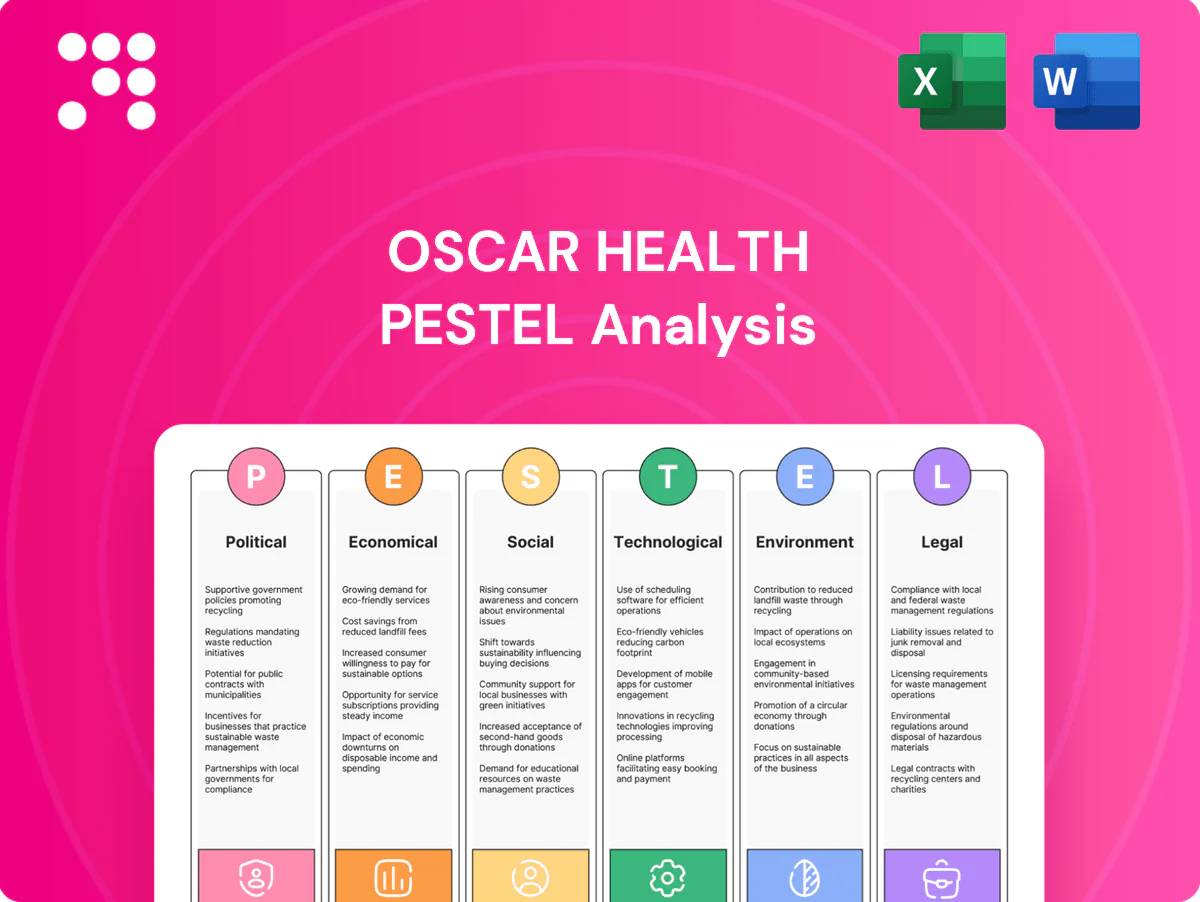
Oscar Health PESTLE Analysis

Your Competitive Advantage Starts with This Report
Explore how political, economic, social, technological, legal and environmental forces shape Oscar Health’s prospects. Our concise PESTLE highlights regulatory risks, market drivers, tech disruptions and sustainability pressures to inform investment and strategy. Purchase the full report for the complete, editable analysis and actionable intelligence.
Political factors

ACA stability
Oscar’s exchange-based plans rely on ACA funding, risk-adjustment and subsidy architecture; CMS data show roughly 80% of 2024 marketplace enrollees received premium tax credits, so federal shifts can meaningfully change enrollment mixes and pricing. Stable ACA support enables predictable growth and margin planning, while repeal or subsidy cuts would pressure profitability; ongoing navigator and outreach rule tweaks raise member acquisition costs.
Medicaid and state waivers
State-level Medicaid expansion and 1332 waivers reshape individual-market risk pools; as of July 2025, 40 states plus DC have expanded Medicaid, leaving 10 non-expansion states that limit Oscar’s addressable market. Favorable 1332 waivers (eg reinsurance/direct enrollment) enable innovative, lower-cost plan designs that suit Oscar’s digital model. Political turnover shifts waiver priorities and contracting windows, adding revenue and enrollment volatility.

Public option momentum
State and federal public option momentum—with roughly 12 states pursuing proposals by mid-2025—could compress premiums and narrow margins if public competitors set lower network rates. Oscar could capture revenue as a partner or TPA, leveraging tech and care-management, but would still face sustained price pressure and margin erosion. Market entry by public plans may reset network rates and provider leverage in affected markets. Policy design will determine coexistence versus outright crowd-out of private plans.

Provider consolidation scrutiny
Tougher DOJ/FTC antitrust enforcement since 2021 has increased scrutiny of hospital-insurer consolidation, changing bargaining dynamics; if consolidation slows Oscar could secure better rates for narrow-network plans, while entrenched systems in key metros may still retain leverage. CMS implemented site-neutral payment changes in the 2024 OPPS final rule, affecting unit costs and plan actuarial value.
- DOJ/FTC: heightened merger scrutiny since 2021
- CMS: 2024 site-neutral payment rule reduces OPD payments
- Implication: potential for lower network costs vs persistent metro leverage
Telehealth reimbursement policy
Continuation of telehealth flexibilities materially affects Oscar’s virtual-first economics, with telehealth accounting for roughly 8–12% of outpatient visits nationally in 2024, sustaining lower marginal costs and higher care access.
Permanent reimbursement parity supports utilization and member satisfaction; rollbacks or tighter originating-site rules could cut digital engagement and increase cost per episode.
State medical boards and evolving federal guidance jointly determine scope and cross-state practice, impacting Oscar’s network strategy and license costs.
- policy-parity: 2024 parity boosts revenue predictability
- utilization: telehealth ~8–12% outpatient mix (2024)
- risk: originating-site rollbacks reduce digital visits
- regulatory: state+federal rules shape cross-state care
Subsidy shifts and Medicaid expansion redefine margins; telehealth enables virtual-first savings
Oscar’s ACA-dependent exchange model (≈80% of 2024 enrollees on premium tax credits) makes federal subsidy changes material to pricing and margins. Medicaid expansion (40 states+DC by Jul 2025) and 1332 waivers reshape addressable market and risk pools. Public option activity (~12 states mid-2025) and stronger DOJ/FTC merger scrutiny alter network leverage and unit costs; telehealth (8–12% of outpatient visits in 2024) supports virtual-first economics.
| Metric | Value |
|---|---|
| Marketplace PTC take-up (2024) | ≈80% |
| Medicaid expansion (Jul 2025) | 40 states + DC |
| Public option activity (mid-2025) | ≈12 states |
| Telehealth outpatient mix (2024) | 8–12% |
What is included in the product
 Detailed Word Document
Explores how macro-environmental factors uniquely affect Oscar Health across Political, Economic, Social, Technological, Environmental, and Legal dimensions, with data-backed trends and examples specific to the U.S. health-insurance market to help executives, investors, and strategists identify risks, opportunities, and forward-looking scenarios.

 Customizable Excel Spreadsheet
A concise, visually segmented Oscar Health PESTLE summary that distills regulatory, economic, technological and competitive factors for quick reference in meetings or presentations, easily sharable and editable for team alignment and strategic risk discussions.
Economic factors

Medical cost inflation
Rising unit costs for drugs, hospitals and physician services are pushing Oscar’s medical loss ratio and premium setting higher, with specialty medicines now representing roughly 50% of US drug spending (IQVIA 2023). Rapid GLP-1 uptake risks outpacing premium increases and elevating per-member cost trends. Strong utilization management and network steerage are essential to protect margins, while economic cycles drive elective care deferral and a subsequent rebound in claims.
Macroeconomic cycles
Employment shifts between ESI (~150 million covered, KFF 2023), exchanges (~14 million enrollees in 2024) and uninsured status push members into and out of Oscar’s risk pools; a U.S. unemployment rate near 4.0% (mid‑2025) amplifies this churn. Recessions typically boost individual‑market enrollment while increasing reliance on premium tax credits, heightening political exposure. Tight capital markets raise reinsurance costs and constrain growth funding for expansion.

Risk adjustment transfers
ACA risk-adjustment transfers materially increase revenue volatility for Oscar Health, flipping margins between quarters. Accurate coding, claims data quality, and proactive population health management drive settlement outcomes. Negative transfers can erode profitability in fast-growing markets where risk pools lag. Sustained investment in analytics and care management has produced favorable net settlements for insurers over time.

Scale and operating leverage
Fixed platform costs require membership density to achieve efficiency; Oscar operated in about 20 U.S. markets with roughly 1.3 million members in 2024, enabling PMPM leverage. Market-by-market scale reduces admin PMPM and improves unit economics. Concentrated growth can secure better network rates and raise care-management ROI, while overexpansion risks adverse selection and operational dilution.
- ~1.3M members (2024)
- ~20 markets
- Lower admin PMPM with scale
- Risk: adverse selection, dilution
Reinsurance and stop-loss
Carrier reinsurance and state 1332 reinsurance programs help stabilize premiums, with programs historically lowering premiums by single-digit to low-teens percentages in participating states (2024–2025 observations). Pricing and availability fluctuate with catastrophe losses and capital market cycles, forcing insurers to adjust attachment points to balance volatility and cost; state-by-state reliance changes competitive positioning.
- Reinsurance stabilizes rates
- 1332 cuts premiums ~single-digit–low-teens
- Attachment point = volatility vs cost
- State reliance alters market share
Subsidy shifts and Medicaid expansion redefine margins; telehealth enables virtual-first savings
Rising unit costs—specialty drugs ~50% of US drug spend (IQVIA 2023)—and GLP‑1 uptake push medical loss ratios higher, pressuring premiums.
Enrollment churn (ESI ~150M, exchanges ~14M in 2024) and U.S. unemployment ~4.0% (mid‑2025) amplify risk‑pool volatility and premium tax‑credit reliance.
Scale (≈1.3M members, ~20 markets in 2024) plus reinsurance/1332 programs (single‑digit–low‑teens premium relief) are key to margin stability.
| Metric | Value |
|---|---|
| Members (2024) | ≈1.3M |
| Specialty drug share | ~50% (IQVIA 2023) |
| Exchanges (2024) | ~14M |
| Unemployment (mid‑2025) | ~4.0% |
| 1332 impact | single‑digit–low‑teens % |
Full Version Awaits
Oscar Health PESTLE Analysis
This Oscar Health PESTLE Analysis preview is the exact document you’ll receive after purchase—fully formatted and ready to use. The content, structure, and insights shown here match the final downloadable file. No placeholders or teasers—this is the real, finished analysis you’ll own after checkout.

Original: $10.00
-65%$10.00
$3.50Product Information
Product Information
Shipping & Returns
Shipping & Returns
Description
Your Competitive Advantage Starts with This Report
Explore how political, economic, social, technological, legal and environmental forces shape Oscar Health’s prospects. Our concise PESTLE highlights regulatory risks, market drivers, tech disruptions and sustainability pressures to inform investment and strategy. Purchase the full report for the complete, editable analysis and actionable intelligence.
Political factors
ACA stability
Oscar’s exchange-based plans rely on ACA funding, risk-adjustment and subsidy architecture; CMS data show roughly 80% of 2024 marketplace enrollees received premium tax credits, so federal shifts can meaningfully change enrollment mixes and pricing. Stable ACA support enables predictable growth and margin planning, while repeal or subsidy cuts would pressure profitability; ongoing navigator and outreach rule tweaks raise member acquisition costs.
Medicaid and state waivers
State-level Medicaid expansion and 1332 waivers reshape individual-market risk pools; as of July 2025, 40 states plus DC have expanded Medicaid, leaving 10 non-expansion states that limit Oscar’s addressable market. Favorable 1332 waivers (eg reinsurance/direct enrollment) enable innovative, lower-cost plan designs that suit Oscar’s digital model. Political turnover shifts waiver priorities and contracting windows, adding revenue and enrollment volatility.
Public option momentum
State and federal public option momentum—with roughly 12 states pursuing proposals by mid-2025—could compress premiums and narrow margins if public competitors set lower network rates. Oscar could capture revenue as a partner or TPA, leveraging tech and care-management, but would still face sustained price pressure and margin erosion. Market entry by public plans may reset network rates and provider leverage in affected markets. Policy design will determine coexistence versus outright crowd-out of private plans.
Provider consolidation scrutiny
Tougher DOJ/FTC antitrust enforcement since 2021 has increased scrutiny of hospital-insurer consolidation, changing bargaining dynamics; if consolidation slows Oscar could secure better rates for narrow-network plans, while entrenched systems in key metros may still retain leverage. CMS implemented site-neutral payment changes in the 2024 OPPS final rule, affecting unit costs and plan actuarial value.
- DOJ/FTC: heightened merger scrutiny since 2021
- CMS: 2024 site-neutral payment rule reduces OPD payments
- Implication: potential for lower network costs vs persistent metro leverage
Telehealth reimbursement policy
Continuation of telehealth flexibilities materially affects Oscar’s virtual-first economics, with telehealth accounting for roughly 8–12% of outpatient visits nationally in 2024, sustaining lower marginal costs and higher care access.
Permanent reimbursement parity supports utilization and member satisfaction; rollbacks or tighter originating-site rules could cut digital engagement and increase cost per episode.
State medical boards and evolving federal guidance jointly determine scope and cross-state practice, impacting Oscar’s network strategy and license costs.
- policy-parity: 2024 parity boosts revenue predictability
- utilization: telehealth ~8–12% outpatient mix (2024)
- risk: originating-site rollbacks reduce digital visits
- regulatory: state+federal rules shape cross-state care
Subsidy shifts and Medicaid expansion redefine margins; telehealth enables virtual-first savings
Oscar’s ACA-dependent exchange model (≈80% of 2024 enrollees on premium tax credits) makes federal subsidy changes material to pricing and margins. Medicaid expansion (40 states+DC by Jul 2025) and 1332 waivers reshape addressable market and risk pools. Public option activity (~12 states mid-2025) and stronger DOJ/FTC merger scrutiny alter network leverage and unit costs; telehealth (8–12% of outpatient visits in 2024) supports virtual-first economics.
| Metric | Value |
|---|---|
| Marketplace PTC take-up (2024) | ≈80% |
| Medicaid expansion (Jul 2025) | 40 states + DC |
| Public option activity (mid-2025) | ≈12 states |
| Telehealth outpatient mix (2024) | 8–12% |
What is included in the product
Detailed Word Document
Explores how macro-environmental factors uniquely affect Oscar Health across Political, Economic, Social, Technological, Environmental, and Legal dimensions, with data-backed trends and examples specific to the U.S. health-insurance market to help executives, investors, and strategists identify risks, opportunities, and forward-looking scenarios.
Customizable Excel Spreadsheet
A concise, visually segmented Oscar Health PESTLE summary that distills regulatory, economic, technological and competitive factors for quick reference in meetings or presentations, easily sharable and editable for team alignment and strategic risk discussions.
Economic factors
Medical cost inflation
Rising unit costs for drugs, hospitals and physician services are pushing Oscar’s medical loss ratio and premium setting higher, with specialty medicines now representing roughly 50% of US drug spending (IQVIA 2023). Rapid GLP-1 uptake risks outpacing premium increases and elevating per-member cost trends. Strong utilization management and network steerage are essential to protect margins, while economic cycles drive elective care deferral and a subsequent rebound in claims.
Macroeconomic cycles
Employment shifts between ESI (~150 million covered, KFF 2023), exchanges (~14 million enrollees in 2024) and uninsured status push members into and out of Oscar’s risk pools; a U.S. unemployment rate near 4.0% (mid‑2025) amplifies this churn. Recessions typically boost individual‑market enrollment while increasing reliance on premium tax credits, heightening political exposure. Tight capital markets raise reinsurance costs and constrain growth funding for expansion.
Risk adjustment transfers
ACA risk-adjustment transfers materially increase revenue volatility for Oscar Health, flipping margins between quarters. Accurate coding, claims data quality, and proactive population health management drive settlement outcomes. Negative transfers can erode profitability in fast-growing markets where risk pools lag. Sustained investment in analytics and care management has produced favorable net settlements for insurers over time.
Scale and operating leverage
Fixed platform costs require membership density to achieve efficiency; Oscar operated in about 20 U.S. markets with roughly 1.3 million members in 2024, enabling PMPM leverage. Market-by-market scale reduces admin PMPM and improves unit economics. Concentrated growth can secure better network rates and raise care-management ROI, while overexpansion risks adverse selection and operational dilution.
- ~1.3M members (2024)
- ~20 markets
- Lower admin PMPM with scale
- Risk: adverse selection, dilution
Reinsurance and stop-loss
Carrier reinsurance and state 1332 reinsurance programs help stabilize premiums, with programs historically lowering premiums by single-digit to low-teens percentages in participating states (2024–2025 observations). Pricing and availability fluctuate with catastrophe losses and capital market cycles, forcing insurers to adjust attachment points to balance volatility and cost; state-by-state reliance changes competitive positioning.
- Reinsurance stabilizes rates
- 1332 cuts premiums ~single-digit–low-teens
- Attachment point = volatility vs cost
- State reliance alters market share
Subsidy shifts and Medicaid expansion redefine margins; telehealth enables virtual-first savings
Rising unit costs—specialty drugs ~50% of US drug spend (IQVIA 2023)—and GLP‑1 uptake push medical loss ratios higher, pressuring premiums.
Enrollment churn (ESI ~150M, exchanges ~14M in 2024) and U.S. unemployment ~4.0% (mid‑2025) amplify risk‑pool volatility and premium tax‑credit reliance.
Scale (≈1.3M members, ~20 markets in 2024) plus reinsurance/1332 programs (single‑digit–low‑teens premium relief) are key to margin stability.
| Metric | Value |
|---|---|
| Members (2024) | ≈1.3M |
| Specialty drug share | ~50% (IQVIA 2023) |
| Exchanges (2024) | ~14M |
| Unemployment (mid‑2025) | ~4.0% |
| 1332 impact | single‑digit–low‑teens % |
Full Version Awaits
Oscar Health PESTLE Analysis
This Oscar Health PESTLE Analysis preview is the exact document you’ll receive after purchase—fully formatted and ready to use. The content, structure, and insights shown here match the final downloadable file. No placeholders or teasers—this is the real, finished analysis you’ll own after checkout.