Himatsingka Seide PESTLE Analysis

Skip the Research. Get the Strategy.
Discover how political shifts, economic cycles, social trends, and regulatory changes are shaping Himatsingka Seide’s strategic outlook. Our concise PESTLE highlights key risks and opportunities to inform smarter decisions and spot growth levers. Ideal for investors and strategists—buy the full analysis for the complete, downloadable intelligence you need.
Political factors

Trade policy and tariffs
Export duties and FTAs materially affect Himatsingka Seide’s landed costs: India’s CEPA with the UAE (signed 2022) and other FTAs can cut tariffs on finished home textiles, improving pricing power in GCC and Middle East markets. U.S. Section 301 tariffs on Chinese goods (rates up to 25%) and EU trade remedies on certain textile lines can tighten margins or force volume re‑routing. Proactive multi‑country sourcing, tariff engineering and HS code optimization reduce shock exposure, while active policy lobbying and compliance readiness preserve market access and prevent de‑listing.
Government incentives
Government incentives materially affect Himatsingka Seide: the central PLI for textiles (approved at Rs 10,683 crore) and legacy TUFS (operational since 1999) improve production subsidy economics, while PM-MITRA/state textile parks (7 parks envisaged with ~Rs 19,000 crore expected investment and 7.5 lakh jobs) lower capex/unit costs. Duty drawback and export incentives enhance export competitiveness, and multi-year tracking/PLI structures reduce cliff risk; aligning capex to these priorities unlocks benefits.

Geopolitical supply risks
Regional conflicts in 2023–24 disrupted cotton, dye imports and freight lanes, with common rerouting adding roughly 10–20% to voyage distances and escalating transit times; this raises input and inventory carrying costs for Himatsingka Seide. Sanctions and origin restrictions have shifted sourcing math, forcing higher-cost alternatives and compliance overheads. Diversified suppliers and alternate ports hedge volatility, while scenario planning preserves service levels for global clients.

Labor and social policy
- Minimum wage revisions: ILO 2024 — 58% countries raised wages
- Compliance spend: higher due to buyer audits and govt norms
- HR compliance: reduces stoppages, reputational losses
- Skilling: integrated mills productivity +12–15%
Infrastructure and energy policy
Improved power reliability and rising renewable uptake cut overheads for textile mills; auctioned solar PPAs averaged about ₹2.5–3.5/kWh in 2024, making captive/solar increasingly economical. Rail and port modernization (Dedicated Freight Corridor phases) has trimmed export lead times by up to 30%, while aligned grid and logistics policy boosts supply‑chain resilience.
- Power reliability: fewer outages
- Renewable incentives: solar PPA ₹2.5–3.5/kWh (2024)
- Logistics upgrades: lead times −30%
- Grid policy: improves captive solar economics
CEPA/FTAs lower tariffs; PLI Rs10,683cr aids capex; wages rise; solar ₹2.5–3.5/kWh
Political drivers materially affect costs and market access for Himatsingka Seide: India CEPA/FTAs cut tariffs (post‑2022), PLI textiles Rs 10,683 crore boosts capex economics, and state wage hikes (ILO 2024: 58% countries) raise labour costs; solar PPAs ₹2.5–3.5/kWh (2024) and logistics upgrades (lead times −30%) improve competitiveness.
| Factor | 2024/25 metric | Impact |
|---|---|---|
| PLI | Rs 10,683 cr | Capex subsidy |
| Wages | 58% countries ↑ (ILO) | Higher unit costs |
| Solar PPA | ₹2.5–3.5/kWh | Lower energy Opex |
What is included in the product
 Detailed Word Document
Explores how macro-environmental factors uniquely affect Himatsingka Seide across Political, Economic, Social, Technological, Environmental and Legal dimensions, with each section backed by relevant data and trends to identify threats and opportunities; designed for executives and investors to support strategy, scenario planning and funding decisions.

 Customizable Excel Spreadsheet
A concise, visually segmented PESTLE summary for Himatsingka Seide that eases meeting prep, can be dropped into presentations, annotated for regional or business-line context, and quickly shared across teams to streamline external risk discussions and strategic planning.
Economic factors

Raw material price volatility
Raw material price volatility—cotton, yarn and petrochemical inputs—drive roughly 60–70% of textile COGS; in 2024 Cotlook A averaged near 90–100 cents/lb. Hedging and tighter inventory discipline have dampened spikes for Himatsingka, improving cost predictability. A strategic mix shift toward higher-value SKUs has supported gross margins, while long-term supplier partnerships stabilize quality and pricing.
Currency and interest rates
INR/USD traded roughly 82–84 and EUR/INR showed ~8–10% YTD swings to mid-2025, directly affecting Himatsingka Seide export realizations. Natural hedges (local sourcing, euro-denominated sales) plus derivatives (forwards/options) have materially reduced P&L noise. Rate cycles—RBI repo ~6.5% and global rates ~5.25–5.5%—raise working capital and capex costs. Contractual pricing clauses are used to share FX risk with buyers.

Global demand cycles
Retail and hospitality demand mirrors housing, travel and consumer confidence, with IATA reporting 2023 air passenger volumes at about 88% of 2019 levels. Downcycles compress volumes and force promotional intensity, eroding standard ASPs. License-backed premium lines help defend margins by commanding higher sell-through. Agile capacity planning and channel diversification (wholesale, DTC, contract) smooth utilisation and reduce cyclicality risk.

Inflation and consumer spend
Inflationary pressure (RBI target 4% ±2%) shifts wallet share to essentials, pressuring discretionary premium bedding sales, while demand favors durability and wellness features that justify higher ticket items. Pack-price architecture and multi-pack SKUs sustain conversion by lowering unit price perception, and operational efficiency (scale, backward integration) protects price points and margins.
- Inflation tag: RBI 4% ±2%
- Premium focus: durability, wellness
- Conversion: pack-price SKUs
- Protection: operational efficiency
Logistics and freight costs
Ocean freight volatility directly affects Himatsingka Seide: Drewry's World Container Index fell about 70% from 2022 peaks to 2024 levels, improving delivery reliability but leaving pockets of container scarcity on key India-Europe/US lanes. Multi-origin shipping and near-market stocking reduce single-route exposure, while long-term contracts with carriers stabilize service and pricing. Retailer scorecards benefit as lead times compressed 10-15% in 2024, raising on-time delivery metrics.
- Ocean rates: Drewry WCI down ~70% (2022→2024)
- Risk mitigation: multi-origin + near-market stocking
- Contracts: stabilized capacity/pricing
- Lead times: compressed ~10-15% in 2024, boosting retailer scores
CEPA/FTAs lower tariffs; PLI Rs10,683cr aids capex; wages rise; solar ₹2.5–3.5/kWh
Himatsingka faces raw-material cost swings (Cotlook A ~90–100c/lb in 2024) and INR/USD ~82–84 (mid‑2025) impacting export margins; hedging and supplier ties improved cost visibility. Lower Drewry WCI (~70% down 2022→2024) cut logistics costs; RBI repo ~6.5% raises working-capital and capex costs, pressuring margin recovery.
| Metric | Value |
|---|---|
| Cotlook A (2024) | 90–100 c/lb |
| INR/USD (mid‑2025) | 82–84 |
| Drewry WCI change | ~‑70% (2022→2024) |
| RBI repo (2025) | ~6.5% |
Full Version Awaits
Himatsingka Seide PESTLE Analysis
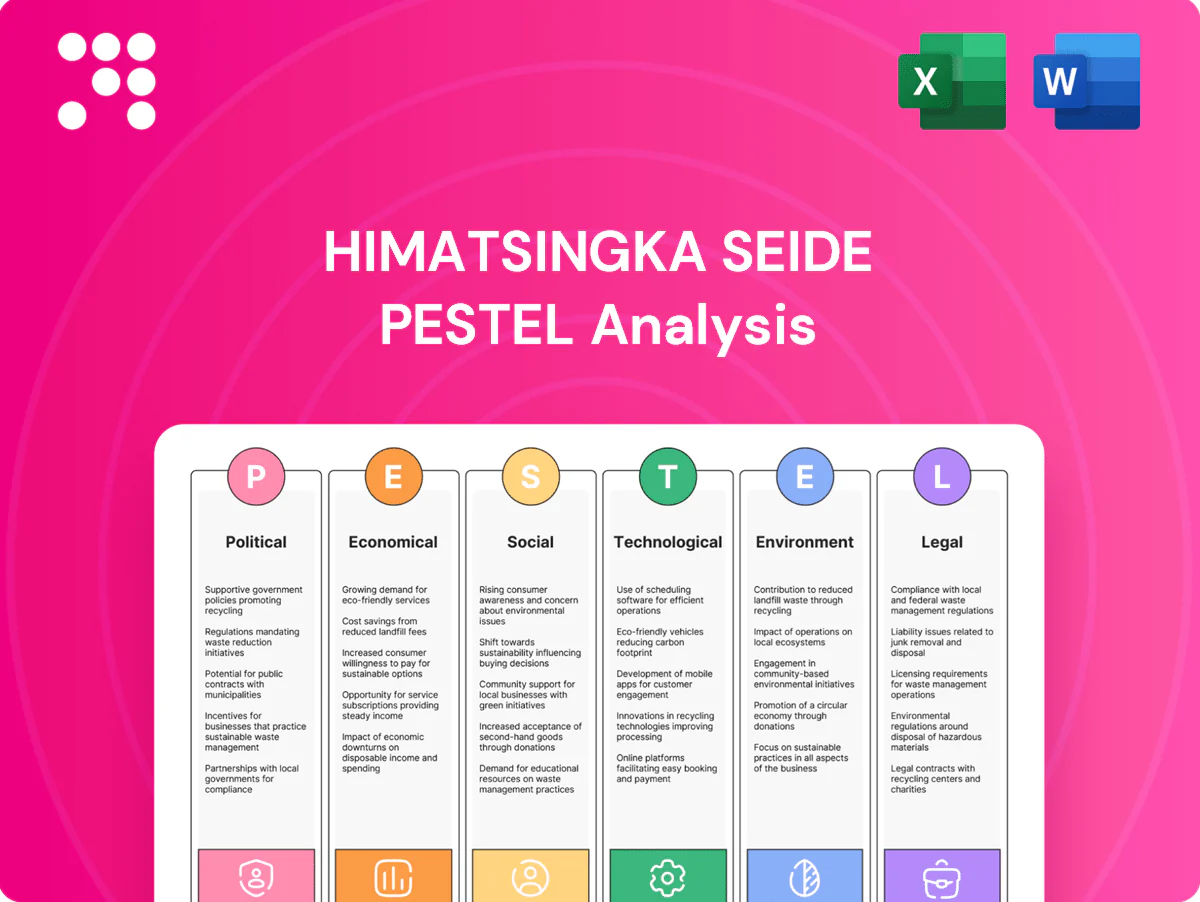
The preview shown is the exact Himatsingka Seide PESTLE Analysis you’ll receive after purchase—fully formatted, professionally structured, and ready to use. No placeholders or teasers; the content, layout, and structure are identical to the downloadable file. Receive this exact document instantly after checkout.

Original: $10.00
-65%$10.00
$3.50Product Information
Product Information
Shipping & Returns
Shipping & Returns
Description
Skip the Research. Get the Strategy.
Discover how political shifts, economic cycles, social trends, and regulatory changes are shaping Himatsingka Seide’s strategic outlook. Our concise PESTLE highlights key risks and opportunities to inform smarter decisions and spot growth levers. Ideal for investors and strategists—buy the full analysis for the complete, downloadable intelligence you need.
Political factors
Trade policy and tariffs
Export duties and FTAs materially affect Himatsingka Seide’s landed costs: India’s CEPA with the UAE (signed 2022) and other FTAs can cut tariffs on finished home textiles, improving pricing power in GCC and Middle East markets. U.S. Section 301 tariffs on Chinese goods (rates up to 25%) and EU trade remedies on certain textile lines can tighten margins or force volume re‑routing. Proactive multi‑country sourcing, tariff engineering and HS code optimization reduce shock exposure, while active policy lobbying and compliance readiness preserve market access and prevent de‑listing.
Government incentives
Government incentives materially affect Himatsingka Seide: the central PLI for textiles (approved at Rs 10,683 crore) and legacy TUFS (operational since 1999) improve production subsidy economics, while PM-MITRA/state textile parks (7 parks envisaged with ~Rs 19,000 crore expected investment and 7.5 lakh jobs) lower capex/unit costs. Duty drawback and export incentives enhance export competitiveness, and multi-year tracking/PLI structures reduce cliff risk; aligning capex to these priorities unlocks benefits.
Geopolitical supply risks
Regional conflicts in 2023–24 disrupted cotton, dye imports and freight lanes, with common rerouting adding roughly 10–20% to voyage distances and escalating transit times; this raises input and inventory carrying costs for Himatsingka Seide. Sanctions and origin restrictions have shifted sourcing math, forcing higher-cost alternatives and compliance overheads. Diversified suppliers and alternate ports hedge volatility, while scenario planning preserves service levels for global clients.
Labor and social policy
- Minimum wage revisions: ILO 2024 — 58% countries raised wages
- Compliance spend: higher due to buyer audits and govt norms
- HR compliance: reduces stoppages, reputational losses
- Skilling: integrated mills productivity +12–15%
Infrastructure and energy policy
Improved power reliability and rising renewable uptake cut overheads for textile mills; auctioned solar PPAs averaged about ₹2.5–3.5/kWh in 2024, making captive/solar increasingly economical. Rail and port modernization (Dedicated Freight Corridor phases) has trimmed export lead times by up to 30%, while aligned grid and logistics policy boosts supply‑chain resilience.
- Power reliability: fewer outages
- Renewable incentives: solar PPA ₹2.5–3.5/kWh (2024)
- Logistics upgrades: lead times −30%
- Grid policy: improves captive solar economics
CEPA/FTAs lower tariffs; PLI Rs10,683cr aids capex; wages rise; solar ₹2.5–3.5/kWh
Political drivers materially affect costs and market access for Himatsingka Seide: India CEPA/FTAs cut tariffs (post‑2022), PLI textiles Rs 10,683 crore boosts capex economics, and state wage hikes (ILO 2024: 58% countries) raise labour costs; solar PPAs ₹2.5–3.5/kWh (2024) and logistics upgrades (lead times −30%) improve competitiveness.
| Factor | 2024/25 metric | Impact |
|---|---|---|
| PLI | Rs 10,683 cr | Capex subsidy |
| Wages | 58% countries ↑ (ILO) | Higher unit costs |
| Solar PPA | ₹2.5–3.5/kWh | Lower energy Opex |
What is included in the product
Detailed Word Document
Explores how macro-environmental factors uniquely affect Himatsingka Seide across Political, Economic, Social, Technological, Environmental and Legal dimensions, with each section backed by relevant data and trends to identify threats and opportunities; designed for executives and investors to support strategy, scenario planning and funding decisions.
Customizable Excel Spreadsheet
A concise, visually segmented PESTLE summary for Himatsingka Seide that eases meeting prep, can be dropped into presentations, annotated for regional or business-line context, and quickly shared across teams to streamline external risk discussions and strategic planning.
Economic factors
Raw material price volatility
Raw material price volatility—cotton, yarn and petrochemical inputs—drive roughly 60–70% of textile COGS; in 2024 Cotlook A averaged near 90–100 cents/lb. Hedging and tighter inventory discipline have dampened spikes for Himatsingka, improving cost predictability. A strategic mix shift toward higher-value SKUs has supported gross margins, while long-term supplier partnerships stabilize quality and pricing.
Currency and interest rates
INR/USD traded roughly 82–84 and EUR/INR showed ~8–10% YTD swings to mid-2025, directly affecting Himatsingka Seide export realizations. Natural hedges (local sourcing, euro-denominated sales) plus derivatives (forwards/options) have materially reduced P&L noise. Rate cycles—RBI repo ~6.5% and global rates ~5.25–5.5%—raise working capital and capex costs. Contractual pricing clauses are used to share FX risk with buyers.
Global demand cycles
Retail and hospitality demand mirrors housing, travel and consumer confidence, with IATA reporting 2023 air passenger volumes at about 88% of 2019 levels. Downcycles compress volumes and force promotional intensity, eroding standard ASPs. License-backed premium lines help defend margins by commanding higher sell-through. Agile capacity planning and channel diversification (wholesale, DTC, contract) smooth utilisation and reduce cyclicality risk.
Inflation and consumer spend
Inflationary pressure (RBI target 4% ±2%) shifts wallet share to essentials, pressuring discretionary premium bedding sales, while demand favors durability and wellness features that justify higher ticket items. Pack-price architecture and multi-pack SKUs sustain conversion by lowering unit price perception, and operational efficiency (scale, backward integration) protects price points and margins.
- Inflation tag: RBI 4% ±2%
- Premium focus: durability, wellness
- Conversion: pack-price SKUs
- Protection: operational efficiency
Logistics and freight costs
Ocean freight volatility directly affects Himatsingka Seide: Drewry's World Container Index fell about 70% from 2022 peaks to 2024 levels, improving delivery reliability but leaving pockets of container scarcity on key India-Europe/US lanes. Multi-origin shipping and near-market stocking reduce single-route exposure, while long-term contracts with carriers stabilize service and pricing. Retailer scorecards benefit as lead times compressed 10-15% in 2024, raising on-time delivery metrics.
- Ocean rates: Drewry WCI down ~70% (2022→2024)
- Risk mitigation: multi-origin + near-market stocking
- Contracts: stabilized capacity/pricing
- Lead times: compressed ~10-15% in 2024, boosting retailer scores
CEPA/FTAs lower tariffs; PLI Rs10,683cr aids capex; wages rise; solar ₹2.5–3.5/kWh
Himatsingka faces raw-material cost swings (Cotlook A ~90–100c/lb in 2024) and INR/USD ~82–84 (mid‑2025) impacting export margins; hedging and supplier ties improved cost visibility. Lower Drewry WCI (~70% down 2022→2024) cut logistics costs; RBI repo ~6.5% raises working-capital and capex costs, pressuring margin recovery.
| Metric | Value |
|---|---|
| Cotlook A (2024) | 90–100 c/lb |
| INR/USD (mid‑2025) | 82–84 |
| Drewry WCI change | ~‑70% (2022→2024) |
| RBI repo (2025) | ~6.5% |
Full Version Awaits
Himatsingka Seide PESTLE Analysis
The preview shown is the exact Himatsingka Seide PESTLE Analysis you’ll receive after purchase—fully formatted, professionally structured, and ready to use. No placeholders or teasers; the content, layout, and structure are identical to the downloadable file. Receive this exact document instantly after checkout.