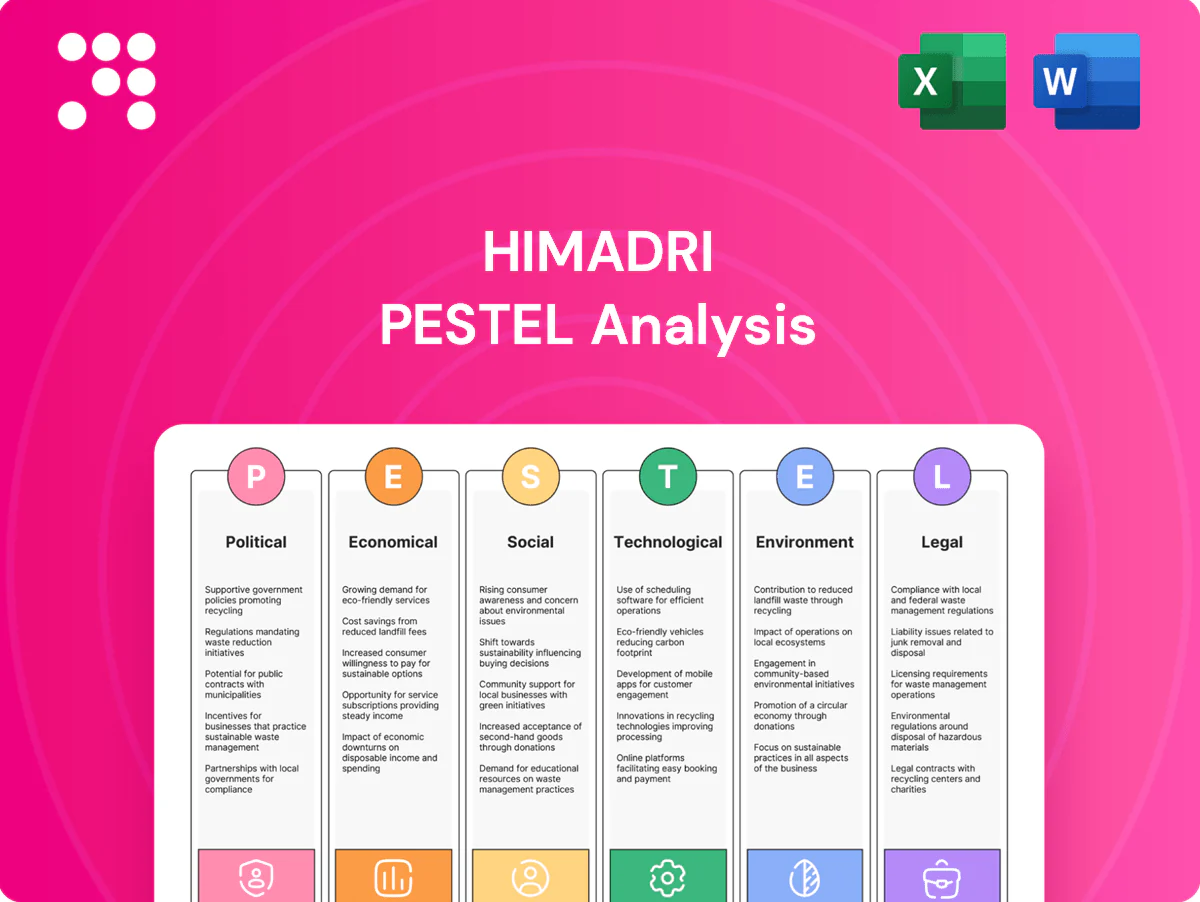
Himadri PESTLE Analysis

Plan Smarter. Present Sharper. Compete Stronger.
Gain a strategic advantage with our PESTLE Analysis of Himadri. Explore political, economic, social, technological, legal and environmental forces shaping its prospects, with actionable insights for investors and strategists. Purchase the full, editable report for immediate use.
Political factors

Trade policy and tariffs
Import/export duties on coal tar, carbon black and specialty oils directly shift Himadri’s feedstock and product pricing; India’s prevailing basic customs duty on carbon black was 7.5% in 2024, raising landed costs for imports. Anti-dumping or safeguard duty actions—recently applied by several jurisdictions against Chinese carbon black suppliers—can improve Himadri’s competitive positioning versus Chinese/EU exporters. Preferential trade agreements such as RCEP exclusions and bilateral pacts can open markets or cut landed costs, while tighter customs norms and documentation checks amplify margin volatility and require continuous monitoring for margin stability.
Industrial policy and incentives
Government schemes such as FAME India Phase II (Rs 10,000 crore) and the Production Linked Incentive for Advanced Chemistry Cell batteries (Rs 18,100 crore) boost demand for pitch, carbon materials and anodes, underpinning Himadri’s addressable market. PLI and state capex subsidies can accelerate localization and drive capex decisions. Priority-sector classification for advanced materials would ease approvals and lending. Policy reversals could delay projects and extend payback periods.

Geopolitical supply risk
Coal tar supply ties tightly to regional steel/coke dynamics—China accounted for about 53% of global crude steel in 2024, concentrating feedstock risk. Sanctions or conflicts can sever raw-material flows and shipping lanes; Red Sea disruptions saw freight insurance premia spike up to ~700% in 2023. Freight-rate volatility materially shifts delivered costs, so diversifying suppliers and ports reduces exposure.

State and local regulations
State and local regulations materially affect Himadri: plant siting, grid and water access, and permitting timelines vary across India’s 28 states and 8 union territories and by foreign jurisdictions, affecting CAPEX and ramp-up. Export market local content norms influence product mix and sales strategy. Political stability and community relations drive execution timelines, while incentive packages typically attach employment, investment and environmental compliance conditions.
- Plant siting: state-by-state permitting and utilities
- Exports: local content shapes product mix
- Stability: impacts timelines and community risk
- Incentives: conditional on jobs, investment, environment
Public infrastructure and energy policy
Public infrastructure and energy policy materially affect Himadri: power reliability and limited domestic gas availability force higher captive generation and LNG purchases, raising energy costs and utilization trade-offs. Rail and port capacity and new corridors (DFC) shorten turnaround for bulk inputs and exports, improving working capital. Carbon pricing signals and renewable mandates — India targets 500 GW non-fossil capacity by 2030 — shift energy sourcing and can lower Scope 2 as grid intensity fell ~8% in 2023.
- Power reliability: higher outages → more captive fuel spend
- Gas availability: LNG imports bridge domestic shortfall
- Logistics: DFC/port capacity cut bulk turnaround times
- Policy: 500 GW 2030 target and falling grid intensity reduce Scope 2
Duties, PLI & FAME II expand markets as geopolitics and permits squeeze margins
Import duties (carbon black 7.5% in 2024) and anti-dumping measures reshape margins and competitiveness; PLI schemes (ACC PLI Rs 18,100 crore) and FAME II (Rs 10,000 crore) expand addressable markets. Geopolitical risks (China 53% of 2024 crude steel; Red Sea freight premia +700% in 2023) threaten feedstock and shipping. State-level permits across 28 states/8 UTs and local content rules drive timelines and incentives.
| Metric | Value |
|---|---|
| Carbon black duty (2024) | 7.5% |
| ACC PLI | Rs 18,100 crore |
| FAME II | Rs 10,000 crore |
| China share crude steel (2024) | 53% |
What is included in the product
 Detailed Word Document
Explores how external macro-environmental factors uniquely affect Himadri across six dimensions—Political, Economic, Social, Technological, Environmental, and Legal—each backed by current data and trend analysis. Designed to help executives and investors identify risks, opportunities, and forward-looking scenarios for strategic planning.

 Customizable Excel Spreadsheet
A concise, visually segmented PESTLE summary for Himadri that’s easily dropped into presentations, annotated for local context, and shared across teams to align discussions on external risks, market positioning and strategic planning.
Economic factors

Commodity and cycle exposure
End-markets such as aluminum, steel electrodes and construction are highly cyclical, and downcycles materially compress volumes and pricing for coal tar pitch and carbon black. Global carbon black demand is forecast to grow roughly 3% CAGR to 2030, while lithium-ion battery materials are projected near 20% CAGR to 2030, giving battery-sector growth a counter-cyclical tailwind. Himadri’s diversified portfolio helps smooth revenue swings across cycles.
Energy and feedstock costs
Coal tar, CBFS and furnace fuels remain the biggest cost drivers for Himadri, with feedstock and energy accounting for a majority of variable costs; Brent crude averaged about $85/bbl in 2024, driving petcoke and furnace fuel prices higher. Oil and gas swings transmit imperfectly to customer contracts, creating lagged margin effects. Operational efficiency and hedging programs have supported margin resilience, while long‑term supply agreements have reduced spot volatility.

FX and export competitiveness
INR movements, trading around 83–84 per USD in mid‑2025, materially affect Himadri export realizations and imported equipment costs, given India’s merchandise exports of about $448bn in FY2023‑24. Dollar‑denominated sales can partially hedge local inflationary pressures, but mismatched currency cash flows elevate FX risk. Natural hedges and prudent treasury policies, including forward cover and cash‑flow matching, are essential.

Capital intensity and interest rates
Advanced carbon and battery-materials projects require sizable capex, often hundreds of millions USD, driving high fixed costs and long payback horizons. Higher rates, with RBI repo around 6.5% in mid-2025, elevate WACC and hurdle returns, squeezing project viability. Access to green finance and phased commissioning can lower cost of capital and reduce ramp-up risk.
- Capex intensity: large upfront investment, long payback
- Interest impact: higher repo/WACC raises required returns
- Green finance: lowers effective cost of capital
- Phased commissioning: mitigates ramp-up and execution risk
Global demand for EVs and storage
Global EV sales momentum—EVs reached about 14% of new car sales in 2023 (IEA) and lithium-ion batteries account for over 90% of installed battery capacity—directly lifts anode and specialty carbon demand; policy targets in China, EU and US support multi-year visibility, while chemistry shifts (LFP, solid-state) pose substitution risk and 6–18 month customer qualification cycles can delay revenue recognition.
- Demand: lithium-ion >90% share
- EV penetration: ~14% of new sales (2023, IEA)
- Risk: LFP/solid-state substitution
- Timing: 6–18 month qualification cycles
Duties, PLI & FAME II expand markets as geopolitics and permits squeeze margins
End‑market cyclicality compresses volumes/prices; portfolio diversification and battery-material exposure (battery materials ~20% CAGR to 2030; carbon black ~3% CAGR) smooth revenue. Feedstock/energy are largest cost drivers (Brent ~$85/bbl in 2024), FX (INR ~83–84/USD mid‑2025) and repo ~6.5% raise WACC and capex pressure; green finance and phased commissioning mitigate risks.
| Metric | Value |
|---|---|
| Brent (2024) | $85/bbl |
| INR/USD (mid‑2025) | 83–84 |
| RBI repo (mid‑2025) | ~6.5% |
| Carbon black CAGR | ~3% to 2030 |
| Battery materials CAGR | ~20% to 2030 |
Full Version Awaits
Himadri PESTLE Analysis
The Himadri PESTLE Analysis preview shown here is the exact document you’ll receive after purchase—fully formatted and ready to use. The layout, content, and structure visible are identical to the downloadable file you’ll get upon payment. No placeholders or teasers—this is the final, professionally structured report you’ll own immediately after checkout.

Original: $10.00
-65%$10.00
$3.50Product Information
Product Information
Shipping & Returns
Shipping & Returns
Description
Plan Smarter. Present Sharper. Compete Stronger.
Gain a strategic advantage with our PESTLE Analysis of Himadri. Explore political, economic, social, technological, legal and environmental forces shaping its prospects, with actionable insights for investors and strategists. Purchase the full, editable report for immediate use.
Political factors
Trade policy and tariffs
Import/export duties on coal tar, carbon black and specialty oils directly shift Himadri’s feedstock and product pricing; India’s prevailing basic customs duty on carbon black was 7.5% in 2024, raising landed costs for imports. Anti-dumping or safeguard duty actions—recently applied by several jurisdictions against Chinese carbon black suppliers—can improve Himadri’s competitive positioning versus Chinese/EU exporters. Preferential trade agreements such as RCEP exclusions and bilateral pacts can open markets or cut landed costs, while tighter customs norms and documentation checks amplify margin volatility and require continuous monitoring for margin stability.
Industrial policy and incentives
Government schemes such as FAME India Phase II (Rs 10,000 crore) and the Production Linked Incentive for Advanced Chemistry Cell batteries (Rs 18,100 crore) boost demand for pitch, carbon materials and anodes, underpinning Himadri’s addressable market. PLI and state capex subsidies can accelerate localization and drive capex decisions. Priority-sector classification for advanced materials would ease approvals and lending. Policy reversals could delay projects and extend payback periods.
Geopolitical supply risk
Coal tar supply ties tightly to regional steel/coke dynamics—China accounted for about 53% of global crude steel in 2024, concentrating feedstock risk. Sanctions or conflicts can sever raw-material flows and shipping lanes; Red Sea disruptions saw freight insurance premia spike up to ~700% in 2023. Freight-rate volatility materially shifts delivered costs, so diversifying suppliers and ports reduces exposure.
State and local regulations
State and local regulations materially affect Himadri: plant siting, grid and water access, and permitting timelines vary across India’s 28 states and 8 union territories and by foreign jurisdictions, affecting CAPEX and ramp-up. Export market local content norms influence product mix and sales strategy. Political stability and community relations drive execution timelines, while incentive packages typically attach employment, investment and environmental compliance conditions.
- Plant siting: state-by-state permitting and utilities
- Exports: local content shapes product mix
- Stability: impacts timelines and community risk
- Incentives: conditional on jobs, investment, environment
Public infrastructure and energy policy
Public infrastructure and energy policy materially affect Himadri: power reliability and limited domestic gas availability force higher captive generation and LNG purchases, raising energy costs and utilization trade-offs. Rail and port capacity and new corridors (DFC) shorten turnaround for bulk inputs and exports, improving working capital. Carbon pricing signals and renewable mandates — India targets 500 GW non-fossil capacity by 2030 — shift energy sourcing and can lower Scope 2 as grid intensity fell ~8% in 2023.
- Power reliability: higher outages → more captive fuel spend
- Gas availability: LNG imports bridge domestic shortfall
- Logistics: DFC/port capacity cut bulk turnaround times
- Policy: 500 GW 2030 target and falling grid intensity reduce Scope 2
Duties, PLI & FAME II expand markets as geopolitics and permits squeeze margins
Import duties (carbon black 7.5% in 2024) and anti-dumping measures reshape margins and competitiveness; PLI schemes (ACC PLI Rs 18,100 crore) and FAME II (Rs 10,000 crore) expand addressable markets. Geopolitical risks (China 53% of 2024 crude steel; Red Sea freight premia +700% in 2023) threaten feedstock and shipping. State-level permits across 28 states/8 UTs and local content rules drive timelines and incentives.
| Metric | Value |
|---|---|
| Carbon black duty (2024) | 7.5% |
| ACC PLI | Rs 18,100 crore |
| FAME II | Rs 10,000 crore |
| China share crude steel (2024) | 53% |
What is included in the product
Detailed Word Document
Explores how external macro-environmental factors uniquely affect Himadri across six dimensions—Political, Economic, Social, Technological, Environmental, and Legal—each backed by current data and trend analysis. Designed to help executives and investors identify risks, opportunities, and forward-looking scenarios for strategic planning.
Customizable Excel Spreadsheet
A concise, visually segmented PESTLE summary for Himadri that’s easily dropped into presentations, annotated for local context, and shared across teams to align discussions on external risks, market positioning and strategic planning.
Economic factors
Commodity and cycle exposure
End-markets such as aluminum, steel electrodes and construction are highly cyclical, and downcycles materially compress volumes and pricing for coal tar pitch and carbon black. Global carbon black demand is forecast to grow roughly 3% CAGR to 2030, while lithium-ion battery materials are projected near 20% CAGR to 2030, giving battery-sector growth a counter-cyclical tailwind. Himadri’s diversified portfolio helps smooth revenue swings across cycles.
Energy and feedstock costs
Coal tar, CBFS and furnace fuels remain the biggest cost drivers for Himadri, with feedstock and energy accounting for a majority of variable costs; Brent crude averaged about $85/bbl in 2024, driving petcoke and furnace fuel prices higher. Oil and gas swings transmit imperfectly to customer contracts, creating lagged margin effects. Operational efficiency and hedging programs have supported margin resilience, while long‑term supply agreements have reduced spot volatility.
FX and export competitiveness
INR movements, trading around 83–84 per USD in mid‑2025, materially affect Himadri export realizations and imported equipment costs, given India’s merchandise exports of about $448bn in FY2023‑24. Dollar‑denominated sales can partially hedge local inflationary pressures, but mismatched currency cash flows elevate FX risk. Natural hedges and prudent treasury policies, including forward cover and cash‑flow matching, are essential.
Capital intensity and interest rates
Advanced carbon and battery-materials projects require sizable capex, often hundreds of millions USD, driving high fixed costs and long payback horizons. Higher rates, with RBI repo around 6.5% in mid-2025, elevate WACC and hurdle returns, squeezing project viability. Access to green finance and phased commissioning can lower cost of capital and reduce ramp-up risk.
- Capex intensity: large upfront investment, long payback
- Interest impact: higher repo/WACC raises required returns
- Green finance: lowers effective cost of capital
- Phased commissioning: mitigates ramp-up and execution risk
Global demand for EVs and storage
Global EV sales momentum—EVs reached about 14% of new car sales in 2023 (IEA) and lithium-ion batteries account for over 90% of installed battery capacity—directly lifts anode and specialty carbon demand; policy targets in China, EU and US support multi-year visibility, while chemistry shifts (LFP, solid-state) pose substitution risk and 6–18 month customer qualification cycles can delay revenue recognition.
- Demand: lithium-ion >90% share
- EV penetration: ~14% of new sales (2023, IEA)
- Risk: LFP/solid-state substitution
- Timing: 6–18 month qualification cycles
Duties, PLI & FAME II expand markets as geopolitics and permits squeeze margins
End‑market cyclicality compresses volumes/prices; portfolio diversification and battery-material exposure (battery materials ~20% CAGR to 2030; carbon black ~3% CAGR) smooth revenue. Feedstock/energy are largest cost drivers (Brent ~$85/bbl in 2024), FX (INR ~83–84/USD mid‑2025) and repo ~6.5% raise WACC and capex pressure; green finance and phased commissioning mitigate risks.
| Metric | Value |
|---|---|
| Brent (2024) | $85/bbl |
| INR/USD (mid‑2025) | 83–84 |
| RBI repo (mid‑2025) | ~6.5% |
| Carbon black CAGR | ~3% to 2030 |
| Battery materials CAGR | ~20% to 2030 |
Full Version Awaits
Himadri PESTLE Analysis
The Himadri PESTLE Analysis preview shown here is the exact document you’ll receive after purchase—fully formatted and ready to use. The layout, content, and structure visible are identical to the downloadable file you’ll get upon payment. No placeholders or teasers—this is the final, professionally structured report you’ll own immediately after checkout.











