Hilton Food Group PESTLE Analysis

Plan Smarter. Present Sharper. Compete Stronger.
Stay ahead with our PESTLE analysis of Hilton Food Group—spot political, economic and environmental trends shaping margins and supply chains. Tailored for investors and strategists, it delivers concise, actionable insights to inform decisions. Purchase the full report for the complete, downloadable breakdown.
Political factors

Trade policy and tariffs
Import duties on meat, seafood and ingredients—often reaching double‑digit percentage points for some product lines—directly raise landed costs and compress margins for Hilton Food Group.
Post‑Brexit shifts in UK/EU trade rules and the UK's 2023 CPTPP accession change tariff landscapes and sourcing economics across suppliers and distribution hubs.
Retaliatory tariffs or SPS barriers (health checks, border delays) have previously disrupted cold‑chain flows and can spike logistics costs and waste.
Proactive hedging of currency/commodity exposure and diversified multi‑regional sourcing reduce single‑market tariff risk and protect gross margin.
Food security and agri policy
Governments increasingly prioritize stable protein supply, shaping subsidies and public procurement that favor reliable processors; as of 2024 Hilton Food Group operates 36 production facilities across 12 countries, positioning it to capture such contracts. Policy emphasis on domestic processing and resilience creates incentives and local content expectations that can raise barriers for imports. Aligning operations with national food strategies strengthens eligibility for supply contracts and licensing.

Geopolitical supply disruptions
Conflicts and sanctions since the 2022 Russia‑Ukraine war have disrupted fisheries, feed ingredient flows and logistics lanes, forcing port congestion and corridor closures that raise lead times and costs. Hilton must maintain multi‑origin approvals and contingency plans across its network to protect supply continuity. Political risk insurance and dual sourcing remain key strategic levers amid elevated geopolitical volatility in 2023–24.

Sustainability-driven public procurement
Public bodies and major retailers increasingly set sustainability thresholds, and UK political commitments to net zero by 2050 (legally binding since 2019) cascade into supplier requirements; UK public procurement spend was £328bn in 2022–23, making compliance commercially material. Meeting thresholds can unlock preferred‑supplier status, while lagging performance risks exclusion from tenders and lost revenue.
- NetZeroPolicy: UK net zero by 2050
- ProcurementValue: £328bn (2022–23)
- CommercialImpact: preferred‑supplier access
- Risk: exclusion from tenders
Labor and immigration policy
Processing relies on skilled and semi-skilled labour pools, and tighter visa regimes since 2023 have raised recruitment costs and constrained capacity across European plants. Automation incentives and capital programmes in 2024 can offset labour scarcity, with industry reports showing labour reductions of c.30–40% from mechanisation. Workforce localisation plans build political goodwill and reduce visa dependence.
- Tighter visas: higher recruitment costs
- Automation: c.30–40% labour reduction
- Localisation: improves permits & relations
- Operational resilience: mixed human/auto model
Tariff, visa and sustainability shifts raise landed costs; automation and multi-sourcing vital
Tariff shifts post‑Brexit and CPTPP accession (2023) raise landed costs and sourcing complexity across Hilton's 36 plants in 12 countries.
UK net‑zero by 2050 and £328bn public procurement (2022–23) make sustainability compliance commercially material for contract access.
Tighter 2023 visa regimes increase labour costs; automation programmes (c.30–40% labour reduction) and multi‑origin sourcing mitigate political supply risks.
What is included in the product
 Detailed Word Document
Explores how macro-environmental factors uniquely affect Hilton Food Group across Political, Economic, Social, Technological, Environmental and Legal dimensions, with data-backed trends, forward-looking insights and industry-specific examples to help executives, consultants and investors identify risks, opportunities and actionable strategy implications.

 Customizable Excel Spreadsheet
A concise, visually segmented PESTLE summary for Hilton Food Group that highlights external risks and market opportunities, easily dropped into presentations, annotated for regional or business-line notes, and shareable across teams to streamline strategic planning and risk discussions.
Economic factors

Protein input price volatility
Protein input prices for beef, pork, salmon and plant proteins swing with feed, disease and weather—global meat prices rose roughly 15–25% across 2021–23 during feed and supply shocks. Cost pass‑through to retailers depends on contract terms, with fixed-price deals limiting immediate recovery. Margin management needs indexation and flexible formulations; strategic inventory and hedging (futures/options) can cut price shock volatility by double digits.
Consumer trading down
Inflation-driven consumer trading down has pushed baskets toward value tiers and private label, with UK grocery inflation easing to around 6% in 2024, supporting growth in lower-priced proteins and ready meals. Ready meals and affordable proteins have outperformed staples in many markets as households seek convenience at lower cost. Hilton’s close retailer partnerships enable rapid adjustment of pack sizes and price points, while active mix management is essential to defend volumes and margins.

FX and multi-currency exposure
Hilton Food Group operates with revenues and costs in GBP, EUR, AUD, SEK and other currencies, so FX swings materially affect both reported results and competitive pricing across markets.

Retailer consolidation and pricing power
Large grocers (UK top 5 ~75% market share in 2024, Kantar) exert strong commercial terms on suppliers, raising margin pressure for Hilton Food Group and increasing renegotiation risk due to high customer concentration. Differentiation through service, product innovation and ESG commitments improves customer stickiness. Diversifying into foodservice, e-commerce and international channels reduces single-customer dependency.
- Customer concentration: high (risk of renegotiation)
- UK top-5 grocers ~75% market share (Kantar 2024)
- Differentiation: service, innovation, ESG = higher stickiness
- Channel diversification: lowers dependence on large grocers
Capital intensity and interest rates
Hilton Food Group (LSE: HFG) operates highly automated plants that require sustained capex—HFG reported c.£30m capex in FY2024—so higher interest rates raise its WACC and required hurdle returns, tightening project economics against a UK base rate near 5.25% in 2024–25. Phased investments and asset‑light partnerships reduce upfront funding, but efficiency gains only help if passed through into contractual savings with retailers and processors.
- Capex pressure: c.£30m FY2024
- Rates/WACC: UK base rate ~5.25% (2024–25)
- Mitigation: phased investments, asset‑light JV
- Requirement: efficiency → contractual savings
Tariff, visa and sustainability shifts raise landed costs; automation and multi-sourcing vital
Protein input volatility (meat prices +15–25% 2021–23) and 2024 grocery inflation ~6% compress margins; FX exposure across GBP/EUR/AUD/SEK affects reported results. UK top‑5 grocers ~75% share (Kantar 2024) increases commercial pressure. Capex c.£30m FY2024 and UK base rate ~5.25% tighten WACC and project returns.
| Metric | Value |
|---|---|
| Meat price shock | +15–25% (2021–23) |
| Grocery inflation | ~6% (2024) |
| UK top‑5 grocers | ~75% market share (Kantar 2024) |
| Capex | c.£30m FY2024 |
| UK base rate | ~5.25% (2024–25) |
Same Document Delivered
Hilton Food Group PESTLE Analysis
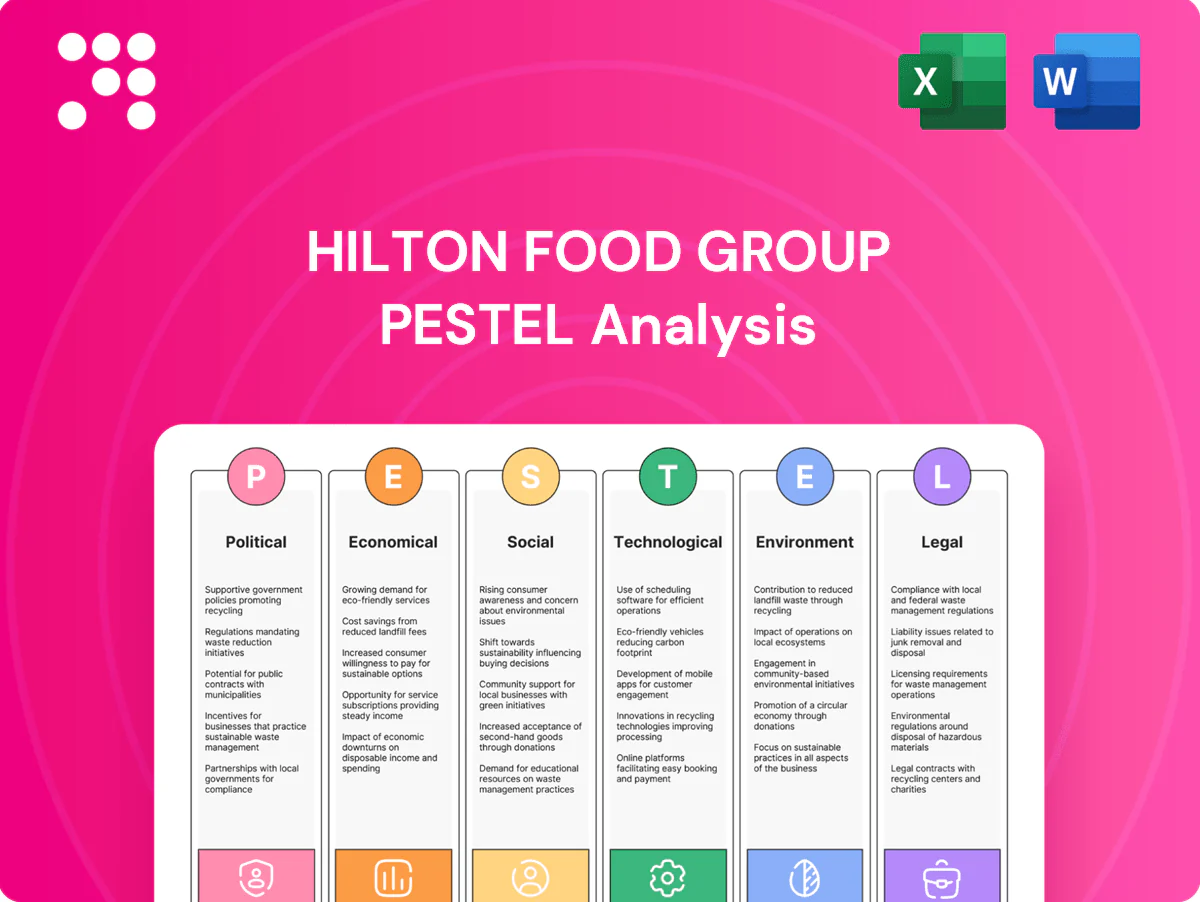
The preview shown here is the exact document you’ll receive after purchase—fully formatted and ready to use. This PESTLE analysis of Hilton Food Group examines political, economic, social, technological, legal and environmental factors shaping strategy and risk. It’s concise, sourced and ready to download immediately after checkout.

Original: $10.00
-65%$10.00
$3.50Product Information
Product Information
Shipping & Returns
Shipping & Returns
Description
Plan Smarter. Present Sharper. Compete Stronger.
Stay ahead with our PESTLE analysis of Hilton Food Group—spot political, economic and environmental trends shaping margins and supply chains. Tailored for investors and strategists, it delivers concise, actionable insights to inform decisions. Purchase the full report for the complete, downloadable breakdown.
Political factors
Trade policy and tariffs
Import duties on meat, seafood and ingredients—often reaching double‑digit percentage points for some product lines—directly raise landed costs and compress margins for Hilton Food Group.
Post‑Brexit shifts in UK/EU trade rules and the UK's 2023 CPTPP accession change tariff landscapes and sourcing economics across suppliers and distribution hubs.
Retaliatory tariffs or SPS barriers (health checks, border delays) have previously disrupted cold‑chain flows and can spike logistics costs and waste.
Proactive hedging of currency/commodity exposure and diversified multi‑regional sourcing reduce single‑market tariff risk and protect gross margin.
Food security and agri policy
Governments increasingly prioritize stable protein supply, shaping subsidies and public procurement that favor reliable processors; as of 2024 Hilton Food Group operates 36 production facilities across 12 countries, positioning it to capture such contracts. Policy emphasis on domestic processing and resilience creates incentives and local content expectations that can raise barriers for imports. Aligning operations with national food strategies strengthens eligibility for supply contracts and licensing.
Geopolitical supply disruptions
Conflicts and sanctions since the 2022 Russia‑Ukraine war have disrupted fisheries, feed ingredient flows and logistics lanes, forcing port congestion and corridor closures that raise lead times and costs. Hilton must maintain multi‑origin approvals and contingency plans across its network to protect supply continuity. Political risk insurance and dual sourcing remain key strategic levers amid elevated geopolitical volatility in 2023–24.
Sustainability-driven public procurement
Public bodies and major retailers increasingly set sustainability thresholds, and UK political commitments to net zero by 2050 (legally binding since 2019) cascade into supplier requirements; UK public procurement spend was £328bn in 2022–23, making compliance commercially material. Meeting thresholds can unlock preferred‑supplier status, while lagging performance risks exclusion from tenders and lost revenue.
- NetZeroPolicy: UK net zero by 2050
- ProcurementValue: £328bn (2022–23)
- CommercialImpact: preferred‑supplier access
- Risk: exclusion from tenders
Labor and immigration policy
Processing relies on skilled and semi-skilled labour pools, and tighter visa regimes since 2023 have raised recruitment costs and constrained capacity across European plants. Automation incentives and capital programmes in 2024 can offset labour scarcity, with industry reports showing labour reductions of c.30–40% from mechanisation. Workforce localisation plans build political goodwill and reduce visa dependence.
- Tighter visas: higher recruitment costs
- Automation: c.30–40% labour reduction
- Localisation: improves permits & relations
- Operational resilience: mixed human/auto model
Tariff, visa and sustainability shifts raise landed costs; automation and multi-sourcing vital
Tariff shifts post‑Brexit and CPTPP accession (2023) raise landed costs and sourcing complexity across Hilton's 36 plants in 12 countries.
UK net‑zero by 2050 and £328bn public procurement (2022–23) make sustainability compliance commercially material for contract access.
Tighter 2023 visa regimes increase labour costs; automation programmes (c.30–40% labour reduction) and multi‑origin sourcing mitigate political supply risks.
What is included in the product
Detailed Word Document
Explores how macro-environmental factors uniquely affect Hilton Food Group across Political, Economic, Social, Technological, Environmental and Legal dimensions, with data-backed trends, forward-looking insights and industry-specific examples to help executives, consultants and investors identify risks, opportunities and actionable strategy implications.
Customizable Excel Spreadsheet
A concise, visually segmented PESTLE summary for Hilton Food Group that highlights external risks and market opportunities, easily dropped into presentations, annotated for regional or business-line notes, and shareable across teams to streamline strategic planning and risk discussions.
Economic factors
Protein input price volatility
Protein input prices for beef, pork, salmon and plant proteins swing with feed, disease and weather—global meat prices rose roughly 15–25% across 2021–23 during feed and supply shocks. Cost pass‑through to retailers depends on contract terms, with fixed-price deals limiting immediate recovery. Margin management needs indexation and flexible formulations; strategic inventory and hedging (futures/options) can cut price shock volatility by double digits.
Consumer trading down
Inflation-driven consumer trading down has pushed baskets toward value tiers and private label, with UK grocery inflation easing to around 6% in 2024, supporting growth in lower-priced proteins and ready meals. Ready meals and affordable proteins have outperformed staples in many markets as households seek convenience at lower cost. Hilton’s close retailer partnerships enable rapid adjustment of pack sizes and price points, while active mix management is essential to defend volumes and margins.
FX and multi-currency exposure
Hilton Food Group operates with revenues and costs in GBP, EUR, AUD, SEK and other currencies, so FX swings materially affect both reported results and competitive pricing across markets.
Retailer consolidation and pricing power
Large grocers (UK top 5 ~75% market share in 2024, Kantar) exert strong commercial terms on suppliers, raising margin pressure for Hilton Food Group and increasing renegotiation risk due to high customer concentration. Differentiation through service, product innovation and ESG commitments improves customer stickiness. Diversifying into foodservice, e-commerce and international channels reduces single-customer dependency.
- Customer concentration: high (risk of renegotiation)
- UK top-5 grocers ~75% market share (Kantar 2024)
- Differentiation: service, innovation, ESG = higher stickiness
- Channel diversification: lowers dependence on large grocers
Capital intensity and interest rates
Hilton Food Group (LSE: HFG) operates highly automated plants that require sustained capex—HFG reported c.£30m capex in FY2024—so higher interest rates raise its WACC and required hurdle returns, tightening project economics against a UK base rate near 5.25% in 2024–25. Phased investments and asset‑light partnerships reduce upfront funding, but efficiency gains only help if passed through into contractual savings with retailers and processors.
- Capex pressure: c.£30m FY2024
- Rates/WACC: UK base rate ~5.25% (2024–25)
- Mitigation: phased investments, asset‑light JV
- Requirement: efficiency → contractual savings
Tariff, visa and sustainability shifts raise landed costs; automation and multi-sourcing vital
Protein input volatility (meat prices +15–25% 2021–23) and 2024 grocery inflation ~6% compress margins; FX exposure across GBP/EUR/AUD/SEK affects reported results. UK top‑5 grocers ~75% share (Kantar 2024) increases commercial pressure. Capex c.£30m FY2024 and UK base rate ~5.25% tighten WACC and project returns.
| Metric | Value |
|---|---|
| Meat price shock | +15–25% (2021–23) |
| Grocery inflation | ~6% (2024) |
| UK top‑5 grocers | ~75% market share (Kantar 2024) |
| Capex | c.£30m FY2024 |
| UK base rate | ~5.25% (2024–25) |
Same Document Delivered
Hilton Food Group PESTLE Analysis
The preview shown here is the exact document you’ll receive after purchase—fully formatted and ready to use. This PESTLE analysis of Hilton Food Group examines political, economic, social, technological, legal and environmental factors shaping strategy and risk. It’s concise, sourced and ready to download immediately after checkout.