Hangzhou Hikvision Digital Technology PESTLE Analysis

Your Shortcut to Market Insight Starts Here
Navigate the complex external landscape shaping Hangzhou Hikvision Digital Technology with our concise PESTLE snapshot—covering geopolitical risk, regulatory scrutiny, supply-chain pressures, technological innovation, and socio-environmental trends influencing growth. Use these insights to refine investment theses or strategic plans. Purchase the full PESTLE for a complete, actionable breakdown ready for immediate use.
Political factors

Geopolitical tensions and trade restrictions
Heightened US–China rivalry — exemplified by US export controls on advanced chips since 2022 and Hikvision's placement on the US Entity List in October 2019 — constrains market access, procurement rules, and partner choices. Restrictions limit sourcing of sensitive components and sales in certain markets despite Hikvision's presence in over 180 countries. Strategic supplier and regional diversification is now essential. Strong government relations and compliance readiness directly affect revenue stability.
Government procurement and national security policies
Public-sector surveillance spend is highly policy-driven and cyclical; major procurement rounds often determine annual revenue bursts. National security vetting (Hikvision was added to the US Entity List in October 2019) materially affects vendor eligibility and approval timelines. Preferential local sourcing policies can either grant market access or exclude foreign bidders. Alignment with public safety priorities raises win rates on large projects.

Export controls and blacklists exposure
On the US Entity List since October 2019, Hangzhou Hikvision faces country-specific bans and tightened BIS controls that constrain exports and tech flows; licensing hurdles commonly add 3–9 months and extra compliance costs, forcing product roadmaps to swap controlled components and pursue alternative parts, non-US markets and third-party certifications to mitigate revenue and supply risks.

Smart city and critical infrastructure agendas
Urban modernization programs in 2024 continued to catalyze large-scale deployments of Hikvision cameras and sensors across municipal smart-city projects, while funding cycles and changes in political leadership frequently accelerate or stall rollouts within provinces. Integration of Hikvision systems into national critical infrastructure increases both visibility and regulatory scrutiny from domestic and international stakeholders. Public-private partnerships remain pivotal for multi-year deployments and maintenance contracts.
- Smart-city-driven procurement: municipal tenders dominate sales channels
- Funding volatility: election and budget cycles affect rollout timing
- Regulatory exposure: national integration raises compliance scrutiny
- PPP reliance: long-term O&M and upgrade contracts essential
Diplomatic relations and local content rules
Bilateral ties shape market receptivity and regulatory approvals for Hangzhou Hikvision, which operates in 150+ countries and has been on the US Entity List since 2019, constraining certain exports. Localization mandates push the firm toward regional manufacturing and R&D commitments to retain contracts and comply with procurement rules. Political shifts can quickly reframe data sovereignty and cross‑border encryption requirements, so consistent diplomatic engagement supports operational continuity in sensitive jurisdictions.
Geopolitical export controls force smart-city vendors into regional diversification
Heightened US–China rivalry, US Entity List since Oct 2019 and export controls on advanced chips (since 2022) limit sourcing and market access across 180+ countries, forcing regional diversification. Public-sector smart-city spend drives cyclical procurement peaks; 2024 municipal rollouts increased deployments. Licensing delays typically add 3–9 months and raise compliance costs.
| Factor | Impact | Data |
|---|---|---|
| Bilateral ties | Market access | 180+ countries; Entity List Oct 2019 |
| Export controls | Sourcing changes | Controls since 2022; 3–9m licensing delays |
What is included in the product
 Detailed Word Document
Explores how macro-environmental factors uniquely affect Hangzhou Hikvision across Political, Economic, Social, Technological, Environmental and Legal dimensions, with data-backed insights and forward-looking commentary to help executives, investors and strategists identify risks, opportunities and strategic responses.

 Customizable Excel Spreadsheet
Clean, visually segmented PESTLE summary of Hangzhou Hikvision that highlights key political, regulatory, technological and market risks for quick inclusion in presentations or strategy sessions, editable for regional/context-specific notes and easily shareable across teams to support risk discussions and client reports.
Economic factors

Global capex cycles and public safety budgets
Macroeconomic slowdowns (IMF 2024 global growth ~3.1%) compress customer spend and elongate sales cycles for Hikvision, while core sectors often shield security budgets. Multi-year transport and energy frameworks provide smoothing of revenue streams. Public budget timing drives quarterly volatility and forces inventory planning adjustments.
Currency volatility and pricing power
Currency volatility—with the RMB moving roughly 5–7% vs the USD in 2023–24—directly alters Hangzhou Hikvision’s export competitiveness and reported earnings given about half of sales derive from overseas markets. Active hedging and local-currency pricing have been used to stabilize margins and reduce translation losses. Concurrent component cost inflation has pressured ASPs, forcing selective discounting to preserve volume. A tiered product lineup helps defend share across price bands and retain margin resilience.

Supply chain resilience and cost structure
Semiconductor availability and elevated logistics rates remain key drivers of Hikvision’s COGS, with global chip spot prices easing about 20% in 2024 while the Shanghai Containerized Freight Index stayed roughly 40–50% below 2021 peaks. Nearshoring and dual‑sourcing initiatives have cut disruption risk and shortened lead times. Higher inventory buffers preserve delivery reliability but lift working capital needs; operational excellence is essential to restore gross margins after shocks.

Emerging market demand and urbanization
Rising urban density in emerging markets—Asia and Africa account for roughly 85% of global urban population growth through 2030 per UN WUP 2022—is expanding demand for wide-area surveillance and smart-city deployments.
Affordability and financing terms shape uptake, with leasing and bundling improving access in lower-income markets and enabling faster rollouts.
Channel partnerships accelerate penetration across fragmented distributors, while service-led models (maintenance, cloud VMS) convert one-time hardware sales into recurring revenue streams.
- UN WUP 2022: ~60% global urbanization by 2030; 85% of urban growth in Asia/Africa
- Financing: leasing and pay-as-you-go increase adoption in low-income regions
- Channels: local integrators drive faster market entry
- Services: recurring revenue from cloud/VMS and maintenance boosts lifecycle value
Competitive intensity and consolidation
Global and regional players compete fiercely on price, AI features and service; Hikvision reported revenue of RMB 86.0 billion in 2024 and leverages scale to sustain R&D spend of about 8% of revenue to maintain cost leadership and AI edge.
Consolidation among systems integrators in 2024 shifted bargaining power toward large vendors, while verticalized solutions (retail, transport, smart cities) boosted Hikvision win rates and margin resilience.
- Market share tag: ~30% global (2024)
- Revenue tag: RMB 86.0bn (2024)
- R&D tag: ~8% of revenue (2024)
- Strategy tag: vertical solutions + scale
Geopolitical export controls force smart-city vendors into regional diversification
IMF 2024 global growth ~3.1% slows capex but security spend stays resilient in core verticals; Hikvision RMB revenue 86.0bn (2024) and ~30% global share preserve scale. RMB moved ~5–7% vs USD (2023–24), hedging limits translation pain while COGS impacted by chip costs (chip spot prices down ~20% in 2024) and logistics (SCFI ~40–50% below 2021 peaks). Urbanization (UN WUP: ~60% global by 2030; 85% growth in Asia/Africa) and leasing drive demand; services raise recurring revenue.
| Metric | Value |
|---|---|
| Revenue (2024) | RMB 86.0bn |
| Global share (2024) | ~30% |
| R&D | ~8% rev |
| IMF growth (2024) | ~3.1% |
| RMB volatility (2023–24) | 5–7% |
| Chip prices change (2024) | -~20% |
| SCFI vs 2021 | -40–50% |
| Urban growth to 2030 | ~60% global; 85% in Asia/Africa |
Same Document Delivered
Hangzhou Hikvision Digital Technology PESTLE Analysis
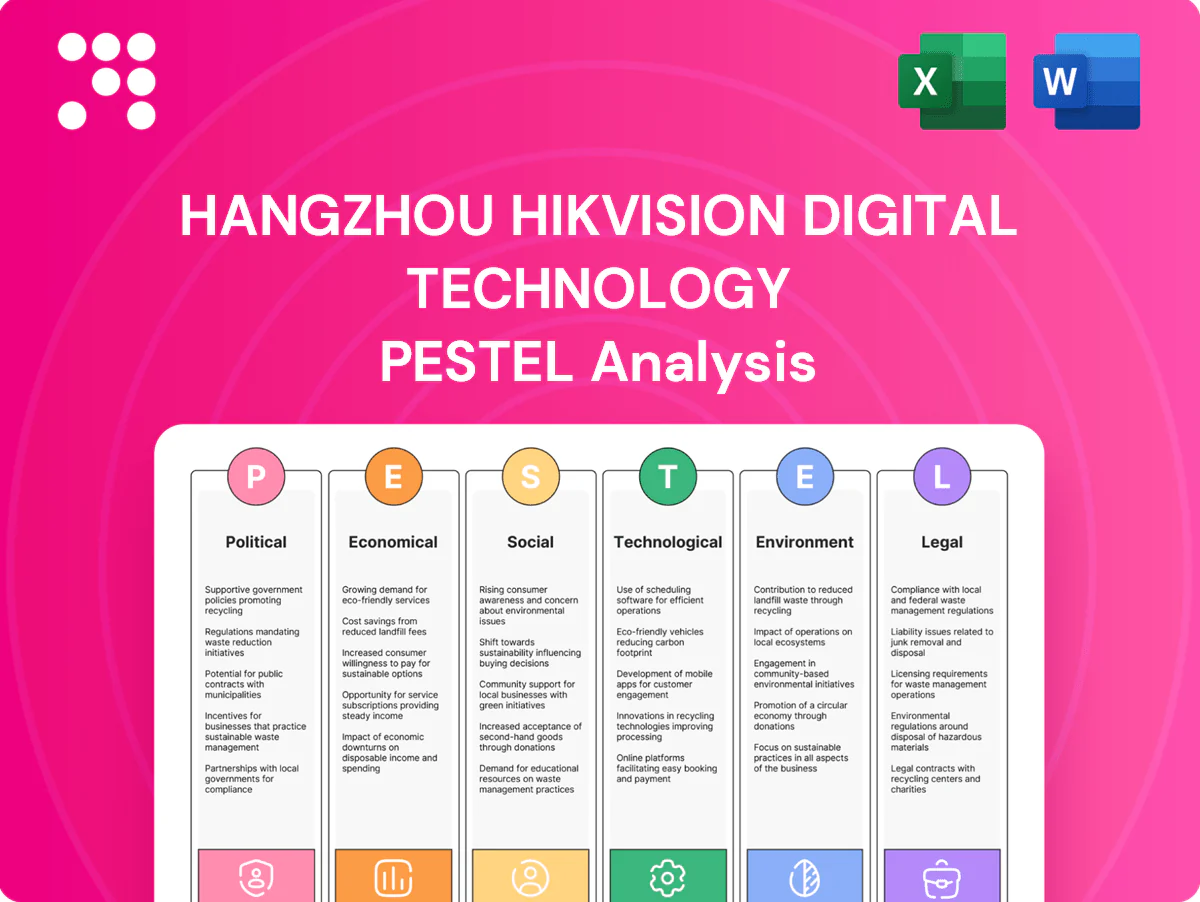
The Hangzhou Hikvision Digital Technology PESTLE Analysis preview shown here is the exact document you’ll receive after purchase. It is fully formatted, professionally structured, and ready to use for strategic or investment decisions. No placeholders or teasers—delivered exactly as displayed.

Original: $10.00
-65%$10.00
$3.50Product Information
Product Information
Shipping & Returns
Shipping & Returns
Description
Your Shortcut to Market Insight Starts Here
Navigate the complex external landscape shaping Hangzhou Hikvision Digital Technology with our concise PESTLE snapshot—covering geopolitical risk, regulatory scrutiny, supply-chain pressures, technological innovation, and socio-environmental trends influencing growth. Use these insights to refine investment theses or strategic plans. Purchase the full PESTLE for a complete, actionable breakdown ready for immediate use.
Political factors
Geopolitical tensions and trade restrictions
Heightened US–China rivalry — exemplified by US export controls on advanced chips since 2022 and Hikvision's placement on the US Entity List in October 2019 — constrains market access, procurement rules, and partner choices. Restrictions limit sourcing of sensitive components and sales in certain markets despite Hikvision's presence in over 180 countries. Strategic supplier and regional diversification is now essential. Strong government relations and compliance readiness directly affect revenue stability.
Government procurement and national security policies
Public-sector surveillance spend is highly policy-driven and cyclical; major procurement rounds often determine annual revenue bursts. National security vetting (Hikvision was added to the US Entity List in October 2019) materially affects vendor eligibility and approval timelines. Preferential local sourcing policies can either grant market access or exclude foreign bidders. Alignment with public safety priorities raises win rates on large projects.
Export controls and blacklists exposure
On the US Entity List since October 2019, Hangzhou Hikvision faces country-specific bans and tightened BIS controls that constrain exports and tech flows; licensing hurdles commonly add 3–9 months and extra compliance costs, forcing product roadmaps to swap controlled components and pursue alternative parts, non-US markets and third-party certifications to mitigate revenue and supply risks.
Smart city and critical infrastructure agendas
Urban modernization programs in 2024 continued to catalyze large-scale deployments of Hikvision cameras and sensors across municipal smart-city projects, while funding cycles and changes in political leadership frequently accelerate or stall rollouts within provinces. Integration of Hikvision systems into national critical infrastructure increases both visibility and regulatory scrutiny from domestic and international stakeholders. Public-private partnerships remain pivotal for multi-year deployments and maintenance contracts.
- Smart-city-driven procurement: municipal tenders dominate sales channels
- Funding volatility: election and budget cycles affect rollout timing
- Regulatory exposure: national integration raises compliance scrutiny
- PPP reliance: long-term O&M and upgrade contracts essential
Diplomatic relations and local content rules
Bilateral ties shape market receptivity and regulatory approvals for Hangzhou Hikvision, which operates in 150+ countries and has been on the US Entity List since 2019, constraining certain exports. Localization mandates push the firm toward regional manufacturing and R&D commitments to retain contracts and comply with procurement rules. Political shifts can quickly reframe data sovereignty and cross‑border encryption requirements, so consistent diplomatic engagement supports operational continuity in sensitive jurisdictions.
Geopolitical export controls force smart-city vendors into regional diversification
Heightened US–China rivalry, US Entity List since Oct 2019 and export controls on advanced chips (since 2022) limit sourcing and market access across 180+ countries, forcing regional diversification. Public-sector smart-city spend drives cyclical procurement peaks; 2024 municipal rollouts increased deployments. Licensing delays typically add 3–9 months and raise compliance costs.
| Factor | Impact | Data |
|---|---|---|
| Bilateral ties | Market access | 180+ countries; Entity List Oct 2019 |
| Export controls | Sourcing changes | Controls since 2022; 3–9m licensing delays |
What is included in the product
Detailed Word Document
Explores how macro-environmental factors uniquely affect Hangzhou Hikvision across Political, Economic, Social, Technological, Environmental and Legal dimensions, with data-backed insights and forward-looking commentary to help executives, investors and strategists identify risks, opportunities and strategic responses.
Customizable Excel Spreadsheet
Clean, visually segmented PESTLE summary of Hangzhou Hikvision that highlights key political, regulatory, technological and market risks for quick inclusion in presentations or strategy sessions, editable for regional/context-specific notes and easily shareable across teams to support risk discussions and client reports.
Economic factors
Global capex cycles and public safety budgets
Macroeconomic slowdowns (IMF 2024 global growth ~3.1%) compress customer spend and elongate sales cycles for Hikvision, while core sectors often shield security budgets. Multi-year transport and energy frameworks provide smoothing of revenue streams. Public budget timing drives quarterly volatility and forces inventory planning adjustments.
Currency volatility and pricing power
Currency volatility—with the RMB moving roughly 5–7% vs the USD in 2023–24—directly alters Hangzhou Hikvision’s export competitiveness and reported earnings given about half of sales derive from overseas markets. Active hedging and local-currency pricing have been used to stabilize margins and reduce translation losses. Concurrent component cost inflation has pressured ASPs, forcing selective discounting to preserve volume. A tiered product lineup helps defend share across price bands and retain margin resilience.
Supply chain resilience and cost structure
Semiconductor availability and elevated logistics rates remain key drivers of Hikvision’s COGS, with global chip spot prices easing about 20% in 2024 while the Shanghai Containerized Freight Index stayed roughly 40–50% below 2021 peaks. Nearshoring and dual‑sourcing initiatives have cut disruption risk and shortened lead times. Higher inventory buffers preserve delivery reliability but lift working capital needs; operational excellence is essential to restore gross margins after shocks.
Emerging market demand and urbanization
Rising urban density in emerging markets—Asia and Africa account for roughly 85% of global urban population growth through 2030 per UN WUP 2022—is expanding demand for wide-area surveillance and smart-city deployments.
Affordability and financing terms shape uptake, with leasing and bundling improving access in lower-income markets and enabling faster rollouts.
Channel partnerships accelerate penetration across fragmented distributors, while service-led models (maintenance, cloud VMS) convert one-time hardware sales into recurring revenue streams.
- UN WUP 2022: ~60% global urbanization by 2030; 85% of urban growth in Asia/Africa
- Financing: leasing and pay-as-you-go increase adoption in low-income regions
- Channels: local integrators drive faster market entry
- Services: recurring revenue from cloud/VMS and maintenance boosts lifecycle value
Competitive intensity and consolidation
Global and regional players compete fiercely on price, AI features and service; Hikvision reported revenue of RMB 86.0 billion in 2024 and leverages scale to sustain R&D spend of about 8% of revenue to maintain cost leadership and AI edge.
Consolidation among systems integrators in 2024 shifted bargaining power toward large vendors, while verticalized solutions (retail, transport, smart cities) boosted Hikvision win rates and margin resilience.
- Market share tag: ~30% global (2024)
- Revenue tag: RMB 86.0bn (2024)
- R&D tag: ~8% of revenue (2024)
- Strategy tag: vertical solutions + scale
Geopolitical export controls force smart-city vendors into regional diversification
IMF 2024 global growth ~3.1% slows capex but security spend stays resilient in core verticals; Hikvision RMB revenue 86.0bn (2024) and ~30% global share preserve scale. RMB moved ~5–7% vs USD (2023–24), hedging limits translation pain while COGS impacted by chip costs (chip spot prices down ~20% in 2024) and logistics (SCFI ~40–50% below 2021 peaks). Urbanization (UN WUP: ~60% global by 2030; 85% growth in Asia/Africa) and leasing drive demand; services raise recurring revenue.
| Metric | Value |
|---|---|
| Revenue (2024) | RMB 86.0bn |
| Global share (2024) | ~30% |
| R&D | ~8% rev |
| IMF growth (2024) | ~3.1% |
| RMB volatility (2023–24) | 5–7% |
| Chip prices change (2024) | -~20% |
| SCFI vs 2021 | -40–50% |
| Urban growth to 2030 | ~60% global; 85% in Asia/Africa |
Same Document Delivered
Hangzhou Hikvision Digital Technology PESTLE Analysis
The Hangzhou Hikvision Digital Technology PESTLE Analysis preview shown here is the exact document you’ll receive after purchase. It is fully formatted, professionally structured, and ready to use for strategic or investment decisions. No placeholders or teasers—delivered exactly as displayed.