Honghua Group PESTLE Analysis

Skip the Research. Get the Strategy.
Unlock how political shifts, supply-chain economics, and green-tech trends shape Honghua Group’s strategic outlook in our concise PESTLE snapshot. This analysis highlights regulatory risks, market opportunities, and technological pressures impacting performance. Ideal for investors and strategists seeking quick, actionable intelligence. Purchase the full PESTLE for the complete, editable report and data-driven recommendations.
Political factors

Geopolitical energy policy and sanctions
As a Chinese oilfield equipment supplier, Honghua faces expanded US/EU export controls since 2022 that can curtail sales to sanctioned markets; shifts in Russia, the Middle East or Venezuela can alter market access within months. Management must diversify customers, implement rigorous KYC/screening and use political risk insurance (eg MIGA, Euler Hermes) and local partnerships to protect and sustain project pipelines.
China industrial policy and subsidies
China’s industrial policy channels financing, tax relief and R&D grants toward high‑end equipment manufacturing and energy security, supporting Honghua’s capital access and technology development. Tightened controls on overcapacity and dual‑use technologies can slow project approvals and export licenses. Close alignment with state priorities—domestic shale, ultra‑deep drilling and offshore capabilities—and active engagement with SOEs and provincial governments increases tender success and order visibility.

Trade tariffs and localization pressures
Rising protectionism has pushed local-content rules in markets such as the Middle East, India and Latin America, with quotas commonly ranging 30–60% on major energy and infrastructure contracts. Tariffs on steel, machinery and electronics often range 5–25% (US steel Section 232 at 25%), raising input costs and complicating pricing. Establishing local assembly or JVs meets quotas while strategic sourcing and modular designs reduce tariff exposure.

Resource nationalism and licensing
Host governments may mandate technology transfer, local hiring and 30–60% local content to access projects, raising costs and IP exposure for Honghua Group. Offshore module licensing is often stringent and can take months to years, so early regulatory mapping minimizes bidding delays. Structuring contracts to share compliance obligations with local partners mitigates operational and reputational risk.
- Mandates: tech transfer, local hiring, 30–60% local content
- Licensing: often months to years
- Mitigation: early regulatory mapping
- Contracts: share compliance with local partners
Political stability and security of operations
Projects in frontier or conflict-prone basins face heightened security risks and recurrent force majeure events that can halt production and delay deliveries. Election cycles in major producer states have recently delayed national oil company capex decisions, pushing sanctioning timelines past 2023–2024 targets. Robust contingency planning, geographic diversification, political-risk insurance and flexible delivery schedules have been used to stabilize revenue and protect margins.
- Security risk: force majeure exposure
- NOC capex: election-related delays (2023–24)
- Mitigants: contingency planning, diversification
- Financial protection: political-risk insurance, flexible delivery
Export controls, tariffs and local-content mandates force JVs
Honghua faces expanded US/EU export controls since 2022, tariffs (eg US steel 25%) and 30–60% local‑content mandates in key markets, forcing JVs and local assembly to secure tenders. China industrial policy and R&D grants support capex and tech, while election‑driven NOC capex delays in 2023–24 tightened pipelines. Political‑risk insurance (MIGA, Euler Hermes) and KYC/screening are now standard mitigants.
| Factor | Metric |
|---|---|
| US steel tariff | 25% |
| Local content | 30–60% |
| Export controls active | Since 2022 |
What is included in the product
 Detailed Word Document
Explores how Political, Economic, Social, Technological, Environmental and Legal factors uniquely affect Honghua Group, using data and current trends to identify threats, opportunities and scenario-driven insights tailored to its regional oilfield equipment and manufacturing footprint; designed for executives, investors and strategists.

 Customizable Excel Spreadsheet
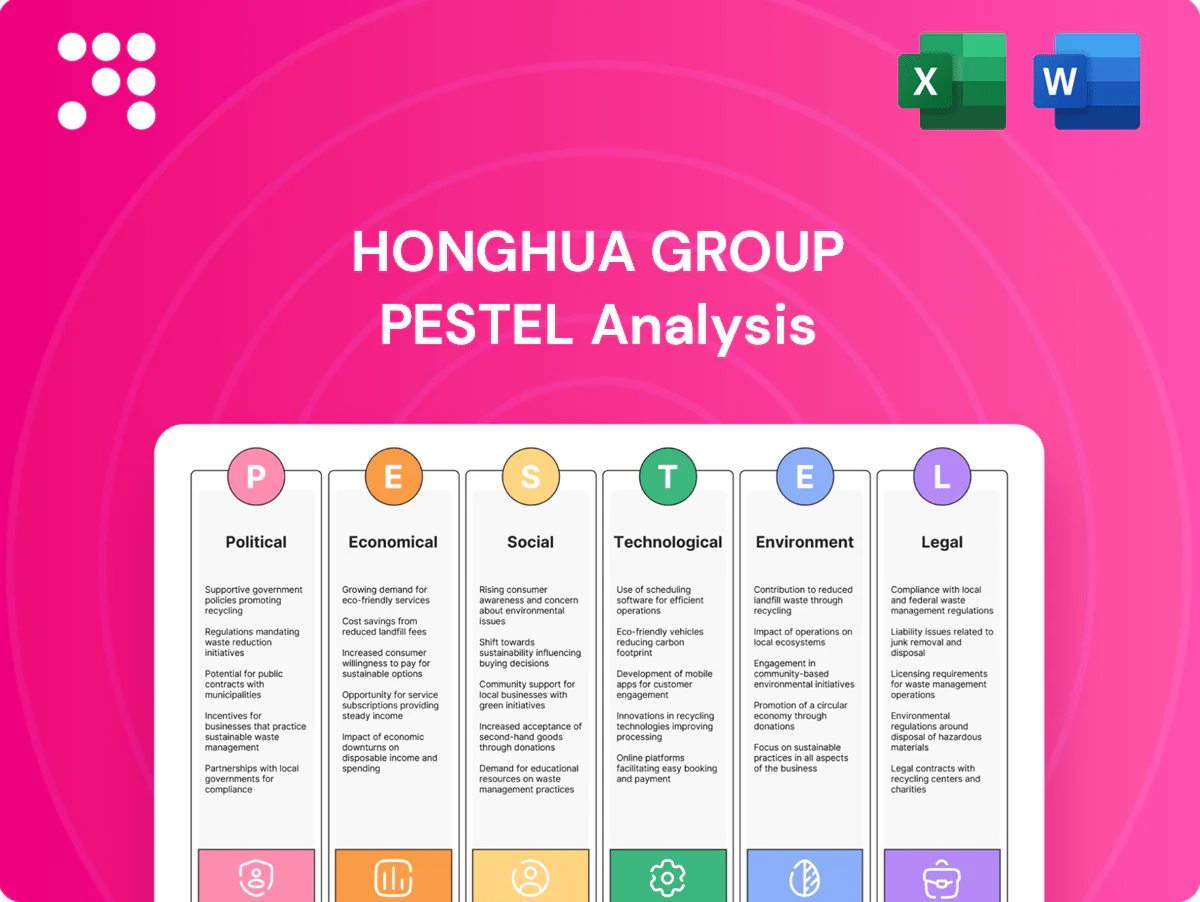
A concise, visually segmented PESTLE summary of Honghua Group that can be dropped into presentations, annotated by region or business line, and easily shared to streamline external risk discussions and align teams during strategic planning.
Economic factors

Oil price cycles and capex sensitivity
Upstream capital spending directly drives demand for rigs and modules and moves in step with Brent/WTI; Brent averaged about $85/bbl in 2024, underpinning renewed E&P capex. Downturns extend tender cycles and compress prices, while upswings boost backlog and product mix. Planning around $60–90/bbl guides capacity and inventory decisions, and expanded service offerings can smooth revenue volatility across cycles.
Global interest rates and financing costs
Elevated global policy rates since the 2022–24 tightening cycle have raised project financing costs for Honghua clients and increased WIP carrying costs, while export credit and leasing structures (ECAs, vendor leasing) can preserve affordability on large rigs; maintaining strong liquidity and undrawn facilities enables bidding for bigger EPC contracts; currency-hedged financing limits FX volatility on cross-border deals.

FX exposure and RMB volatility
Honghua invoicing in USD while major inputs are paid in RMB, EUR and steel-linked currencies creates translation and transaction risk as USD/CNY ranged roughly 6.7–7.3 between 2023–2024. Hedging programs and USD procurement of key components act as natural offsets that help stabilize gross margins. Contract price-escalation clauses tied to commodity indices protect against raw-material swings. Diversifying suppliers reduces FX concentration and counterparty risk.

Commodity and freight costs
Steel, alloy and electronics costs feed directly into Honghua Group’s BOM — Chinese HRC/rebar averaged about 3,800 CNY/ton in 2024, raising rig/module input costs. Freight disruptions and port congestion, reflected in a Baltic Dry Index near 1,200 at end-2024, can delay deliveries and compress margins. Long-term supply contracts and dual sourcing have materially reduced input-price volatility. Design standardization drives economies of scale, lowering per-unit costs.
- Steel prices: China HRC/rebar ~3,800 CNY/ton (2024)
- Freight: BDI ~1,200 (end-2024)
- Mitigation: long-term contracts, dual sourcing
- Efficiency: design standardization for scale
Customer credit and NOC/IOC budgets
NOCs accounted for about 60% of global upstream capex in 2024 (Rystad), tending to maintain spend through cycles while independents reduce budgets quickly; Honghua benefits from this stability. Credit risk in emerging markets pushes stronger payment terms and a rise in ECA-backed deals (circa 15% of project finance in 2024), reducing counterparty exposure. After-sales and spare parts generate recurring cash flows—often 10–20% of equipment revenue—helping stabilize receivables when client mix is balanced.
- Stable NOC spend ~60% (2024)
- ECA-backed ≈15% of project finance (2024)
- After-sales recurring 10–20% rev
- Balanced mix reduces receivable volatility
Export controls, tariffs and local-content mandates force JVs
Brent ~$85/bbl in 2024 bolstered E&P capex guiding Honghua capacity planning; cycles still compress prices and extend tenders. Elevated policy rates 2022–24 raised client financing and WIP costs, increasing reliance on ECAs and liquidity lines. USD invoicing vs RMB inputs, steel (~3,800 CNY/t) and BDI (~1,200) drive margin and delivery risks mitigated by hedges and long-term contracts.
| Metric | 2024 |
|---|---|
| Brent | $85/bbl |
| China HRC/rebar | 3,800 CNY/t |
| BDI (end-2024) | ~1,200 |
| NOC share capex | ~60% |
Same Document Delivered
Honghua Group PESTLE Analysis
The preview shown here is the exact Honghua Group PESTLE Analysis you’ll receive after purchase—fully formatted and ready to use. This is the real document you’re buying, delivered exactly as shown with no placeholders. The layout, content, and structure are identical to the downloadable file.

Product Information
Product Information
Shipping & Returns
Shipping & Returns
Description
Skip the Research. Get the Strategy.
Unlock how political shifts, supply-chain economics, and green-tech trends shape Honghua Group’s strategic outlook in our concise PESTLE snapshot. This analysis highlights regulatory risks, market opportunities, and technological pressures impacting performance. Ideal for investors and strategists seeking quick, actionable intelligence. Purchase the full PESTLE for the complete, editable report and data-driven recommendations.
Political factors
Geopolitical energy policy and sanctions
As a Chinese oilfield equipment supplier, Honghua faces expanded US/EU export controls since 2022 that can curtail sales to sanctioned markets; shifts in Russia, the Middle East or Venezuela can alter market access within months. Management must diversify customers, implement rigorous KYC/screening and use political risk insurance (eg MIGA, Euler Hermes) and local partnerships to protect and sustain project pipelines.
China industrial policy and subsidies
China’s industrial policy channels financing, tax relief and R&D grants toward high‑end equipment manufacturing and energy security, supporting Honghua’s capital access and technology development. Tightened controls on overcapacity and dual‑use technologies can slow project approvals and export licenses. Close alignment with state priorities—domestic shale, ultra‑deep drilling and offshore capabilities—and active engagement with SOEs and provincial governments increases tender success and order visibility.
Trade tariffs and localization pressures
Rising protectionism has pushed local-content rules in markets such as the Middle East, India and Latin America, with quotas commonly ranging 30–60% on major energy and infrastructure contracts. Tariffs on steel, machinery and electronics often range 5–25% (US steel Section 232 at 25%), raising input costs and complicating pricing. Establishing local assembly or JVs meets quotas while strategic sourcing and modular designs reduce tariff exposure.
Resource nationalism and licensing
Host governments may mandate technology transfer, local hiring and 30–60% local content to access projects, raising costs and IP exposure for Honghua Group. Offshore module licensing is often stringent and can take months to years, so early regulatory mapping minimizes bidding delays. Structuring contracts to share compliance obligations with local partners mitigates operational and reputational risk.
- Mandates: tech transfer, local hiring, 30–60% local content
- Licensing: often months to years
- Mitigation: early regulatory mapping
- Contracts: share compliance with local partners
Political stability and security of operations
Projects in frontier or conflict-prone basins face heightened security risks and recurrent force majeure events that can halt production and delay deliveries. Election cycles in major producer states have recently delayed national oil company capex decisions, pushing sanctioning timelines past 2023–2024 targets. Robust contingency planning, geographic diversification, political-risk insurance and flexible delivery schedules have been used to stabilize revenue and protect margins.
- Security risk: force majeure exposure
- NOC capex: election-related delays (2023–24)
- Mitigants: contingency planning, diversification
- Financial protection: political-risk insurance, flexible delivery
Export controls, tariffs and local-content mandates force JVs
Honghua faces expanded US/EU export controls since 2022, tariffs (eg US steel 25%) and 30–60% local‑content mandates in key markets, forcing JVs and local assembly to secure tenders. China industrial policy and R&D grants support capex and tech, while election‑driven NOC capex delays in 2023–24 tightened pipelines. Political‑risk insurance (MIGA, Euler Hermes) and KYC/screening are now standard mitigants.
| Factor | Metric |
|---|---|
| US steel tariff | 25% |
| Local content | 30–60% |
| Export controls active | Since 2022 |
What is included in the product
Detailed Word Document
Explores how Political, Economic, Social, Technological, Environmental and Legal factors uniquely affect Honghua Group, using data and current trends to identify threats, opportunities and scenario-driven insights tailored to its regional oilfield equipment and manufacturing footprint; designed for executives, investors and strategists.
Customizable Excel Spreadsheet
A concise, visually segmented PESTLE summary of Honghua Group that can be dropped into presentations, annotated by region or business line, and easily shared to streamline external risk discussions and align teams during strategic planning.
Economic factors
Oil price cycles and capex sensitivity
Upstream capital spending directly drives demand for rigs and modules and moves in step with Brent/WTI; Brent averaged about $85/bbl in 2024, underpinning renewed E&P capex. Downturns extend tender cycles and compress prices, while upswings boost backlog and product mix. Planning around $60–90/bbl guides capacity and inventory decisions, and expanded service offerings can smooth revenue volatility across cycles.
Global interest rates and financing costs
Elevated global policy rates since the 2022–24 tightening cycle have raised project financing costs for Honghua clients and increased WIP carrying costs, while export credit and leasing structures (ECAs, vendor leasing) can preserve affordability on large rigs; maintaining strong liquidity and undrawn facilities enables bidding for bigger EPC contracts; currency-hedged financing limits FX volatility on cross-border deals.
FX exposure and RMB volatility
Honghua invoicing in USD while major inputs are paid in RMB, EUR and steel-linked currencies creates translation and transaction risk as USD/CNY ranged roughly 6.7–7.3 between 2023–2024. Hedging programs and USD procurement of key components act as natural offsets that help stabilize gross margins. Contract price-escalation clauses tied to commodity indices protect against raw-material swings. Diversifying suppliers reduces FX concentration and counterparty risk.
Commodity and freight costs
Steel, alloy and electronics costs feed directly into Honghua Group’s BOM — Chinese HRC/rebar averaged about 3,800 CNY/ton in 2024, raising rig/module input costs. Freight disruptions and port congestion, reflected in a Baltic Dry Index near 1,200 at end-2024, can delay deliveries and compress margins. Long-term supply contracts and dual sourcing have materially reduced input-price volatility. Design standardization drives economies of scale, lowering per-unit costs.
- Steel prices: China HRC/rebar ~3,800 CNY/ton (2024)
- Freight: BDI ~1,200 (end-2024)
- Mitigation: long-term contracts, dual sourcing
- Efficiency: design standardization for scale
Customer credit and NOC/IOC budgets
NOCs accounted for about 60% of global upstream capex in 2024 (Rystad), tending to maintain spend through cycles while independents reduce budgets quickly; Honghua benefits from this stability. Credit risk in emerging markets pushes stronger payment terms and a rise in ECA-backed deals (circa 15% of project finance in 2024), reducing counterparty exposure. After-sales and spare parts generate recurring cash flows—often 10–20% of equipment revenue—helping stabilize receivables when client mix is balanced.
- Stable NOC spend ~60% (2024)
- ECA-backed ≈15% of project finance (2024)
- After-sales recurring 10–20% rev
- Balanced mix reduces receivable volatility
Export controls, tariffs and local-content mandates force JVs
Brent ~$85/bbl in 2024 bolstered E&P capex guiding Honghua capacity planning; cycles still compress prices and extend tenders. Elevated policy rates 2022–24 raised client financing and WIP costs, increasing reliance on ECAs and liquidity lines. USD invoicing vs RMB inputs, steel (~3,800 CNY/t) and BDI (~1,200) drive margin and delivery risks mitigated by hedges and long-term contracts.
| Metric | 2024 |
|---|---|
| Brent | $85/bbl |
| China HRC/rebar | 3,800 CNY/t |
| BDI (end-2024) | ~1,200 |
| NOC share capex | ~60% |
Same Document Delivered
Honghua Group PESTLE Analysis
The preview shown here is the exact Honghua Group PESTLE Analysis you’ll receive after purchase—fully formatted and ready to use. This is the real document you’re buying, delivered exactly as shown with no placeholders. The layout, content, and structure are identical to the downloadable file.