Heineken PESTLE Analysis

Plan Smarter. Present Sharper. Compete Stronger.
Discover how political regulation, shifting consumer tastes, economic cycles and sustainability pressures are reshaping Heineken’s strategy in our concise PESTLE snapshot—designed for investors and strategists. Buy the full analysis to access actionable insights, risk forecasts and ready-to-use slides for immediate decision-making.
Political factors

Alcohol excise policy
Changes in excise taxes directly shift retail prices and margins; with alcohol price elasticity around -0.5 (a 10% price rise can cut volumes ~5%), sudden hikes risk volume declines. Tiered excise structures favour low/no-alcohol extensions, aiding Heineken’s growing N/A portfolio. Active policymaker engagement helps anticipate shifts; Heineken (group revenue ~€32bn in FY2024) must optimize pricing and pack sizes to cushion volatility.
Trade and tariffs
Tariffs on inputs like aluminum and malt and on finished beer materially alter Heineken’s cost-to-serve and route-to-market, affecting margins and distribution choices. Regional trade blocs such as the EU, USMCA and ASEAN can either unlock logistics and tariff efficiencies or create cross-border barriers that raise landed costs. Heineken’s local brewing footprint—around 170 breweries in over 70 countries—helps hedge tariff risk by shifting production closer to demand. Strategic sourcing, long-term supplier contracts and currency/commodity hedges are used to mitigate landed-cost swings.

Geopolitical instability
Geopolitical conflict, sanctions and currency controls disrupt Heineken’s supply chains and distribution — the group operates in over 70 countries and reported €27.7bn revenue in 2023, making market exits or asset impairments (eg Russia 2022 divestment) material risks. Contingency planning, geographic diversification and political-risk insurance with regular country-risk analysis are essential to reduce concentration and financial exposure.

Government alcohol policy
Localization agendas
Local-content agendas push Heineken to expand in-market sourcing and production, reducing import duties and strengthening stakeholder ties; the group operates in over 190 countries and reported about 83,000 employees (2023). Compliance often requires targeted capex and supplier development, while partnerships with local farmers and co-packers build supply resilience and community goodwill.
- Local sourcing: in-market production to cut duties
- Capex: needed for local plants and supplier upgrades
- Stakeholder ties: improves government and community relations
- Resilience: farmer and co-packer partnerships
Policy shifts risk pricing & volumes for global brewer with €32bn revenue
Political risks—excise/taxes, tariffs and MUPs—directly affect Heineken pricing and volumes; group revenue ~€32bn (FY2024) so policy shifts are material. Local-content rules and tariffs push in-market production; ~170 breweries in 70+ countries and presence in 190+ markets reduce import risk. Geopolitical exits (eg Russia 2022) and licensing hours alter on-trade demand; 83,000 employees (2023) mean employment policies matter.
| Metric | Value |
|---|---|
| Group revenue (FY2024) | €32bn |
| Breweries / markets | ~170 / 70+ |
| Global presence | 190+ countries |
| Employees (2023) | ~83,000 |
| Scotland MUP | 50p/unit |
| WHO alcohol deaths | ~3m/yr |
What is included in the product
 Detailed Word Document
Explores how external macro-environmental factors uniquely affect Heineken across six dimensions—Political, Economic, Social, Technological, Environmental, and Legal—each backed by data and current trends to reflect real market and regulatory dynamics. Designed for executives and investors, it delivers forward-looking insights and ready-to-use findings for strategy and reporting.

 Customizable Excel Spreadsheet
A clean, summarized Heineken PESTLE for easy reference in meetings, visually segmented by category and editable for regional or business-line notes—ideal for slides, team alignment, and supporting external-risk and market-position discussions.
Economic factors

Input cost inflation
Barley, hops, aluminum, glass and energy cost swings drive COGS volatility for Heineken, squeezing margins when pricing lags. Inflation spikes have historically compressed profitability absent prompt price recovery. Long-term supply contracts and commodity hedges are used to smooth input cost exposure. Ongoing efficiency programs and value engineering protect margins by reducing unit costs and capex intensity.
FX and macro cycles
Heineken reported group net revenue of about €32.1bn in 2024, with roughly 40% of volumes from emerging markets, creating FX risk as a large share of costs (packaging, malt, logistics) are invoiced in hard currencies such as EUR and USD. Recessions typically compress premium-segment demand while driving trade-up into value tiers; Heineken’s balanced brand ladder (premium to mainstream) helps retain share. Natural hedging from local sourcing plus pricing corridors and periodic price adjustments limited FX-related margin erosion in 2024.

Premiumization trend
Consumers accept paying up for quality, provenance and craft cues, with IWSR reporting global premium beer value growth near 7% in 2023, outpacing mainstream volumes; premium and super‑premium extensions lift Heineken’s mix and ASPs. Economic slowdowns can pause trading‑up, but strong brand equity allows persistent pricing power and margin resilience. On‑trade recovery—around 90–95% of 2019 levels by 2023—amplifies premium momentum.

Emerging market growth
Rising incomes and rapid urbanization across Africa, APAC and LATAM are expanding beer penetration, while local tastes and affordability drive demand for smaller, low-cost pack formats; Heineken operates in 190+ countries with a 300+ brand portfolio, leveraging this to tailor offerings. Distribution depth and cold-chain logistics are critical in hot climates, and joint ventures remain a fast route to scale and reach.
- 190+ countries presence
- 300+ brands for local tailoring
- Cold-chain & last-mile distribution essential
- Joint ventures accelerate market entry
Logistics and energy costs
Freight rates and fuel price volatility directly raise Heineken’s delivered costs and can cut service levels; with Brent averaging about $86/bbl in 2024, fuel-linked logistics costs remained elevated. Network optimization and nearshoring reduced average miles per shipment, while modal shifts to rail/sea lowered unit costs. Energy efficiency upgrades in breweries (ongoing since 2022) help cushion margin swings.
- Freight & fuel: Brent ~86 USD/bbl (2024)
- Nearshoring: fewer miles, lower lead times
- Modal shift: rail/sea reduces unit cost
- Breweries: energy efficiency lowers volatility
Policy shifts risk pricing & volumes for global brewer with €32bn revenue
Input-cost volatility (barley, hops, aluminum, energy) and FX exposure compress margins when pricing lags; Heineken 2024 net revenue €32.1bn with ~40% volumes in emerging markets. Premium beer value grew ~7% (IWSR 2023), supporting ASPs; Brent averaged ~$86/bbl in 2024, keeping logistics costs elevated. Efficiency programs, hedges and local sourcing mitigate shocks.
| Metric | Value (2024) |
|---|---|
| Net revenue | €32.1bn |
| Emerging market volume | ~40% |
| Brent oil | $86/bbl |
| Premium value growth | ~7% |
Preview the Actual Deliverable
Heineken PESTLE Analysis
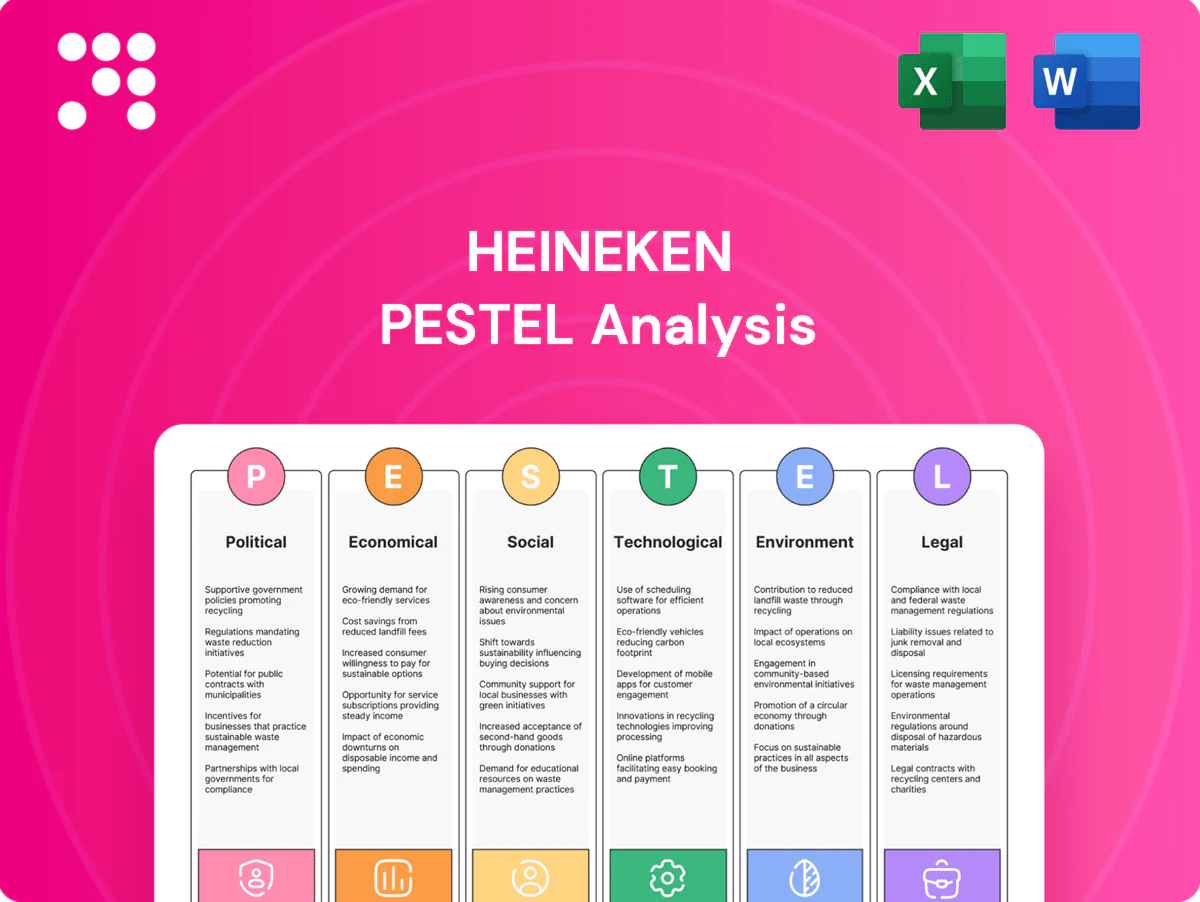
The Heineken PESTLE Analysis shown here is the exact document you’ll receive after purchase—fully formatted, professionally structured, and ready to use. It covers political, economic, social, technological, legal, and environmental factors specific to Heineken. No placeholders or teasers—what you see is what you’ll download.

Original: $10.00
-65%$10.00
$3.50Product Information
Product Information
Shipping & Returns
Shipping & Returns
Description
Plan Smarter. Present Sharper. Compete Stronger.
Discover how political regulation, shifting consumer tastes, economic cycles and sustainability pressures are reshaping Heineken’s strategy in our concise PESTLE snapshot—designed for investors and strategists. Buy the full analysis to access actionable insights, risk forecasts and ready-to-use slides for immediate decision-making.
Political factors
Alcohol excise policy
Changes in excise taxes directly shift retail prices and margins; with alcohol price elasticity around -0.5 (a 10% price rise can cut volumes ~5%), sudden hikes risk volume declines. Tiered excise structures favour low/no-alcohol extensions, aiding Heineken’s growing N/A portfolio. Active policymaker engagement helps anticipate shifts; Heineken (group revenue ~€32bn in FY2024) must optimize pricing and pack sizes to cushion volatility.
Trade and tariffs
Tariffs on inputs like aluminum and malt and on finished beer materially alter Heineken’s cost-to-serve and route-to-market, affecting margins and distribution choices. Regional trade blocs such as the EU, USMCA and ASEAN can either unlock logistics and tariff efficiencies or create cross-border barriers that raise landed costs. Heineken’s local brewing footprint—around 170 breweries in over 70 countries—helps hedge tariff risk by shifting production closer to demand. Strategic sourcing, long-term supplier contracts and currency/commodity hedges are used to mitigate landed-cost swings.
Geopolitical instability
Geopolitical conflict, sanctions and currency controls disrupt Heineken’s supply chains and distribution — the group operates in over 70 countries and reported €27.7bn revenue in 2023, making market exits or asset impairments (eg Russia 2022 divestment) material risks. Contingency planning, geographic diversification and political-risk insurance with regular country-risk analysis are essential to reduce concentration and financial exposure.
Government alcohol policy
Localization agendas
Local-content agendas push Heineken to expand in-market sourcing and production, reducing import duties and strengthening stakeholder ties; the group operates in over 190 countries and reported about 83,000 employees (2023). Compliance often requires targeted capex and supplier development, while partnerships with local farmers and co-packers build supply resilience and community goodwill.
- Local sourcing: in-market production to cut duties
- Capex: needed for local plants and supplier upgrades
- Stakeholder ties: improves government and community relations
- Resilience: farmer and co-packer partnerships
Policy shifts risk pricing & volumes for global brewer with €32bn revenue
Political risks—excise/taxes, tariffs and MUPs—directly affect Heineken pricing and volumes; group revenue ~€32bn (FY2024) so policy shifts are material. Local-content rules and tariffs push in-market production; ~170 breweries in 70+ countries and presence in 190+ markets reduce import risk. Geopolitical exits (eg Russia 2022) and licensing hours alter on-trade demand; 83,000 employees (2023) mean employment policies matter.
| Metric | Value |
|---|---|
| Group revenue (FY2024) | €32bn |
| Breweries / markets | ~170 / 70+ |
| Global presence | 190+ countries |
| Employees (2023) | ~83,000 |
| Scotland MUP | 50p/unit |
| WHO alcohol deaths | ~3m/yr |
What is included in the product
Detailed Word Document
Explores how external macro-environmental factors uniquely affect Heineken across six dimensions—Political, Economic, Social, Technological, Environmental, and Legal—each backed by data and current trends to reflect real market and regulatory dynamics. Designed for executives and investors, it delivers forward-looking insights and ready-to-use findings for strategy and reporting.
Customizable Excel Spreadsheet
A clean, summarized Heineken PESTLE for easy reference in meetings, visually segmented by category and editable for regional or business-line notes—ideal for slides, team alignment, and supporting external-risk and market-position discussions.
Economic factors
Input cost inflation
Barley, hops, aluminum, glass and energy cost swings drive COGS volatility for Heineken, squeezing margins when pricing lags. Inflation spikes have historically compressed profitability absent prompt price recovery. Long-term supply contracts and commodity hedges are used to smooth input cost exposure. Ongoing efficiency programs and value engineering protect margins by reducing unit costs and capex intensity.
FX and macro cycles
Heineken reported group net revenue of about €32.1bn in 2024, with roughly 40% of volumes from emerging markets, creating FX risk as a large share of costs (packaging, malt, logistics) are invoiced in hard currencies such as EUR and USD. Recessions typically compress premium-segment demand while driving trade-up into value tiers; Heineken’s balanced brand ladder (premium to mainstream) helps retain share. Natural hedging from local sourcing plus pricing corridors and periodic price adjustments limited FX-related margin erosion in 2024.
Premiumization trend
Consumers accept paying up for quality, provenance and craft cues, with IWSR reporting global premium beer value growth near 7% in 2023, outpacing mainstream volumes; premium and super‑premium extensions lift Heineken’s mix and ASPs. Economic slowdowns can pause trading‑up, but strong brand equity allows persistent pricing power and margin resilience. On‑trade recovery—around 90–95% of 2019 levels by 2023—amplifies premium momentum.
Emerging market growth
Rising incomes and rapid urbanization across Africa, APAC and LATAM are expanding beer penetration, while local tastes and affordability drive demand for smaller, low-cost pack formats; Heineken operates in 190+ countries with a 300+ brand portfolio, leveraging this to tailor offerings. Distribution depth and cold-chain logistics are critical in hot climates, and joint ventures remain a fast route to scale and reach.
- 190+ countries presence
- 300+ brands for local tailoring
- Cold-chain & last-mile distribution essential
- Joint ventures accelerate market entry
Logistics and energy costs
Freight rates and fuel price volatility directly raise Heineken’s delivered costs and can cut service levels; with Brent averaging about $86/bbl in 2024, fuel-linked logistics costs remained elevated. Network optimization and nearshoring reduced average miles per shipment, while modal shifts to rail/sea lowered unit costs. Energy efficiency upgrades in breweries (ongoing since 2022) help cushion margin swings.
- Freight & fuel: Brent ~86 USD/bbl (2024)
- Nearshoring: fewer miles, lower lead times
- Modal shift: rail/sea reduces unit cost
- Breweries: energy efficiency lowers volatility
Policy shifts risk pricing & volumes for global brewer with €32bn revenue
Input-cost volatility (barley, hops, aluminum, energy) and FX exposure compress margins when pricing lags; Heineken 2024 net revenue €32.1bn with ~40% volumes in emerging markets. Premium beer value grew ~7% (IWSR 2023), supporting ASPs; Brent averaged ~$86/bbl in 2024, keeping logistics costs elevated. Efficiency programs, hedges and local sourcing mitigate shocks.
| Metric | Value (2024) |
|---|---|
| Net revenue | €32.1bn |
| Emerging market volume | ~40% |
| Brent oil | $86/bbl |
| Premium value growth | ~7% |
Preview the Actual Deliverable
Heineken PESTLE Analysis
The Heineken PESTLE Analysis shown here is the exact document you’ll receive after purchase—fully formatted, professionally structured, and ready to use. It covers political, economic, social, technological, legal, and environmental factors specific to Heineken. No placeholders or teasers—what you see is what you’ll download.